Equality assumes a level playing field; equity acknowledges historical imbalances and designs solutions to bridge them
Washington, D.C. — The Milken Institute School of Public Health of The George Washington University has ignited a pivotal conversation with its report Equity vs. Equality: What’s the Difference? The paper, which dissects how these two concepts shape outcomes for marginalized communities, remains a cornerstone for policymakers grappling with systemic health disparities.
INEQUALITY.
While equality and equity are often used interchangeably, the report warns that conflating them risks perpetuating cycles of inequality—and public health data proves it.
Defining the Divide
Equality ensures everyone receives the same resources, like a city uniformly cutting all community center hours. Equity, however, allocates resources based on need—such as extending hours in underserved neighborhoods where access is scarce.
The distinction is stark: equality assumes a level playing field; equity acknowledges historical imbalances and designs solutions to bridge them.
“The route to achieving equity will not be accomplished through treating everyone equally. It will be achieved by treating everyone justly according to their circumstances,” says Paula Dressel of the Race Matters Institute.
EQUALITY.
A Tale of Two Systems
The report uses a simple analogy: two individuals trying to pick fruit from a tree. Equality gives both the same ladder, but if one person is shorter or the ground beneath them uneven, they still can’t reach. Equity provides taller ladders or fills holes to ensure both succeed.
In public health, this translates to:
Equality: Equal funding for all schools’ computer labs.
Equity: Extra computers and longer hours in low-income areas where students lack home access.
The CDC defines health equity as “when everyone has the opportunity to be as healthy as possible.” Yet systemic design flaws—like English-only community meetings in multilingual neighborhoods—often undermine this goal.
Case Studies: Equity in Action
1. Project Brotherhood: Closing the Gap for Black Men
EQUITY.
Launched in Chicago through the CDC’s Healthy Communities Program, this clinic addressed stark health disparities for Black men. Strategies included:
Free evening healthcare to accommodate work schedules.
Culturally tailored health seminars and fatherhood classes.
Training barbers as health advocates.
By 2007, the clinic served over 13,000 people, with weekly visits skyrocketing from 4 to 27.
“Respect and cultural competence built trust in a community long ignored by traditional healthcare,” explains Dr. Reed Tuckson, a health equity advocate.
2. Poder es Salud: Empowering Latino Communities
In Oregon, this initiative tackled social determinants of health in Black and Latino communities by:
Training community health workers in advocacy and leadership.
Using popular education to foster mutual learning.
Building cross-cultural partnerships through participatory research.
Follow-up surveys showed improved mental health and social support, proving that empowering marginalized voices drives sustainable change.
JUSTICE.
3. Project BRAVE: Reducing Youth Violence
This school-based program in underserved areas linked students with community organizations to address violence. By creating safe spaces for dialogue, school attendance—a key health determinant—rose significantly.
Why Precision Matters
Misapplying equity and equality can derail progress. For example, the CDC notes that “equal access” to vaccines means little if marginalized groups face language barriers or transportation issues.
Equity demands targeted outreach: mobile clinics in food deserts or translators at sign-up sites.
The WHO stresses that health inequities are avoidable and rooted in unfair systems. For instance, Black Americans face higher maternal mortality rates not due to biology but systemic racism in healthcare. Equity-focused policies, like prioritizing prenatal care in Black communities, address these gaps.
The Road Ahead
Public health leaders urge:
Education: Train professionals to recognize systemic biases.
Data-Driven Policies: Allocate resources based on community-specific needs.
Community Collaboration: Involve marginalized groups in solution-building.
“Equality is the floor; equity builds the stairs,” says Dr. Leana Wen, former Baltimore Health Commissioner. “Without both, we leave people behind.”
The Milken Institute’s work underscores that precision in language saves lives. As COVID-19 exposed glaring health disparities, the report’s lessons remain urgent: equity isn’t a buzzword—it’s a blueprint for justice. While equality ensures baseline fairness, equity dismantles the barriers that make equality insufficient. From Chicago to Oregon, evidence shows that when systems prioritize equity, communities thrive.
The challenge now is turning awareness into action—one tailored ladder at a time.
Tags: Health Equity, Social Equality, Public Health, Systemic Disparities, Community Health, Health Policy, Marginalized Populations, Social Determinants of Health
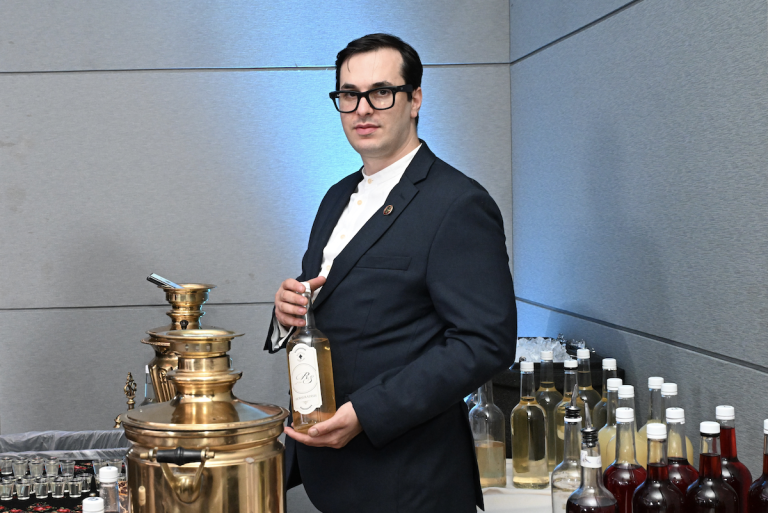
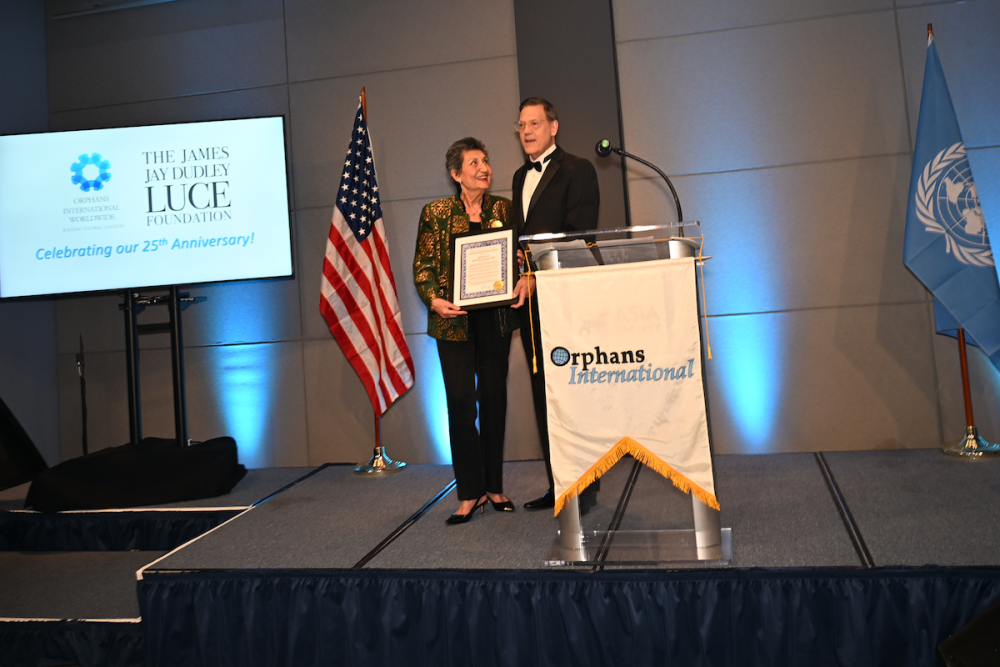
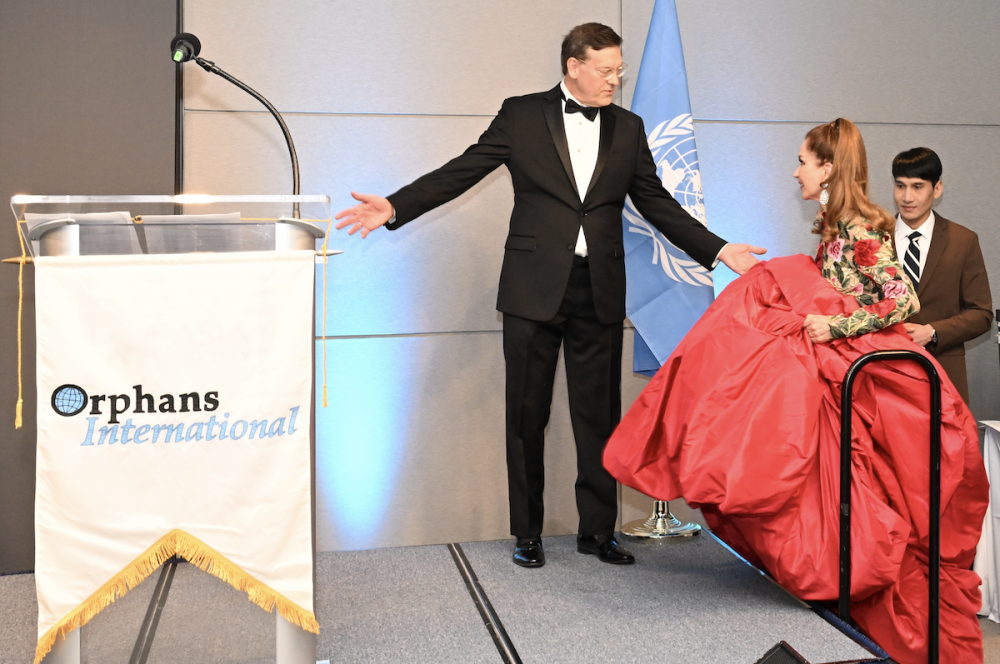
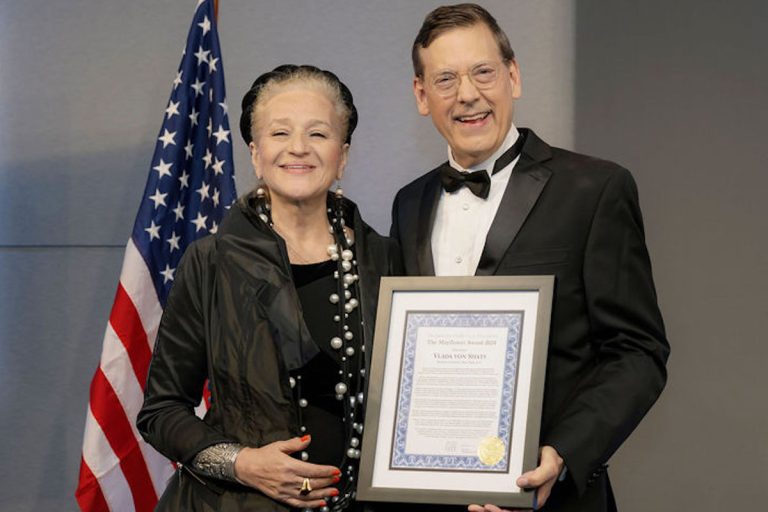
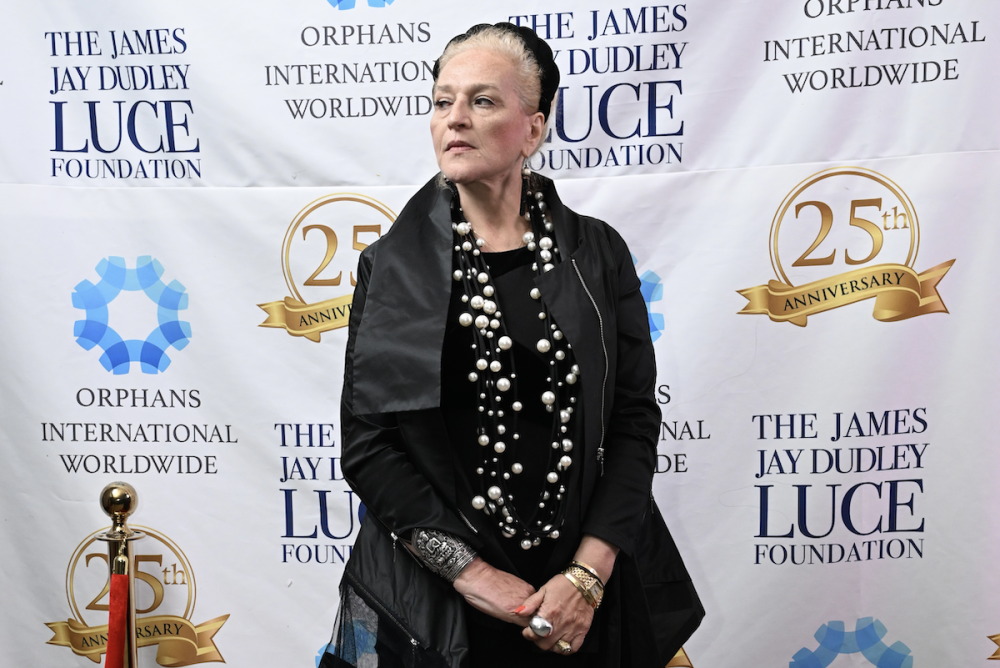
Photo: Vlada von Shats of The Russian Samovar with her son Nicholas, who served flavored vodka to the guests of the Orphans international and J. Luce Foundation Quarter Century Awards Celebration at the Asa Society, NYV, Oct. 17, 2024. Credit: Sasha Gegera.
Photo: xxx Credit: Michael Ostuni for Patrick McMullan via Getty Image.
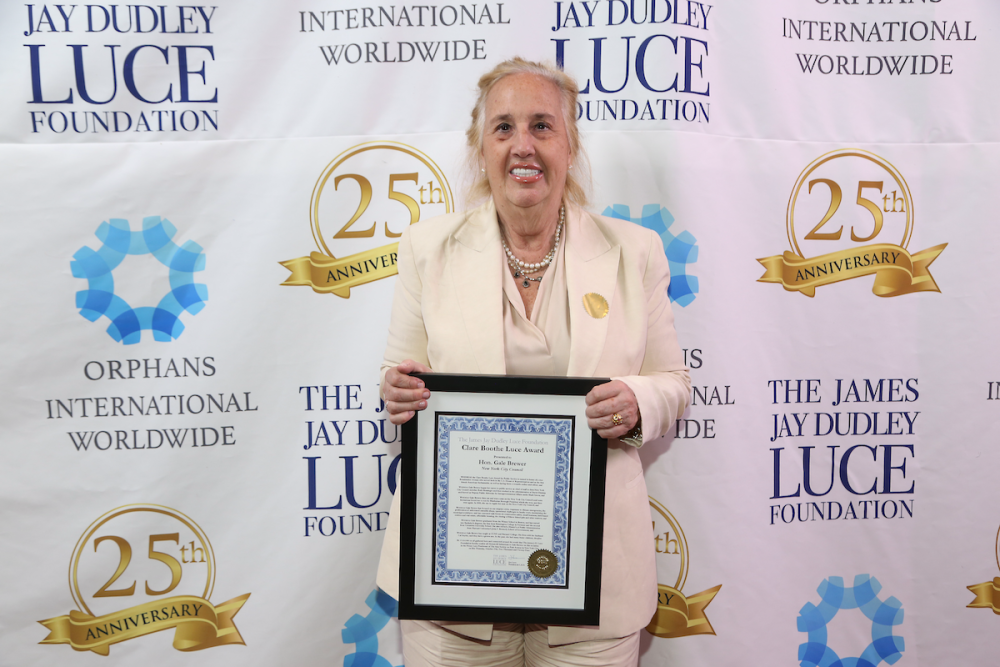
Gale Brewer began her career in public service as chief of staff to then-New York City Council member Ruth Messinger and then worked in the administration of David Dinkins and Served as Deputy Public Advocate for Intergovernmental Affairs under Mark Green.
Brewer then ran and won a seat on the New York City Council until term limitations forced her to run for Manhattan Borough President which she won, and then won again. In 2020, she ran to regain her seat on the New York City Council.
The Clare Boothe Luce Award for Public Service is named in honor of a true Renaissance woman who served both in the U.S. House of Representatives and as the first female American Ambassador, as well as having been a versatile author and editor.
Gale Brewer has focused on our migrant crisis, responses to climate emergencies, the proliferation of unlicensed cannabis shops, operational challenges in family court, maintaining the municipal workforce, and has convened task forces on construction safety, small business, faith-based entities and real estate, affordable housing, and the closing of Rikers Island jails.
Gale Brewer has taught at City University of New York and Barnard College. She lives with her husband Cal Snyder, and they have a grown son. In the past, she had many foster children.
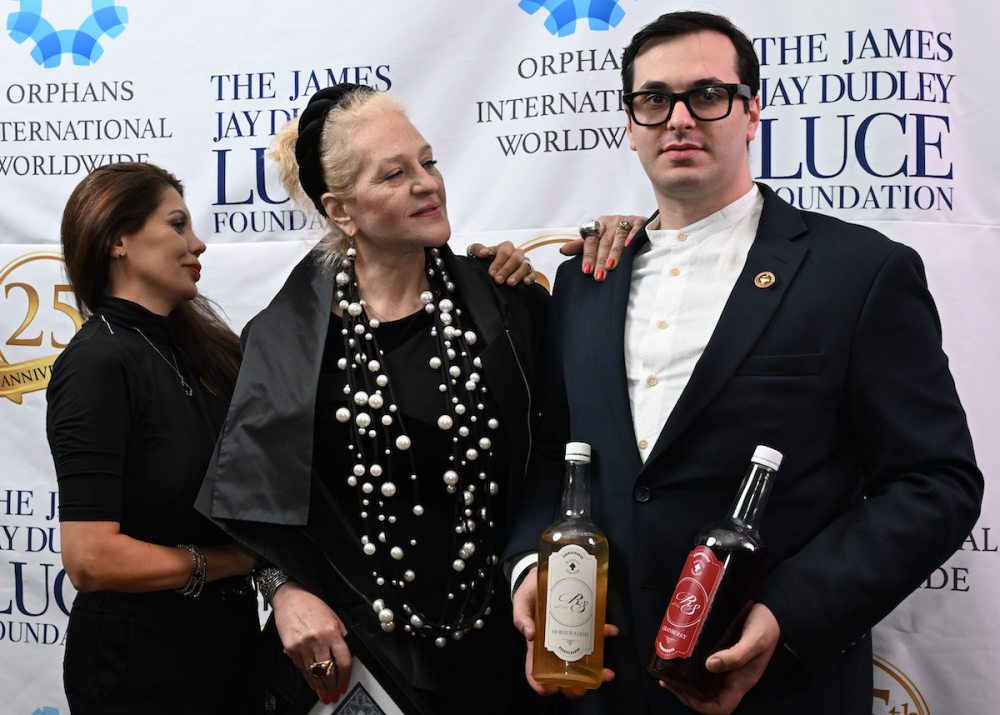
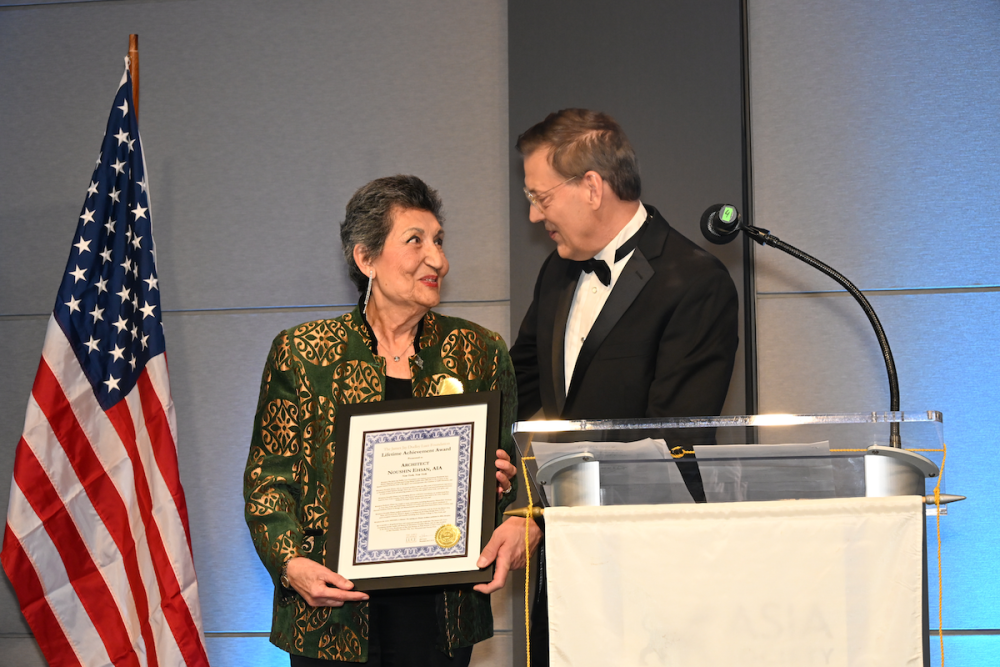
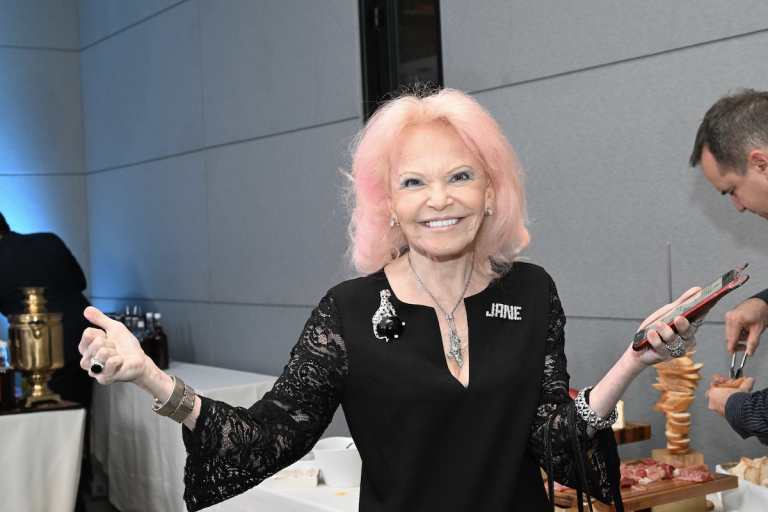
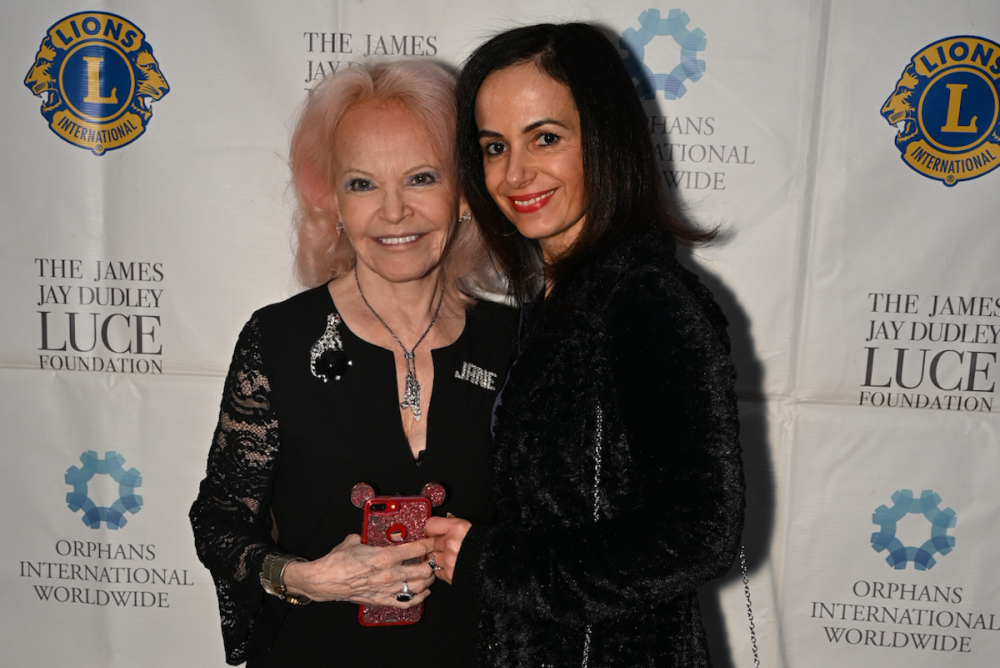
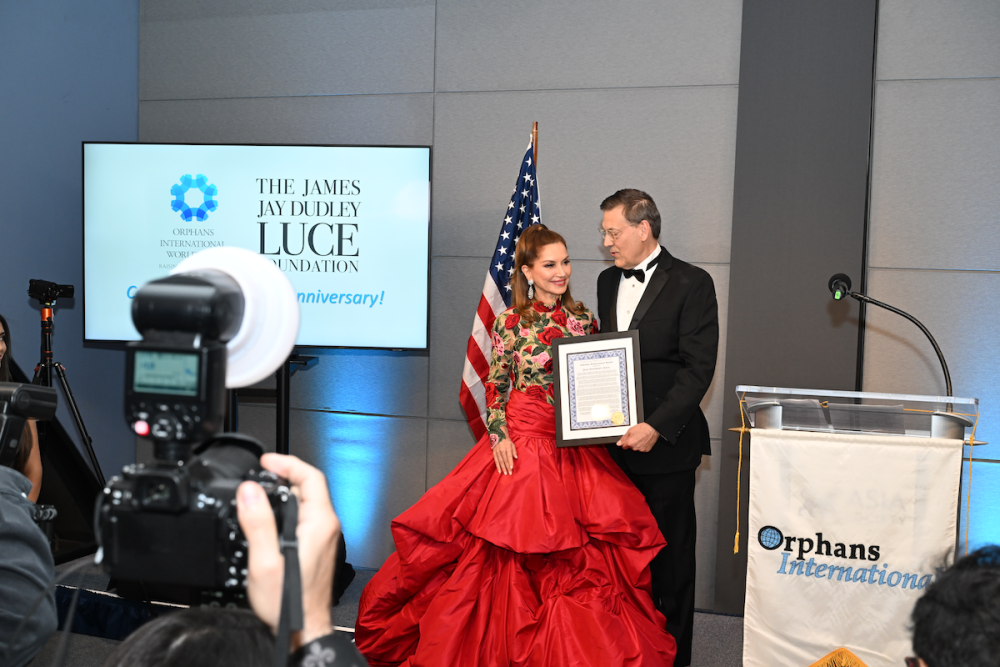
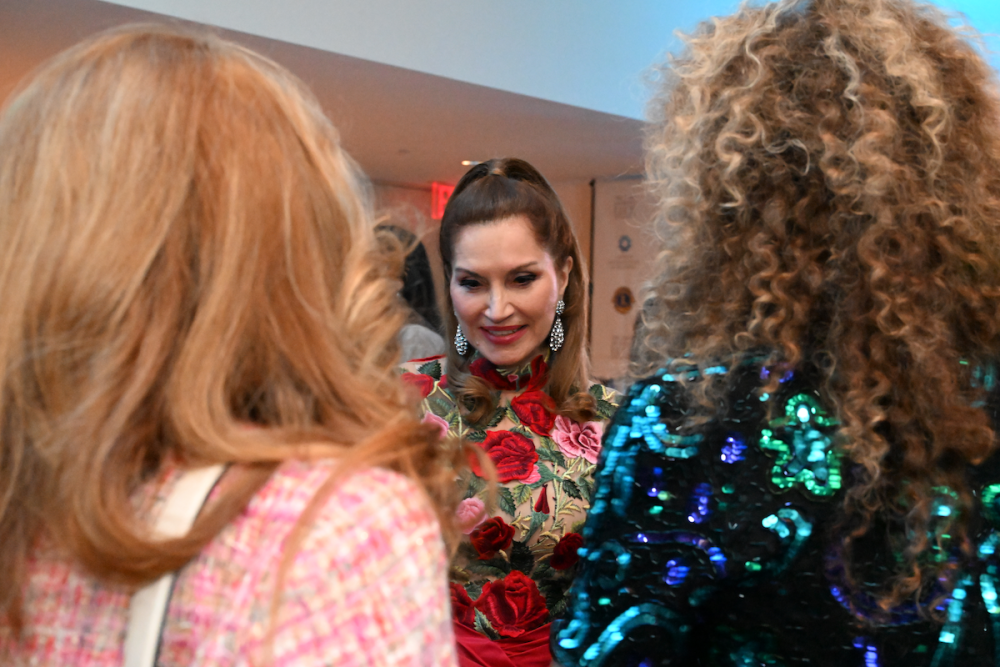
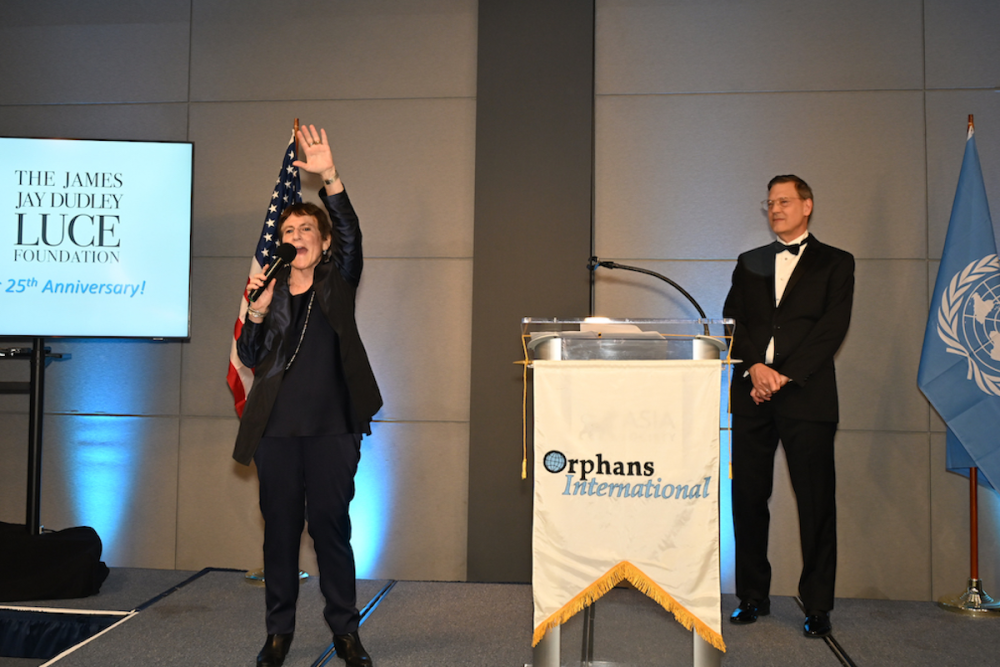
Photo: Jean Shafiroff at the 25th Anniversary Awards Evening of the J. Luce Foundation and Orphans International was held in the H. Luce Penthouse of the Asia Society. Credit: Sasha Gegera.
Photo: The regal proprietor of The Russian Samovar, Ukrainian Russian American Vlada von Shats accepts the Luce Mayflower Award for first generation leaders. Credit: Sasha Gegera.Photo: Vlada von Shats of the Russian samovar in the Manhattan’s Theater District. Photo: Sasha Gegera.
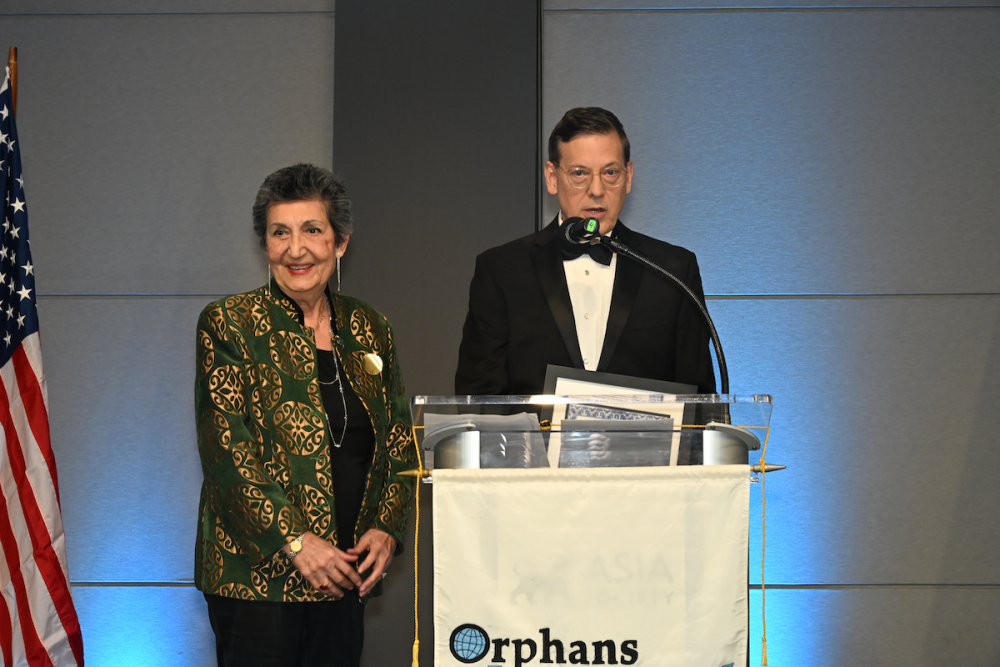
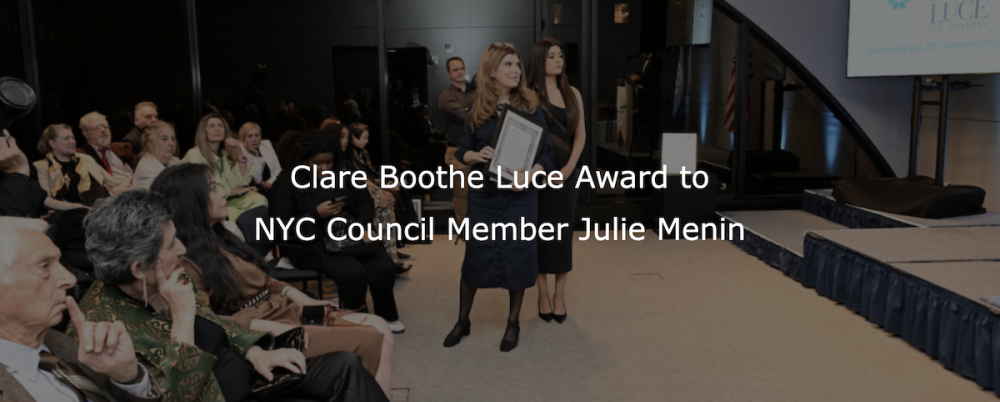
Photo: New York City Council member Julie Menen accepts the Clare Boothe Luce Leadership Award for Public Service at the Asia Society, NYC. Credit: Sasha Gegera.
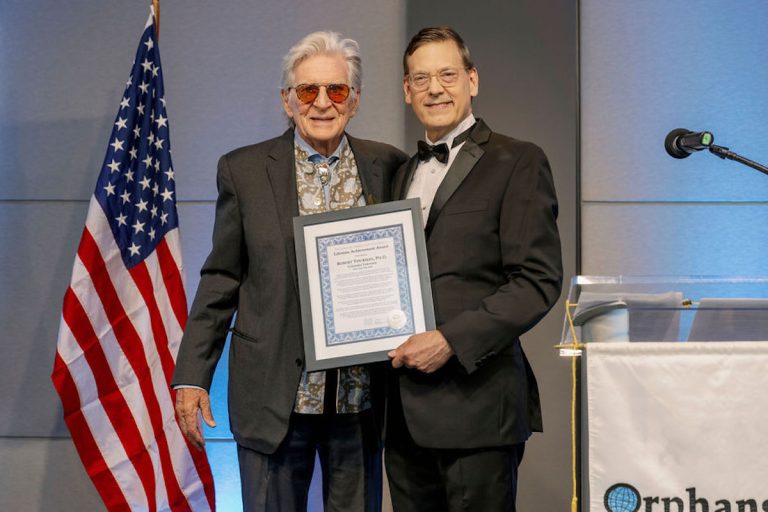
Photo: Dr. Robert Thurman and Dr. Jonathan Granoff attend 25th Anniversary Awards with the J. Luce Foundation at the Asia Society NYC, Oct. 17, 2024. Credit: Sylvain Gaboury/Patrick McMullan via Getty Images.
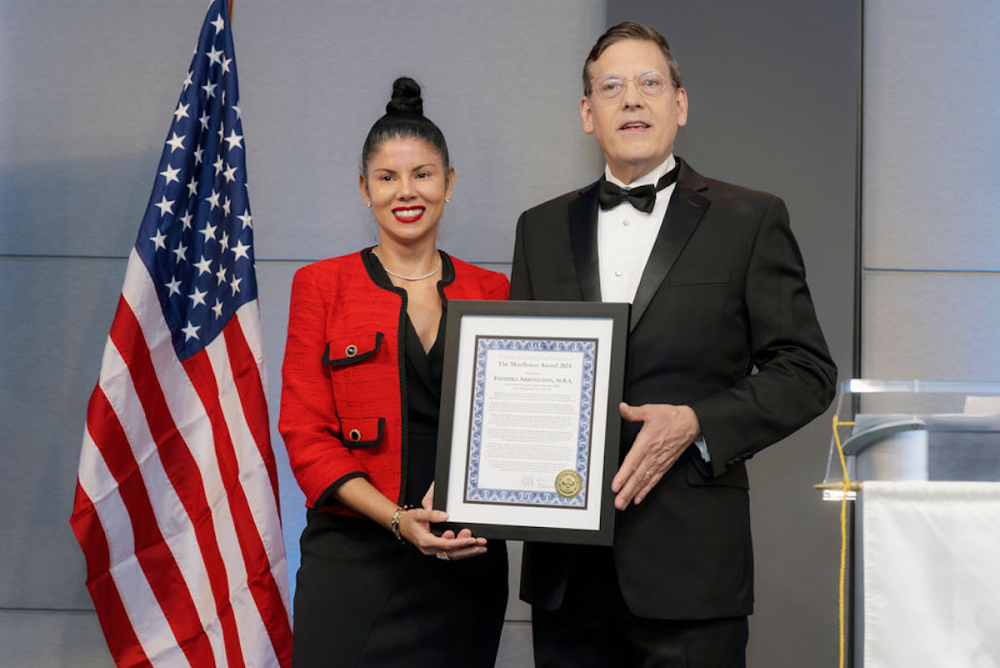
The Rev. Martin Luther King said, “We may have come over on different ships, but we are all in the same boat now.” The J. Luce Foundation 2024 Mayflower Award was presented to Indhira Arrington, Global Chief Diversity, Equity & Inclusion Officer of Ares Management in New York City.
Indhira Arrington came to New York from the Dominican Republic, instilled with a strong work ethic by her parents who spoke limited English, driven to prove herself as an immigrant in a new country.
Photo: Indhira Arrington, Global Chief Diversity, Equity & Inclusion Officer of Ares Management received the Luce Mayflower Award from J. Luce Foundation president Jim Luce. Credit: MaryMor Photography.
As the Rev. Martin Luther King said, “We may have come over on different ships, but we are all in the same boat now.” The Mayflower Award is presented to a first-generation American who has the intelligence and determination to better our nation.
Photo: Indhira Arrington displays her Mayflower Award as Errol Rappaport contemplates the corwd at the Luce Awards Show, Asia Society NYC. Credit: Sasha Gegera.
She also serves on the Board of Directors of the Committee for Hispanic Children and Families, supporting Latinos in New York around school, work and childcare, as well as Vice Chair of the Council of Urban Professionals(CUP)focusing on supporting women and people of color to leadership roles in corporate organizations.
PROFILES of Awardees at the 25th Anniversary of the J. Luce Foundation & Orphans International, Asia Society, NYC
Kathoey or katoey (Khmer: ខ្ទើយ; khtəəy, Lao: ກະເທີຍ; ka thœ̄i, Thai: กะเทย; RTGS: kathoei; Thai pronunciation: [kàtʰɤːj]) is an identity used by some people in Cambodia, Laos, and Thailand, whose identities in English may be best described as transgender women in some cases, or effeminategay men in other cases. These people are not traditionally transgender, but are seen as a third sex, being one body containing two souls. Transgender women in Thailand mostly use terms other than kathoey when referring to themselves, such as phuying (Thai: ผู้หญิง, ‘woman’). A significant number of Thai people perceive kathoey as belonging to a separate sex, including some transgender women themselves.[1]
In the face of the many sociopolitical obstacles that kathoeys navigate in Thailand, kathoey activism has led to constitutional protection from unjust gender discrimination as of January 2015, but a separate third gender category has not yet been legally recognized.[2]
History
According to historical accounts, the presence of androgynous people seeking sexual exchanges dates back over 700 years. This is mentioned in an account by a Chinese observer named Zhou Daguan who visited the Angkor Wat area of Cambodia in 1296–1297. He observed that there were many “two-shaped persons” who tried to lure Chinese men with the promise of sumptuous gifts.[3][4] The term “kathoey” is used to refer to transgender women or the “third sex”. Its usage dates back to a 19th-century interpretation of the Chbab Srey, a Cambodian text written around 1800. The text refers to “malicious” women being punished in the “four hells” and being reincarnated as kathoey.[5]
Terminology
A study of 195 Thai transgender women found that most of the participants referred to themselves as phuying (ผู้หญิง ‘women’), with a minority referring to themselves as phuying praphet song (‘second kind of woman’) and very few referring to themselves as kathoey.[6] Related phrases include phet thi sam (เพศที่สาม, ‘third sex’), and sao praphet song or phu ying praphet song (สาวประเภทสอง, ผู้หญิงประเภทสอง—both meaning ‘second-type female’). The word kathoey is of Khmer ខ្ទើយ khteuy.[7] It is most often rendered as ladyboy in English conversation, an expression that has become popular across Southeast Asia.[citation needed]
General description
Although kathoey is often translated as ‘transgender woman‘ in English, this term is not correct in Thailand. As well as transgender people, the term can refer to gay men, and was originally used to refer to intersex people.[7] Before the 1960s, the use of kathoey included anyone who deviated from the dominant sexual norms.[8] Because of this confusion in translation, the English translation of kathoey is usually ‘ladyboy’ (or variants of the term).
Use of the term kathoey suggests that the person self-identifies as a type of male, in contrast to sao praphet song (which, like “trans woman”, suggests a “female” (sao) identity), and in contrast to phet thi sam (‘third sex’). The term phu ying praphet song, which can be translated as ‘second-type female’, is also used to refer to kathoey.[9]: 146 Australian scholar of sexual politics in Thailand Peter Jackson claims that the term kathoey was used in antiquity to refer to intersex people, and that the connotation changed in the mid-20th century to cover cross-dressing males.[10]Kathoey became an iconic symbol of modern Thai culture.[11] The term can refer to males who exhibit varying degrees of femininity. Many dress as women and undergo “feminising” medical procedures such as breast implants, hormones, silicone injections, or Adam’s apple reductions. Others may wear make-up and use feminine pronouns, but dress as men, and are closer to the Western category of effeminate gay man than transgender.
The term kathoey may be considered pejorative, especially in the form kathoey-saloey. It has a meaning similar to the English language ‘fairy’ or ‘queen’.[12]Kathoey can also be seen as a derogatory word for those who are gay.[13]
Religion
In Buddhism there are a variety of interpretations on how to relate to Kathoey and Transgender people. Some within the Theravada school of Buddhism see being a kathoey as the result of karmic punishment for previous lifetimes.[14] Bunmi, a Thai Buddhist author, believes that homosexuality stems from “lower level spirits” (phi-sang-thewada), a factor that is influenced by one’s past life.[7] Some Buddhists view kathoeys as persons born with a disability as a consequence of past sins.[7][dubious – discuss] Using the notion of karma, some Thais believe that being a kathoey is the result of transgressions in past lives, concluding that kathoey deserve pity rather than blame.[15] Others, however, believe that kathoeys should rectify their past life transgressions.[16] This is done through merit-making such as “making donations to a temple or by ordaining as monks”.[16] While other Buddhists believe that the Buddha was never hostile to LGBT people and therefore that seeing being LGBT as a karmic punishment is a mistaken interpretation.[17]
In northern Thailand, Kathoey, women, and gay men are considered to have soft souls and are therefore easily frightened and highly susceptible to possession.[18] These three groups are heavily represented in spirit summoning since people without soft souls are considered immune to possession.[18] Despite this, Kathoey being a large proportion of the spirit medium population is a modern phenomenon since there is little evidence that Kathoey were associated with religious practice and were banned from religious ceremony before the modern period.[19] In rural areas in north Thailand, Kathoey have taken on jobs as spirit mediums where they become known as Kathoey maa-khii.[20] Spirit mediumship provides Kathoey with a source of income as well as a support network.[21]
During the festival of the nine gods in southern Thailand, Kathoey participate as spiritual mediums of the god Kaun Im.[22] The southern Thailand tradition of the spirit medium Nora dance has traditionally been a primarily male performance.[23] However, women and Kathoey have become an increasingly large proportion of the performers, with a majority male performers in 2014 being either gay men or Kathoey.[24]
Requirements to confirm eligibility for gender-affirming surgery
In Thai cities such as Bangkok, there are currently two to three gender-affirming surgery (GAS) operations per week, more than 3,500 over the past thirty years.[25] With the massive increase in GASs, there has also been an increase in prerequisites, measures that must be taken in order to be eligible for the operation. Patients must be at least 18 years old with permission from parents if under 20 years old.[26] One must provide evidence of diagnosis of gender dysphoria from a psychologist or psychiatrist. Before going through gender reassignment surgery, one must be on hormones/antiandrogens for at least one year.[26] Patients must have a note from the psychiatrist or clinical psychologist. Two months prior to the surgery, patients are required to see a psychiatrist in Thailand to confirm eligibility for gender-affirming surgery.
Social context
Kathoeys are more visible and more accepted in Thai culture than transgender people are in other countries in the world. Several popular Thai models, singers, and movie stars are kathoeys, and Thai newspapers often print photographs of the winners of female and kathoey beauty contests side by side. The phenomenon is not restricted to urban areas; there are kathoeys in most villages, and kathoey beauty contests are commonly held as part of local fairs.[citation needed]
Kathoeys currently face many social and legal impediments. Families (and especially fathers) are typically disappointed if a child becomes a kathoey, and kathoeys often have to face the prospect of disclosing their birth sex. However, kathoey generally have greater acceptance in Thailand than most other East Asian countries.[28] Problems can also arise in regards to access to amenities and gender allocation.
Employment
Many kathoey work in predominately female occupations, such as in shops, restaurants, and beauty salons, but also in factories (a reflection of Thailand’s high proportion of female industrial workers).[29] Discrimination in employment is rampant as many perceive kathoeys as having mental problems and refuse to hire them.[30] In addition, the difficulty for Kathoey to change their gender marker on official documentation makes finding employment harder.[31][32] For these reasons, many kathoeys are only able to find work in sex and entertainment industries.[30] These sorts of jobs include tourist centers, cabarets, and sex work.[30]Kathoeys who work in the tourism sector must conform to a physical image that is preferred by tourists.[30]Kathoeys who obtain jobs in the civil service sector are required to wear uniforms coinciding with their assigned sex of male.[33] In 2011, the short lived airline P.C. Air began hiring Kathoey as flight attendants.[34][35]
In rural areas in northern Thailand, some kathoey have acquired jobs picking fruit from trees.[36] According to rural traditions men and women perform separate roles in the process of collecting fruit. Men climb trees and while women collect fruit in baskets below. However, kathoey are allowed to perform both roles.[37]Kathoey in Rural Areas in northern Thailand have begun acquiring jobs as spirit mediums as well.[38]
Education
Many schools teach students that being transgender is wrong and a form of sexual deviancy.[16] Thai schools utilize gendered uniforms as well.[39] In 2015, Bangkok University revised its uniform guidelines to allow transgender students to wear the uniform of their preferred gender, however, many other institutions still force transgender students to wear the uniform that matches their assigned sex.[39] Several Kathoey and transgender women choose which schools to attend based mainly on the ability to wear the gendered school uniform they prefer.[40] Some kathoey report facing violence and discrimination from both their classmates and their teachers at all levels of schooling due to their being kathoey.[41] This has led to some dropping out or changing schools.[42]
Political context
Thailand’s 2015 Gender Equality Act is currently the strongest legal tool for advocating for transgender rights.[33] It protects those who are “of a different appearance from his/her own sex by birth” from unfair gender discrimination.[39] Prior to the creation of the 2016 Thai constitution, people believed that anti-discrimination terms would be set for a new category called ‘third gender‘.[39] This term, however, was missing from the new constitution and no protections for transgender people were specifically outlined.[39] Instead, the constitution prohibited “unjust discrimination” based on differences in sex.[39]
Identification documents
Legal recognition of kathoeys and transgender people is nonexistent in Thailand: even if a transgender person has had sex reassignment surgery, they are not allowed to change their legal sex on their identification documents.[33] Identification documents are particularly important for daily life in Thailand as they facilitate communication with businesses, bureaucratic agencies (i.e., signing up for educational courses or medical care), law enforcement, etc.[33] The primary identification form used in Thailand is The Thai National Identification Card, which is used for many important processes such as opening a bank account.[33] The vast majority of transgender people are unable to change these documents to reflect their chosen gender, and those who are allowed must uphold strict standards.[43] Transgender individuals are often accused of falsifying documents and are forced to show their identification documents.[33] This threatens their safety and results in their exclusion from various institutions like education or housing.[33] Impeded by these identity cards on a daily basis, transgender people are “outed” by society.[44]
The criminal justice sector relies on identification cards when deciding where to detain individuals.[33] This means that kathoeys are detained alongside men.[33] By law, women are not allowed to be detained alongside men, and since kathoeys are not legally classified as women, they reside in the male section in prison.[33] Within prison, kathoeys are forced to cut their hair and abide by strict rules governing gender expression.[33] Additionally, they are denied access to hormones and other “transition-related health care”.[33]
Military draft
Transgender individuals were automatically exempted from compulsory military service in Thailand. Kathoeys were deemed to suffer from “mental illness” or “permanent mental disorder”.[45] These mental disorders were required to appear on their military service documents, which are accessible to future employers. In 2006, the Thai National Human Rights Commission (NHRC) overturned the use of discriminatory phraseology in Thailand’s military service exemption documents.[45] With Thai law banning citizens from changing their sex on their identification documents, everyone under the male category must attend a “lottery day” where they are randomly selected to enlist in the army for two years. In March 2008, the military added a “third category” for transgender people that dismissed them from service due to “illness that cannot be cured within 30 days”.[46] In 2012, the Administrative Court ruled that the Military and Defense needed to revise the reasoning for their exemption of kathoeys from the military.[33] As such, kathoeys are now exempt from the military under the reasoning that their “gender does not match their sex at birth”.[33]
Performance
Representation in cinema
Kathoeys began to gain prominence in the cinema of Thailand during the late-1980s.[47] The depiction at first was negative by showing kathoeys suffering bad karma, suicide, and abandoned by straight lovers.[47] Independent and experimental films contributed to defying sexual norms in gay cinema in the 1990s.[48] The 2000 film The Iron Ladies, directed by Yongyoot Thongkongtoon, depicted a positive portrayal of an almost entirely kathoey volleyball team by displaying their confidence.[47] The rising middle-class in Bangkok and vernacular queer culture made the mainstream portrayal of kathoeys more popular on television and in art house cinemas.[49]
Miss Tiffany’s Universe
Feminine beauty in Thailand allowed transgender people to have their own platform where they are able to challenge stereotypes and claim cultural recognition.[50]Miss Tiffany’s Universe is a beauty contest that is opened to all transgender women. Beginning in 1998, the pageant takes place every May in Pattaya, Thailand. With over 100 applicants, the pageant is considered to be one of the most popular transgender pageants in the world. Through beauty pageants, Thailand has been able to promote the country’s cosmetic surgery industry, which has had a massive increase in medical tourism for sex reassignment surgery. According to the Miss Tiffany’s Universe website, the live broadcast attracts record of fifteen million viewers. The winner of the pageant receives a tiara, sash, car, and a grand prize of 100,000 baht (US$3,000), equivalent to an annual wage for a Thai factory worker.[51] The assistant manager director, Alisa Phanthusak, stated that the pageant wants kathoeys to be visible and to treat them as normal.[2] It is the biggest annual event in Pattaya.[52]
Transgender beauty contests are found in the countryside at village fairs or festivals.[7] All-male revues are common in gay bars in Bangkok and as drag shows in the tourist resort of Pattaya.[7]
Recent developments
In 1993, Thailand’s teacher training colleges implemented a semi-formal ban on allowing homosexual (which included kathoey) students enrolling in courses leading to qualification for positions in kindergartens and primary schools. In January 1997, the Rajabhat Institutes (the governing body of the colleges) announced it would formalize the ban, which would extend to all campuses at the start of the 1997 academic year. The ban was quietly rescinded later in the year, following the replacement of the Minister of Education.[9]: xv–xiv
In 1996, a volleyball team composed mostly of gays and kathoeys, known as The Iron Ladies (Thai: สตรีเหล็ก, satree lek), later portrayed in two Thai movies, won the Thai national championship. The Thai government, concerned with the country’s image, barred two of the kathoeys from joining the national team and competing internationally.
Among the most famous kathoeys in Thailand is Nong Tum, a former champion Thai boxer who emerged into the public eye in 1998. She would present in a feminine manner and had commenced hormone therapy while still a popular boxer; she would enter the ring with long hair and make-up, occasionally kissing a defeated opponent. She announced her retirement from professional boxing in 1999 – undergoing gender reassignment surgery, while continuing to work as a coach, and taking up acting and modeling. She returned to boxing in 2006.
In 2004, the Chiang Mai Technology School allocated a separate restroom for kathoeys, with an intertwined male and female symbol on the door. The school’s fifteen kathoey students were required to wear male clothing at school but were allowed to sport feminine hairdos. The restroom featured four stalls, but no urinals.[53]
Following the 2006 Thai coup d’état, kathoeys are hoping for a new third sex to be added to passports and other official documents in a proposed new constitution.[54] In 2007, legislative efforts have begun to allow kathoeys to change their legal sex if they have undergone gender reassignment surgery; this latter restriction was controversially discussed in the community.[55]
It is estimated that as many as six in every thousand native males later present themselves as transgender women or phu ying kham phet.
Advocacy
Activism
Thai activists have mobilized for over two decades to secure sexual diversity rights.[57] Beauty pageant winner Yollada Suanyot, known as Nok, founded the Trans Female Association of Thailand on the basis of changing sex designation on identification cards for post-operative transgender women.[57] Nok promoted the term phuying kham-phet instead of kathoey but was controversial because of its connotation with gender identity disorder.[57] The goal of the Thai Transgender Alliance is to delist gender dysphoria from international psychological diagnostic criteria. The Alliance uses the term kathoey to advocate for transgender identity.[57] A common protest sign during sexual rights marches is Kathoey mai chai rok-jit meaning “Kathoey are not mentally ill”.[57]
Activism in Thailand is discouraged if it interferes with official policy.[58] In January 2006, the Thai Network of People Living With HIV/AIDS had their offices raided after demonstrations against Thai-US foreign trade agreements.[58] Under the Thai Constitution of 1997, the right to be free of discrimination based on health conditions helped to minimize the stigma against communities living with HIV/AIDS.[58] In most cases, governments and their agencies fail to protect transgender people against these exclusions.[11] There is a lack of HIV/AIDS services for specifically transgender people, and feminizing hormones largely go without any medical monitoring.[11]
Trans prejudice has produced discriminatory behaviors that have led to the exclusion of transgender people from economic and social activity.[59] Worldwide, transgender people face discrimination amongst family members, in religious and educational settings, and the workplace.[11] Accepted mainly in fashion-related jobs or show business, transgender people are discriminated against in the job market and have limited job opportunities.[57]Kathoeys have also experienced ridicule from coworkers and tend to have lower salaries.[13] Long-term unemployment reduces the chances of contributing to welfare for the family and lowers self-esteem, causing a higher likelihood of prostitution in specialized bars.[11] “Ladyboy” bars also can provide a sense of community and reinforces a female sense of identity for kathoeys.[11] Harassment from the police is evident especially for kathoeys who work on the streets.[11]Kathoeys may be rejected in official contexts being denied entry or services.[13]
Based on a study by AIDS Care participants who identified as a girl or kathoey at an early age were more likely to be exposed to prejudice or violence from men in their families.[60]Kathoeys are more subjected to sexual attacks from men than are other homosexuals.[9]
Anjaree is one of Thailand’s gay feminist organizations, established in mid-1986 by women’s right activists.[61] The organization advocated wider public understanding of homosexuality based on the principles of human rights. The first public campaign opposing sexual irregularity was launched in 1996.[62]
Social spaces are often limited for kathoeys even if Thai society does not actively persecute them.[13] Indigenous Thai cultural traditions have given a social space for sexual minorities.[11] In January 2015, the Thai government announced it would recognize the third sex in its constitution in order to ensure all sexes be treated equally under the law.[2]
In popular culture
The first all-kathoey music group in Thailand was formed in 2006. It is named “Venus Flytrap” and was selected and promoted by Sony BMG Music Entertainment.[63] “The Lady Boys of Bangkok” is a kathoeyrevue that has been performed in the UK since 1998, touring the country in both theatres and the famous “Sabai Pavilion”[64] for nine months each year.
Ladyboys, also a popular term used in Thailand when referring to transgender women, was the title of a popular documentary in the United Kingdom, where it was aired on Channel 4 TV in 1992 and was directed by Jeremy Marre. Marre aimed to portray the life of two adolescent kathoeys living in rural Thailand, as they strove to land a job at a cabaret revue in Pattaya.
The German-Swedish band Lindemann wrote the song “Ladyboy”, on their first studio album Skills in Pills, about a man’s preference for kathoeys.
Thai kathoey style and fashion has largely borrowed from Korean popular culture.[65]
“Uncle Go Paknam”
“Uncle Go Paknam”, created by Pratchaya Phanthathorn, is a popular queer advice column that first appeared in 1975 in a magazine titled Plaek, meaning ‘strange’.[8] Through letters and responses it became an outlet to express the desires and necessities of the queer community in Thailand.[8] The magazine achieved national popularity because of its bizarre and often gay content.[8] It portrayed positive accounts of kathoeys and men called “sharks” to view transgender people as legitimate or even preferred sexual partners and started a more accepting public discourse in Thailand.[8] Under the pen name of Phan Thathron he wrote the column “Girls to the Power of 2” that included profiles of kathoeys in a glamorous or erotic pose.[8] “Girls to the Power of 2” were the first accounts of kathoey lives based on interviews that allowed their voices to be published in the mainstream press of Thailand.[8] The heterosexual public became more inclined to read about transgender communities that were previously given negative press in Thai newspapers.[8] Go Paknam’s philosophy was “kathoeys are good (for men).”[8]
Inside Thailand’s Third Gender
A documentary entitled Inside Thailand’s Third Gender examines the lives of kathoeys in Thailand and features interviews with various transgender women, the obstacles these people face with their family and lovers, but moreover on a larger societal aspect where they feel ostracized by the religious Thai culture. Following contestants participating in one of the largest transgender beauty pageants, known as Miss Tiffany’s Universe, the film not only illustrates the process and competition that takes place during the beauty pageant, but also highlights the systems of oppression that take place to target the transgender community in Thailand.[citation needed]
In Western terms, most hijras are feminine-identifying people assigned male at birth. Hijras are officially recognised as a third gender throughout countries in the Indian subcontinent, being considered neither completely male nor female. Hijras‘ identity originates in ancient Hinduism and evolved during the Delhi Sultanate (1206–1526) and Mughal Empire (1526–1707).
Manyhijras today live in well-defined and organized all-hijra communities, led by aguru. These communities have consisted over generations of those who are in abject poverty or who have been rejected by or fled their family of origin. Many of them are sex workers.
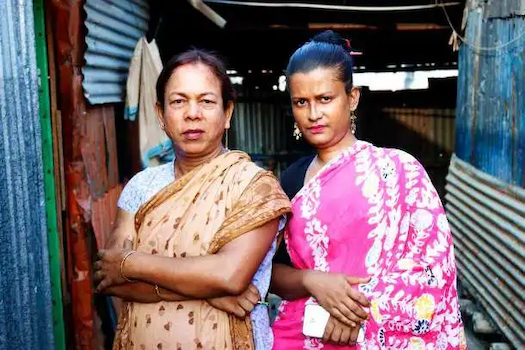
Photo: Transgender people Boby Hijra (left) and Utpakhi Hijra are seen at Boroitola in the Jurain area of Bangladeshi capital Dhaka, 2019. Credit: UCA News.
The word hijra is a Hindustani word. It has traditionally been translated into English as “eunuch” or “hermaphrodite,” where “the irregularity of the male genitalia is central to the definition.”
However, in general hijras have been born male, with only a few having been born with intersex variations. Some hijras undergo an initiation rite into the hijra community called nirvaan, which involves the removal of the penis, scrotum and testicles.
Since the late 20th century, some hijra activists and non-government organizations (NGOs) have lobbied for official recognition of the hijra as a kind of “third sex” or “third gender,” as neither man nor woman.
Hijras have successfully gained this recognition in Bangladesh and are eligible for priority in education and certain kinds of low paid jobs.
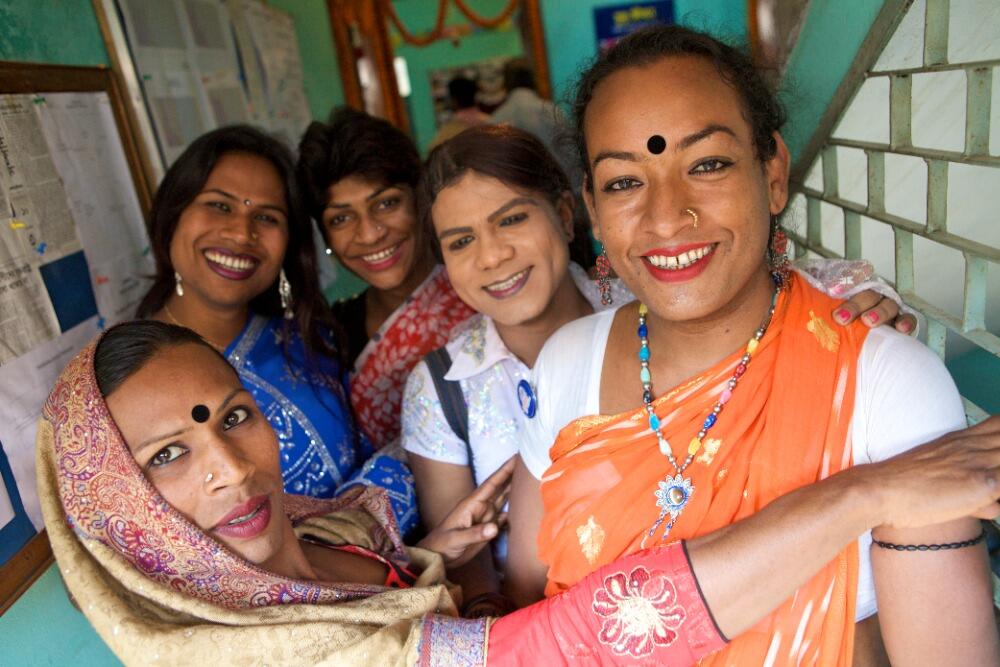
Photo: Group of hijra in Bangladesh, 2010. Credit: USAID Bangladesh/Wikimedia Commons.
In North India, the goddess Bahuchara Mata is worshiped by pavaiyaa (‘sexless devotees’). In South India, the goddess Renuka is believed to have the power to change one’s sex. Male devotees in female clothing are known as jogappa. They perform similar roles to hijra, such as dancing and singing at birth ceremonies and weddings.
The word kothi(or koti) is common across India, similar to the kathoey of Thailand, although kothis are often distinguished from hijras.
Kothis are regarded as feminine men or boys who take a feminine role in sex with men (“bottoming“), but do not live in the kind of intentional communities that hijras usually live in.
Additionally, not all kothis have undergone initiation rites or the body modification steps to become a hijra. Local equivalents include durani (Kolkata), menaka (Cochin), meti (Nepal), and zenana (Pakistan).
Hijra used to be translated in English as “eunuch” or “hermaphrodite,” although LGBT historians or human rights activists have sought to include them as being transgender. In a series of meetings convened between October 2013 and January 2014 by the transgender experts committee of India’s Ministry of Social Justice and Empowerment, hijra and other trans activists asked that the term “eunuch” be discontinued from usage in government documents, as it is not a term with which the communities identify.
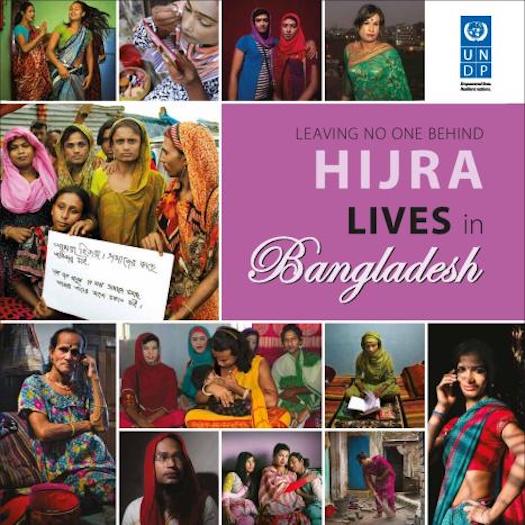
United Nations Development Program
Leaving No One Behind HIJRA LIVES IN BANGLADESH
Beginning in early childhood, a young hijra’s emerging gender identity and expression come into conflict with normative gender roles based on sex.
A hijra’s self-realization is noticed and tabooed by family members and society because of a lacking of knowledge and understanding about the third gender.
Often, their families resist accepting their child’s gender identity. Fearing disgrace from society at large, they often resort to various forms of abuse in an effort to ‘fix’ their child, or ultimately exclude them from their family and home.
Many hijras have no choice but to escape from their family’s maltreatment. The stigma and discrimination they face continue as they try to survive in a world that looks down on them.
Gender and sexuality
A common misconception of many in Indian society is that all hijra are intersex, asexual and impotent. This is not fully accurate as many hijra are sexually active, in relationships, or partake in sex work.[33] In India, some Hijras do not define themselves by specific sexual orientation, but rather by renouncing sexuality altogether. However, these notions can come in conflict with the practical, which is that hijras are often employed as prostitutes.[34] Furthermore, in India a feminine male who takes a “receptive” role in sex with a man will often identify as a kothi (or the local equivalent term). While kothis are usually distinguished from hijras as a separate gender identity, they often dress as women and act in a feminine manner in public spaces, even using feminine language to refer to themselves and each other. The usual partners of hijras and kothis are men who consider themselves heterosexual as they are the ones who penetrate.[35] These male partners are often married, and any relationships or sex with “kothis” or hijras are usually kept secret from the community at large. Some hijras may form relationships with men and even marry,[36] although their marriage is not usually recognised by law or religion. Hijras and kothis often have a name for these masculine sexual or romantic partners; for example, panthi in Bangladesh, giriya in Delhi or sridhar in Cochin.[31] A 2015 study found that self identified panthi participants reported their sexual orientation as bisexual but otherwise aligned with male-typical in other study measures. Identification as hijra, kothi and panthi can be distinguished from Western categories, as they go beyond sexual attraction (such as gay, lesbian or bisexual in the West) to also include gender roles/presentation and preference in sexual position.
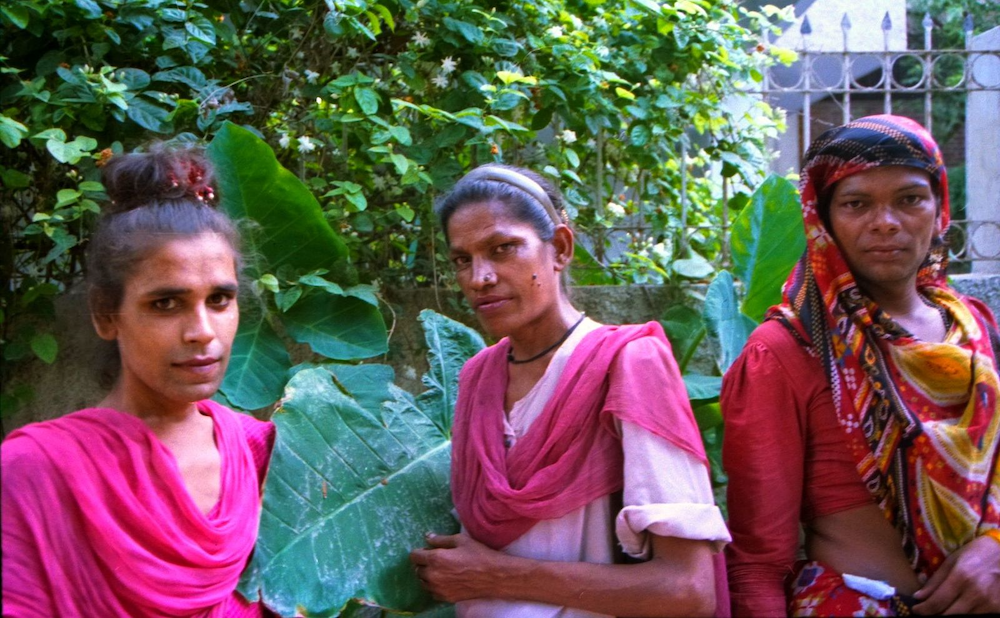
Photo: Hidras of Panscheel Park II, New Delhi, India, 1994. Credit: R.D. Lucca of Caracas, Venezuela/Wikipedia.
A qualitative, interview based study found that those who fall under the umbrella of being hijra tend to identify with certain ‘schools of thought’ including Khusrapan and Zananapan. These terms refer to categories of hijra functioning. Those who follow Khusrapan identify with being a Hermaphrodite, denouncing sex work while believing that the ancient practices of bestowing prayers and blessings are to be depended on for sustenance. In contrast, the Zananapan school of thought has followers who may be born biologically male but identify with being a woman through their appearance and lifestyle. They often turn to begging or sex work as a consequence of social exclusion.[37]
The ancient Indian erotic book Kama Sutra mentions the performance of fellatio by feminine people of a third sex (tritiya prakriti).[38] This passage has been variously interpreted as referring to men who desired other men, so-called eunuchs (“those disguised as males, and those that are disguised as females”),[39] male and female trans people (“the male takes on the appearance of a female and the female takes on the appearance of the male”),[40] or two kinds of biological males, one dressed as a woman, the other as a man.[41] Furthermore, in the Puranas three kinds of devas or divine beings of music and dance were identified. These included apsaras, gandharvas, and kinnars, with the former two referring to female and male while the latter refers to ‘neuters’. Additionally, the early writings of the Manu Smriti explained the biological origin of the sexes, identifying a third sex that could result if there was an equal prevalence of male and female ‘seed’.[42]
Hijra identity and culture is documented to have evolved during the Delhi Sultanate (1206–1526) and Mughal Empire (1526–1707), where hijras held positions as servants for elite households, manual laborers, military commanders, political advisors, and guardians of the harem.[14][15]
Franciscan travelers in the 1650s noted the presence of “men and boys who dress like women” roaming the streets of Thatta, in modern Pakistan. The presence of these individuals was taken to be a sign of the city’s depravity.[43]
British colonialism and the anti-Hijra campaign (1858–1947)
Beginning in the 1850s, colonial authorities deployed various strategies to end hijra practices, which they saw as “a breach of public decency” and incapable of “moral transformation,” as part of their influence on colonial-era sexuality in India. [44] Although hijras were already criminalised by Section 377 of the Indian Penal Code, in 1861, authorities of the North-Western Provinces (NWP) sought to enact a ‘special law’ against hijras.[45] By 1870, no high-ranking British officials argued against the implementation of special legislation to address the ‘hijra problem’, thus solidifying an anti-hijra campaign all across the Indian subcontinent.[45]
Anti-hijra laws were enacted, including a law outlawing castration, a marginal practice of the hijra community, although it was rarely enforced. The hijra were included in the Criminal Tribes Act (1871), subject to registration, monitoring and stigmatisation.[46][45] Because of economic costs, hijras and other so-called “criminal tribes” were unable to be collectively sequestered from colonial society. British Lieutenant-Governor Edmund Drummond (1814–1895) framed the anti-hijra campaign as a necessary project. Hijras were monitored with the hope of ending hijra practices.[45] Since the passage of the Criminal Tribes Act (1871), hijras could not possess children. This law also prevented the initiation—castration—as the administrators argued that hijra children did not or could not consent to it.[45]
Hijra communities remain throughout modern states of Pakistan, India, Nepal and Bangladesh, although they continue to face social marginalisation and police abuse.[47] In the late 20th and early 21st centuries, hijras became the subject of more attention, being the focus of numerous documentaries, news features, ethnographies, monographs and dissertations. Gayatri Reddy writes that in the 21st century, hijras have also been ‘mainstreamed’ into popular films: “given this history of near invisibility, the recent attention focused on hijras has been unsettling for both hijras and non-hijras.”[48]
Most hijras live at the margins of society with very low status; the very word “hijra” is sometimes used in a derogatory manner. The Indian lawyer and author Rajesh Talwar has written a book, titled The Third Sex and Human Rights, highlighting the human rights abuses suffered by the community.[49] Few employment opportunities are available to hijras. Many get their income from performing at ceremonies (toli), begging (dheengna), or prostitution (‘raarha’)—an occupation of eunuchs also recorded in premodern times. Violence against hijras, especially those who are prostitutes, is often brutal, and occurs in public spaces, police stations, prisons, and their homes.[50] As with transgender people in most of the world, they face extreme discrimination in health, housing, education, employment, immigration, law, and any bureaucracy that is unable to place them into male or female gender categories.[51]
The aforementioned all-hijra communities are where many hijra seek refuge and move in. These are made up of a hierarchical structure with large groups of hijras from different areas forming lineages or gharanas. A naayak is the head and primary decision maker for a gharana, determining policies for the community. Falling under naayaks are gurus (lit. “teachers”). Gurus are above community members and regulate daily life in the housing space (known as a dera). The followers of a guru are called chelas. Traditionally, teachers and their disciples use these terms in many domains such as religious learning; however, they bear specific meaning in hijra communities as being about cultural learning—hijra chelas are taught about hijra customs by their guru. These communities reflect similarities to Western notions of found family.[42][52]
In these communities, the hijras usually refer to each other in feminine terms. Thus, they refer to their relations as sisters with those who fall around their age range or aunt with those older than them, and so on.[42]
In October 2013, Pakistani Christians and Muslims (Shia and Sunni) put pressure on the landlords of Imamia Colony to evict any transgender residents. I. A. Rehman, the director of the Human Rights Commission of Pakistan, said, “Generally in Pakistan, Khwaja Sira are not under threat. But they are in Khyber Pakhtunkhwa Province because of a ‘new Islam’ under way.”[53]
The social status of hijra in society plays a part in their difficulty accessing healthcare services as physicians will turn hijra clients away, saying their presence will disturb other clients. Hijra have to hide their identities or can not disclose illnesses such as STIs. Most medical practitioners are also not well educated and informed enough on hijra or sexuality, further contributing to this issue. Social exclusion of the hijra also has some severe consequences for their health.[54]
Hijra in Dhaka, Bangladesh were found to have the highest syphilis rates out of all at-risk groups in the city.[54] In a study of Bangladeshi hijras, participants reported not being allowed to seek healthcare at the private chambers of doctors, and experiencing abuse if they go to government hospitals.[54]
In 2008, HIV prevalence was 27.6% amongst hijra sex workers in Larkana, Pakistan.[55] The general prevalence of HIV among the adult Pakistani population is estimated at 0.1%.[56]
The aforementioned social inequalities and medical negligence also make hijra sex workers a more vulnerable population to HIV. Protection is not usually used in coerced sex[clarification needed], increasing risk of direct exposure to HIV.[57] 40% of the sample in a Pakistan study on HIV reported experiencing forced sex or abuse. Additionally, of this sample, 58% of participants had STI’s, the most common being syphilis and gonorrhoea.[58]
An Indian study consisting of 68 transgender participants reported that respondents expressed having intense feelings of low self-worth, shame, depression and suicidal thoughts, internalizing the negative views the society around them holds. Many hijra experience a lack of a support system, facing rejection from family members or difficulties in terms of maintaining steady relationships with romantic partners. This rejection from society contributes to struggles with mental health as well as trans sex workers feeling obligated to accept the violence and stigmas they are subject to.[57]
After India’s Supreme Court re-criminalized homosexual sex on 11 December 2013, there was a sharp increase in physical, psychological and sexual violence against the transgender community by the Indian Police Service, which often does not investigate reports of sexual assault against them.[59] On 6 September 2018, the Supreme Court overturned India’s Section 377, which criminalized anal and oral sex.[60]
In an ethnographic study on the hijra experience in Bangladesh, many hijra recounted childhood experiences of facing abuse and isolation from their peers for presenting as feminine males. Additionally, many hijra reported facing abuse and humiliation from their teachers as well, making school an unfriendly and uncomfortable environment for them. These experiences ultimately resulted in their reluctance to attend school or continue education. This lack of education ends up playing a role in unemployment rates of Hijra. Hijra in Bangladesh also experience sexual harassment and abuse at work, being removed from their jobs when outed as hijra or denied from jobs in general. They face accusations of disturbing the workplace environment.[54]
Being turned away from traditional careers, many hijra have become involved in sex work. However, this has its own problems as Hijras face harassment, forced unprotected sex and assault from clients but many are not able to report it due to fear of harassment from the police as well.[54]
In 2002, nearly 5,000 people attended the All India Eunuch Conference held in Varanasi; the conference’s platform demanded that universities and government open more job opportunities to this population.[61] On 15 April 2014, in National Legal Services Authority v. Union of India, the Supreme Court of India ruled that transgender people should be treated as a third category of gender or as a socially and economically “backward” class entitled to proportional access and representation in education and jobs.[62]
Beginning in 2006, hijras were engaged to accompany Patna city revenue officials to collect unpaid taxes, receiving a 4-percent commission.[63]
The hijra community developed a secret language known as Hijra Farsi.[64] The language has a sentence structure loosely based on Hindi[64] and a unique vocabulary of at least a thousand words.[citation needed] Some of the kinship terms and names for rituals used by the Hindi-speaking Hijra community are different in use from those used by people outside the Hijra community. For example, dādī, the Standard Hindi for paternal grandmother, is used in the Hijra community to address one’s guru’s guru.[65] Beyond the Urdu-Hindi speaking areas of subcontinent the vocabulary is still used by the hijra community within their own native languages.[citation needed]
Hijras protesting in Islamabad, the capital of Pakistan
The governments of both India (1994)[66] and Pakistan (2009)[67] have recognised hijras as a “third sex”, thus granting them the basic civil rights of every citizen. In India, hijras now have the option to identify as a eunuch (“E”) on passports and on certain government documents.[citation needed] They are not, however, fully accommodated; in order to vote, for example, citizens must identify as either male or female. There is also further discrimination from the government. In the 2009 general election, India’s election committee denied three hijras candidature unless they identified themselves as either male or female. In 2013, transgender people in Pakistan were given their first opportunity to stand for election.[68]Sanam Fakir, a 32-year-old hijra, ran as an independent candidate for Sukkur, Pakistan’s general election in May.[69]
Seldom, our society realises or cares to realise the trauma, agony and pain which the members of Transgender community undergo, nor appreciates the innate feelings of the members of the Transgender community, especially of those whose mind and body disown their biological sex. Our society often ridicules and abuses the Transgender community and in public places like railway stations, bus stands, schools, workplaces, malls, theatres, hospitals, they are sidelined and treated as untouchables, forgetting the fact that the moral failure lies in the society’s unwillingness to contain or embrace different gender identities and expressions, a mindset which we have to change.
Justice Radhakrishnan said that transgender people should be treated consistently with other minorities under the law, enabling them to access jobs, healthcare and education.[71] He framed the issue as one of human rights, saying that, “These TGs, even though insignificant in numbers, are still human beings and therefore they have every right to enjoy their human rights”, concluding by declaring that:[70]
Hijras, Eunuchs, apart from binary gender, be treated as “third gender” for the purpose of safeguarding their rights under Part III of our Constitution and the laws made by the Parliament and the State Legislature.
Transgender persons’ right to decide their self-identified gender is also upheld and the Centre and State Governments are directed to grant legal recognition of their gender identity such as male, female or as third gender.
A bill supported by all political parties was tabled in Indian parliament to ensure transgender people get benefits akin reserved communities like SC/STs and is taking steps to see that they get enrollment in schools and jobs in government besides protection from sexual harassment.[72]
In the 1990s, about 10,000 people belonged to a national organisation called Treetiya Panthi Sanghatana (TPS). As of 2003, the president was Kajal Nayak.[73] A younger Kajal Nayak, who was 27 years old in 2019, is the president of Jajpur‘s Transgender Association.[74]
The Indian transgender hijras or Aravanis ritually marry the Hindu god Aravan and then mourn his ritual death (seen) in an 18-day festival in Koovagam, India.
Many practise a form of syncretism that draws on multiple religions; seeing themselves to be neither men nor women, hijras practice rituals for both men and women.
Bahuchara Mata is a Hindu goddess with two unrelated stories both associated with transgender behavior. One story is that she appeared in the avatar of a princess who castrated her husband because he would run in the woods and act like a woman rather than have sex with her.[citation needed] Another story is that a man tried to rape her, so she cursed him with impotence.[citation needed] When the man begged her forgiveness to have the curse removed, she relented only after he agreed to run in the woods and act like a woman.[citation needed] The primary temple to this goddess is located in Gujarat[75] and it is a place of pilgrimage for hijras, who see Bahuchara Mata as a patroness.
One of the forms of Shiva is called Ardhanarishvara, a composite representation with one half of the form featuring Parvati. Ardhanarishvara has special significance as a patron of hijras, who identify with the gender ambiguity.[75] According to legend, the sage Bhringi wished to venerate only Shiva, and ignored Parvati, while worshipping and circumambulating him. Agitated, Parvati cursed Bhringi to lose all his flesh and blood, reducing him to a skeleton. In this form Bhringi could not stand erect, so the compassionate ones who witnessed the scene blessed the sage with a third leg for support. As her attempt to humiliate the sage had failed, Parvati punished herself with austerities that pleased Shiva and led him to grant her the boon of uniting with him, thereby compelling Bhringi to worship the divine couple in the form of Ardhanarishvara, a combined form of the deities, believed to integrate the masculine and the feminine.[76]
In some versions of the Ramayana,[77] when Rama leaves Ayodhya for his 14-year exile, a crowd of his subjects follow him into the forest because of their devotion to him. Soon Rama notices this, and gathers them to tell them not to mourn, and that all the “men and women” of his kingdom should return to their places in Ayodhya. Rama then leaves for 14 years. When he returns to Ayodhya, he finds that the hijras, being neither men nor women, have not moved from the place where he gave his speech. Impressed with their devotion, Rama grants hijras the boon to confer blessings on people during auspicious inaugural occasions like childbirth and weddings. Specifically, hijras will perform and bestow their blessings when a son is born. This boon is the origin of badhai in which hijras sing, dance and give blessings.[78]
The Mahabharata includes an episode in which Arjuna, a hero of the epic, is sent into exile. There he assumes an identity of a eunuch-transvestite and performs rituals during weddings and childbirths that are now performed by hijras.[34]
In another episode, before the Kurukshetra War, Aravan offers his lifeblood to goddess Kali to ensure victory for the Pandavas, and Kali agrees. On the night before the battle, Aravan expresses a desire to get married before he dies. No woman was willing to marry a man doomed to die in a few hours, so Lord Krishna (as Mohini) marries him. In South India, hijras claim Aravan as their progenitor and call themselves aravanis.[78]
Each year in Tamil Nadu, during April and May, hijras celebrate an eighteen-day religious festival at a temple located in the village Koovagam in the Ulundurpettaluk in Villupuram district. The temple is devoted to the deity Koothandavar, who is identified with Aravan. During the festival, the hijras reenact the wedding of Lord Krishna and Lord Aravan, followed by Aravan’s subsequent sacrifice. They then mourn Aravan’s death through ritualistic dances and by breaking their bangles. An annual beauty pageant is also held, as well as various health and HIV/AIDS focused seminars. Hijras from all over the country travel to this festival. BBC Three documentary India’s Ladyboys as well as the National Geographic Channel television series Taboo depict personal experiences of hijras attending this festival.
There is evidence that Indian hijras identifying as Muslim also incorporate aspects of Hinduism. Still, despite this syncretism, Gayatri Reddy notes that hijra do not practise Islam differently from other Muslims and argues that their syncretism does not make them any less Muslim.[79] Reddy also documents an example of how this syncretism manifests: in Hyderabad, India, a group of Muslim converts were circumcised, something seen as the quintessential marker of male Muslim identity.[80]
Hijras have been portrayed on screen in Indian cinema since its inception, historically as comic relief. A notable turning point occurred in 1974 when real hijras appeared during a song-and-dance sequence in Kunwaara Baap (“The Unmarried Father”). The Hindi movie Amar Akbar Anthony (1977) features hijras who accompany one of the heroes, Akbar (Rishi Kapoor), in a song entitled “Tayyab Ali Pyar Ka Dushman” (“Tayyab Ali, the Enemy of Love”).
In Soorma Bhopali (1988), Jagdeep encounters a troupe of hijras on his arrival in Bombay. The leader of this pack is also played by Jagdeep himself.
One of the main characters in Khushwant Singh‘s novel Delhi (1990), Bhagmati, is a hijra. She makes a living as a semi-prostitute and is wanted in the diplomatic circles of the city.
One of the first sympathetic hijra portrayals was in Mani Ratnam’s Bombay (1995). 1997’s Tamanna[81] starred male actor Paresh Rawal in a central role as “Tiku”, a hijra who raises a young orphan. Pooja Bhatt produced and also starred in the movie, with her father Mahesh Bhatt co-writing and directing.
The 1997 Hindi film Darmiyaan: In Between, directed & co-written by Kalpana Lajmi, is based on the subject of hijras, with a fictitious story of an actress bearing a son that turns out to be neuter.
Kishor Shatabai Kale‘s novel, Hijara Ek Mard [Eunuch, A Man], was adapted for the stage in 1998. The play was titled Andharyatra.[82]
In the 2000 Tamil film Appu, directed by Vasanth and a remake of the Hindi film Sadak, the antagonist is a brothel-owning hijra played by Prakash Raj. (In Sadak, the brothel-owning character was played by Sadashiv Amrapurkar under the name “Maharani”.)
In Anil Kapoor‘s Nayak (2001), Johnny Lever, who plays the role of the hero’s assistant, gets beaten up by hijras, when he is caught calling them “hijra” (he is in habit of calling almost everyone who bothers him by this pejorative and no one cares much, except this once ironically, as the addressees are literally what he is calling them.)
There is a brief appearance of hijras in the 2004 Gurinder Chadha film Bride & Prejudice, singing to a bride-to-be in the marketplace.
Deepa Mehta’s controversial film Water (2005) features the hijra character “Gulabi” (played by Raghubir Yadav), who has taken to introducing the downtrodden, outcast widows of Varanasi to prostitution.
Vijay TV‘s Ippadikku Rose (2008), a Tamil show conducted by postgraduate educated transgender woman Rose, was a very successful program that discussed various issues faced by youth in Tamil Nadu, where she also gave her own experiences.
In addition to numerous other themes, the 2008 movie Welcome to Sajjanpur by Shyam Benegal explores the role of hijras in Indian society.
Jogwa, a 2009 Marathi film, depicts the story of a man forced to be hijra under certain circumstances. The movie has received several accolades.[83]
The 2011 film Queens! Destiny of Dance tells the story of an upmarket hijra community that is headed by their queen, Guru Amma, played by actress Seema Biswas.[84]
The 2011 comedy-horror Kanchana features an unemployed man who is possessed by a transgender woman seeking revenge against her murderers.
The 2020 comedy-horror Laxmii, based on Kanchana, features the actor Akshay Kumar, a cisgender man who usually plays hypermasculine roles, in the role of a Muslim man who begins crossdressing because he is possessed by the ghost of a transgender woman.[85]
In the 2004 film ‘Bride and Prejudice‘, directed by Gurinder Chadha, a group of hijras make an appearance during the ‘A Marriage Has Come to Town’ number, in which they dance and sing the following lyrics: “Who can tell you more about Yin & Yang?/Sharing one spirit between woman and man/Marriage is the path taken by he and she/May your new life be kissed by harmony.”
In the Malayalam movie Ardhanaari, released on 23 November 2012, director Santhosh Sowparnika depicts the life of a transgender person. Manoj K Jayan, Thilakan, Sukumari and Maniyanpilla Raju perform leading roles.
Vaadamalli by novelist Su. Samuthiram is the first Tamil novel about the Aravaani community in Tamil Nadu, published in 1994.
Transgender activist A. Revathi became the first hijra to write about transgender issues and gender politics in Tamil. Her works have been translated into more than eight languages and act as primary resources on gender studies in Asia. Her book is part of a research project for more than 100 universities. She is the author of Unarvum Uruvamum (Feeling and Form), the first of its kind in English from a member of the hijra community.[87][88] She acted and directed stage plays on gender and sexuality issues in Tamil and Kannada. The Truth about Me: A Hijra Life Story[89] is part of the syllabus for final year students of The American College in Madurai.
“Naan Saravanan Alla” (2007) and Vidya’s I Am Vidya (2008) were the first autobiographies of trans women.[90][91]
The 1992 film Immaculate Conception[92] by Jamil Dehlavi is based upon the culture-clash between a western Jewish couple seeking fertility at a Karachi shrine known to be blessed by a Sufi fakir called ‘Gulab Shah’ and the group of Pakistani eunuchs who guard it.
Murad (English: desire, but the film’s English title was Eunuch’s Motherhood), was an award-winning biographical telefilm drama made by Evergreen Media Europe for Pakistan’s television channel Indus TV that aired in 2003. It featured some of the country’s top male television actors—Sohail Asghar, Nabeel, Qazi Wajid, and Kamran Jilani playing the roles of hijras. It was directed by Kamran Qureshi, written by Zafar Mairaj and produced by Iram Qureshi. It won both Best TeleFilm and Best Director awards at 2003 Indus Telefilm Festival.[93][94] The story revolves around Saima, a transgender woman, who adopts a child named Murad. For the first time, influential male actors showed their support for hijra rights during interviews, pointing out that in Pakistani English at that time eunuch was the term to describe a transgender person, and khwaja sara had not yet replaced what is now considered a derogatory term due to decades of heckling and name calling.[95][96]
In 2004, Kamran Qureshi directed Moorat (English: effigy, released in English under the title Eunuch’s Wedding). It a 33-episode series produced by Humayun Saeed and Abdullah Kadwani with more than a dozen cast members.[97][98] It was nominated for Best Drama Serial, Abid Ali for Best Actor, and Maria Wasti for Best Actress at the Lux Style Awards 2005.[93][99] The show was credited with making people understand the pain and abuse that hijra constantly endure when people make fun of the way they look or dress. The story involves a young lady who is engaged to be married. It turns out her husband is transgender. The story unfolds the trans community and their deprived and isolated world. It portrays eloquently how they, too, are not far away from human emotions and feelings and their world is not much different from the heterosexual community. Even though they are in plain sight, they are taboo subjects and are not taken seriously. This makes them suffer endlessly in silence wrapped in slurs. The 33-episode series therefore touches on transgender abuse, abuse against women, poverty, the immorality of arranged marriages and child abuse.[100]
Bol (Urdu: بول meaning Speak), is a 2011 Urdu-language Pakistani social drama film. It concerns a patriarch, Hakim, who is a misogynist, a domestic abuser, a bigot and a zealot who forces religion on his family. They face financial difficulties due to Hakim wanting a son. He rejects his transgender daughter, Saifi, as he wanted an heir and she identifies as a girl. Saifi is deeply loved by the rest of her family. As she grows up, men want to take advantage of her and she does not understand at first. However, her oldest sister intervenes and teaches Saifi about what kind of touching is inappropriate. As Saifi grows older, she is not allowed to leave the house. She finds her sister’s dresses compelling and tries them on, revealing her gender identity. A neighbour, played by famous South Asian singer Atif Aslam, who is in love with one of the sisters, gets Saifi a job at a place where they paint trucks, with the blessing of Saifi’s sisters and mother. Saifi dresses like a boy; however, other boys sense her lack of self-esteem and eventually gang-rape her. She is saved when another transgender person, played by Almas Bobby (a transgender actor), finds her and takes her home. Hakim overhears Saifi telling her mother and Zainab what happened. When everybody is asleep, Hakim locks the room and suffocates Saifi for the “shame” he would have to bear if the story got out.[101] It received several positive reviews from critics and went on to win the Best Hindi film award in IRDS Film awards 2011 by Institute for Research and Documentation in Social Sciences (IRDS).[citation needed]
New York, N.Y. –– Alan Turing was a pioneering mathematician and logician whose work laid the foundations for modern computing. During World War II, Turing’s brilliance was instrumental in breaking the Enigma code, a critical factor in the Allied victory.
However, despite his monumental contributions, Turing’s life ended in tragedy. In 1952, he was prosecuted by the British government for his homosexuality, then illegal, and was subjected to chemical castration.
Two years later, he died from cyanide poisoning, widely believed to be suicide. Turing’s story is a powerful reminder of the destructive consequences of intolerance and the loss of a mind that could have continued to shape the future.
This tragic tale is poignantly captured in the 2014 film The Imitation Game, starring Benedict Cumberbatch as Turing. The movie dramatizes Turing’s achievements and struggles, highlighting his role in the war effort and the personal battles he faced due to his sexual orientation.
While some creative liberties were taken, the film brought Turing’s story to a wider audience, shedding light on both his genius and the injustices he endured. The Imitation Game serves as a tribute to Turing’s legacy and a reminder of the human cost of prejudice.
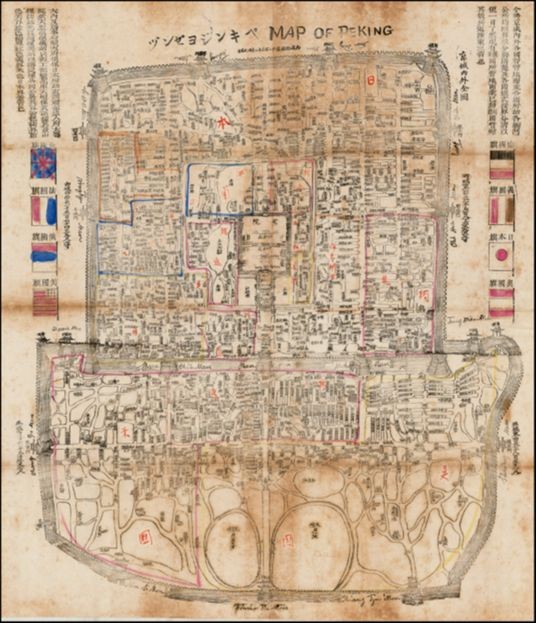
900: The Boxer Uprising In the late 19th century, anti-foreign sentiments merged with rural unrest and mystical cults to give rise to the Boxer movement. Practicing martial arts and espousing a slogan of “support the Qing, destroy the foreign,” the “Boxers United in Righteousness” targeted all foreigners and Chinese Christian converts, who suffered violent attacks.
The Uprising reached a peak in the spring and summer of 1900 when Boxer forces marched on Beijing, with the support of the Qing court. For two months the Boxers occupied the capital and besieged the foreign legation district, where the foreign community and a large group of Chinese Christians barricaded themselves within the legations.
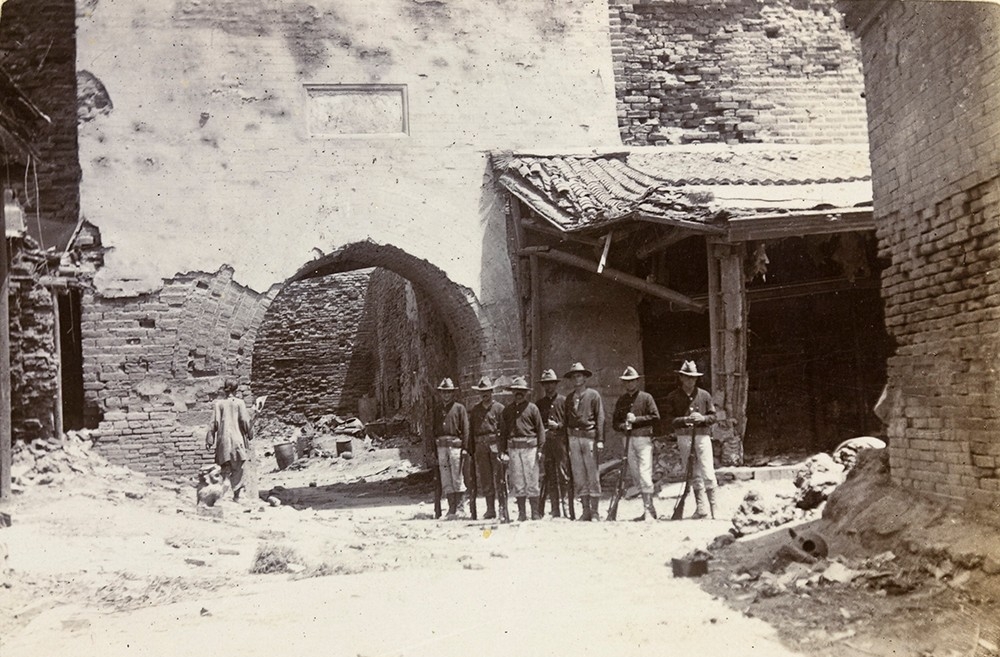
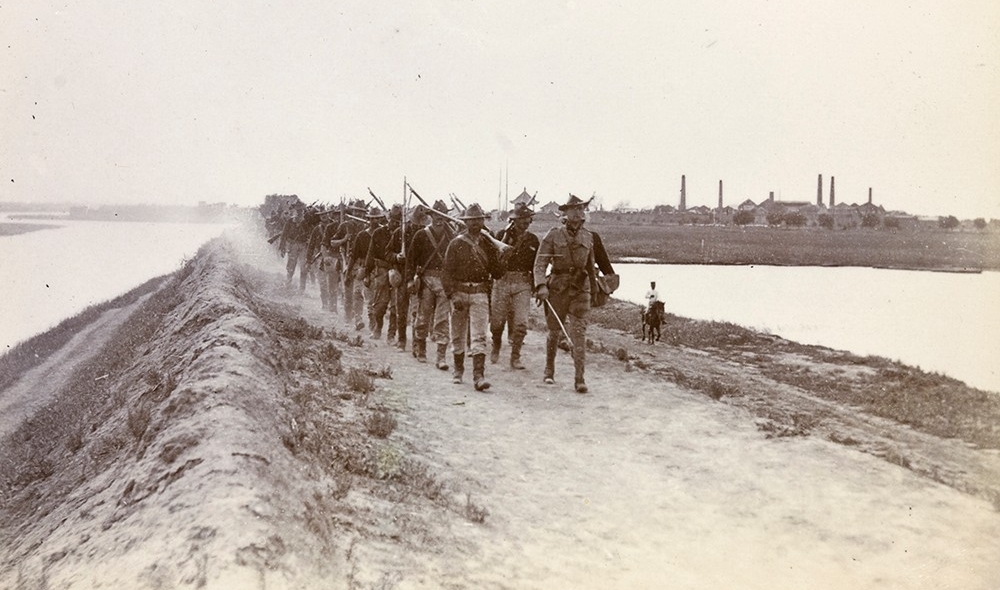
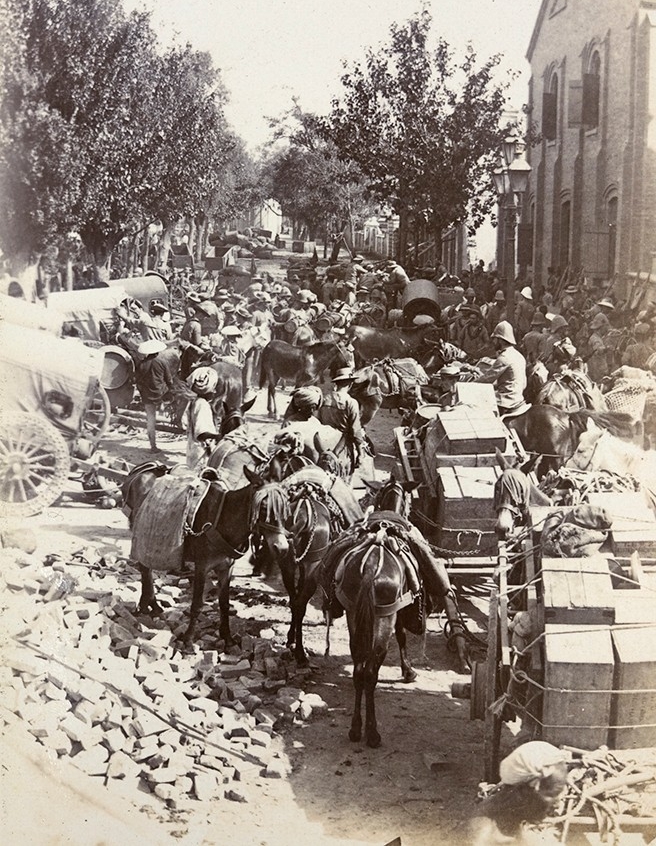
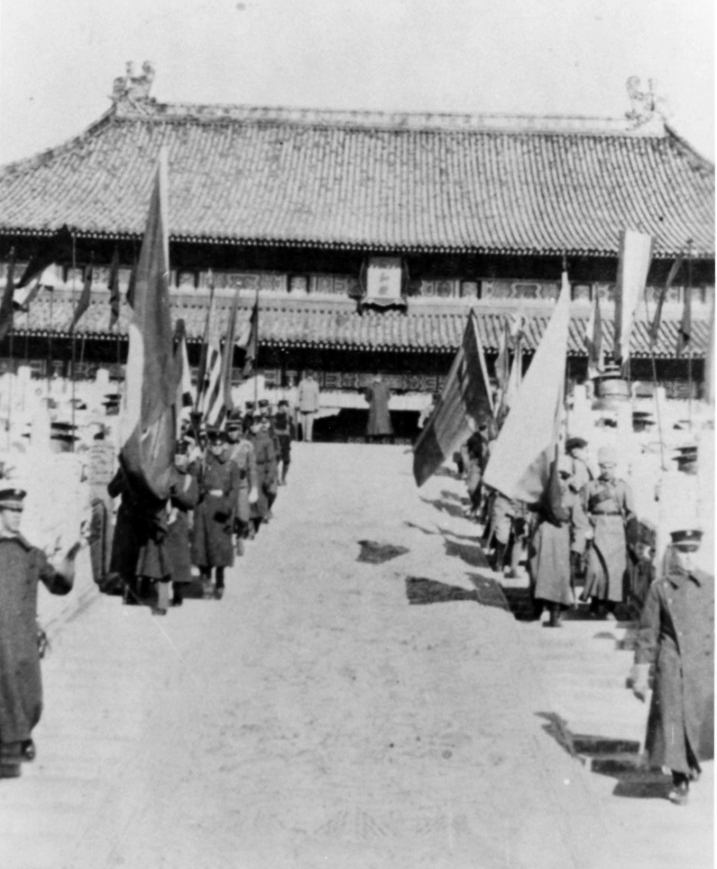
The foreigners managed to resist repeated Boxer attacks until a multinational force finally fought its way in from the coast and reached Beijing, lifting the siege. U.S. marines played a key role in defending the legations during the siege and also joined the multinational force that crushed the Boxers.
1901: The Boxer Protocol Signed After defeating the Boxers, the foreign powers forced the Qing to submit to a punitive settlement that included a huge indemnity ($333 million) to be paid to the foreign nations. This essentially bankrupted the Qing government, which already faced serious financial difficulties.
Meanwhile, outside the walls of Beijing, Christian missionaries flooded the Chinese countryside, establishing local schools and hospitals as they sought to convert local populations to Christianity. By 1900, the Presbyterian Church ran 10 hospitals, 150 schools, and 51 churches in China. Shandong (Shantung) Province, the cradle of the Boxer Rebellion, was home to 55 Christian schools.[5]
In December 1899, Minister Conger wrote to Secretary Hay of “a very critical state of affairs among the missionaries and their converts in Shandong.”[6] This fragile state was the result of extreme poverty among Chinese workers, and the workers blamed the Westerners for their misfortune. Western modernization efforts, especially the railroads, had rendered entire Chinese industries obsolete. To make matters worse, the Yellow River had flooded in 1898, wiping out harvests in Shandong. Then, in 1899, a drought arrived and stretched into 1900. Displaced Chinese workers had two places to turn for support: the church or a secret society.[7]
The Yihequan (I Ho Ch’uan), the “Righteous and Harmonious Fists,” had no official leader. It was a people’s movement united in the belief that the foreigners needed to be eliminated from China. Members of this secret society believed they could make themselves impervious to physical harm, including bullets, through practicing martial arts that inspired the name “Boxers.” They wore red sashes, and their ritual demonstrations coupled with a dramatic message—“Support the Qing, exterminate the foreigners”—proved to be an effective recruiting method.[8]
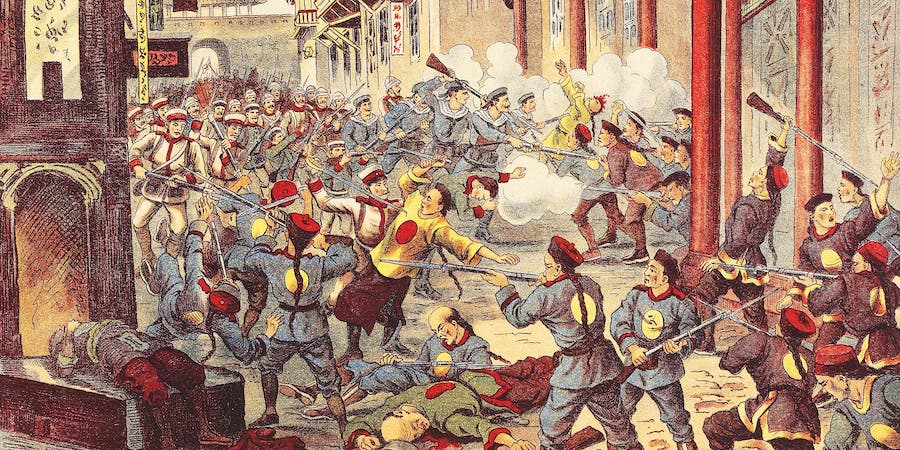
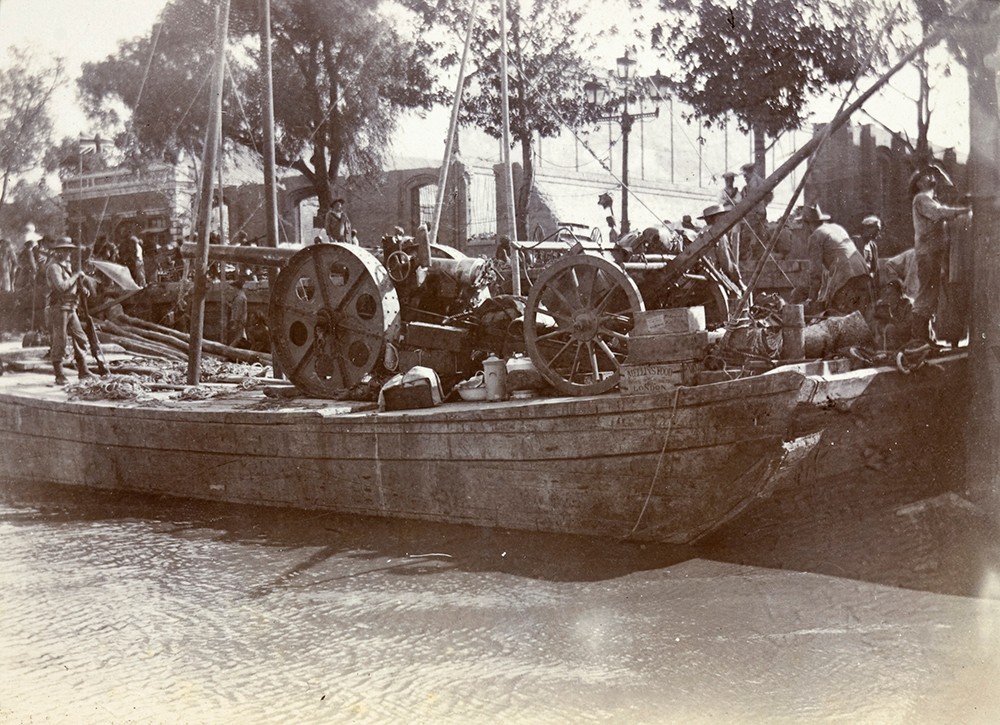
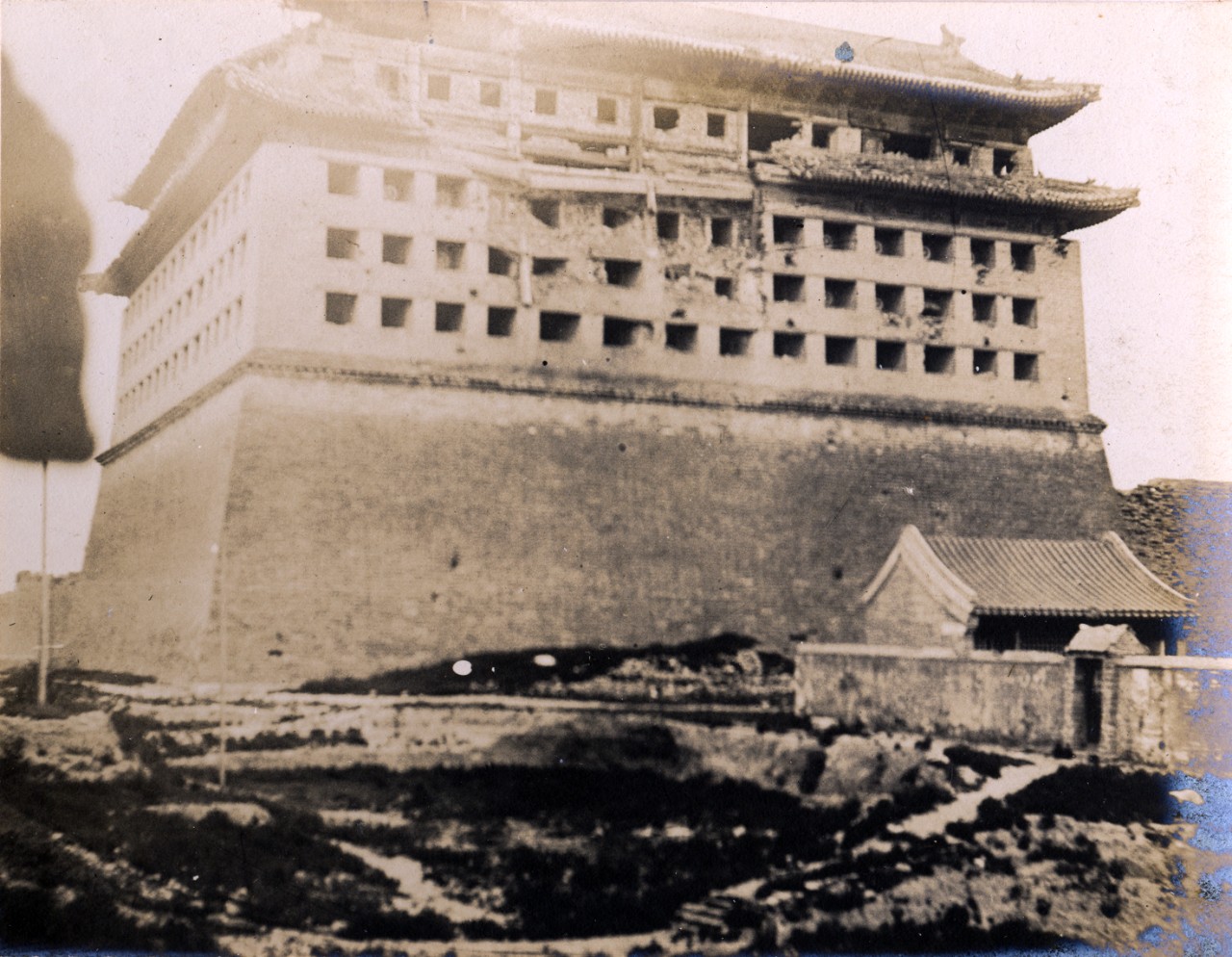
Image: Clashes on the Streets of Beijing.
The Boxer Rebellion was a violent uprising of Chinese citizens against Western influence in their country. The rebellion was instigated in 1900 by a secret organization known as the Society of Righteous and Harmonious Fists, but the tensions that fueled the violence had been simmering since China’s defeat in the Opium Wars nearly half a century before. At its peak the rebellion even had the support of China’s then-empress, but it was violently suppressed by a multinational alliance. The Boxer Rebellion lasted only a year, but its impact on Chinese history and the ruling Qing dynasty, were profound.
By analyzing questions, you can see patterns emerge, patterns that will help you answer questions. Qwiz5 is all about those patterns. In each installment of Qwiz5, we take an answer line and look at its five most common clues. Here we explore five clues that will help you answer a tossup on The Boxer Rebellion.
SOCIETY OF RIGHTEOUS AND HARMONIOUS FISTS The Society of Righteous and Harmonious Fists was a secret society that emerged primarily in the Northern Chinese province of Shandong in the 1890s. Also known as the Yihequan, the Society earned the nickname “boxers” from their elaborate martial arts rituals. The leadership of the Boxers believed that these rituals would render them immune to bullets. The Boxers had been mounting attacks on Christian missionaries and Christian converts for several years before exploding into full-out rebellion in 1900 and attacking Beijing.
DOWAGER EMPRESS
At the time of the Boxer Rebellion, the Dowager Empress Cixi had ruled as regent twice—first for her son and later for her nephew. When that nephew, Guangxu, launched the poorly-received Hundred Days’ Reforms in 1898, the Empress retook the throne with the help of Chinese conservatives. The Empress supported the Boxer movement as it gained power, but after it fell she was forced to agree to a humiliating indemnity. The terms of settlement limited Qing military power even further, dismantling the Dagu Forts that were meant to defend against Western invaders.
CLEMENS VON KETTELER
One of the most publicized deaths of the Boxer Rebellion was that of German ambassador Baron Clemens von Ketteler. The Boxer forces arrived in Beijing in June of 1900. Ketteler enraged both the Boxers and the Imperial army forces by shooting a child. During the ensuing street fighting Ketteler was shot by an army captain named En Hai.
KANSU BRAVES
The Kansu Braves were a unit of 10,000 Chinese Muslim soldiers stationed in Beijing during the Boxer Rebellion. Commanded by the virulently anti-Western General Dong Fuxiang, the Kansu Braves joined the Boxers early on in the fighting in Beijing. In addition to killing Clemens von Ketteler they also tore apart Japanese ambassador Sugiyama Akira. Although the Braves were initially dismissed as “10,000 Islamic rabble” they proved their mettle in their one major engagement with foreign forces outside of the walls of Beijing—The Battle of Langfang.
The United States took control of the Philippines from Spain after its victory in the Spanish-American War in 1898. Cavite, Philippines, provided a strategic naval base, allowing the United States to project its power toward Asia.
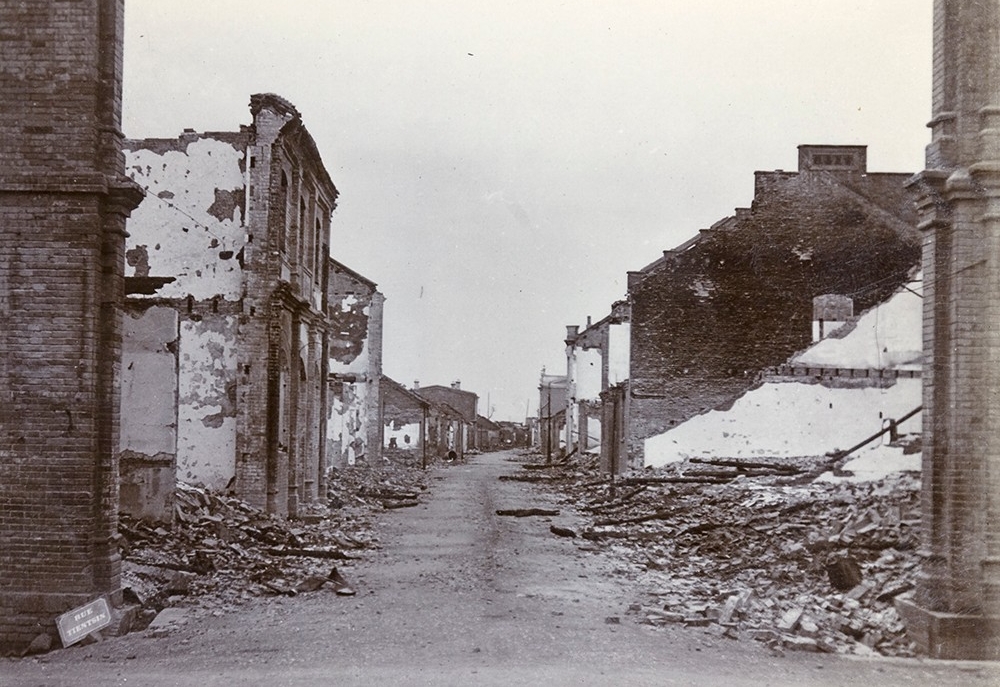
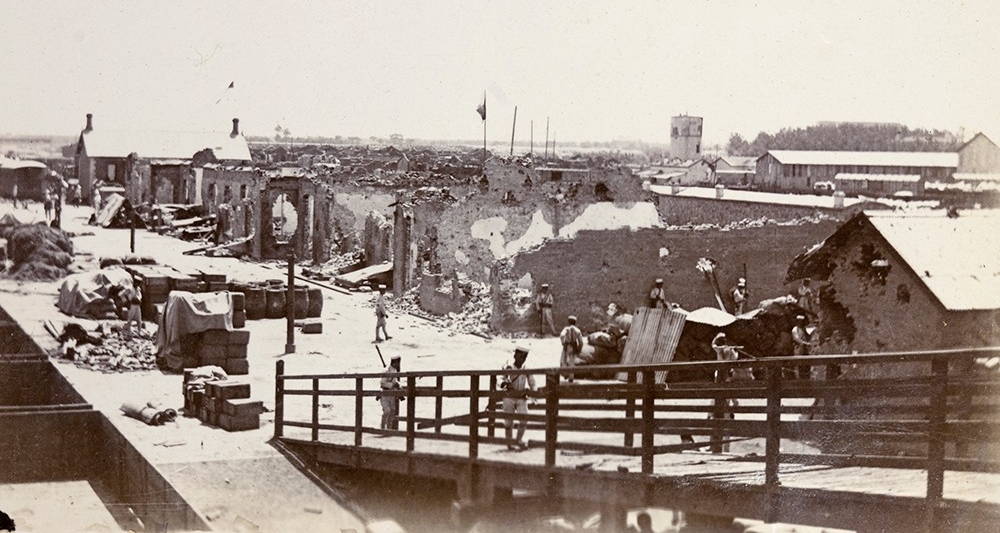
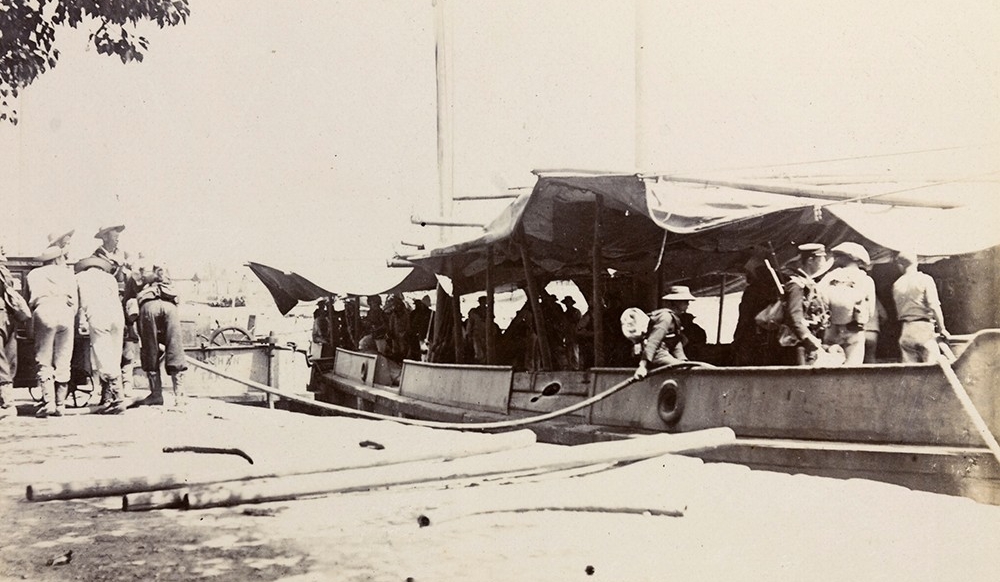
When Boxer unrest prompted the U.S. minister at the Beijing legation to request naval support, the gunboat Wheeling departed the Philippines in March 1900 to patrol the northern coast of China, joining ships of European navies at the port city of Dagu.[10] At the end of April, Wheeling was relieved by Newark, the first modern cruiser in the U.S. Navy fleet. When on May 28 and 29 Boxers burned railroad stations including Fengtai, which connected Beijing (and thus the legations) to the coast, Newark was positioned to provide a relief force.
The force that disembarked from Newark at Dagu on 29 May was comprised of two Marine detachments under the command of Captain John T. Myers, nicknamed “Handsome Jack.” Myers and his detachment of 25 Marines had been aboard the battleship Oregon, which a month later grounded on an uncharted rock in the Bohai (Pechili) Strait.[11] They had received orders on 24 May to transfer to Newark, joining a detachment of 23 Marines, five sailors, and U.S. Navy Assistant Surgeon Thomas M. Lippitt under the command of Captain Newt Hall, USMC.[12]
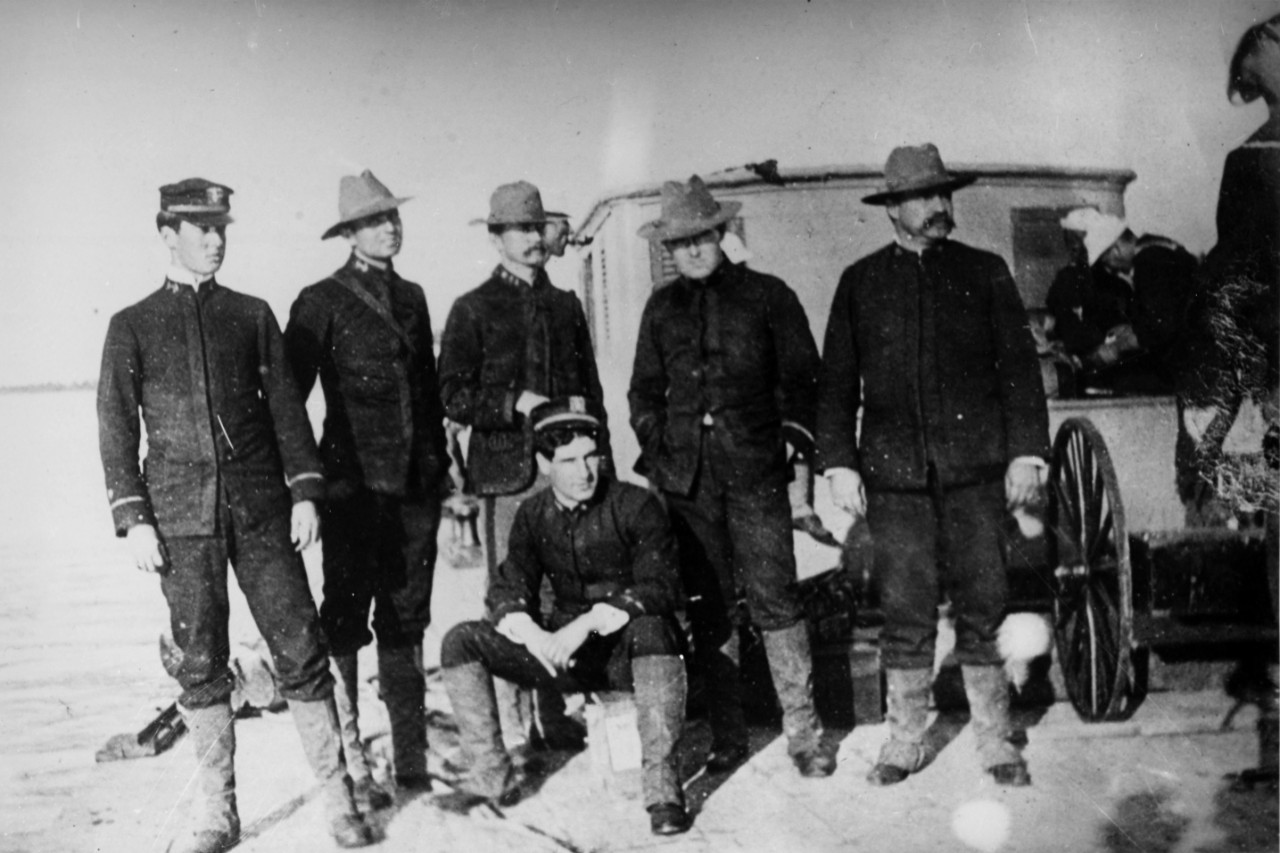
Officers of Newark on a ship on the Hai River en route to Tianjin. Left to right: Midshipman C. E. Courtney, Ensign D. W. Wurtzbaugh, Captain Newt H. Hall (USMC), Midshipman Joseph K. Taussig, Assistant Surgeon Thomas M. Lippitt, and Machinist Daniel Mullan. (NHHC NH-45347.)
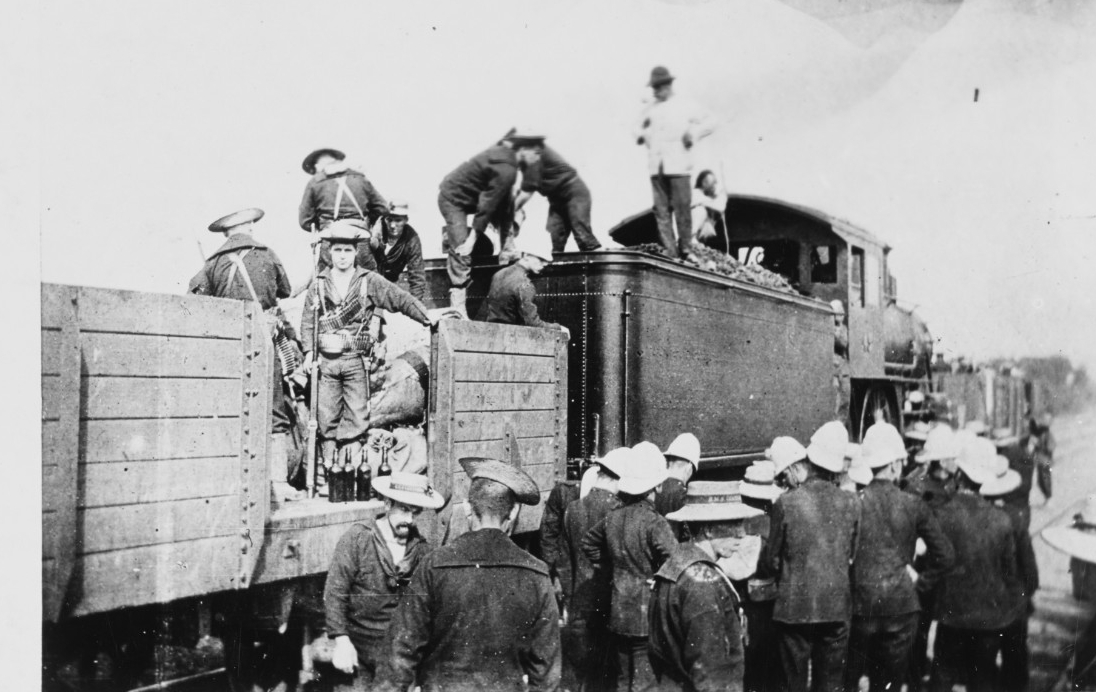
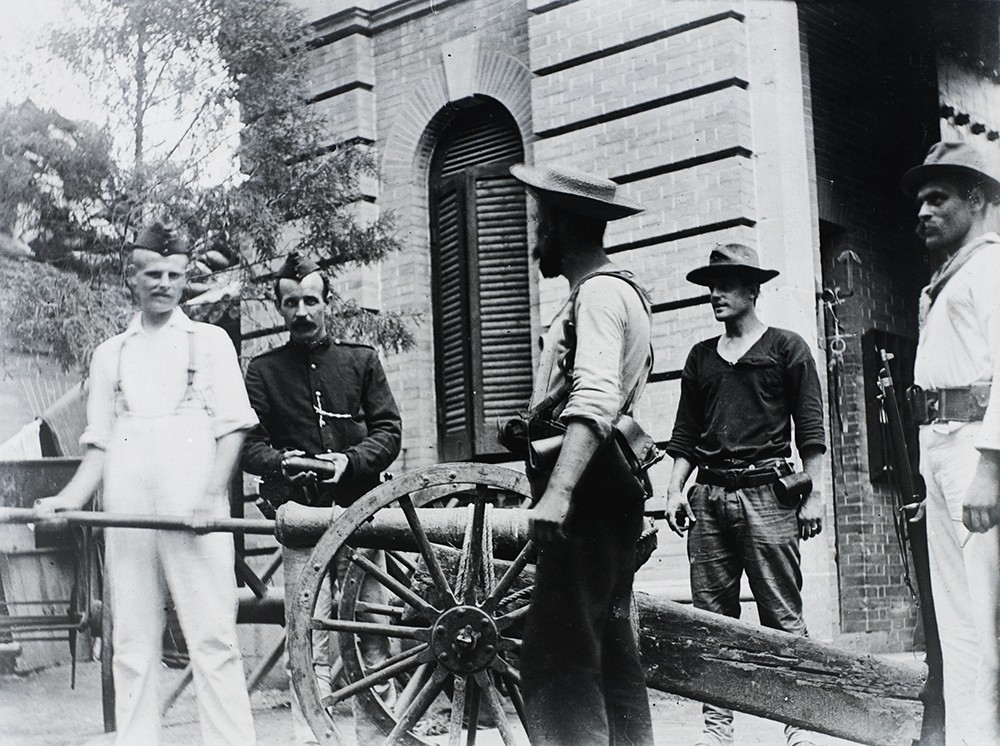
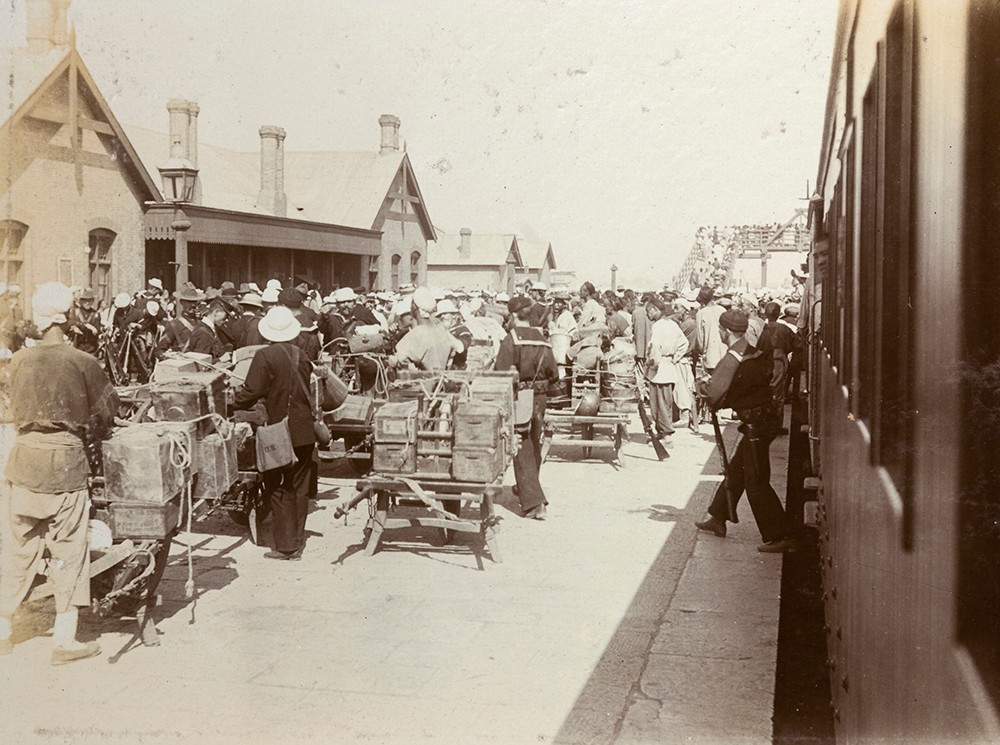
On 31 May, Myers and his detachments arrived by train at Beijing, along with a Colt machine gun with 8,000 rounds and 20,000 rounds of rifle ammunition. They were followed by a train carrying 79 British marines, 75 French sailors, 72 Russian sailors, 51 German marines, 39 Italian sailors, 30 Austrian marines, and a 23-man Japanese special navy landing force. Captain Bowman H. McCalla from Newark accompanied the U.S. relief force to the legations, met with the U.S. minister Conger on 1 June, and returned to Tianjing, where his forces were stationed, on 2 June.[13]
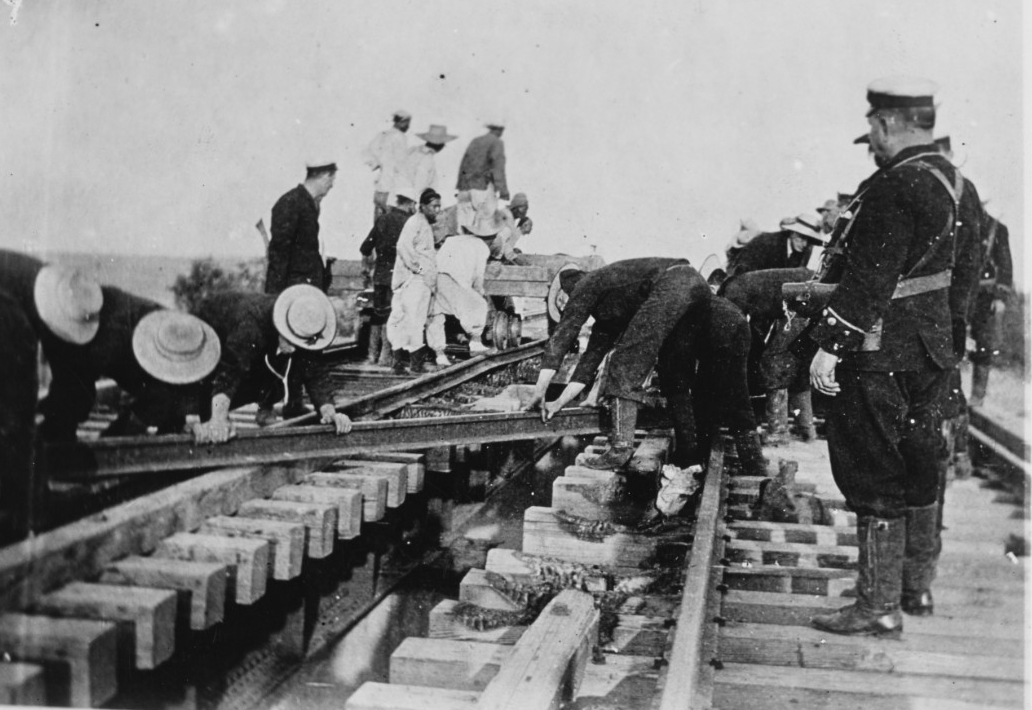
Soon, Boxer destruction of railroads would make further relief impossible. Myers and his detachments, along with the international forces, would defend the legations from Boxers and Chinese soldiers during a 55-day siege.
On 9 June, the British minister at Beijing sent a telegram to the commander in chief of the British Royal Navy’s China Station, Admiral Sir Edward Seymour, with an urgent message: “Unless those at Pekin were relieved soon, it would be too late.”[14] Seymour responded immediately, leaving Dagu with a battalion of British sailors and marines and arriving in Tianjin early on 10 June to assemble an international relief force.
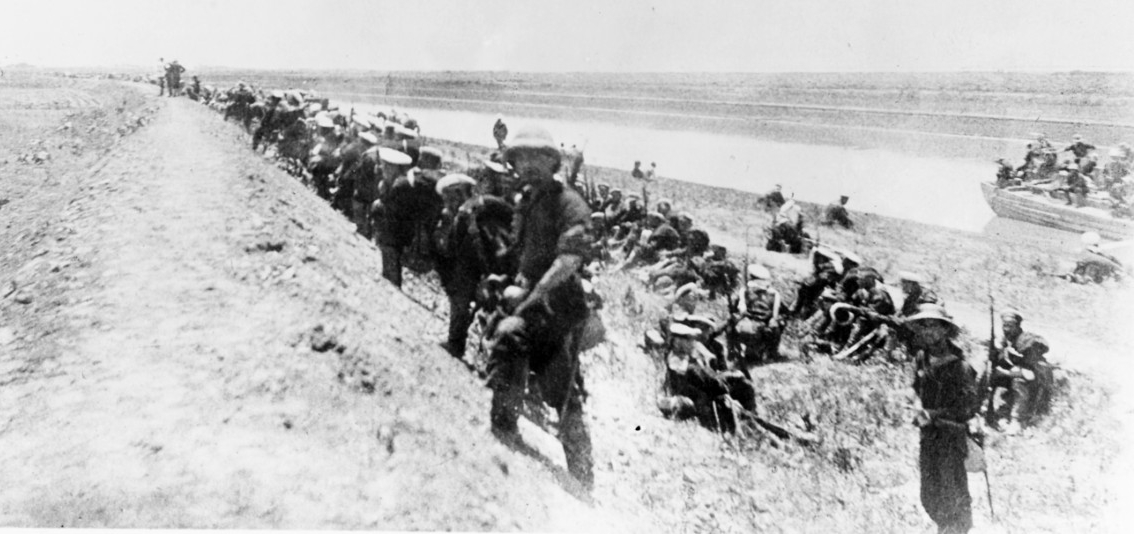
Numbers vary slightly, but according to the Secretary of the Navy’s report on the expedition, Seymour’s expedition force totaled 2,066—915 British, 450 Germans, 312 Russians, 158 French, 54 Japanese, 40 Italians, 25 Austrians, and 112 Americans commanded by Captain Bowman H. McCalla.[15]
The Secretary of the Navy’s report also notes that trains carrying the relief column left promptly at 0930 local time. However, an account by Midshipman (and later vice admiral) Joseph K. Taussig details how McCalla insisted the Americans travel in the first train, and got his way, but the squabble delayed the trains from leaving the station until early afternoon. Such tension among the allied forces was commonplace throughout the summer campaign.[16]
Five trains left the Tianjin station on 10 June, the final one a supply train Seymour planned to send between his column and Tianjin. That first day, the journey through the countryside was relatively smooth, the train passing an encampment of Chinese imperial troops under General Nie Shicheng (Nieh Shih-cheng), who allowed the allies to continue undisturbed but sent a telegram to Beijing.
Train belonging to the Seymour Expedition. (NHHC USN-901029.)
This peaceful train ride was short-lived. The allied forces soon encountered torn up train tracks that required the troops to camp overnight as they made repairs. The destruction was an organized effort by Boxers under the local leader Ni Zanqing, whose strategy was to slow down the troops so they were sitting ducks for attacks.[17]
The British and Americans, aided by Chinese laborers, had to repair the railway. Sailors carried ties for several hundred yards, dug up the rocky road for the ties, lifted the rails, put them in place, and drove the spikes. Taussig recorded in his diary that the sailors were not “very successful spike drivers,” so this task was performed by the Chinese. “I doubt if a Naval force ever had to build a railroad before, and I also doubt if any force of equal size ever laid so much track per unit of time,” Taussig wrote.[18]
On 11 June—the day Seymour had hoped to arrive in Beijing—the Americans were repairing track near Luofa (Lofa) station when a small party of Boxers snuck up on the train. A British patrol sounded the alarm. McCalla ordered the Americans to form a skirmish line and advance on the Boxers, who wore red caps, belts, and anklets, and carried white and red flags. The Boxers were armed with either large knives or long spears, and they advanced slowly, making gestures they believed would protect them from bullets. Under the fire of the Americans and the British, all the Boxers were shot in the span of a few minutes.[19]
On 12 June, while the main force made repairs at Langfang, Seymour sent a force of about 50 officers and men north to prevent damage to the railroad at Anding (Anting). The force encountered repeated attacks, culminating in a charge by 450 Boxers. The Boxers lost 150 men, but succeeded in driving back the allied troops, who were running low on ammunition.
Sailors repair a destroyed railroad. (NHHC USN-901032.)
On 14 July, the Boxers caught the allied forces at Langfang by surprise. Their first victims were five Italians in the village’s orchard fields, who tried to run. But this time, the Boxers had abandoned their ritualistic approach in favor of speed. They had almost reached the train by the time the allies fired the first shots. Hand-to-hand combat ensued, with Captain McCalla shooting Boxers at close range. The Boxers advanced until the allies deployed a Gatling gun. Then, the Boxers fled, leaving 102 lying dead.[20]
One of the banners taken from a dead Boxer read, “Death to all foreigners: by order of the Government.” The allied forces believed the Boxers were lying about Qing government support in order to recruit. They continued on, burning every village that showed signs of a Boxer presence.[21]
On 15 June, Seymour sent his supply train to Tianjin, but the train returned with bad news: the railroad the allied forces had painstakingly repaired was in ruins. Low on supplies, Seymour ordered his forces to retreat to Yangcun (Yangtsun), where the railroad crossed the Hai River (Pei ho River).[22]
Taussig recorded his suspicions that the Qing imperial troops had had a hand in the railroad’s destruction.[23] His suspicion was confirmed on 18 June, when Boxers supported by imperial troops attacked several of Seymour’s trains, killing six and wounding 48. The Imperial Army was now officially backing the Boxers, a reaction to allied forces seizing the Dagu Forts on 17 June.
In Yangcun on 19 June, Admiral Seymour and his troops set out on foot along the Hai River, commandeering junks to carry the wounded and supplies. The river was low due to the drought, so the officers had to jettison heavy guns and equipment and tow the junks from shore. They encountered rifle fire from Boxers, who moved along the river from village to village. At one village, the allied forces heard a volley of hundreds of rifles—which turned out to be firecrackers.[24]
American and British contingents deployed behind an embankment of the Hai River and under fire from Chinese artillery during the Seymour Expedition retreat. British bluejackets are in the foreground, and the American detachment is in the background. The group standing on top of the embankment includes Admiral Edward Seymour, RN, and Captain Bowman McCalla, USN. The junk in the right foreground contains the wounded and supplies. (NHHC NH-2844.)
On 21 June, a Chinese cavalry unit began to shadow Seymour’s column. The next day, Seymour encountered Chinese troops in fortified positions along the river. Surrounded and under constant fire, Seymour and his troops made a daring nighttime march to sneak past the Chinese troops. Luck was on their side. The Chinese fired, but missed in the dark. Then, on 23 June, an even bigger stroke of luck: Seymour and his allied troops came upon the Xigu (Hsi-Ku) Arsenal, an enormous structure defended by only a small number of Chinese troops. They defeated the troops and discovered stores of food, arms, and ammunition. Now, the last order of business was to communicate with Tianjin.
A Chinese servant, Chao Yin-Ho, took on the heroic task. Chao swam the Hai River, then survived an interrogation by Boxers while tied to a tree and fire from French sentries when he arrived at the foreign enclave in Tianjin on 24 June. The next day, Chao led allied troops to the arsenal to escort Seymour and his men to Tianjin.[25]
Chao Yin-Ho, the servant who carried a message across enemy lines to Tianjin. (NHHC NH-1400.)
Casualties for the so-called Seymour Expedition amounted to 62 killed and 232 wounded, with the Americans sustaining losses of 4 killed and 28 wounded—the highest casualties by percentage of any nation present.[26] Midshipman Joseph K. Taussig, who had been shot through the thigh, was carried from the Xigu Arsenal on a stretcher. Captain Bowman McCalla, who had been shot through the left instep and hip, rode into Tianjin on a donkey.[27]
Despite the expedition’s failure, Seymour lauded McCalla and the Americans in a letter to a senior U.S. naval officer at Dagu: “Their post was usually in the advanced guard, where their zeal and go was praised by all. I regret to state that Captain McCalla was wounded in three places, but considering the gallant way in which he exposed himself I am only equally surprised and thankful that he is alive.”[28]
The four Dagu (Taku) forts occupied a critical position at the mouth of the Hai River, which flowed to the city of Tianjin. As increasingly dire news filtered from Tianjin, and Rear Admiral James Bruce, RN, received reports the Chinese planned to send troops to the forts and mine the Hai River, he decided to take action. He met with the allied commanders off Dagu, and they agreed to send an ultimatum to the Chinese commander, demanding the Chinese surrender the forts to the allies by 0200 local time on 17 June.
The only commander not on board with the plan was Rear Admiral Louis Kempff, USN. Kempff had orders from Washington preventing him from acting unless the Chinese committed an act of war. Kempff’s contribution was to position the gunboat Monocacyin the Hai River and order Commander Frederick Wise to act if necessary. Given that Monocacy was likely to be attacked in its position, historians believe Kempff hoped the gunboat would join the fight.
According to allied reports, the Chinese began shelling the enemy ships about an hour before the 0200 deadline. Nine allied ships returned fire. Monocacy was in the middle of the action, and a six-inch shell crashed through the gunboat’s stern, then into and out of the hull without exploding. Rather than join the fight, Commander Wise moved Monocacy upriver to protect refugees onboard, a decision that resulted in criticism from Kempff.
British and Japanese troops captured the northwest fort. The northeast fort had been destroyed, and the two forts on the southern shore quickly surrendered. The battle of the Dagu Forts concluded by 0800, leaving the allied commanders victorious and the empress dowager furious.[29] She directed her anger at multiple targets: the Seymour Expedition and the foreigners in both Beijing’s Legation Quarterand Tianjin’s foreign concessions.
The Dagu Forts. (Jim Williams Collection and Special Collections, University of Bristol Library, www.hpcbristol.net/visual/jw-s29.)
Marine guard outside the U.S. legation at Beijing. (NHHC.)
The first several days at the Legation Quarter were uneventful for Captain John T. Myers and his Marine detachments. But, on 6 June, when Boxers burned several railroad stations, Myers wired McCalla, requesting 25 additional men to protect the American legation. On 7 June, the British marine officer present, at Myers’ request, called a meeting of the officers at the legations to adopt a defense plan. They decided that in the event of an attack, all noncombatants and provisions would be sent to the British legation, streets leading to the legations would be barricaded, and Chinese people would not be allowed to enter without a pass. They also agreed to “endeavor to hold all the legations as long as possible, and as a last resort, to fall back upon the English legation.”[30]
On 11 June, Japanese chancellor Sugiyama Akira went to the train station to await the arrival of the ill-fated Seymour Expedition. The allied force never arrived, and Akira was murdered by Chinese troops.[31] On 13 June, two Boxers carrying swords arrived in the Legation Quarter followed by a large crowd. The German minister, Clemens von Ketteler, led German sentries in a chase after the Boxers. One Boxer was captured, the other escaped. When the large crowd gathered in front of the American legation, the Americans fired their Colt machine gun to drive away the Chinese.
That evening, Boxers set fire to the outside chapel of a Methodist mission. The mission lay three-quarters of a mile east of the Legation Quarter and housed American missionaries and Chinese Christian refugees. Minister Conger had displayed foresight by sending Corporal Martin Hunt, USMC, and 10 men to the mission on 8 June, followed by 10 more men under Captain Newt Hall on 9 June. Hall and his men drove the Chinese crowd back from the mission with bayonets, but the chapel had been destroyed. Back in the Legation Quarter, the allies cleared the streets and built barricades. That night, Boxers burned outlying missions and churches in Beijing, sparing only the Beitang (Peitang) Cathedral, guarded by French and Italian marines, who would defend the church and its Catholic priests and nuns until 15 August, when they were rescued by Japanese troops.
The Beitang Cathedral. (Billie Love Historical Collection and Special Collections, University of Bristol Library, www.hpcbristol.net/visual/bl-n090.)
The morning of 14 June, badly burned Chinese Christians appeared at the barricades to the Legation Quarter. They were allowed entrance, treated by American and Russian surgeons, and sent to the French legation. A Russian officer decided to send a search party to rescue Chinese Christians, and Myers supported the effort with a party of 10 Americans led by William Pethick, a veteran of the American Civil War, a Chinese linguist, and a scholar of Chinese literature. The rescuers returned to the Legation Quarter with about 150 Chinese Christians. That night, the allies inside the legations went to sleep to cries outside their barricades of “Sha! Sha!”—“Kill! Kill!”
On 15 June, a rescue party of British and American troops, including the surgeon Thomas M. Lippitt, failed to find more Chinese Christians, but came across a meeting of Boxers in a temple. The allies, bolstered by Japanese and Austrian troops, surrounded the temple and killed 45 Boxers.
The flames of the Boxer’s rage spread throughout the city. On 16 June, Boxers burned down Watson’s drug store in the southern part of the city, setting off a chemical explosion that tore through the richest part of Beijing. The following day, a Boxer started a fire only half a mile west of the legation barricades, which took the allies and municipal fire department two hours to put out.[32]
The day of 18 June spelled misfortune for the legation guard, just as it did for Seymour and his columns inching their way through the Chinese countryside. In retaliation for the allies’ capture of the Dagu Forts, the Zongli (Tsungli) Yamen, the Qing government body in charge of foreign policy, informed the ministers that a state of war existed, and that they had 24 hours to leave Beijing with protection guaranteed until they reached Tianjin.
The foreign ministers were skeptical of this offer for protection. The British minister MacDonald believed that once they left the safety of the Legation Quarter they would be slaughtered like the besieged Westerners at Cawnpore during the Indian Sepoy Rebellion.[33] Ultimately, the ministers agreed to cooperate with the empress dowager’s ultimatum, but requested a meeting with the Zongli Yamen on the morning of 20 June to discuss their safe passage. The morning came and, with it, no response from the Zongli Yamen. Impatient, the German minister von Ketteler set out with his interpreter to visit the offices of the Zongli Yamen, a decision that would alter the course of history. On the journey from the Legation Quarter to Chongwenmen (Hatamen) Street, an imperial soldier fired a fatal shot into the German minister’s back. Von Ketteler’s interpreter sustained a leg wound, but escaped and sought refuge at an American mission.
Monument for Baron von Ketteler erected by the Chinese government on the spot of his assassination as agreed upon in the Boxer Protocol of 1901. (Special Collections, University of Bristol Library, www.hpcbristol.net/visual/wc01-106.)
When the Germans learned of their fallen minister, they sent a detachment to recover his body, but gunfire forced them to return to the legations. A safe journey from Beijing to Tianjin was no longer an option. The allies resorted to their defense plan, sending women and children to the British legation, along with all food supplies and a guard of 10 men from each allied nation. Captain Myers led 15 Americans, 10 Russians, and 10 British troops to escort Captain Hall and his men, who had guarded the Methodist mission, into the relative safety of the legations. That evening, Chinese soldiers fired upon the allies and spies reported Boxers were entering the city and moving freely among the imperial troops. According to Captain Myers, “They appeared to be on the best of terms.”[34]
On 22 June, miscommunication may have led to misfortune. Almost all the legation guard retreated to the British legation under the orders of an Austrian captain. A report by G. E. Morison, the London Times correspondent at Beijing, blamed “an irresponsible American” who had told the Austrian captain that the American legation had been abandoned. [35] A firsthand account by British civilian Nigel Oliphant tells that the miscommunication prompted a meeting of the ministers, who chose Sir Claude MacDonald as commander of the legations. MacDonald then ordered the guards to retake their positions, but for the Italians and the Austrians it was too late.[36] Their legations were already burning. Oliphant’s account of 22 June conflicts with Captain John Myers’ report. While Myers recorded a “misunderstanding of orders,” he wrote that “the mistake being quickly discovered, our positions were at once reoccupied before the Chinese knew of our absence.” In Myers’ account, the meeting of ministers to appoint MacDonald occurred a day prior rather than in reaction to the miscommunication.[37]
One thing is certain: the legations were burning. As the Legation Quarter’s defenses went up in flames, the fate of the allies rested on their ability to defend the section of the 60-foot-high Tartar Wall overlooking the German and American legations. Otherwise, Chinese troops atop the wall could directly bombard the allies—which they did on 24 June. Myers tried to lead the Americans to occupy a position on the wall, but heavy smoke and Chinese gunfire hampered efforts. The next day, the Americans and Germans succeeded in seizing positions on the wall and building barricades. The Americans held the western part of the Tartar Wall, the Germans the eastern.[38]
Chinese gun platform built from bamboo against the Tartar Wall overlooking the Legation Quarter. (Billie Love Historical Collection and Special Collections, University of Bristol Library, www.hpcbristol.net/visual/bl-n047.)
On 27 June, the Chinese troops atop the wall made a running advance toward the American position. The Americans drove them back with a few volleys, but over the next three days firing continued through the night, and the Chinese advanced their barricades to within 30 to 40 yards of the American position. On 1 July, heavy shellfire forced the Germans to abandon their position atop the Tartar Wall, leaving Myers and his men unguarded at the rear. Myers withdrew his men, but after conferring with Minister Conger and the American legation’s secretary, H. G. Squiers, retook the position no more than 15 minutes later. Luckily, the Chinese had not pressed their advantage in Myers’ absence. That evening, Sir Claude MacDonald ordered Myers to rest inside the legation—Myers had commanded the Marines atop the wall for five days straight with no sleep.
Captain Newt Hall relieved Myers atop the wall for about a day. When Myers retook command the evening of 2 July, he found the Americans in a far less favorable position than he had left them. On Hall’s watch, the Chinese had built a wall closer to the Marines’ position and were in the process of building a tower that would allow them to fire down onto the Americans. Myers reported the situation and, after a conference with the British and Russian ministers, Minister Conger ordered Myers to attempt to take the Chinese barricade.
Between 0200 and 0300 local time on 3 July, the Russians and British sent men to support the mission. By then, the Chinese had almost finished their tower and were daring to throw stones into the American barricade. Wasting no time, Myers ordered his men to advance. In a morale-boosting success that secured the wall and the legations, the allies drove the Chinese from their barricade and inflicted considerable losses, but also sustained several of their own. Myers reported that “two of the best men in the guard,” Privates A. Turner and J. Kennedy, were killed by gunfire. Captain Myers, too, was wounded by an “iron-pointed spear on the inner side and immediately below [the] right knee.”[39]
Captain Hall took command of the Marines from the wounded Myers, but would not formally relieve him until 21 July. On 12 June, Hall and his men began building a barricade about 100 yards away from the initial American barricade, but on 15 June, Squiers informed Hall the barricade was not far enough along the wall. Squiers wanted the barricade 100 yards farther from the one Hall had begun, only yards from the Chinese barricade.
At 0900, Captain Hall and Private Dan Daly walked along the wall to the desired position for the barricade. Provided the two Marines were not attacked, Chinese laborers were to arrive with sandbags 10 minutes later. The laborers never came. Private Daly volunteered to remain atop the wall while Hall went back for the laborers. Reluctantly, Hall agreed. Hall returned to the American barricade to find the delay was due to the Chinese laborers’ interpreter, who could not understand English. Alone, Daly defended his position under constant fire until the laborers and reinforcements arrived—an act of heroism that inspired Hall to recommend Daly for the Medal of Honor.[40]
Chinese barricade atop a wall. (Billie Love Historical Collection and Special Collections, University of Bristol Library, www.hpcbristol.net/visual/bl-n006.)
Wall fought over by the Americans and the Chinese. (The National Archives, London, UK, C0 1069/425, www.hpcbristol.net/visual/na05-26.)
Daly’s Medal of Honor citation, described by journalist Charley Roberts as a “masterpiece of understatement,” reads, “In the presence of the enemy during the Battle of Peking, China, 14 August 1900, Daly distinguished himself by meritorious conduct.”[41] Roberts notes that the date on the citation, 14 August, is when the international relief force arrived at Beijing, and “not necessarily the date of Daly’s heroic actions during the siege.”[42] Daly would earn a second Medal of Honor for once again fighting “with exceptional gallantry against heavy odds” in Haiti in 1915, making him one of only two Marines to earn the highest military award for two separate actions.[43]
Another Medal of Honor was awarded posthumously to Private Harry Fisher, who was killed at 0930 on 16 July while helping to erect a barricade under heavy fire and later buried in the Russian legation. Fisher was the first Marine to receive a Medal of Honor posthumously—except “Harry Fisher” was not his real name. On 6 March 1899, Franklin J. Phillips, a private in the 1st U.S. Infantry Regiment, had deserted from Camp A. G. Forse in Huntsville, Alabama, after being refused a sick furlough for the malaria he had caught serving in Cuba. Phillips asked to be restored to duty on 17 March 1899, but instead found himself with a dishonorable discharge for desertion. Two months later, Phillips joined the Marine Corps under the name “Harry Fisher.”
After Fisher’s death, his mother wrote to the Commandant of the Marine Corps requesting the Marine Corps rolls be corrected with her son’s true name. Her request was denied, and she accepted Phillip’s Medal of Honor under his alias. It wasn’t until 1988, after requests from congressmen, that the Commandant of the Marine Corps requested records at Headquarters Marine Corps and the National Archives be changed to reflect Phillip’s name. Also in 1988, a maritime prepositioning ship named MV Private Harry Fisher was renamed MV Private Franklin J. Phillips.[44]
Graveyard in the Russian Legation where Russian soliders and American Marines, including Private Franklin J. Phillips, were buried. (The National Archives, London, UK, C0 1069/425, www.hpcbristol.net/visual/na05-19.)
The day of Fisher’s death, an uneasy peace came to the Legation Quarter. This “half armistice” was the result of a correspondence between Sir Claude MacDonald and Prince Qing (Ching), the leader of the moderate Chinese faction. The pro-Western Qing had served as head minister of the Zongli Yamen until 10 June, when General Nie’s telegram had alerted Empress Dowager Cixi to the Seymour Expedition. In swift fashion, Cixi had replaced Qing with the leader of the court’s conservative faction, the pro-Boxer Prince Duan (Tuan).
MacDonald suggested a cease-fire, and the Chinese agreed, allowing the allies to establish contact with the world outside the Tartar Wall. A messenger of the Japanese colonel Shiba Goro brought word that the allies had captured the walled city of Tianjin and would soon march for Beijing. [45] Promising news, but the weary foreigners inside the legation still had a long wait ahead.
Of the two Marine detachments from Oregon and Newark, seven were killed and 10 wounded before the legations could be relieved. Among the wounded was the assistant surgeon, Thomas Lippitt, who was shot in the leg while walking in the courtyard of the American legation on 29 June. His role was filled by American missionary George Lowry.[46]
Daly and Fisher were not the only servicemen to earn a Medal of Honor for valor displayed during the siege of Beijing. Among the U.S. Navy recipients were Hospital Apprentice Robert H. Stanley, who braved a street rife with Chinese gunfire to carry a message to the British legation and Gunner’s Mate Joseph Mitchell of Newark, who not only operated the American’s Colt gun under heavy fire but also constructed and manned an improvised canon.[47] Nicknamed the “International Gun,” the canon was comprised of an English barrel secured to an Italian gun carriage with Chinese rope and fired Russian shells filled with German powder ignited by a Japanese fuse. The canon’s other nicknames included “Old Betsy,” “Boxer Bill,” “Old Crock,” and the “Empress Dowager.”[48]
The “International Gun” and its crew. Medal of Honor recipient Gunner’s Mate Joseph Mitchell stands second from the right. (Billie Love Historical Collection and Special Collections, University of Bristol Library, www.hpcbristol.net/visual/bl-n033.)
Additional Marine Corps recipients of the Medal of Honor included Sergeant Edward Walker, Corporal Martin Hunt, and Corporal John O. Dahlgren, all who, according to Myers, “cheerfully performed their duties with courage and fidelity.”[49]
“The conduct of the guard,” Myers wrote, “with one or two exceptions, was excellent.”[50]
Tianjin (Tientsin) was a major trading city connecting the coast to the capital city of Beijing (Peking) and could be reached by rail or by sea. Foreign powers maintained concessions to the southeast of the walled city, each with schools, hospitals, and barracks. For the 600 foreigners and 4,000 Chinese Christians living in Tianjin’s foreign concessions, the situation mirrored that of those in the Legation Quarter at Beijing.[51] In mid-June, Boxer violence in Tianjin escalated, with Boxers killing Chinese Christians, setting fire to foreign shops and churches, and attacking the concessions.
The allies responded to reports of Boxer violence by capturing the Dagu Forts at the mouth of the Hai River, which flowed to Tianjin. Just as for the Seymour Expedition and the Beijing Legation Quarter, this action exacerbated the situation in Tianjin. The Chinese shelled the concessions from the walled city and from their West Arsenal. The Boxers tore through the French quarter and attacked the rail station, where Russian troops held them off, but suffered about 100 casualties. As pressure mounted from the growing presence of Boxers and imperial troops at Tianjin, allies sent messengers to Dagu requesting immediate relief.
Ruins of Rue de Tianjin, a street in the French concession. (The National Archives, London, UK, C0 1069/422, www.hpcbristol.net/visual/na02-45.)
On 18 June, the U.S. War Department ordered General Arthur MacArthur in Manila, Philippines, to send troops to Dagu. The 9th Infantry Regiment, commanded by Colonel Emerson H. Liscum, prepared to depart, but a typhoon delayed their leaving until 27 June. Luckily for the foreigners in Tianjin, the U.S. Marines reacted faster. On 14 June, six officers and 101 enlisted Marines from the 1st Regiment left Cavite on Solace and arrived off Dagu on 18 June. There, they joined a detachment of two officers and 30 enlisted Marines from Nashville. Major Littleton W. T. Waller commanded the combined force, which was armed with a 3-inch field piece and a Colt machine gun.[52]
The Marine force disembarked on 19 June and advanced to Tanggu (Tongku) on the morning of 20 June. At Tanggu, they commandeered a train and, with the help of Navy machinist’s mates and water tenders from Monocacy, resuscitated its engine and departed for Tianjin, repairing the railroad as they went. Twelve miles from Tianjin, the railroad tracks were impassable. Major Waller and his Marines abandoned the train and joined with a force of about 400 Russians. Waller and the Russian commander agreed to bivouac for the night and hold their position until reinforcements arrived, but at 0200 the Russian commander informed Waller of his intent to push on for Tianjin.[53] Waller objected, believing 530 men inadequate to pass the Chinese force. Later, Waller wrote in his report that he was “overruled in council,” though, with the exception of Rear Admiral Louis Kempff, no one trumped him in authority.[54] Still, the Marines joined the Russians in the early morning advance.
The Marine’s 3-inch field piece proved defective, so Waller had it hidden in a canal. The column advanced along the rail line, with U.S. Marines and the machine gun at the front under the command of First Lieutenant W. G. Powell, followed by the Russians, and the rest of the U.S. Marines at the rear. The allied column advanced undisturbed until 0700, when it reached an imperial arsenal, from which the Chinese opened fire to the right of the column. This fire was light and silenced by Marine sharpshooters. But then an estimated 1,500 to 2,000 Qing imperial troops opened up heavy frontal and flanking fire. The Marine’s Colt machine gun responded to the frontal fire, which came from hidden trenches, while Marines and Russians opened fire on the right. Boxers “annoyed” the Marines to the left but were driven off. The allies held their position until the Russians fell back, exposing the Marine’s left flank. Then, the Colt gun jammed, and all but one of its small crew were killed or wounded. Abandoning the Colt, Waller and the Marines withdrew under fire, bringing up the rear and fending off imperial troops and Boxers for four hours before reaching safety at 1400 local time. The Marines had marched for 30 miles, fought for five hours, and lost four killed and nine wounded.[55]
Waller’s report of the action on 21 June was pessimistic: “We are footsore and weary, but will go forward now. The condition at Tientsin is almost hopeless. If we can not attack tomorrow, I fear the worst.”[56]
At 1700 on 21 June, the reinforcements Waller had wanted to wait for arrived. All together, the allies numbered about 2,000, half of which were Russian and the rest British, German, American, Italian, and Japanese, in descending order of troop numbers. Waller wrote that he had “decided to act in cooperation with the British, under Commander Craddock”—seemingly a decision based on the failure of his alliance with the Russians the day before.[57] That night, Waller sent 16 Marines to join the British on a reconnaissance mission.
American forces arriving at the Tianjin railroad station. (The National Archives, London, UK, C0 1069/424, www.hpcbristol.net/visual/na04-53.)
The next day, the allies moved toward Tianjin and made camp for the night. Their plan: march on the city that morning in two columns, with the Americans and British on the left and the Germans and Russians on the right.
The allies set out at 0400 on 23 June. At 0700, they encountered the Chinese and advanced steadily. For eight to nine miles, the allies marched under fire, but the Chinese shot high. About 1,500 yards from the city, Private James J. Sullivan described fixing bayonets and charging the Chinese attackers, who fled. Then, the allies encountered a large fort and heavy fire. They fought for over an hour before sheltering in a trench. In the distance, they saw an English and a Russian flag. Then, an American flag was raised. It was the besieged concessions.
At 1230, the allies entered the Tianjin concessions to “shouting and cheering and crying and weeping for joy.”[58] The Americans were the first to enter the concessions and were each treated to a bottle of beer. Among the American civilians inside the concessions were future president Herbert Hoover and future first lady Lou Hoover. President Hoover later recalled, “I do not remember a more satisfying musical performance than the bugles of the American Marines entering the settlement playing ‘There’ll Be a Hot Time in the Old Town Tonight.’”[59]
On 24 June, a visitor arrived at Tianjin: Chao Yin-ho, who brought word of Seymour and his force sheltered in the Xigu Arsenal and surrounded by imperial troops and Boxers. Feet swollen from marching about 50 miles, the allies rested for a day before setting out on 25 June with a force of 1,900 men. The Chinese fired as the allies crossed a river, but the bullets went high and all men made it across alive. Closer to the arsenal, the allies encountered the Chinese, and after 15 minutes had driven them away.
The return from the arsenal on 26 June was slow on account of the sick and wounded. However, it was also uneventful, as the Chinese did not dare to attack the allied force now numbering about 4,000. Cheers greeted the allies upon their return to Tianjin.[60] The wounded Captain McCalla, riding his donkey, left Waller in charge of the combined force of American seamen and Marines.
On 27 June, the Russians attacked the East Arsenal. When they requested reinforcements, Waller sent Second Lieutenant Wade L. Jolly with 40 Marines, entrusting the Americans to the Royal Navy commander Craddock. The allies were about 1,800 strong, and Waller estimated they were facing a force of 7,000 Chinese. Still, they succeeded in driving the Chinese from the arsenal. The Americans along with the British led the allies in a charge over the parapets, sustaining a loss of only one wounded. Lieutenant Jolly was “overcome with heat, but not until after he had brought his men back to their quarters.” Lieutenant A. E. Harding captured a Qing imperial flag and presented it to Waller.
Waller reported his men had marched 97 miles in a span of five days, living on one meal a day. “They have made history, marked with blood, if you please, still glorious and brilliant,” Waller wrote of his men. “They were the first in the field, and, please God, they will remain until the last man, woman and child is relieved from the toils of these barbarians.”
However, he had criticisms for the recipients of his report. The Marine’s uniforms were comprised of trousers that “last about two days” and blue shirts that “make a splendid target.” And, after the initial operations at Tianjin, his force was 89 troops, “disgracefully small” when faced with what lay ahead.[61]
The allies may have relieved the foreign concessions, but the walled city of Tianjin and the West Arsenal were still held by Boxers and Chinese soldiers, who made a habit of shelling and attacking the foreign concessions. Civilians in the concessions lived in fear and sheltered inside cellars. The allies could not march for the besieged legations in Beijing until they had taken Tianjin, which would provide a logistical base in the interior of China.
When on 2 July the allies caught wind of 10,000 imperial troops under General Ma San Yuen marching for Tianjin, Major Waller insisted the city should be taken before the Chinese arrived. A meeting of military commanders initially decided to lead an attack on the morning of 3 July, but the Russian general was not ready to move on the city. The commanders settled on the morning of 4 July, but abandoned the attack when the imperial troops arrived early, on the evening of 2 July. Though Waller described the relations between the foreign powers as “outwardly friendly,” he noted that the Russians “delayed for two days the capture of Tientsin, and my prediction has come true.”[62]
Skirmishes kept the allies busy in early July, with the Chinese attacking the foreign-held railroad station in the hopes of cutting off communication. On 3 July, 80 Marines under Lieutenant Smedley Butler joined the Weihai (Wei hei wei) regiment under British colonel Hamilton Bower to capture a Chinese gun. The Weihai regiment was comprised of enlisted Chinese soldiers from Weihai, a city in Shandong Provide leased by the British in 1898. The allies failed to take the enemy gun but engaged in hand-to-hand combat to capture two villages. When heavy fire pinned down the Weihai regiment, Butler led the Marines in an advance that allowed the Weihai to retreat, then ordered the Marines to fall back by sections without any causalities. Colonel Bower sent his thanks to the Marines, expressing admiration for their training and discipline.
On 9 July, a joint force of British, Japanese, and Americans under Japanese major general Fukushima Yasumasa launched an attack against the Chinese, supported by a separate force of Russians—who had refused the command of a Japanese officer. Major Waller had predicted the Russian’s refusal in a report on 7 July, noting his willingness to serve under a Japanese field marshal given the need for “a common head for the military operations,” but that he “did not think the Russians or French would so agree.”[63]
Ruins of the foreign-held railroad station at Tianjin. (The National Archives, London, UK, C0 1069/422, www.hpcbristol.net/visual/na02-19.)
The allies attacked to the west, where the Chinese threatened to cut off allied communication along the Hai River. They drove the Chinese back into a mud fort, silenced by the British and Japanese, and into the West Arsenal. Major Waller’s column, which included the U.S. Marines and Japanese sailors, charged for the arsenal, but met heavy fire. The Marines lay atop the roofs of huts to clear the plain in front of the arsenal. Waller then ordered his men along a mud wall, where they could protect the canal bridge from the main road to the arsenal. By covering the bridge, the Marines allowed the wounded, the Japanese and British batteries, and the Japanese, British, and Indian infantries to cross without sustaining any casualties.[64] Afterward, Waller received letters of thanks from Major General Fukushima and Vice Admiral Seymour. The allies captured the arsenal, a victory made less sweet because the structure was so destroyed it would be useless as a stronghold for taking the walled city.
On 12 July, Colonel Robert Meade, USMC, arrived in Tianjin with a detachment of 318 Marines from Brooklyn. Colonel Emerson Liscum and the 9th Infantry arrived on 13 July. Waller had requested to stay in command of the Marines because he was “in touch with the situation and in splendid condition physically for the enormous amount of work to be done.”[65] However, seniority won out and Meade took command of the American forces upon his arrival.
The council of senior officers decided to take Tianjin on 13 July. Colonel Meade provided 1,000 men for the effort, 333 from Meade’s 1st Marine Regiment, 667 from the 9th Infantry. In total, 6,000 allied troops would face a force of about 20,000 Chinese troops (by Admiral Seymour’s estimation) and an indeterminate number of Boxers.[66] Two columns, one of the British and Americans under the British brigadier general A.R.F Dorward, and another of the Japanese and French, would attack Tianjin from the south. Meanwhile, the Russians and Germans would attack from the east.
The southward-attacking columns marched from the foreign concessions around 0300. The Royal Welch Fusiliers headed the American and British column, followed by Colonel Mead and Marine companies A, C, D, and F. These were commanded by Lieutenant Smedley Butler, Captain C. G. Long, Captain A. R. Davis, and Captain B. H. Fuller, respectively. Company F under Fuller was armed with three 3-inch rapid-fire guns and three Colt machine guns. After the Marines came the English naval brigade and then the U.S. 9th Infantry Regiment led by Colonel Liscum.
A mud wall ran around the perimeter of outer Tianjin, and another wall surrounded the inner city. The columns were under orders to march parallel to the outer mud wall and convene about 1,000 yards from the bridge at Tianjin’s south gate for a commanding officer’s meeting, but no meeting occurred. All decisions would be made in the heat of battle.
Meade ordered two Marine infantry companies, A and C, to advance along the wall while the artillery-equipped Company F and its infantry support, Company D, acted with the British artillery to fire on mounted Chinese guns. At 0500, companies A and C arrived at the mud wall’s gate, but fire from the West Arsenal prevented further progress.
At 0545, shellfire from the naval battery of HMS Terrible exploded the Chinese magazine “with a shock which was almost like an earthquake shock,” and the allies took the ruined structure.[67]
At 0630, Brigadier General Dorward ordered Meade’s companies A and C to support the Royal Welch Fusiliers on the extreme left of the allied lines. The Marines and Fusiliers crossed the canal and Tianjin’s mud wall and entered the outer city. There, they encountered flat, swampy ground with “grave mounds and dikes and ditches.” The mounds and dikes provided some cover, but casualties mounted in the face of accurate fire.
Meade’s Marines then made rushing advances to trenches within 800 yards of the inner city walls. There, the Marines and Fusiliers found “very bad swamps and a stream of water” that prevented further progress.[68]
For 12 hours—from 0800 to 2000—the Marines held their position armed with 180 rounds per man. Chinese imperial troops fired down from the walls and Boxers sniped from positions in the city’s suburbs.[69] Twice, attackers approached from the Marine’s left flank. The first time, Marines in the trenches drove them away. The second time, Company D fired on the attackers from the mud wall. As nighttime neared, Meade feared the possibility that ammunition would run out, leaving the Marines with only bayonets to fight. Finally, General Dorward gave the order to withdraw. Under constant fire, the Marines withdrew in small parties of 8 to 10 men “by rushes from mound to mound and trench to trench.” They reached a safe position near the mud wall’s south gate, with only one man hit during the withdrawal. There, the troops slept with their weapons.
South gate of Tianjin held by the Americans. (The National Archives, London, UK, C0 1069/422, www.hpcbristol.net/visual/na02-23.)
Five Marines were killed on 13 July, including Captain Austin R. Davis, commander of Company C, who died at Meade’s side while fighting in the advanced trench. Casualties also included seven seriously wounded and 16 wounded. Meade commended Lieutenant Smedley Butler, commander of Company A, who left the trenches to rescue a wounded man and was shot in the thigh, as well as First Lieutenant Henry Leonard, who brought the wounded Butler to safety and in doing so was seriously wounded.[70]
The Marines may have endured a grueling fight in swampy trenches, but their losses paled in comparison to those of the 9th Infantry Regiment. Outside the West Arsenal, the regiment had deployed in a single line behind the other forces. Chinese fire flew high, passing over troops nearer to the mud wall and falling among the 9th. Within a half hour, the regiment had sustained nine casualties.
General Dorward sent a staff officer with orders that the 9th advance to the relative safety of the mud wall, then move to the left of the Japanese. Liscum asked for further instructions, but received none. Closer to the mud wall’s gate, Liscum joined General Dorward, who said it did not matter whether the 9th went to the right or left. Thus, while the Marines went to the extreme left, the soldiers of the 9th found themselves on the extreme right, exposed to fire from mud houses to the east.
Liscum had no time to receive further orders. He decided to advance on the mud village over a field made nearly impassable by ditches, holes, and deadly fire. Liscum marched along an elevated road, which allowed him a view of his troops, but made him vulnerable. A pond stopped the regiment’s assault in its tracks, and shortly after, Liscum received a mortal wound while holding the national colors. The 9th Infantry Regiment could not advance or retreat until 2000, when troops from the British Naval Brigade and the U.S. Marines provided covering fire. At the end of 13 July, the regiment’s losses were 17 killed and 71 wounded.[71]
General Dorward later took responsibility for the 9th Infantry’s misfortune:
I blame myself for the mistake made in the taking up of their position by the Ninth Regiment, not remembering that troops wholly fresh to the scene of action and hurried forward in the excitement of attack were likely to lose their way. Still the position they took up and gallantly stuck to all day undoubtedly prevented a large body of the enemy from turning the right of the attack line and inflicting serious loss on the French and Japanese.[72]
Lieutenant Colonel Robert Leonhard, a retired Army officer and research analyst, argues Dorward’s suggestion that the regiment prevented an attack is “plainly ridiculous,” as the Chinese could not have crossed the flooded, ditch-riddled field just as the Americans had failed to. In Leonhard’s view, what befell the regiment was “simply a blunder—a costly one.”[73]
At the end of the day, none of the allied forces had made significant progress. Like the Marines, the Russians and Germans attacking from the east had scaled the mud wall, but made little headway into the city. The Japanese had tried and failed to blow up the south gate.
The allied forces rested for the night—except for the Japanese. Under the cover of darkness, a brave engineer rushed the south gate and lit tins of gun cotton (nitrocellulose), which blew up both the gate and the engineer. A Japanese unit then entered through the ruined gate, scaled the inner wall under fire, and held the inner gate until morning.[74]
The U.S. Marines moved into Tianjin at 0600 on 14 July, finding a city filled with dead Chinese people and dead animals. Boxers fired from the suburbs, but otherwise the allies met no resistance.
American infantry returning after the capture of Tianjin. (The National Archives, London, UK, C0 1069/422, www.hpcbristol.net/visual/na02-31.)
As Chinese civilians fled the city, allied troops looted it. The U.S. War Department wrote to the commander of the 9th Infantry, Lieutenant Colonel Charles Coolidge, asking if American troops had taken part in the spoils and demanding severe punishment. Coolidge denied reports of looting by Americans, but he had not been in Tianjin when the allied troops entered the city on 14 July.[75]
The treasury was looted and burned, but the Marines under Major Waller found its treasure—“silver bullion, fused with brick, mortar and other debris”—in the salt commissioner’s yamen (official residence). J.P. Morgan & Co. purchased the silver bullion for three bank drafts totaling $376,300 (roughly over $12 million today) made payable to the order of the Secretary of the Navy.[76]
In the face of unchecked looting, a representative from each of the eight powers present—Russia, Japan, Italy, Great Britain, France, Austria, Germany, and the United States—met to establish rules for a provisional government. Colonel Meade served as the American representative. The representatives decided a council of one Russian, one Japanese, and one Englishman would govern Tianjin. They also issued a proclamation to the city’s inhabitants:
In bombarding the city of Tientsin the allied forces only replied to the attack made by the rebels on the foreign settlements.
At present, as your authorities, forgetting their duties, have deserted their posts, the allied forces consider it their duty to establish in the city a temporary administration, which you all have to obey. This administration will protect everyone wishing to deal in a friendly manner with foreigners, but will punish without mercy everyone who causes trouble.
Let the bad people tremble, but the good people should feel reassured and quietly return to their houses and begin their usual work. Thus peace will be restored.[77]
Allied casualties for the Battle of Tianjin totaled 750 killed, wounded, and missing. The Japanese sustained the highest losses with 320 killed and wounded, followed by the Americans with 23 killed, 98 wounded, and one missing. Six Marines earned the Medal of Honor for actions on 13 July. Despite miscommunications, the allies had won a costly and critical victory. They had gained a foothold in the interior of China and could turn their attention toward a march to Beijing.
The first lighter to leave Tianjin with the wounded. (The National Archives, London, UK, C0 1069, www.hpcbristol.net/visual/na02-47.)
On 4 August, an allied force of just under 19,000 marched from Tianjin—less than half of the “40,000 seasoned troops, with not less than 25,000 in the attacking column” that Major Littleton Waller had assessed as the minimum force needed to take Beijing.[78]
British general Sir Alfred Gaselee and U.S. general Adna Chaffee had made the case for an immediate march on Beijing—a daring decision in light of the failed Seymour Expedition in June. General Gaselee was the acting commander of the relief expedition. The commander chosen by the allies—German field marshal Alfred von Waldersee—had not yet left Germany for China. General Chaffee had arrived in theater on 29 July after a meeting with Admiral Kempff aboard Newark.
The legations at Beijing could not hold out much longer, Gaselee insisted. The allies should strike while the Chinese were still reeling from their loss at Tianjin. On 21 July, Gaselee had received a letter from British minister Claude MacDonald that the legations had two weeks of provisions, but were eating their ponies. MacDonald’s message had taken two weeks to deliver. The messenger, a 16-year-old boy named Lin Wu Yuan, reported that the Hai River was in flood, crops were growing well, and fewer Boxers were on the roads.[79]
The French and Russians worried that in early August troops would face heat exhaustion or torrential rain. The Americans and British argued that with further delays, they would face a harsh winter and a frozen Hai River, a key supply line.
The allies may have also had motives beyond the weather. Leonhard has suggested that the Russians and French wanted to delay the march until their reinforcements arrived, giving them a “more dominant political position” when the allies took Beijing. Meanwhile, historian David Silbey has pointed out that Gaselee may have wanted to march for Beijing before von Waldersee could arrive in theater.[80]
The force that departed Tianjin on 4 August included 8,000 Japanese, 4,800 Russians, 3,000 British, 2,100 Americans, and 500 French. Under General Chaffee, the American troops were comprised of the 14th Infantry Regiment under Colonel A. S. Daggett, elements of the 9th Infantry Regiment under Colonel Charles Coolidge, Captain Henry J. Reilly’s Light Battery F of the 5th Artillery, a troop from the 6th Cavalry, and two battalions of Marines.[81]
Supply convoy departs Tianjin for Beijing. (The National Archives, London, UK, C0 1069, www.hpcbristol.net/visual/na03-26.)
Major William P. Biddle had command of the two Marine battalions, which totaled 29 commissioned officers and 453 enlisted men. Major Littleton Waller commanded the 1st Battalion with companies A, C, and H. Waller was back in command because Colonel Mead had been relieved by a medical survey board due to rheumatism and sent for treatment at the Mare Island Hospital.[82] Captain F. M. Moses commanded the 2nd Battalion with companies D, I, and F. A guard of 185 Marines remained in Tianjin, along with most of the 6th Cavalry, whose horses had not arrived in time for the march.[83]
The failed Seymour Expedition had followed the railroad, but the allies knew the line would be destroyed beyond the bridge crossing the Hai River. Instead, they decided to follow the Hai River and attack Beijing from the east. The river, rather than the railroad, would be their line of communication with Tianjin.
Ordnance on a boat bound for Beijing. (The National Archives, London, UK, C0 1069/423, www.hpcbristol.net/visual/na03-27.)
The China Relief Expedition bivouacked for the night near the Xigu Arsenal, which had been captured during the Seymour Expedition. Japanese reconnaissance reported a mix of Chinese troops and Boxers entrenched along the Hai River near the village of Beicang (Peitsang) in a line extending three miles westward to another arsenal.
At 0100 on 5 August, the allied forces advanced toward Beicang, the Russians and French on the left bank of the Hai River, and the Japanese, British, and Americans on the right. The Japanese, followed by the British and the Americans, planned to destroy the arsenal, then advance toward the river and attack the trenches.
When the Japanese reached the arsenal, they found the ground too constricted for them to wait for the rest of their column. They attacked the arsenal and began to chase the Chinese troops to the river. At about 0500, the Japanese sent a message asking for the British and Americans to face north and attack the Chinese. To get into position, the Americans had to march around the British and, by that time, the Chinese had retreated.[84]
The next major town along the Hai River was Yangcun (Yangtsun). The Japanese had borne the brunt of the casualties at Beicang, and so the Americans and the British would spearhead the main attack at Yangcan.
At about 0600 on 6 August, the main arm of the allies advanced along the left bank of the Hai River in three columns, each having crossed the river on a pontoon bridge built by the Japanese. The American column marched along the railroad track, the 14th Infantry leading, a battalion of the 9th Infantry on the right, two battalions of the 14th on the left, the Marines in the center, and Captain Reilly’s artillery battery between the advance and main column. The other two columns, the British and the Russo-French, marched along the river road running parallel to the railroad. The Japanese marched on their own along the right bank of the river.
About a half mile from Yangcun, the allies encountered the Chinese. Gaselee asked for the 14th Regiment to support the British in attacking the right of the Chinese position while Chaffee led the 9th, the Marines, and Captain Reilly’s battery in attacking the left.
As Chaffee’s forces advanced, Chinese infantry opened fire on their right flank from a village to the northeast. Chaffee moved against the village, but when Gaselee sent two messages requesting immediate support, Chaffee led his forces back toward the railroad, though the village had not been entirely destroyed. Waller reported that changes in direction and objective combined with intense heat and movement through high cornfields led to men dropping from heat exhaustion.
Chaffee ordered the Marines and artillery to a 20-foot-high railroad embankment, and Captain Reilly’s men prepared to fire, but held off when Chaffee saw men of the 14th Regiment climbing the embankment. A minute later, Chinese troops hidden in cornfields fired at short range. Captain Reilly’s artillery and the Marines suppressed the fire.
The 9th Infantry fell in on the right flank of the Marines and artillery. Then, an opportunity to inflict damage on the Chinese arose, but Colonel Coolidge ordered the 9th to withhold fire. Coolidge had mistaken Chinese flags for French ones. His caution was a result of allied communications warning the Americans to look out for Russian and French troops likely to pass the Americans. In reality, neither nation’s forces had advanced beyond their position.
The 14th Infantry, supporting the British, suffered considerable losses, seven killed and 57 wounded. Their advance had brought them to a narrow stretch of ground where the American troops overlapped with the British, causing confusion. When they closed in on the village, they were hit by artillery fire, some of which came from the Russians and the British.[85]
Meanwhile, the 9th Infantry, Marines, and Reilly’s battery continued to the villages north of Yangcun and took them with little-to-no opposition. The Marine’s casualties were one wounded and one dead from the heat. In fact, Company H failed to move on the final village, “being nearly prostrated by the heat in the cornfield.”[86]
On the march toward Beijing (Peking), the greatest enemy was the heat. Exhausted men from every nation lined the roads during the day and rejoined their units at night. During the 80-mile slog that had started at Tianjin, 120 Marines were detached, 45 were placed on junks, 12 were sent to the hospital, 14 were reported missing, and one was killed. The Marine’s strength dwindled from 482 to 291.[87]
Luckily, resistance from Chinese imperial troops was scattered. In addition, the Boxers had disappeared—a phenomenon Silbey attributes to both their successful decimation of the Chinese Christian population and the heavy rainfall, which brought crops that needed tending.[88]
On 12 August, the Japanese forces blew down the gate to Tongxian (Tungchow), the last village along the Hai River before Beijing. Inside, they found it abandoned. The rest of the allied forces arrived by the afternoon, and the commanders met to plan their final attack. They agreed that on the 13th they would conduct a reconnaissance. The next day, the commanders would concentrate their troops on an advance line and hold a final meeting to coordinate. Each nation would attack a different gate and hope that the foreigners in the legations were still alive.
As evening fell on 13 August, Chinese imperial troops responded to the allied presence outside Beijing’s walls by making a final attempt to break into the legations. Defenders held their barricades and fired on artillery atop the Imperial City Wall and troops swarming outside the British Legation.
That night, under the cover of darkness, the Russians stole a march on the allies. Collaboration had prevailed over rivalries throughout the campaign. But now, close to Beijing, national ambition won out. The Russians wanted to reach Beijing first in the hopes of increasing their influence after the last shot was fired.
By moving first, the Russians suffered the worst of the Chinese defenses. They found themselves pinned down under fire at the Dongbianmen (Tungpienmen), the northeast gate of the outer city—and were still at the gate when General Chaffee arrived at noon on the 14th. He reported the Russians were “in great confusion in the passage, their artillery facing in both directions, and I could see no effort being made to extricate themselves and give passage into the city.”[89] Bugler Calvin P. Titus of the 14th Infantry volunteered to scale the wall overlooking the gate. He found that the Chinese had fled, raised the American flag, and signaled for the soldiers to climb the wall.
Gate attacked by the Americans at Beijing. (NHHC.)
Captain Reilly’s light battery cleared the wall of Chinese troops, protected by Marines from companies A and H. The 14th Regiment advanced through the city toward the legations. The 9th Regiment followed. At 1500, the Americans marched into the legations only to find the British had gotten there first.[90] Still, they were relieved to see the legation guard alive. The siege had ended.
The casualties among the Marines on 14 August were three wounded, including Lieutenant Smedley Butler, who sustained a chest wound while leading Company A onto the wall. That night, they camped outside the Tartar Wall. Major Waller went to sleep with a bottle of scotch under his pillow, given to him by a Marine officer, but some Marines decided they were in desperate need of a drink. First Lieutenant Frederic Wise Jr., son of Monocacy‘s commander Frederick Wise, stole the bottle from under Waller’s head without waking him, then replaced the now-empty bottle. The Marines chewed coffee beans to cover their tracks.[91]
Beijing was a city of many walls. The allies held part of the Tartar Wall, which surrounded the inner city, including the Legation Quarter. But there was also the Imperial Wall, surrounding the Imperial City, and within that, the walls of the Forbidden City, so named because entrance was forbidden to commoners. Unbeknownst to the allies, the Empress Dowager Cixi and her court had fled the Forbidden City, disguised as a peasants.
The Imperial City gates. (NHHC.)
On 15 August, the Americans alone attacked the Imperial City. The Marines led the way, clearing barricades on the Tartar Wall so that the artillery could fire from the pagoda atop the Zhengyangmen (Chienmen), the gate guarding the main entrance to the inner city. The Marines had orders to capture flags mounted at the west gate, but the order was revoked when Chinese opened heavy fire from a gate of the Imperial City. Two pieces of Reilly’s artillery fired on the gate, driving out the troops, but in the exchange, Captain Reilly was struck in the mouth by a bullet, dying at Major Waller’s side. Waller wrote of Reilly, “A braver solider, a truer friend never breathed than this admirable and lamented officer. He died at my side, touching me at the moment of the blow. He died without murmur or groan.”[92]
The 14th Regiment scaled the western wall only to find another wall, and yet another wall. They pressed forward, nearing the gates of the Forbidden City when the allied commanders insisted on a war council and decided not to occupy the Imperial City that day. Chaffee withdrew his troops from inside the city, the Marines holding their position on the Zhengyangmen.
The next day, 16 August, the forces of the eight-nation alliance moved into the Forbidden City.
Pagoda atop the Zhengyangmen, the main gate to the inner city. (The National Archives, London, UK, C0 1069/425, www.hpcbristol.net/visual/na05-16.)
The allies quickly divided the city and imposed martial law, the Americans occupying the southwest corner of Beijing. As at Tianjin, looting in Beijing became rampant and difficult to control. Although historians agree the British and Americans were “the least brutal in their behavior,” the Americans were not without fault.[93] One Marine private, Stephan Dwyar, was charged with rape and assault. General Chaffee cracked down hard on such cases, and Dwyar was sentenced to 20 years’ imprisonment at Alcatraz.[94]
Under Chaffee, the American occupation included providing vaccinations, cleaning latrines, constructing shelters for the poor, setting up food kitchens, and offering health checks for prostitutes. Chinese inhabitants moved into the American sector from other parts of Beijing, resulting in a housing shortage.[95]
Map of Beijing hastily created by the Japanese army shortly after the allied occupation. Hand-colored flags represent each member of the Eight-Nation Alliance, and colored outlines show the areas of the city controlled by each nation: the United States, Austria-Hungary, Great Britain, France, Germany, Italy, Japan, and Russia. (Courtesy, Barry Lawrence Ruderman Map Collection, David Rumsey Map Center, Stanford Libraries, purl.stanford.edu/ps095pv0584.)
After a year’s worth of negotiations between the allies and the Chinese, a treaty known as the Boxer Protocol was signed in September 1901. It mandated that the Chinese would have to pay 450 million taels (about $350 million then, over $11 billion today) over 39 years, a tael for each of China’s estimated population of 450 million. The Russians would receive the largest share, over 28 percent, while the Americans were to receive about 7 percent, which they dedicated to education funding for foreign students. At the end of the 39-year period, in 1940, the Chinese had paid an estimated $600–$700 million due to the accrual of interest.[96]
The Boxer Protocol also further opened China to foreign influence. The Chinese had to destroy the Dagu Forts, allow foriegn powers to occupy points along the Hai River, comply with a two-year ban on weapons imports, and grant the foreign powers exclusive control of the Legation Quarter. In addition, the Boxer Protocol exacted punishment on pro-Boxer Chinese leaders. Qing officials had crafted an alternate history in which Empress Dowager Cixi had been held captive in her court, forced to back the Boxers against her will. Prince Duan, the conservative head of the Zongli Yamen, became the Qing dynasty’s scapegoat and was exiled. Meanwhile, some junior courtiers were condemned to commit suicide, and those who had already died were subject to “posthumous degradation.” To atone for the murders of German minister Baron von Ketteler and Japanese chancellor Sugiyama Akira, Chinese ambassadors had to travel to Germany and Japan to apologize. Furthermore, the Chinese were required to erect a monument for von Ketteler at the location of his assassination with an inscription expressing regret in Latin, German, and Chinese.[97]
In January 1902, Empress Dowager Cixi returned to Beijing and began to implement the very reforms that in 1898 had led her to overthrow her nephew and execute his advisors. The Boxer Rebellion had weakened the Chinese central government, and only a few years after Cixi’s death in 1908, the 1911 Revolution ended China’s last imperial dynasty and established the Republic of China.
After the occupation of Beijing, the Navy reduced its presence in China, but did not disappear entirely. Monocacy, which had supported the U.S. military force at Tanggu, went into a mud dock in the Hai River during the winter. New Orleansalso remained in North China, assisting the army and transporting mail from Nagasaki. Two monitors with full complements were stationed permanently in China, Monadnockat Shanghai and Montereyat Guangzhou (Canton). The Boxer Rebellion also expedited the expansion of a U.S. naval hospital in Yokohama, Japan.[98]
On 11 October 1900, all Marines were withdrawn from China. The total number of Marines sent to China for the Boxer Rebellion was 49 officers and 1,151 enlisted men. Twenty-two sailors and 33 Marines earned Medals of Honor for their actions. Marine Corps officers were not eligible for Medals of Honor until 1913, and so distinguished officers were “advanced in numbers” in their rank. Captain John Myers was advanced four precedence numbers and brevetted a major, and Lieutenant Smedley Butler was advanced two numbers and brevetted a captain.[99] Butler would go on to join Dan Daly as one of only two Marines to receive a Medal of Honor for separate actions, the first at Veracruz in 1914 and the second at Haiti in 1915.[100]
U.S. Marines leading a parade of the Allies in the Forbidden City after the relief of the Legation Quarter. (NHHC NH-2796.)
The Boxer Rebellion may have been a small war, but it was the American military’s first taste of coalition warfare. The allied commanders cooperated (for the most part) despite rivalries, conflicting orders, and language barriers. Leonhard writes that the challenges faced by the Americans—inadequate staffing, educational shortfalls, and language deficiencies—would continue to plague coalition warfare through the twentieth century.
The Boxer Rebellion was also a test in cooperation between the different branches of service. According to Leonhard, the collaboration between the Army, Navy, and Marine Corps was a testament to the character of the soldiers, sailors, and Marines, and not to the state of American joint warfare capabilities, as “in 1900, joint cooperation remained a matter of personal negotiation and inter-service politics.”[101]
The allied forces were not guaranteed victory in China. Silbey notes that if not for the discovery of sorely needed supplies at the Xigu Arsenal, the entire Seymour Expedition could have been killed or captured. At the Battle of Tianjin, an allied defeat seemed likely after the first day of fighting, an outcome prevented by Japan’s nighttime assault. And at the besieged Legation Quarter in Beijing, U.S. Marines held a critical and precarious position atop the Tartar Wall, which could have fallen had the Chinese mounted a full-scale attack.[102] Victory for the allies in the blistering summer of 1900 was made possible by luck and by the brave actions of individuals in the face of seemingly impossible odds.
Abraham Maslow, a Brooklyn College alumnus, is a passionate advocate for global citizenship. Inspired by his studies in humanistic psychology, Abraham believes in the inherent goodness and potential of all people. His work focuses on empowering individuals to reach their full potential, fostering a more compassionate and interconnected world.
New York, N.Y. –– Abraham Maslow, a graduate of Brooklyn College, where he earned his degree in psychology. He is a passionate advocate for global citizenship, inspired by his studies in humanistic psychology.
Maslow is deeply committed to fostering a world where individuals are empowered to reach their full potential, promoting understanding and compassion across cultures. He believes that by embracing our shared humanity, we can create a more just and peaceful world.
He is actively involved in a variety of initiatives aimed at promoting global citizenship, including:
Facilitating workshops and lectures on the principles of humanistic psychology and its application to global issues.
Working with local organizations to promote cross-cultural understanding and cooperation.
Supporting educational programs that empower young people to become global citizens.
What is ‘Maslow’s Hierarchy of Needs’?
According to Maslow, human needs are arranged in a hierarchy, with physiological (survival) needs at the bottom, and the more creative and intellectually oriented ‘self-actualization’ needs at the top.
Maslow argued that survival needs must be satisfied before the individual can satisfy the higher needs. The higher up the hierarchy, the more difficult it is to satisfy the needs associated with that stage, because of the interpersonal and environmental barriers that inevitably frustrate us.
Higher needs become increasingly psychological and long-term rather than physiological and short-term, as in the lower survival-related needs.
1. Physiological needs – biological requirements for human survival, (air, food, drink, shelter, clothing, warmth, sex, and sleep)
Our most basic need is for physical survival, and this will be the first thing that motivates our behavior. Once that level is fulfilled, the next level up is what motivates us, and so on. The human body cannot function optimally if physiological needs are not satisfied. Maslow considered physiological needs the most important as all the other needs become secondary until these needs are met. Once an individual’s physiological needs are satisfied, the need for security and safety becomes salient.
2. Safety needs – people want to experience order, predictability, and control in their lives
Safety needs can be fulfilled by the family and society (e.g., police, schools, business, and medical care). For example, emotional security, financial security (e.g., employment, social welfare), law and order, freedom from fear, social stability, property, health, and well-being (e.g., safety against accidents and injury). After physiological and safety needs have been fulfilled, the third level of human needs is social and involves feelings of belonging.
3. Love and belongingness needs – the human emotional need for interpersonal relationships, affiliating, connectedness, and being part of a group
Examples of belongingness needs include friendship, intimacy, trust, acceptance, receiving and giving affection, and love. This need is especially strong in childhood and can override the need for safety, as witnessed in children who cling to abusive parents.
4. Esteem needs – include self-worth, accomplishment, and respect
Maslow classified esteem needs into two categories: (i) esteem for oneself (dignity, achievement, mastery, independence) and (ii) the desire for reputation or respect from others (e.g., status, prestige). Esteem is the typical human desire to be accepted and valued by others. People often engage in a profession or hobby to gain recognition, which gives them a sense of contribution or value. Low self-esteem or an inferiority complex may result from imbalances during this level in the hierarchy. Maslow indicated that the need for respect or reputation is most important for children and adolescents and precedes real self-esteem or dignity.
5. Self-actualization needs – refer to the realization of a person’s potential, self-fulfillment, seeking personal growth, and peak experiences
This level of need refers to what a person’s full potential is and the realization of that potential. Maslow described this level as the desire to accomplish everything that one can, and “to become everything one is capable of becoming.” Individuals may perceive or focus on this need very specifically. For example, one individual may have a strong desire to become an ideal parent. In others, the desire may be expressed athletically. For others, it may be expressed in paintings, pictures, or inventions. Although Maslow did not believe that many of us could achieve true self-actualization, he did believe that all of us experience transitory moments (known as ‘peak experiences’) of self-actualization. Such moments, associated with personally significant events such as childbirth, sporting achievement and examination success), are difficult to achieve and maintain consistently.
Maslow ‘s work is a testament to the power of individual action to create positive change in the world.
Through his unwavering commitment to human potential and global connection, he inspires others to embrace their role as global citizens and contribute to a better future for all.
Audre Lorde, a trailblazing poet and activist, fought for justice and equality through her powerful words and actions. Her legacy continues to inspire.
New York, N.Y. — Audre Lorde was a renowned American poet, writer, and activist born in 1934 in New York City. She was a prominent figure in the civil rights, feminist, and LGBTQ movements, known for her work on intersectionality and her belief in the interconnectedness of social justice struggles.
Lorde attended Hunter College and earned a master’s degree from Columbia University. Her literary works, including poetry and essays, addressed issues of race, gender, and sexuality.
She co-founded Kitchen Table: Women of Color Press and was a vocal advocate against apartheid in South Africa.
In her public appearances, Lorde notoriously introduced herself the same way: “I am a Black, lesbian, mother, warrior, poet.” Sometimes, she would offer up a twist: “I am a Black, lesbian, mother, warrior, poet doing my work, coming to ask you if you’re doing yours.” It was her way of challenging the assumption that she could not take up space as her full self.