[draft]
What Was America’s Roll in China’s Boxer Rebellion?
xxx Boxer Rebellion
New York, N.Y. — xxx [draft]
900: The Boxer Uprising
In the late 19th century, anti-foreign sentiments merged with rural unrest and mystical cults to give rise to the Boxer movement. Practicing martial arts and espousing a slogan of “support the Qing, destroy the foreign,” the “Boxers United in Righteousness” targeted all foreigners and Chinese Christian converts, who suffered violent attacks.
The Uprising reached a peak in the spring and summer of 1900 when Boxer forces marched on Beijing, with the support of the Qing court. For two months the Boxers occupied the capital and besieged the foreign legation district, where the foreign community and a large group of Chinese Christians barricaded themselves within the legations.
The foreigners managed to resist repeated Boxer attacks until a multinational force finally fought its way in from the coast and reached Beijing, lifting the siege. U.S. marines played a key role in defending the legations during the siege and also joined the multinational force that crushed the Boxers.
1901: The Boxer Protocol Signed
After defeating the Boxers, the foreign powers forced the Qing to submit to a punitive settlement that included a huge indemnity ($333 million) to be paid to the foreign nations. This essentially bankrupted the Qing government, which already faced serious financial difficulties.
Meanwhile, outside the walls of Beijing, Christian missionaries flooded the Chinese countryside, establishing local schools and hospitals as they sought to convert local populations to Christianity. By 1900, the Presbyterian Church ran 10 hospitals, 150 schools, and 51 churches in China. Shandong (Shantung) Province, the cradle of the Boxer Rebellion, was home to 55 Christian schools.[5]
In December 1899, Minister Conger wrote to Secretary Hay of “a very critical state of affairs among the missionaries and their converts in Shandong.”[6] This fragile state was the result of extreme poverty among Chinese workers, and the workers blamed the Westerners for their misfortune. Western modernization efforts, especially the railroads, had rendered entire Chinese industries obsolete. To make matters worse, the Yellow River had flooded in 1898, wiping out harvests in Shandong. Then, in 1899, a drought arrived and stretched into 1900. Displaced Chinese workers had two places to turn for support: the church or a secret society.[7]
The Yihequan (I Ho Ch’uan), the “Righteous and Harmonious Fists,” had no official leader. It was a people’s movement united in the belief that the foreigners needed to be eliminated from China. Members of this secret society believed they could make themselves impervious to physical harm, including bullets, through practicing martial arts that inspired the name “Boxers.” They wore red sashes, and their ritual demonstrations coupled with a dramatic message—“Support the Qing, exterminate the foreigners”—proved to be an effective recruiting method.[8]
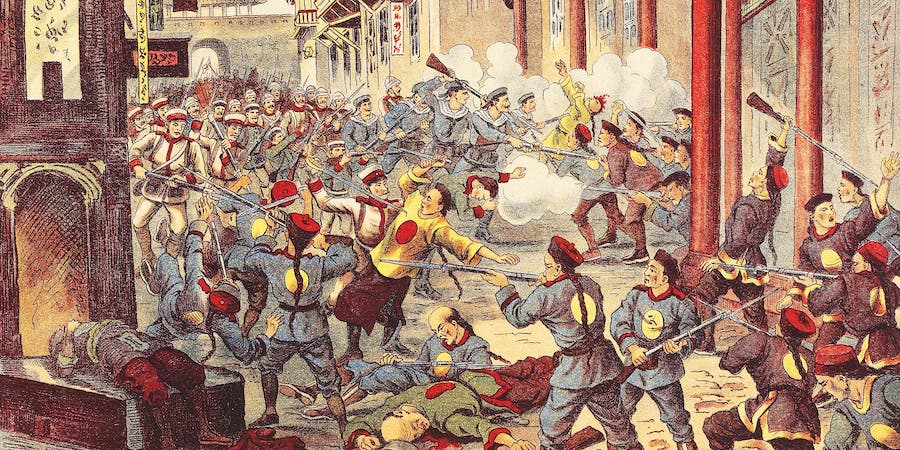
The Boxer Rebellion was a violent uprising of Chinese citizens against Western influence in their country. The rebellion was instigated in 1900 by a secret organization known as the Society of Righteous and Harmonious Fists, but the tensions that fueled the violence had been simmering since China’s defeat in the Opium Wars nearly half a century before. At its peak the rebellion even had the support of China’s then-empress, but it was violently suppressed by a multinational alliance. The Boxer Rebellion lasted only a year, but its impact on Chinese history and the ruling Qing dynasty, were profound.

By analyzing questions, you can see patterns emerge, patterns that will help you answer questions. Qwiz5 is all about those patterns. In each installment of Qwiz5, we take an answer line and look at its five most common clues. Here we explore five clues that will help you answer a tossup on The Boxer Rebellion.
SOCIETY OF RIGHTEOUS AND HARMONIOUS FISTS The Society of Righteous and Harmonious Fists was a secret society that emerged primarily in the Northern Chinese province of Shandong in the 1890s. Also known as the Yihequan, the Society earned the nickname “boxers” from their elaborate martial arts rituals. The leadership of the Boxers believed that these rituals would render them immune to bullets. The Boxers had been mounting attacks on Christian missionaries and Christian converts for several years before exploding into full-out rebellion in 1900 and attacking Beijing.
DOWAGER EMPRESS
At the time of the Boxer Rebellion, the Dowager Empress Cixi had ruled as regent twice—first for her son and later for her nephew. When that nephew, Guangxu, launched the poorly-received Hundred Days’ Reforms in 1898, the Empress retook the throne with the help of Chinese conservatives. The Empress supported the Boxer movement as it gained power, but after it fell she was forced to agree to a humiliating indemnity. The terms of settlement limited Qing military power even further, dismantling the Dagu Forts that were meant to defend against Western invaders.
CLEMENS VON KETTELER
One of the most publicized deaths of the Boxer Rebellion was that of German ambassador Baron Clemens von Ketteler. The Boxer forces arrived in Beijing in June of 1900. Ketteler enraged both the Boxers and the Imperial army forces by shooting a child. During the ensuing street fighting Ketteler was shot by an army captain named En Hai.
KANSU BRAVES
The Kansu Braves were a unit of 10,000 Chinese Muslim soldiers stationed in Beijing during the Boxer Rebellion. Commanded by the virulently anti-Western General Dong Fuxiang, the Kansu Braves joined the Boxers early on in the fighting in Beijing. In addition to killing Clemens von Ketteler they also tore apart Japanese ambassador Sugiyama Akira. Although the Braves were initially dismissed as “10,000 Islamic rabble” they proved their mettle in their one major engagement with foreign forces outside of the walls of Beijing—The Battle of Langfang.
EIGHT-NATION ALLIANCE
Recent Posts
What was China’s Boxer Rebellion? (Aug. 15, 2020)
Arrival of the Navy, May 1900
The United States took control of the Philippines from Spain after its victory in the Spanish-American War in 1898. Cavite, Philippines, provided a strategic naval base, allowing the United States to project its power toward Asia.
When Boxer unrest prompted the U.S. minister at the Beijing legation to request naval support, the gunboat Wheeling departed the Philippines in March 1900 to patrol the northern coast of China, joining ships of European navies at the port city of Dagu.[10] At the end of April, Wheeling was relieved by Newark, the first modern cruiser in the U.S. Navy fleet. When on May 28 and 29 Boxers burned railroad stations including Fengtai, which connected Beijing (and thus the legations) to the coast, Newark was positioned to provide a relief force.
The force that disembarked from Newark at Dagu on 29 May was comprised of two Marine detachments under the command of Captain John T. Myers, nicknamed “Handsome Jack.” Myers and his detachment of 25 Marines had been aboard the battleship Oregon, which a month later grounded on an uncharted rock in the Bohai (Pechili) Strait.[11] They had received orders on 24 May to transfer to Newark, joining a detachment of 23 Marines, five sailors, and U.S. Navy Assistant Surgeon Thomas M. Lippitt under the command of Captain Newt Hall, USMC.[12]
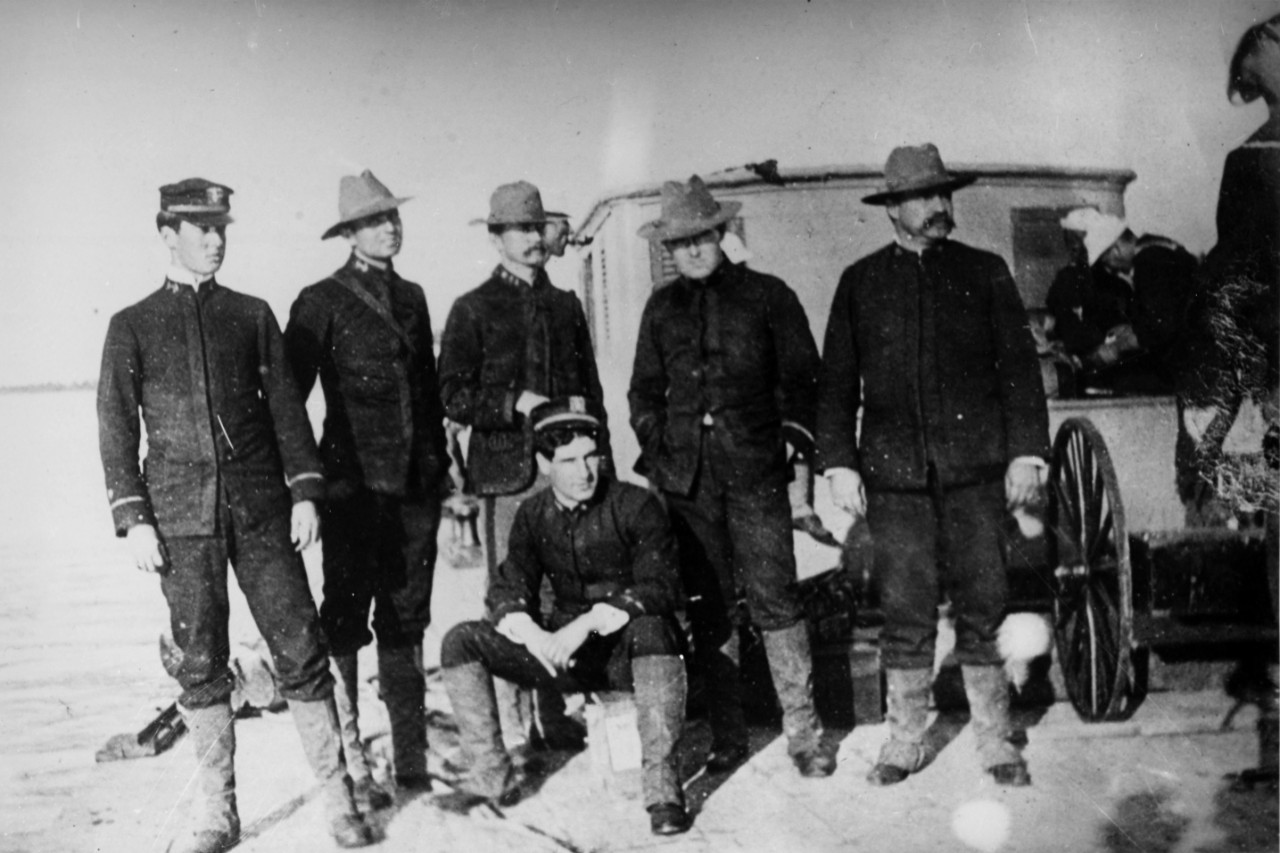
Officers of Newark on a ship on the Hai River en route to Tianjin. Left to right: Midshipman C. E. Courtney, Ensign D. W. Wurtzbaugh, Captain Newt H. Hall (USMC), Midshipman Joseph K. Taussig, Assistant Surgeon Thomas M. Lippitt, and Machinist Daniel Mullan. (NHHC NH-45347.)
On 31 May, Myers and his detachments arrived by train at Beijing, along with a Colt machine gun with 8,000 rounds and 20,000 rounds of rifle ammunition. They were followed by a train carrying 79 British marines, 75 French sailors, 72 Russian sailors, 51 German marines, 39 Italian sailors, 30 Austrian marines, and a 23-man Japanese special navy landing force. Captain Bowman H. McCalla from Newark accompanied the U.S. relief force to the legations, met with the U.S. minister Conger on 1 June, and returned to Tianjing, where his forces were stationed, on 2 June.[13]
Soon, Boxer destruction of railroads would make further relief impossible. Myers and his detachments, along with the international forces, would defend the legations from Boxers and Chinese soldiers during a 55-day siege.
Seymour Expedition, June 1900
On 9 June, the British minister at Beijing sent a telegram to the commander in chief of the British Royal Navy’s China Station, Admiral Sir Edward Seymour, with an urgent message: “Unless those at Pekin were relieved soon, it would be too late.”[14] Seymour responded immediately, leaving Dagu with a battalion of British sailors and marines and arriving in Tianjin early on 10 June to assemble an international relief force.
Numbers vary slightly, but according to the Secretary of the Navy’s report on the expedition, Seymour’s expedition force totaled 2,066—915 British, 450 Germans, 312 Russians, 158 French, 54 Japanese, 40 Italians, 25 Austrians, and 112 Americans commanded by Captain Bowman H. McCalla.[15]
The Secretary of the Navy’s report also notes that trains carrying the relief column left promptly at 0930 local time. However, an account by Midshipman (and later vice admiral) Joseph K. Taussig details how McCalla insisted the Americans travel in the first train, and got his way, but the squabble delayed the trains from leaving the station until early afternoon. Such tension among the allied forces was commonplace throughout the summer campaign.[16]
Five trains left the Tianjin station on 10 June, the final one a supply train Seymour planned to send between his column and Tianjin. That first day, the journey through the countryside was relatively smooth, the train passing an encampment of Chinese imperial troops under General Nie Shicheng (Nieh Shih-cheng), who allowed the allies to continue undisturbed but sent a telegram to Beijing.
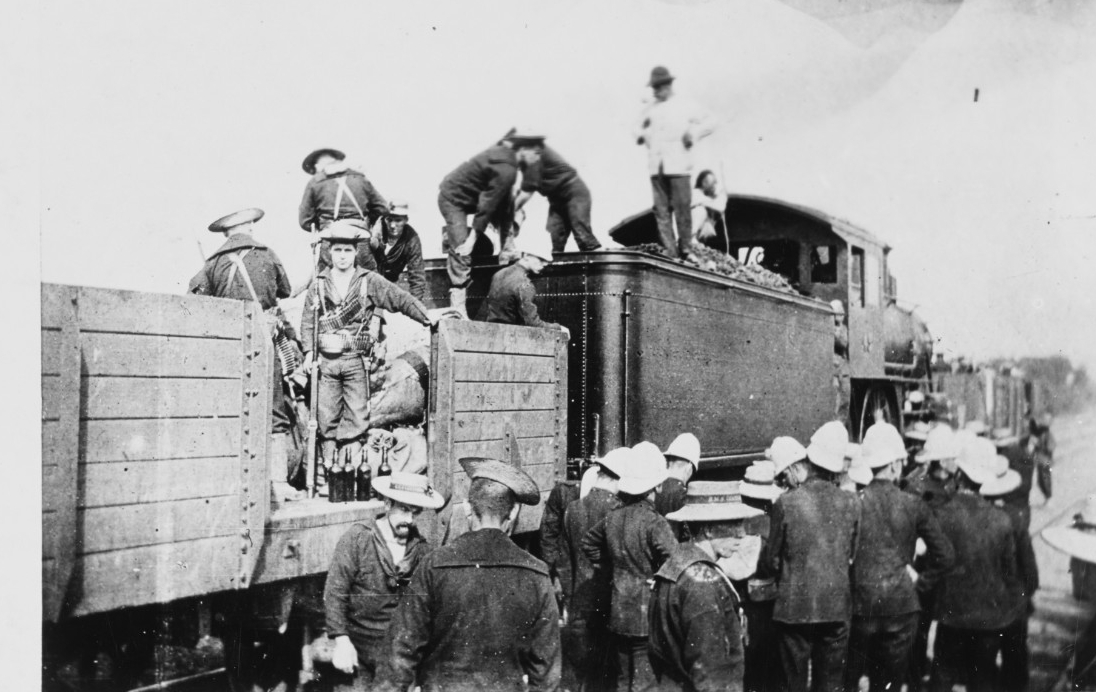
Train belonging to the Seymour Expedition. (NHHC USN-901029.)
This peaceful train ride was short-lived. The allied forces soon encountered torn up train tracks that required the troops to camp overnight as they made repairs. The destruction was an organized effort by Boxers under the local leader Ni Zanqing, whose strategy was to slow down the troops so they were sitting ducks for attacks.[17]
The British and Americans, aided by Chinese laborers, had to repair the railway. Sailors carried ties for several hundred yards, dug up the rocky road for the ties, lifted the rails, put them in place, and drove the spikes. Taussig recorded in his diary that the sailors were not “very successful spike drivers,” so this task was performed by the Chinese. “I doubt if a Naval force ever had to build a railroad before, and I also doubt if any force of equal size ever laid so much track per unit of time,” Taussig wrote.[18]
On 11 June—the day Seymour had hoped to arrive in Beijing—the Americans were repairing track near Luofa (Lofa) station when a small party of Boxers snuck up on the train. A British patrol sounded the alarm. McCalla ordered the Americans to form a skirmish line and advance on the Boxers, who wore red caps, belts, and anklets, and carried white and red flags. The Boxers were armed with either large knives or long spears, and they advanced slowly, making gestures they believed would protect them from bullets. Under the fire of the Americans and the British, all the Boxers were shot in the span of a few minutes.[19]
On 12 June, while the main force made repairs at Langfang, Seymour sent a force of about 50 officers and men north to prevent damage to the railroad at Anding (Anting). The force encountered repeated attacks, culminating in a charge by 450 Boxers. The Boxers lost 150 men, but succeeded in driving back the allied troops, who were running low on ammunition.
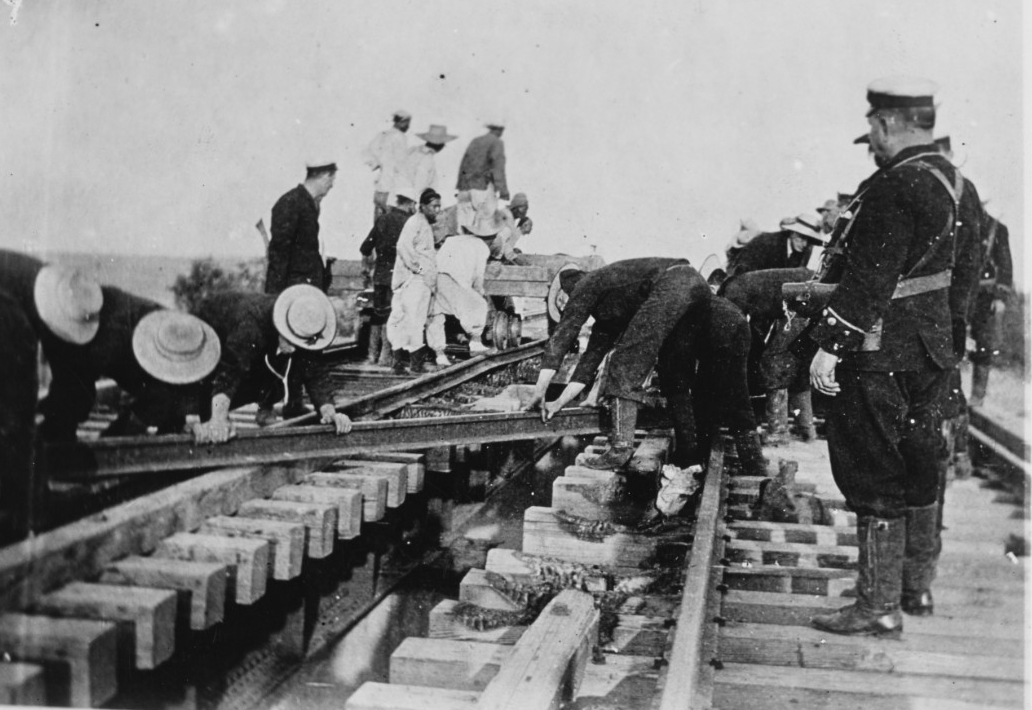
Sailors repair a destroyed railroad. (NHHC USN-901032.)
On 14 July, the Boxers caught the allied forces at Langfang by surprise. Their first victims were five Italians in the village’s orchard fields, who tried to run. But this time, the Boxers had abandoned their ritualistic approach in favor of speed. They had almost reached the train by the time the allies fired the first shots. Hand-to-hand combat ensued, with Captain McCalla shooting Boxers at close range. The Boxers advanced until the allies deployed a Gatling gun. Then, the Boxers fled, leaving 102 lying dead.[20]
One of the banners taken from a dead Boxer read, “Death to all foreigners: by order of the Government.” The allied forces believed the Boxers were lying about Qing government support in order to recruit. They continued on, burning every village that showed signs of a Boxer presence.[21]
On 15 June, Seymour sent his supply train to Tianjin, but the train returned with bad news: the railroad the allied forces had painstakingly repaired was in ruins. Low on supplies, Seymour ordered his forces to retreat to Yangcun (Yangtsun), where the railroad crossed the Hai River (Pei ho River).[22]
Taussig recorded his suspicions that the Qing imperial troops had had a hand in the railroad’s destruction.[23] His suspicion was confirmed on 18 June, when Boxers supported by imperial troops attacked several of Seymour’s trains, killing six and wounding 48. The Imperial Army was now officially backing the Boxers, a reaction to allied forces seizing the Dagu Forts on 17 June.
In Yangcun on 19 June, Admiral Seymour and his troops set out on foot along the Hai River, commandeering junks to carry the wounded and supplies. The river was low due to the drought, so the officers had to jettison heavy guns and equipment and tow the junks from shore. They encountered rifle fire from Boxers, who moved along the river from village to village. At one village, the allied forces heard a volley of hundreds of rifles—which turned out to be firecrackers.[24]
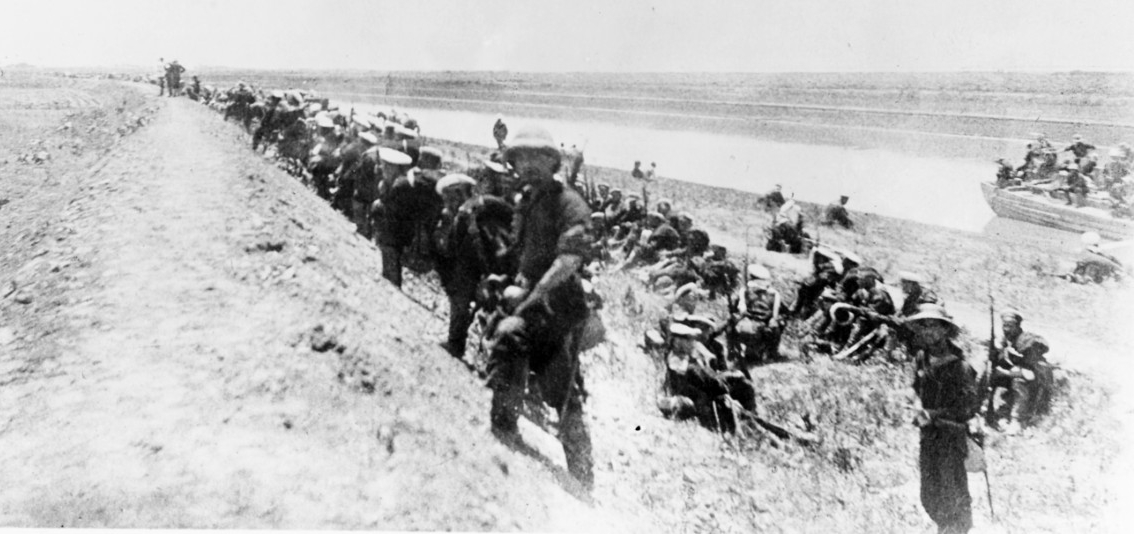
American and British contingents deployed behind an embankment of the Hai River and under fire from Chinese artillery during the Seymour Expedition retreat. British bluejackets are in the foreground, and the American detachment is in the background. The group standing on top of the embankment includes Admiral Edward Seymour, RN, and Captain Bowman McCalla, USN. The junk in the right foreground contains the wounded and supplies. (NHHC NH-2844.)
On 21 June, a Chinese cavalry unit began to shadow Seymour’s column. The next day, Seymour encountered Chinese troops in fortified positions along the river. Surrounded and under constant fire, Seymour and his troops made a daring nighttime march to sneak past the Chinese troops. Luck was on their side. The Chinese fired, but missed in the dark. Then, on 23 June, an even bigger stroke of luck: Seymour and his allied troops came upon the Xigu (Hsi-Ku) Arsenal, an enormous structure defended by only a small number of Chinese troops. They defeated the troops and discovered stores of food, arms, and ammunition. Now, the last order of business was to communicate with Tianjin.
A Chinese servant, Chao Yin-Ho, took on the heroic task. Chao swam the Hai River, then survived an interrogation by Boxers while tied to a tree and fire from French sentries when he arrived at the foreign enclave in Tianjin on 24 June. The next day, Chao led allied troops to the arsenal to escort Seymour and his men to Tianjin.[25]
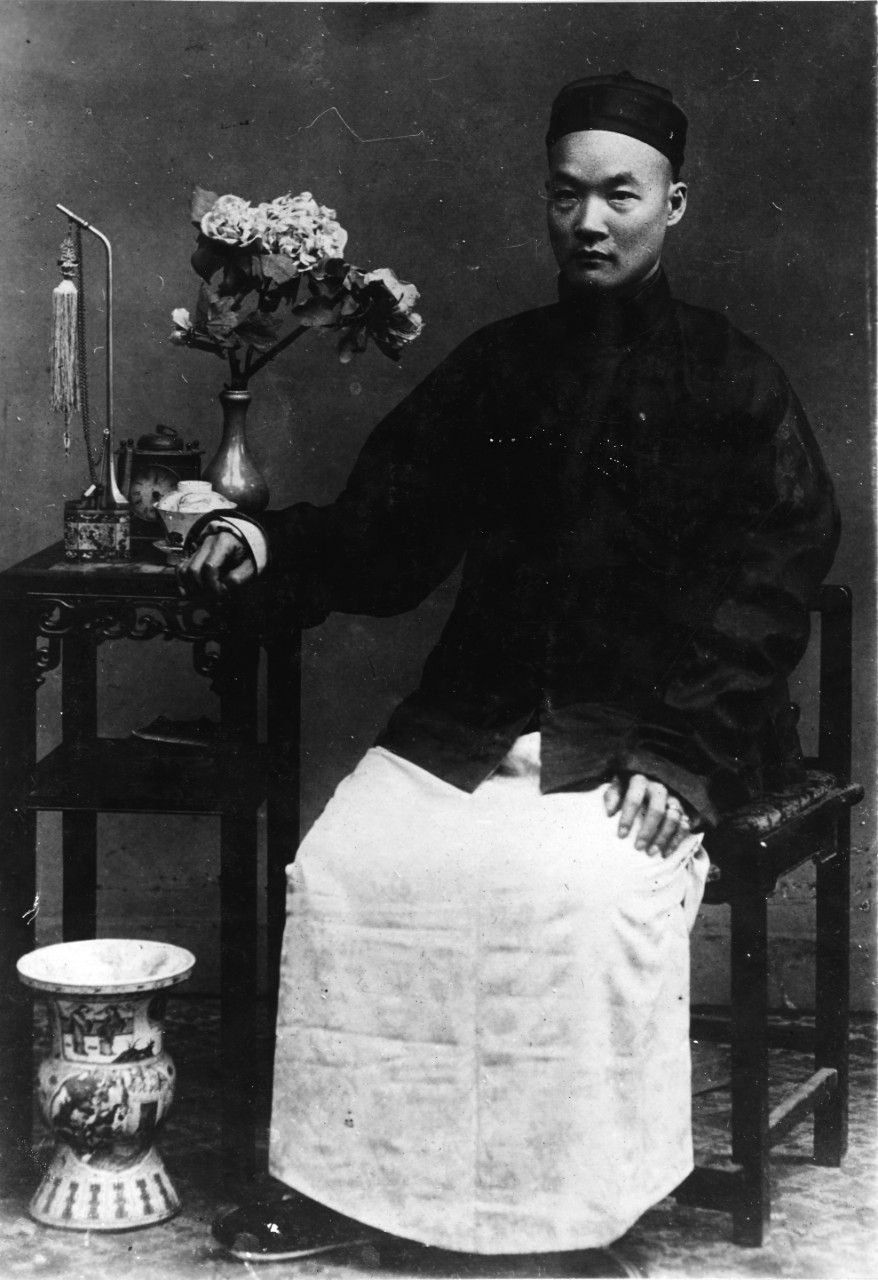
Chao Yin-Ho, the servant who carried a message across enemy lines to Tianjin. (NHHC NH-1400.)
Casualties for the so-called Seymour Expedition amounted to 62 killed and 232 wounded, with the Americans sustaining losses of 4 killed and 28 wounded—the highest casualties by percentage of any nation present.[26] Midshipman Joseph K. Taussig, who had been shot through the thigh, was carried from the Xigu Arsenal on a stretcher. Captain Bowman McCalla, who had been shot through the left instep and hip, rode into Tianjin on a donkey.[27]
Despite the expedition’s failure, Seymour lauded McCalla and the Americans in a letter to a senior U.S. naval officer at Dagu: “Their post was usually in the advanced guard, where their zeal and go was praised by all. I regret to state that Captain McCalla was wounded in three places, but considering the gallant way in which he exposed himself I am only equally surprised and thankful that he is alive.”[28]
Dagu Forts, 17 June 1900
The four Dagu (Taku) forts occupied a critical position at the mouth of the Hai River, which flowed to the city of Tianjin. As increasingly dire news filtered from Tianjin, and Rear Admiral James Bruce, RN, received reports the Chinese planned to send troops to the forts and mine the Hai River, he decided to take action. He met with the allied commanders off Dagu, and they agreed to send an ultimatum to the Chinese commander, demanding the Chinese surrender the forts to the allies by 0200 local time on 17 June.
The only commander not on board with the plan was Rear Admiral Louis Kempff, USN. Kempff had orders from Washington preventing him from acting unless the Chinese committed an act of war. Kempff’s contribution was to position the gunboat Monocacyin the Hai River and order Commander Frederick Wise to act if necessary. Given that Monocacy was likely to be attacked in its position, historians believe Kempff hoped the gunboat would join the fight.
According to allied reports, the Chinese began shelling the enemy ships about an hour before the 0200 deadline. Nine allied ships returned fire. Monocacy was in the middle of the action, and a six-inch shell crashed through the gunboat’s stern, then into and out of the hull without exploding. Rather than join the fight, Commander Wise moved Monocacy upriver to protect refugees onboard, a decision that resulted in criticism from Kempff.
British and Japanese troops captured the northwest fort. The northeast fort had been destroyed, and the two forts on the southern shore quickly surrendered. The battle of the Dagu Forts concluded by 0800, leaving the allied commanders victorious and the empress dowager furious.[29] She directed her anger at multiple targets: the Seymour Expedition and the foreigners in both Beijing’s Legation Quarter and Tianjin’s foreign concessions.
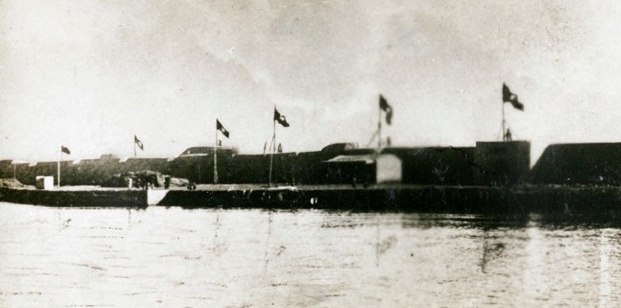
The Dagu Forts. (Jim Williams Collection and Special Collections, University of Bristol Library, www.hpcbristol.net/visual/jw-s29.)
Siege of the Legations, June–August 1900
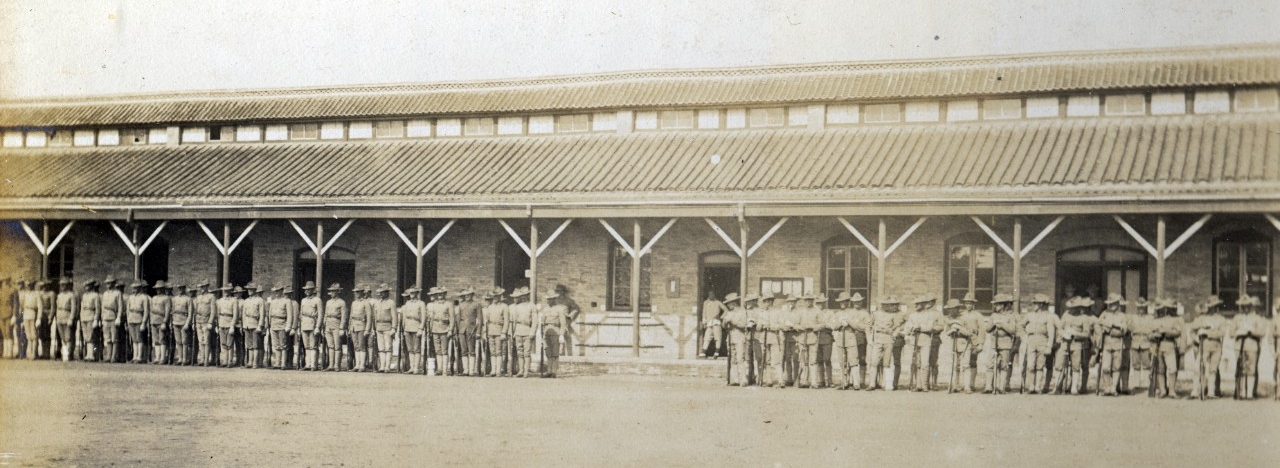
Marine guard outside the U.S. legation at Beijing. (NHHC.)
The first several days at the Legation Quarter were uneventful for Captain John T. Myers and his Marine detachments. But, on 6 June, when Boxers burned several railroad stations, Myers wired McCalla, requesting 25 additional men to protect the American legation. On 7 June, the British marine officer present, at Myers’ request, called a meeting of the officers at the legations to adopt a defense plan. They decided that in the event of an attack, all noncombatants and provisions would be sent to the British legation, streets leading to the legations would be barricaded, and Chinese people would not be allowed to enter without a pass. They also agreed to “endeavor to hold all the legations as long as possible, and as a last resort, to fall back upon the English legation.”[30]
On 11 June, Japanese chancellor Sugiyama Akira went to the train station to await the arrival of the ill-fated Seymour Expedition. The allied force never arrived, and Akira was murdered by Chinese troops.[31] On 13 June, two Boxers carrying swords arrived in the Legation Quarter followed by a large crowd. The German minister, Clemens von Ketteler, led German sentries in a chase after the Boxers. One Boxer was captured, the other escaped. When the large crowd gathered in front of the American legation, the Americans fired their Colt machine gun to drive away the Chinese.
That evening, Boxers set fire to the outside chapel of a Methodist mission. The mission lay three-quarters of a mile east of the Legation Quarter and housed American missionaries and Chinese Christian refugees. Minister Conger had displayed foresight by sending Corporal Martin Hunt, USMC, and 10 men to the mission on 8 June, followed by 10 more men under Captain Newt Hall on 9 June. Hall and his men drove the Chinese crowd back from the mission with bayonets, but the chapel had been destroyed. Back in the Legation Quarter, the allies cleared the streets and built barricades. That night, Boxers burned outlying missions and churches in Beijing, sparing only the Beitang (Peitang) Cathedral, guarded by French and Italian marines, who would defend the church and its Catholic priests and nuns until 15 August, when they were rescued by Japanese troops.
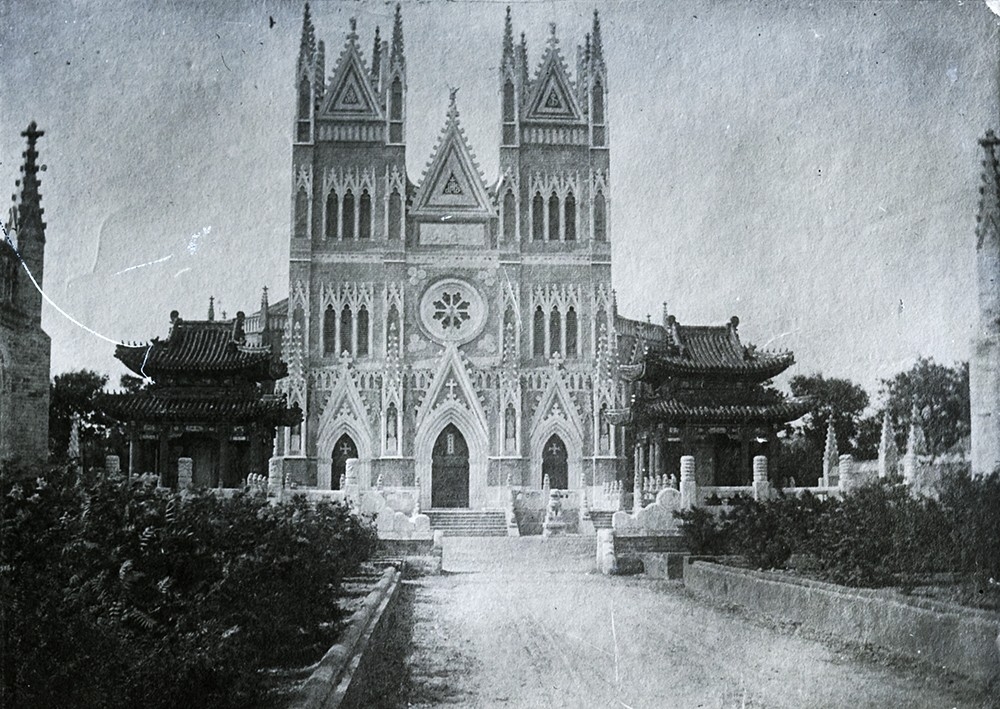
The Beitang Cathedral. (Billie Love Historical Collection and Special Collections, University of Bristol Library, www.hpcbristol.net/visual/bl-n090.)
The morning of 14 June, badly burned Chinese Christians appeared at the barricades to the Legation Quarter. They were allowed entrance, treated by American and Russian surgeons, and sent to the French legation. A Russian officer decided to send a search party to rescue Chinese Christians, and Myers supported the effort with a party of 10 Americans led by William Pethick, a veteran of the American Civil War, a Chinese linguist, and a scholar of Chinese literature. The rescuers returned to the Legation Quarter with about 150 Chinese Christians. That night, the allies inside the legations went to sleep to cries outside their barricades of “Sha! Sha!”—“Kill! Kill!”
On 15 June, a rescue party of British and American troops, including the surgeon Thomas M. Lippitt, failed to find more Chinese Christians, but came across a meeting of Boxers in a temple. The allies, bolstered by Japanese and Austrian troops, surrounded the temple and killed 45 Boxers.
The flames of the Boxer’s rage spread throughout the city. On 16 June, Boxers burned down Watson’s drug store in the southern part of the city, setting off a chemical explosion that tore through the richest part of Beijing. The following day, a Boxer started a fire only half a mile west of the legation barricades, which took the allies and municipal fire department two hours to put out.[32]
The day of 18 June spelled misfortune for the legation guard, just as it did for Seymour and his columns inching their way through the Chinese countryside. In retaliation for the allies’ capture of the Dagu Forts, the Zongli (Tsungli) Yamen, the Qing government body in charge of foreign policy, informed the ministers that a state of war existed, and that they had 24 hours to leave Beijing with protection guaranteed until they reached Tianjin.
The foreign ministers were skeptical of this offer for protection. The British minister MacDonald believed that once they left the safety of the Legation Quarter they would be slaughtered like the besieged Westerners at Cawnpore during the Indian Sepoy Rebellion.[33] Ultimately, the ministers agreed to cooperate with the empress dowager’s ultimatum, but requested a meeting with the Zongli Yamen on the morning of 20 June to discuss their safe passage. The morning came and, with it, no response from the Zongli Yamen. Impatient, the German minister von Ketteler set out with his interpreter to visit the offices of the Zongli Yamen, a decision that would alter the course of history. On the journey from the Legation Quarter to Chongwenmen (Hatamen) Street, an imperial soldier fired a fatal shot into the German minister’s back. Von Ketteler’s interpreter sustained a leg wound, but escaped and sought refuge at an American mission.
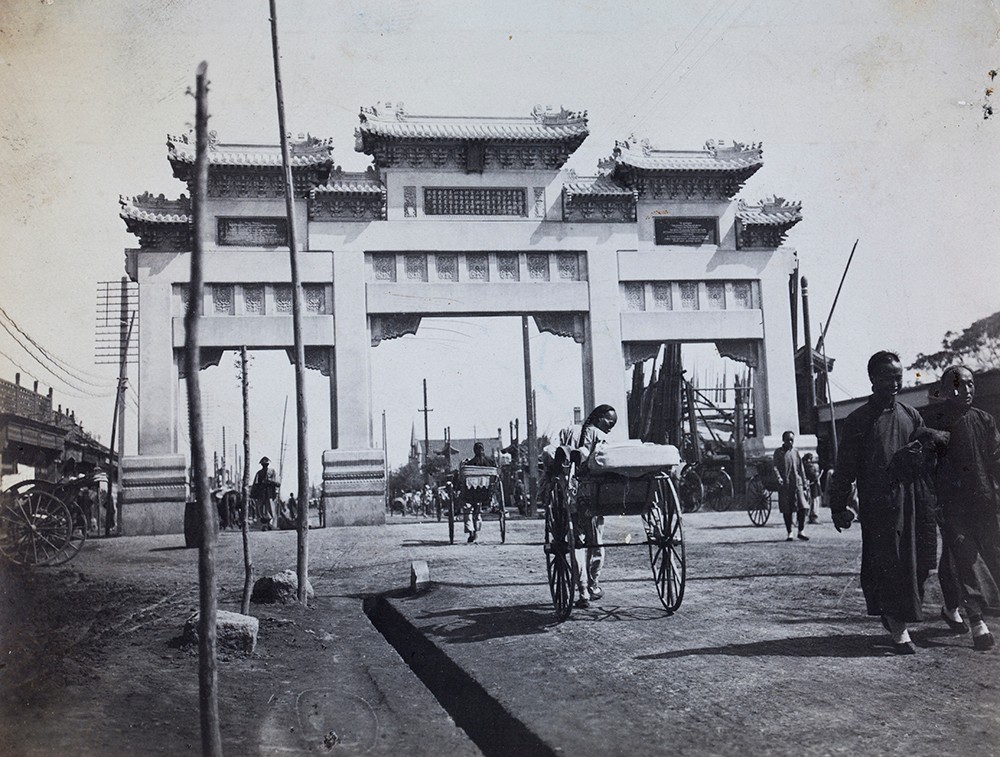
Monument for Baron von Ketteler erected by the Chinese government on the spot of his assassination as agreed upon in the Boxer Protocol of 1901. (Special Collections, University of Bristol Library, www.hpcbristol.net/visual/wc01-106.)
When the Germans learned of their fallen minister, they sent a detachment to recover his body, but gunfire forced them to return to the legations. A safe journey from Beijing to Tianjin was no longer an option. The allies resorted to their defense plan, sending women and children to the British legation, along with all food supplies and a guard of 10 men from each allied nation. Captain Myers led 15 Americans, 10 Russians, and 10 British troops to escort Captain Hall and his men, who had guarded the Methodist mission, into the relative safety of the legations. That evening, Chinese soldiers fired upon the allies and spies reported Boxers were entering the city and moving freely among the imperial troops. According to Captain Myers, “They appeared to be on the best of terms.”[34]
On 22 June, miscommunication may have led to misfortune. Almost all the legation guard retreated to the British legation under the orders of an Austrian captain. A report by G. E. Morison, the London Times correspondent at Beijing, blamed “an irresponsible American” who had told the Austrian captain that the American legation had been abandoned. [35] A firsthand account by British civilian Nigel Oliphant tells that the miscommunication prompted a meeting of the ministers, who chose Sir Claude MacDonald as commander of the legations. MacDonald then ordered the guards to retake their positions, but for the Italians and the Austrians it was too late.[36] Their legations were already burning. Oliphant’s account of 22 June conflicts with Captain John Myers’ report. While Myers recorded a “misunderstanding of orders,” he wrote that “the mistake being quickly discovered, our positions were at once reoccupied before the Chinese knew of our absence.” In Myers’ account, the meeting of ministers to appoint MacDonald occurred a day prior rather than in reaction to the miscommunication.[37]
One thing is certain: the legations were burning. As the Legation Quarter’s defenses went up in flames, the fate of the allies rested on their ability to defend the section of the 60-foot-high Tartar Wall overlooking the German and American legations. Otherwise, Chinese troops atop the wall could directly bombard the allies—which they did on 24 June. Myers tried to lead the Americans to occupy a position on the wall, but heavy smoke and Chinese gunfire hampered efforts. The next day, the Americans and Germans succeeded in seizing positions on the wall and building barricades. The Americans held the western part of the Tartar Wall, the Germans the eastern.[38]
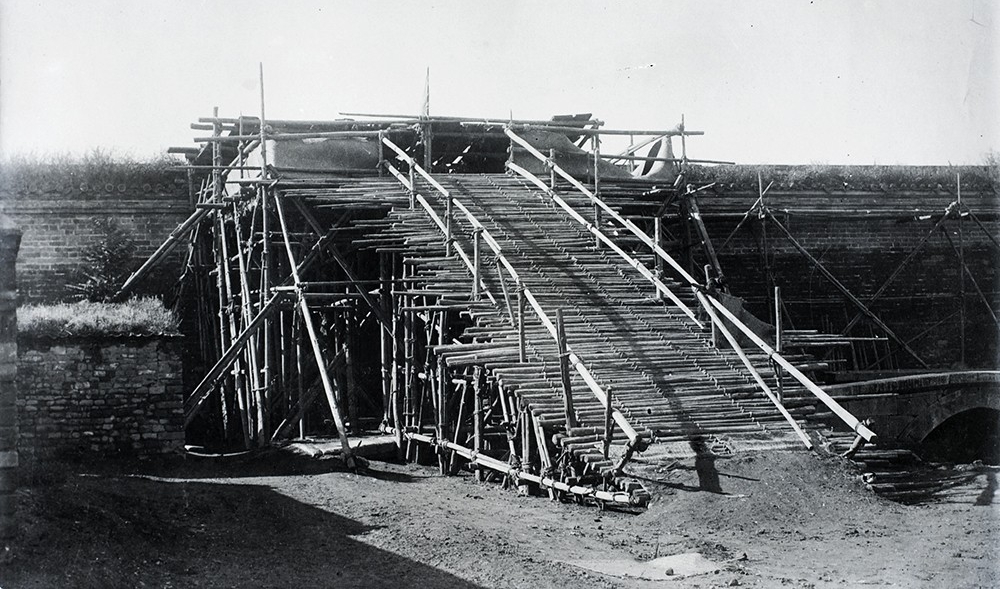
Chinese gun platform built from bamboo against the Tartar Wall overlooking the Legation Quarter. (Billie Love Historical Collection and Special Collections, University of Bristol Library, www.hpcbristol.net/visual/bl-n047.)
On 27 June, the Chinese troops atop the wall made a running advance toward the American position. The Americans drove them back with a few volleys, but over the next three days firing continued through the night, and the Chinese advanced their barricades to within 30 to 40 yards of the American position. On 1 July, heavy shellfire forced the Germans to abandon their position atop the Tartar Wall, leaving Myers and his men unguarded at the rear. Myers withdrew his men, but after conferring with Minister Conger and the American legation’s secretary, H. G. Squiers, retook the position no more than 15 minutes later. Luckily, the Chinese had not pressed their advantage in Myers’ absence. That evening, Sir Claude MacDonald ordered Myers to rest inside the legation—Myers had commanded the Marines atop the wall for five days straight with no sleep.
Captain Newt Hall relieved Myers atop the wall for about a day. When Myers retook command the evening of 2 July, he found the Americans in a far less favorable position than he had left them. On Hall’s watch, the Chinese had built a wall closer to the Marines’ position and were in the process of building a tower that would allow them to fire down onto the Americans. Myers reported the situation and, after a conference with the British and Russian ministers, Minister Conger ordered Myers to attempt to take the Chinese barricade.
Between 0200 and 0300 local time on 3 July, the Russians and British sent men to support the mission. By then, the Chinese had almost finished their tower and were daring to throw stones into the American barricade. Wasting no time, Myers ordered his men to advance. In a morale-boosting success that secured the wall and the legations, the allies drove the Chinese from their barricade and inflicted considerable losses, but also sustained several of their own. Myers reported that “two of the best men in the guard,” Privates A. Turner and J. Kennedy, were killed by gunfire. Captain Myers, too, was wounded by an “iron-pointed spear on the inner side and immediately below [the] right knee.”[39]
Captain Hall took command of the Marines from the wounded Myers, but would not formally relieve him until 21 July. On 12 June, Hall and his men began building a barricade about 100 yards away from the initial American barricade, but on 15 June, Squiers informed Hall the barricade was not far enough along the wall. Squiers wanted the barricade 100 yards farther from the one Hall had begun, only yards from the Chinese barricade.
At 0900, Captain Hall and Private Dan Daly walked along the wall to the desired position for the barricade. Provided the two Marines were not attacked, Chinese laborers were to arrive with sandbags 10 minutes later. The laborers never came. Private Daly volunteered to remain atop the wall while Hall went back for the laborers. Reluctantly, Hall agreed. Hall returned to the American barricade to find the delay was due to the Chinese laborers’ interpreter, who could not understand English. Alone, Daly defended his position under constant fire until the laborers and reinforcements arrived—an act of heroism that inspired Hall to recommend Daly for the Medal of Honor.[40]
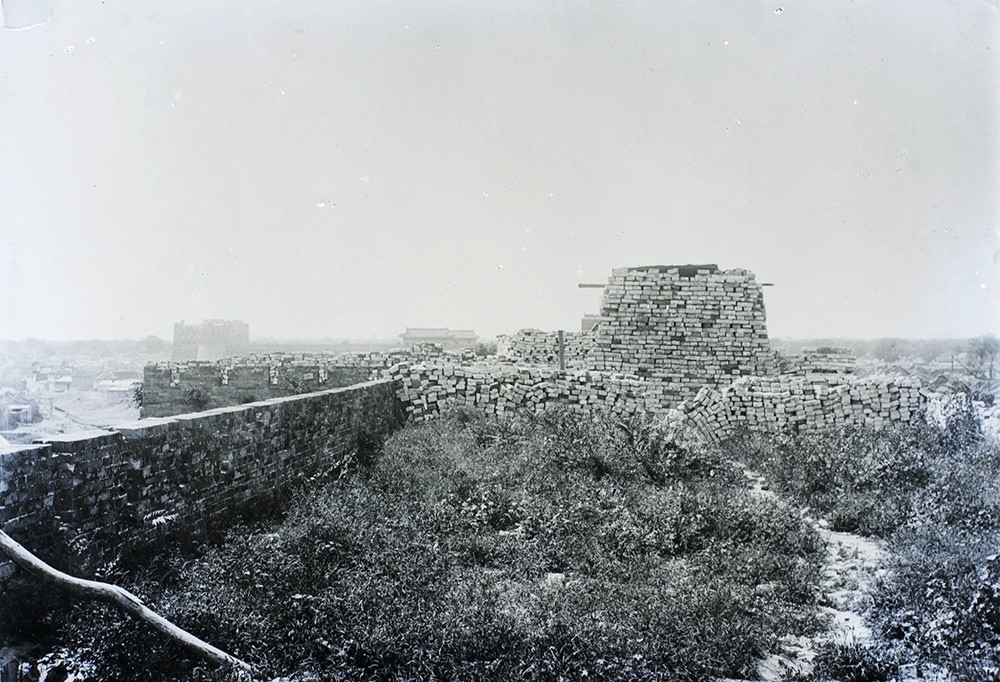
Chinese barricade atop a wall. (Billie Love Historical Collection and Special Collections, University of Bristol Library, www.hpcbristol.net/visual/bl-n006.)
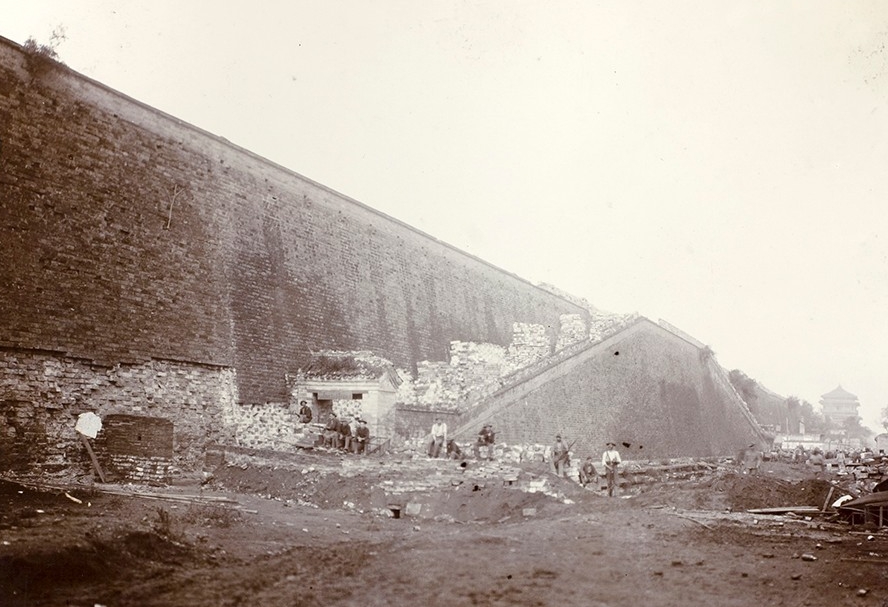
Wall fought over by the Americans and the Chinese. (The National Archives, London, UK, C0 1069/425, www.hpcbristol.net/visual/na05-26.)
Daly’s Medal of Honor citation, described by journalist Charley Roberts as a “masterpiece of understatement,” reads, “In the presence of the enemy during the Battle of Peking, China, 14 August 1900, Daly distinguished himself by meritorious conduct.”[41] Roberts notes that the date on the citation, 14 August, is when the international relief force arrived at Beijing, and “not necessarily the date of Daly’s heroic actions during the siege.”[42] Daly would earn a second Medal of Honor for once again fighting “with exceptional gallantry against heavy odds” in Haiti in 1915, making him one of only two Marines to earn the highest military award for two separate actions.[43]
Another Medal of Honor was awarded posthumously to Private Harry Fisher, who was killed at 0930 on 16 July while helping to erect a barricade under heavy fire and later buried in the Russian legation. Fisher was the first Marine to receive a Medal of Honor posthumously—except “Harry Fisher” was not his real name. On 6 March 1899, Franklin J. Phillips, a private in the 1st U.S. Infantry Regiment, had deserted from Camp A. G. Forse in Huntsville, Alabama, after being refused a sick furlough for the malaria he had caught serving in Cuba. Phillips asked to be restored to duty on 17 March 1899, but instead found himself with a dishonorable discharge for desertion. Two months later, Phillips joined the Marine Corps under the name “Harry Fisher.”
After Fisher’s death, his mother wrote to the Commandant of the Marine Corps requesting the Marine Corps rolls be corrected with her son’s true name. Her request was denied, and she accepted Phillip’s Medal of Honor under his alias. It wasn’t until 1988, after requests from congressmen, that the Commandant of the Marine Corps requested records at Headquarters Marine Corps and the National Archives be changed to reflect Phillip’s name. Also in 1988, a maritime prepositioning ship named MV Private Harry Fisher was renamed MV Private Franklin J. Phillips.[44]
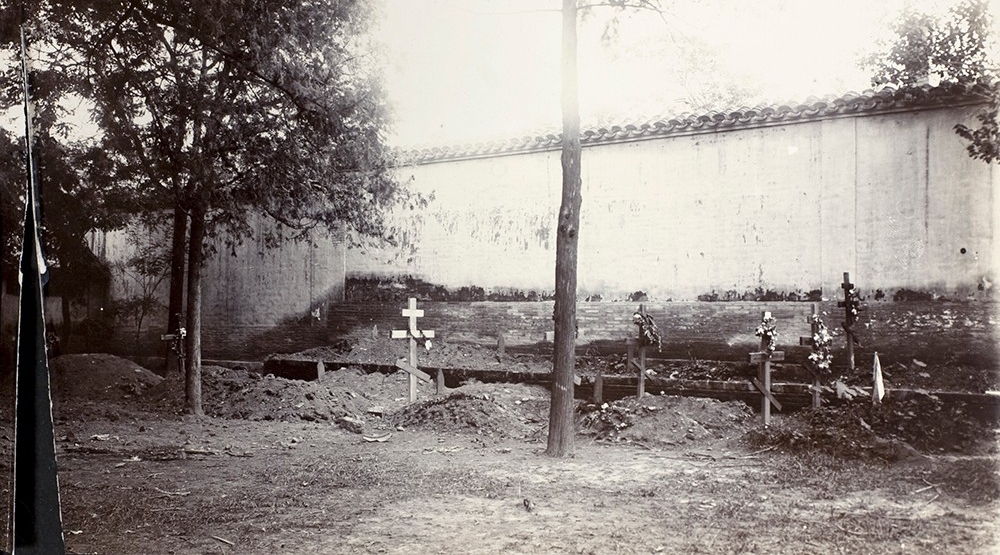
Graveyard in the Russian Legation where Russian soliders and American Marines, including Private Franklin J. Phillips, were buried. (The National Archives, London, UK, C0 1069/425, www.hpcbristol.net/visual/na05-19.)
The day of Fisher’s death, an uneasy peace came to the Legation Quarter. This “half armistice” was the result of a correspondence between Sir Claude MacDonald and Prince Qing (Ching), the leader of the moderate Chinese faction. The pro-Western Qing had served as head minister of the Zongli Yamen until 10 June, when General Nie’s telegram had alerted Empress Dowager Cixi to the Seymour Expedition. In swift fashion, Cixi had replaced Qing with the leader of the court’s conservative faction, the pro-Boxer Prince Duan (Tuan).
MacDonald suggested a cease-fire, and the Chinese agreed, allowing the allies to establish contact with the world outside the Tartar Wall. A messenger of the Japanese colonel Shiba Goro brought word that the allies had captured the walled city of Tianjin and would soon march for Beijing. [45] Promising news, but the weary foreigners inside the legation still had a long wait ahead.
Of the two Marine detachments from Oregon and Newark, seven were killed and 10 wounded before the legations could be relieved. Among the wounded was the assistant surgeon, Thomas Lippitt, who was shot in the leg while walking in the courtyard of the American legation on 29 June. His role was filled by American missionary George Lowry.[46]
Daly and Fisher were not the only servicemen to earn a Medal of Honor for valor displayed during the siege of Beijing. Among the U.S. Navy recipients were Hospital Apprentice Robert H. Stanley, who braved a street rife with Chinese gunfire to carry a message to the British legation and Gunner’s Mate Joseph Mitchell of Newark, who not only operated the American’s Colt gun under heavy fire but also constructed and manned an improvised canon.[47] Nicknamed the “International Gun,” the canon was comprised of an English barrel secured to an Italian gun carriage with Chinese rope and fired Russian shells filled with German powder ignited by a Japanese fuse. The canon’s other nicknames included “Old Betsy,” “Boxer Bill,” “Old Crock,” and the “Empress Dowager.”[48]
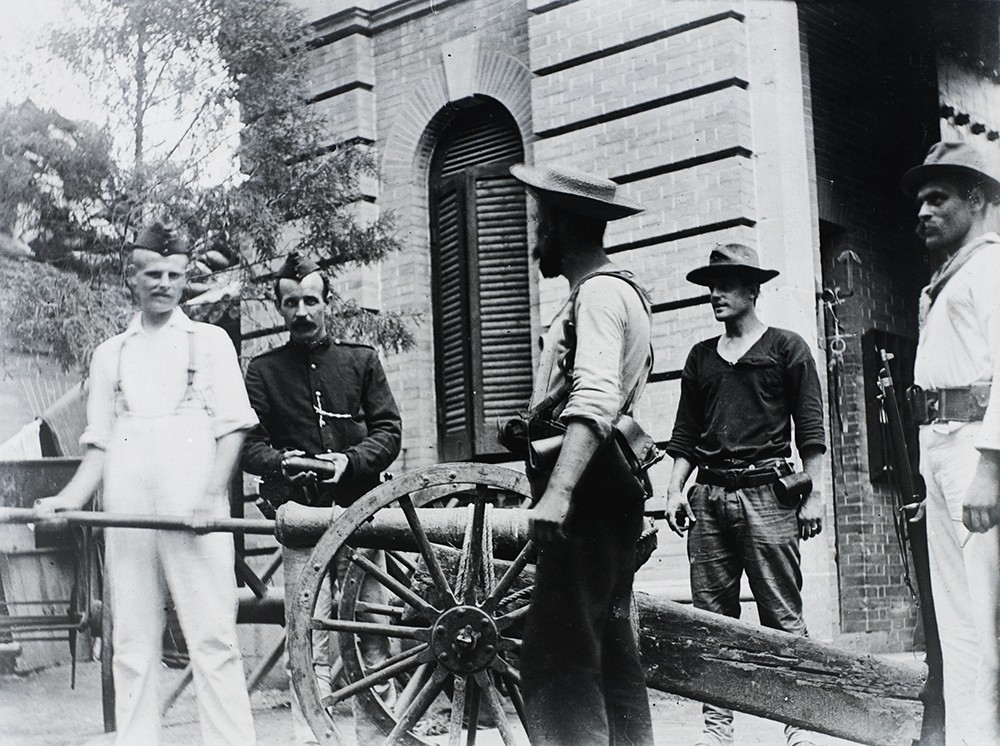
The “International Gun” and its crew. Medal of Honor recipient Gunner’s Mate Joseph Mitchell stands second from the right. (Billie Love Historical Collection and Special Collections, University of Bristol Library, www.hpcbristol.net/visual/bl-n033.)
Additional Marine Corps recipients of the Medal of Honor included Sergeant Edward Walker, Corporal Martin Hunt, and Corporal John O. Dahlgren, all who, according to Myers, “cheerfully performed their duties with courage and fidelity.”[49]
“The conduct of the guard,” Myers wrote, “with one or two exceptions, was excellent.”[50]
Battle of Tianjin, June–July 1900
Tianjin (Tientsin) was a major trading city connecting the coast to the capital city of Beijing (Peking) and could be reached by rail or by sea. Foreign powers maintained concessions to the southeast of the walled city, each with schools, hospitals, and barracks. For the 600 foreigners and 4,000 Chinese Christians living in Tianjin’s foreign concessions, the situation mirrored that of those in the Legation Quarter at Beijing.[51] In mid-June, Boxer violence in Tianjin escalated, with Boxers killing Chinese Christians, setting fire to foreign shops and churches, and attacking the concessions.
The allies responded to reports of Boxer violence by capturing the Dagu Forts at the mouth of the Hai River, which flowed to Tianjin. Just as for the Seymour Expedition and the Beijing Legation Quarter, this action exacerbated the situation in Tianjin. The Chinese shelled the concessions from the walled city and from their West Arsenal. The Boxers tore through the French quarter and attacked the rail station, where Russian troops held them off, but suffered about 100 casualties. As pressure mounted from the growing presence of Boxers and imperial troops at Tianjin, allies sent messengers to Dagu requesting immediate relief.
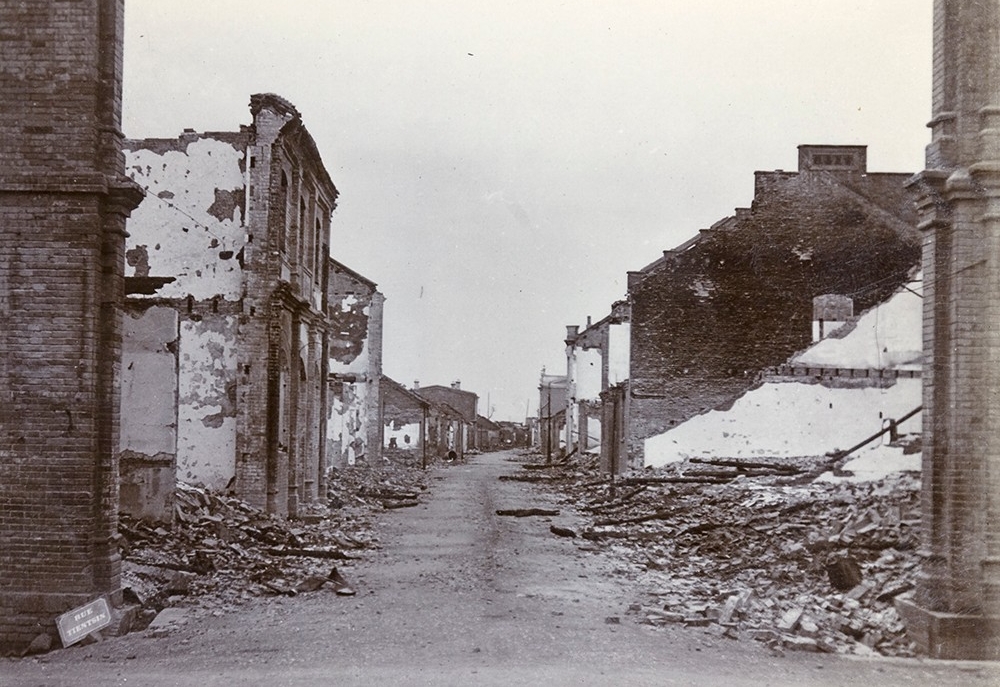
Ruins of Rue de Tianjin, a street in the French concession. (The National Archives, London, UK, C0 1069/422, www.hpcbristol.net/visual/na02-45.)
Initial Attack, 21 June 1900
On 18 June, the U.S. War Department ordered General Arthur MacArthur in Manila, Philippines, to send troops to Dagu. The 9th Infantry Regiment, commanded by Colonel Emerson H. Liscum, prepared to depart, but a typhoon delayed their leaving until 27 June. Luckily for the foreigners in Tianjin, the U.S. Marines reacted faster. On 14 June, six officers and 101 enlisted Marines from the 1st Regiment left Cavite on Solace and arrived off Dagu on 18 June. There, they joined a detachment of two officers and 30 enlisted Marines from Nashville. Major Littleton W. T. Waller commanded the combined force, which was armed with a 3-inch field piece and a Colt machine gun.[52]
The Marine force disembarked on 19 June and advanced to Tanggu (Tongku) on the morning of 20 June. At Tanggu, they commandeered a train and, with the help of Navy machinist’s mates and water tenders from Monocacy, resuscitated its engine and departed for Tianjin, repairing the railroad as they went. Twelve miles from Tianjin, the railroad tracks were impassable. Major Waller and his Marines abandoned the train and joined with a force of about 400 Russians. Waller and the Russian commander agreed to bivouac for the night and hold their position until reinforcements arrived, but at 0200 the Russian commander informed Waller of his intent to push on for Tianjin.[53] Waller objected, believing 530 men inadequate to pass the Chinese force. Later, Waller wrote in his report that he was “overruled in council,” though, with the exception of Rear Admiral Louis Kempff, no one trumped him in authority.[54] Still, the Marines joined the Russians in the early morning advance.
The Marine’s 3-inch field piece proved defective, so Waller had it hidden in a canal. The column advanced along the rail line, with U.S. Marines and the machine gun at the front under the command of First Lieutenant W. G. Powell, followed by the Russians, and the rest of the U.S. Marines at the rear. The allied column advanced undisturbed until 0700, when it reached an imperial arsenal, from which the Chinese opened fire to the right of the column. This fire was light and silenced by Marine sharpshooters. But then an estimated 1,500 to 2,000 Qing imperial troops opened up heavy frontal and flanking fire. The Marine’s Colt machine gun responded to the frontal fire, which came from hidden trenches, while Marines and Russians opened fire on the right. Boxers “annoyed” the Marines to the left but were driven off. The allies held their position until the Russians fell back, exposing the Marine’s left flank. Then, the Colt gun jammed, and all but one of its small crew were killed or wounded. Abandoning the Colt, Waller and the Marines withdrew under fire, bringing up the rear and fending off imperial troops and Boxers for four hours before reaching safety at 1400 local time. The Marines had marched for 30 miles, fought for five hours, and lost four killed and nine wounded.[55]
Waller’s report of the action on 21 June was pessimistic: “We are footsore and weary, but will go forward now. The condition at Tientsin is almost hopeless. If we can not attack tomorrow, I fear the worst.”[56]
Relief of the Foreign Concessions, Capture of the East Arsenal, 21–27 June
At 1700 on 21 June, the reinforcements Waller had wanted to wait for arrived. All together, the allies numbered about 2,000, half of which were Russian and the rest British, German, American, Italian, and Japanese, in descending order of troop numbers. Waller wrote that he had “decided to act in cooperation with the British, under Commander Craddock”—seemingly a decision based on the failure of his alliance with the Russians the day before.[57] That night, Waller sent 16 Marines to join the British on a reconnaissance mission.
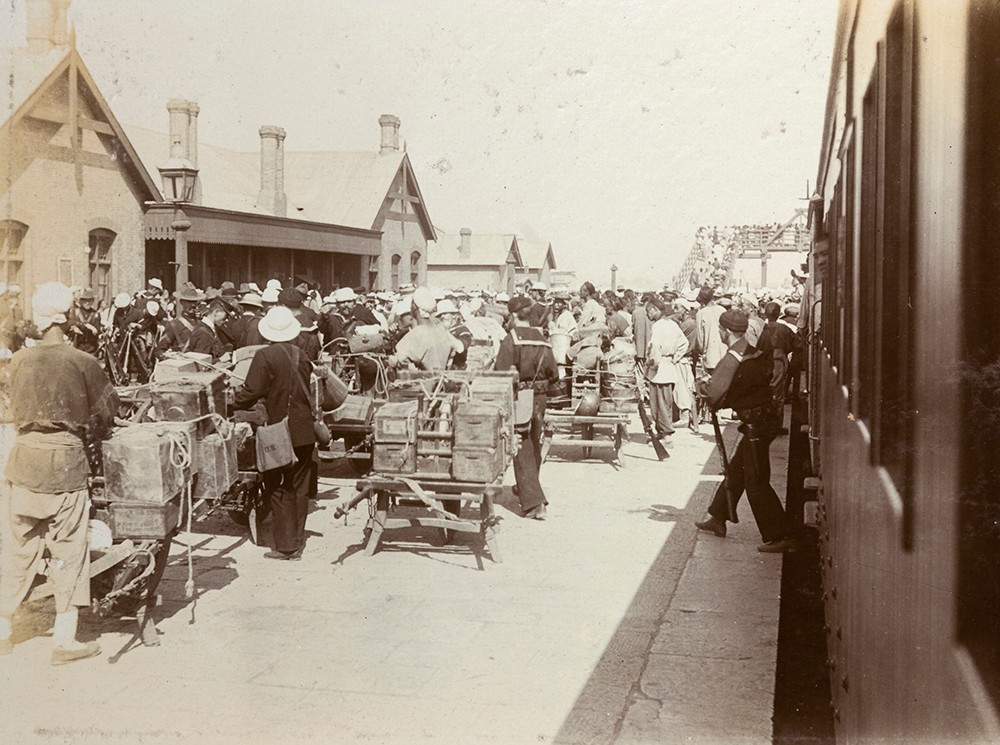
American forces arriving at the Tianjin railroad station. (The National Archives, London, UK, C0 1069/424, www.hpcbristol.net/visual/na04-53.)
The next day, the allies moved toward Tianjin and made camp for the night. Their plan: march on the city that morning in two columns, with the Americans and British on the left and the Germans and Russians on the right.
The allies set out at 0400 on 23 June. At 0700, they encountered the Chinese and advanced steadily. For eight to nine miles, the allies marched under fire, but the Chinese shot high. About 1,500 yards from the city, Private James J. Sullivan described fixing bayonets and charging the Chinese attackers, who fled. Then, the allies encountered a large fort and heavy fire. They fought for over an hour before sheltering in a trench. In the distance, they saw an English and a Russian flag. Then, an American flag was raised. It was the besieged concessions.
At 1230, the allies entered the Tianjin concessions to “shouting and cheering and crying and weeping for joy.”[58] The Americans were the first to enter the concessions and were each treated to a bottle of beer. Among the American civilians inside the concessions were future president Herbert Hoover and future first lady Lou Hoover. President Hoover later recalled, “I do not remember a more satisfying musical performance than the bugles of the American Marines entering the settlement playing ‘There’ll Be a Hot Time in the Old Town Tonight.’”[59]
On 24 June, a visitor arrived at Tianjin: Chao Yin-ho, who brought word of Seymour and his force sheltered in the Xigu Arsenal and surrounded by imperial troops and Boxers. Feet swollen from marching about 50 miles, the allies rested for a day before setting out on 25 June with a force of 1,900 men. The Chinese fired as the allies crossed a river, but the bullets went high and all men made it across alive. Closer to the arsenal, the allies encountered the Chinese, and after 15 minutes had driven them away.
The return from the arsenal on 26 June was slow on account of the sick and wounded. However, it was also uneventful, as the Chinese did not dare to attack the allied force now numbering about 4,000. Cheers greeted the allies upon their return to Tianjin.[60] The wounded Captain McCalla, riding his donkey, left Waller in charge of the combined force of American seamen and Marines.
On 27 June, the Russians attacked the East Arsenal. When they requested reinforcements, Waller sent Second Lieutenant Wade L. Jolly with 40 Marines, entrusting the Americans to the Royal Navy commander Craddock. The allies were about 1,800 strong, and Waller estimated they were facing a force of 7,000 Chinese. Still, they succeeded in driving the Chinese from the arsenal. The Americans along with the British led the allies in a charge over the parapets, sustaining a loss of only one wounded. Lieutenant Jolly was “overcome with heat, but not until after he had brought his men back to their quarters.” Lieutenant A. E. Harding captured a Qing imperial flag and presented it to Waller.
Waller reported his men had marched 97 miles in a span of five days, living on one meal a day. “They have made history, marked with blood, if you please, still glorious and brilliant,” Waller wrote of his men. “They were the first in the field, and, please God, they will remain until the last man, woman and child is relieved from the toils of these barbarians.”
However, he had criticisms for the recipients of his report. The Marine’s uniforms were comprised of trousers that “last about two days” and blue shirts that “make a splendid target.” And, after the initial operations at Tianjin, his force was 89 troops, “disgracefully small” when faced with what lay ahead.[61]
Assault on the Walled City Delayed, Capture of the West Arsenal, 2–9 July
The allies may have relieved the foreign concessions, but the walled city of Tianjin and the West Arsenal were still held by Boxers and Chinese soldiers, who made a habit of shelling and attacking the foreign concessions. Civilians in the concessions lived in fear and sheltered inside cellars. The allies could not march for the besieged legations in Beijing until they had taken Tianjin, which would provide a logistical base in the interior of China.
When on 2 July the allies caught wind of 10,000 imperial troops under General Ma San Yuen marching for Tianjin, Major Waller insisted the city should be taken before the Chinese arrived. A meeting of military commanders initially decided to lead an attack on the morning of 3 July, but the Russian general was not ready to move on the city. The commanders settled on the morning of 4 July, but abandoned the attack when the imperial troops arrived early, on the evening of 2 July. Though Waller described the relations between the foreign powers as “outwardly friendly,” he noted that the Russians “delayed for two days the capture of Tientsin, and my prediction has come true.”[62]
Skirmishes kept the allies busy in early July, with the Chinese attacking the foreign-held railroad station in the hopes of cutting off communication. On 3 July, 80 Marines under Lieutenant Smedley Butler joined the Weihai (Wei hei wei) regiment under British colonel Hamilton Bower to capture a Chinese gun. The Weihai regiment was comprised of enlisted Chinese soldiers from Weihai, a city in Shandong Provide leased by the British in 1898. The allies failed to take the enemy gun but engaged in hand-to-hand combat to capture two villages. When heavy fire pinned down the Weihai regiment, Butler led the Marines in an advance that allowed the Weihai to retreat, then ordered the Marines to fall back by sections without any causalities. Colonel Bower sent his thanks to the Marines, expressing admiration for their training and discipline.
On 9 July, a joint force of British, Japanese, and Americans under Japanese major general Fukushima Yasumasa launched an attack against the Chinese, supported by a separate force of Russians—who had refused the command of a Japanese officer. Major Waller had predicted the Russian’s refusal in a report on 7 July, noting his willingness to serve under a Japanese field marshal given the need for “a common head for the military operations,” but that he “did not think the Russians or French would so agree.”[63]
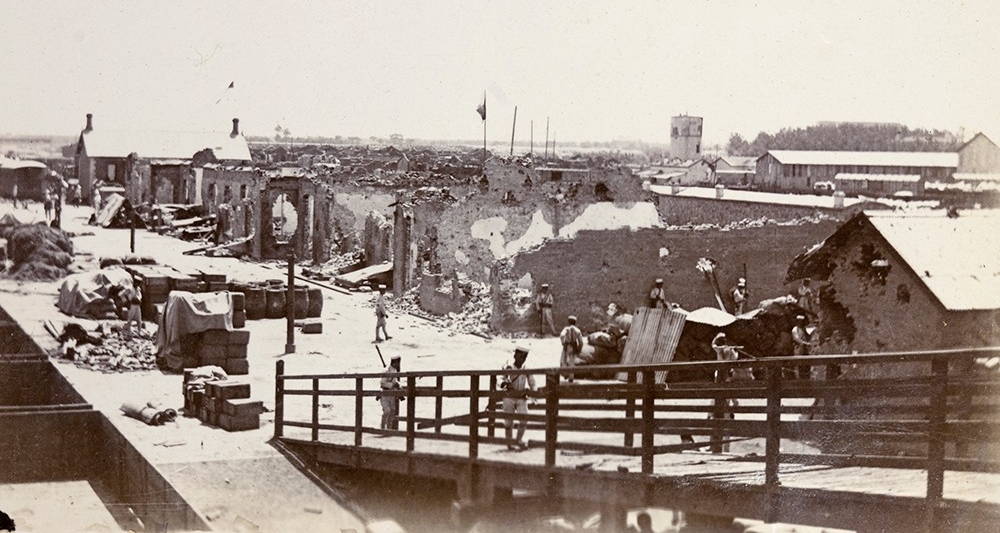
Ruins of the foreign-held railroad station at Tianjin. (The National Archives, London, UK, C0 1069/422, www.hpcbristol.net/visual/na02-19.)
The allies attacked to the west, where the Chinese threatened to cut off allied communication along the Hai River. They drove the Chinese back into a mud fort, silenced by the British and Japanese, and into the West Arsenal. Major Waller’s column, which included the U.S. Marines and Japanese sailors, charged for the arsenal, but met heavy fire. The Marines lay atop the roofs of huts to clear the plain in front of the arsenal. Waller then ordered his men along a mud wall, where they could protect the canal bridge from the main road to the arsenal. By covering the bridge, the Marines allowed the wounded, the Japanese and British batteries, and the Japanese, British, and Indian infantries to cross without sustaining any casualties.[64] Afterward, Waller received letters of thanks from Major General Fukushima and Vice Admiral Seymour. The allies captured the arsenal, a victory made less sweet because the structure was so destroyed it would be useless as a stronghold for taking the walled city.
Attack on the Walled City, 13–14 July
On 12 July, Colonel Robert Meade, USMC, arrived in Tianjin with a detachment of 318 Marines from Brooklyn. Colonel Emerson Liscum and the 9th Infantry arrived on 13 July. Waller had requested to stay in command of the Marines because he was “in touch with the situation and in splendid condition physically for the enormous amount of work to be done.”[65] However, seniority won out and Meade took command of the American forces upon his arrival.
The council of senior officers decided to take Tianjin on 13 July. Colonel Meade provided 1,000 men for the effort, 333 from Meade’s 1st Marine Regiment, 667 from the 9th Infantry. In total, 6,000 allied troops would face a force of about 20,000 Chinese troops (by Admiral Seymour’s estimation) and an indeterminate number of Boxers.[66] Two columns, one of the British and Americans under the British brigadier general A.R.F Dorward, and another of the Japanese and French, would attack Tianjin from the south. Meanwhile, the Russians and Germans would attack from the east.
The southward-attacking columns marched from the foreign concessions around 0300. The Royal Welch Fusiliers headed the American and British column, followed by Colonel Mead and Marine companies A, C, D, and F. These were commanded by Lieutenant Smedley Butler, Captain C. G. Long, Captain A. R. Davis, and Captain B. H. Fuller, respectively. Company F under Fuller was armed with three 3-inch rapid-fire guns and three Colt machine guns. After the Marines came the English naval brigade and then the U.S. 9th Infantry Regiment led by Colonel Liscum.
A mud wall ran around the perimeter of outer Tianjin, and another wall surrounded the inner city. The columns were under orders to march parallel to the outer mud wall and convene about 1,000 yards from the bridge at Tianjin’s south gate for a commanding officer’s meeting, but no meeting occurred. All decisions would be made in the heat of battle.
Meade ordered two Marine infantry companies, A and C, to advance along the wall while the artillery-equipped Company F and its infantry support, Company D, acted with the British artillery to fire on mounted Chinese guns. At 0500, companies A and C arrived at the mud wall’s gate, but fire from the West Arsenal prevented further progress.
At 0545, shellfire from the naval battery of HMS Terrible exploded the Chinese magazine “with a shock which was almost like an earthquake shock,” and the allies took the ruined structure.[67]
At 0630, Brigadier General Dorward ordered Meade’s companies A and C to support the Royal Welch Fusiliers on the extreme left of the allied lines. The Marines and Fusiliers crossed the canal and Tianjin’s mud wall and entered the outer city. There, they encountered flat, swampy ground with “grave mounds and dikes and ditches.” The mounds and dikes provided some cover, but casualties mounted in the face of accurate fire.
Meade’s Marines then made rushing advances to trenches within 800 yards of the inner city walls. There, the Marines and Fusiliers found “very bad swamps and a stream of water” that prevented further progress.[68]
For 12 hours—from 0800 to 2000—the Marines held their position armed with 180 rounds per man. Chinese imperial troops fired down from the walls and Boxers sniped from positions in the city’s suburbs.[69] Twice, attackers approached from the Marine’s left flank. The first time, Marines in the trenches drove them away. The second time, Company D fired on the attackers from the mud wall. As nighttime neared, Meade feared the possibility that ammunition would run out, leaving the Marines with only bayonets to fight. Finally, General Dorward gave the order to withdraw. Under constant fire, the Marines withdrew in small parties of 8 to 10 men “by rushes from mound to mound and trench to trench.” They reached a safe position near the mud wall’s south gate, with only one man hit during the withdrawal. There, the troops slept with their weapons.
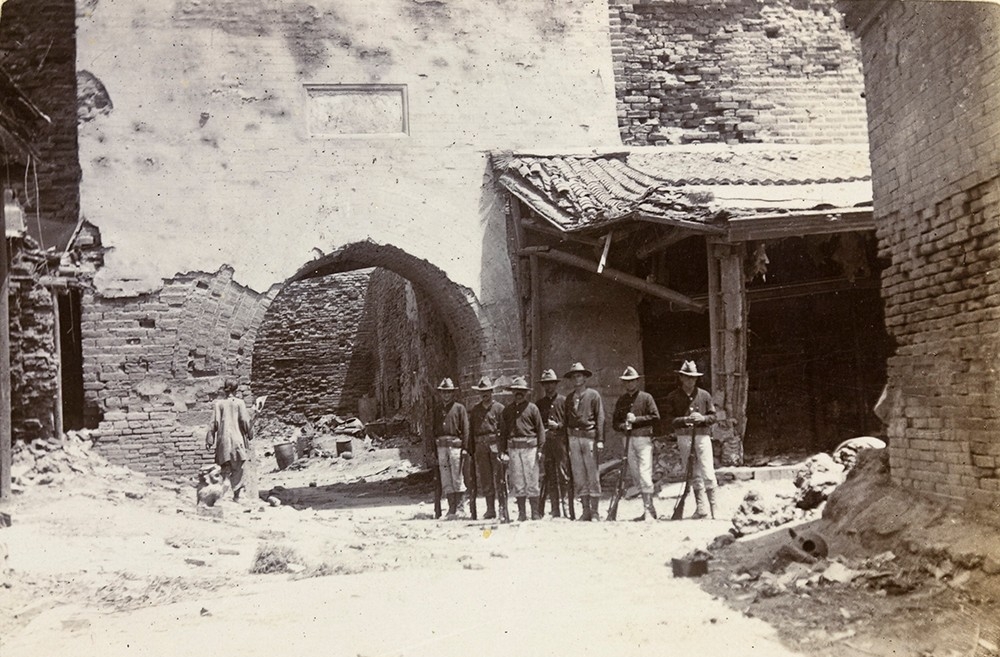
South gate of Tianjin held by the Americans. (The National Archives, London, UK, C0 1069/422, www.hpcbristol.net/visual/na02-23.)
Five Marines were killed on 13 July, including Captain Austin R. Davis, commander of Company C, who died at Meade’s side while fighting in the advanced trench. Casualties also included seven seriously wounded and 16 wounded. Meade commended Lieutenant Smedley Butler, commander of Company A, who left the trenches to rescue a wounded man and was shot in the thigh, as well as First Lieutenant Henry Leonard, who brought the wounded Butler to safety and in doing so was seriously wounded.[70]
The Marines may have endured a grueling fight in swampy trenches, but their losses paled in comparison to those of the 9th Infantry Regiment. Outside the West Arsenal, the regiment had deployed in a single line behind the other forces. Chinese fire flew high, passing over troops nearer to the mud wall and falling among the 9th. Within a half hour, the regiment had sustained nine casualties.
General Dorward sent a staff officer with orders that the 9th advance to the relative safety of the mud wall, then move to the left of the Japanese. Liscum asked for further instructions, but received none. Closer to the mud wall’s gate, Liscum joined General Dorward, who said it did not matter whether the 9th went to the right or left. Thus, while the Marines went to the extreme left, the soldiers of the 9th found themselves on the extreme right, exposed to fire from mud houses to the east.
Liscum had no time to receive further orders. He decided to advance on the mud village over a field made nearly impassable by ditches, holes, and deadly fire. Liscum marched along an elevated road, which allowed him a view of his troops, but made him vulnerable. A pond stopped the regiment’s assault in its tracks, and shortly after, Liscum received a mortal wound while holding the national colors. The 9th Infantry Regiment could not advance or retreat until 2000, when troops from the British Naval Brigade and the U.S. Marines provided covering fire. At the end of 13 July, the regiment’s losses were 17 killed and 71 wounded.[71]
General Dorward later took responsibility for the 9th Infantry’s misfortune:
I blame myself for the mistake made in the taking up of their position by the Ninth Regiment, not remembering that troops wholly fresh to the scene of action and hurried forward in the excitement of attack were likely to lose their way. Still the position they took up and gallantly stuck to all day undoubtedly prevented a large body of the enemy from turning the right of the attack line and inflicting serious loss on the French and Japanese.[72]
Lieutenant Colonel Robert Leonhard, a retired Army officer and research analyst, argues Dorward’s suggestion that the regiment prevented an attack is “plainly ridiculous,” as the Chinese could not have crossed the flooded, ditch-riddled field just as the Americans had failed to. In Leonhard’s view, what befell the regiment was “simply a blunder—a costly one.”[73]
At the end of the day, none of the allied forces had made significant progress. Like the Marines, the Russians and Germans attacking from the east had scaled the mud wall, but made little headway into the city. The Japanese had tried and failed to blow up the south gate.
The allied forces rested for the night—except for the Japanese. Under the cover of darkness, a brave engineer rushed the south gate and lit tins of gun cotton (nitrocellulose), which blew up both the gate and the engineer. A Japanese unit then entered through the ruined gate, scaled the inner wall under fire, and held the inner gate until morning.[74]
The U.S. Marines moved into Tianjin at 0600 on 14 July, finding a city filled with dead Chinese people and dead animals. Boxers fired from the suburbs, but otherwise the allies met no resistance.
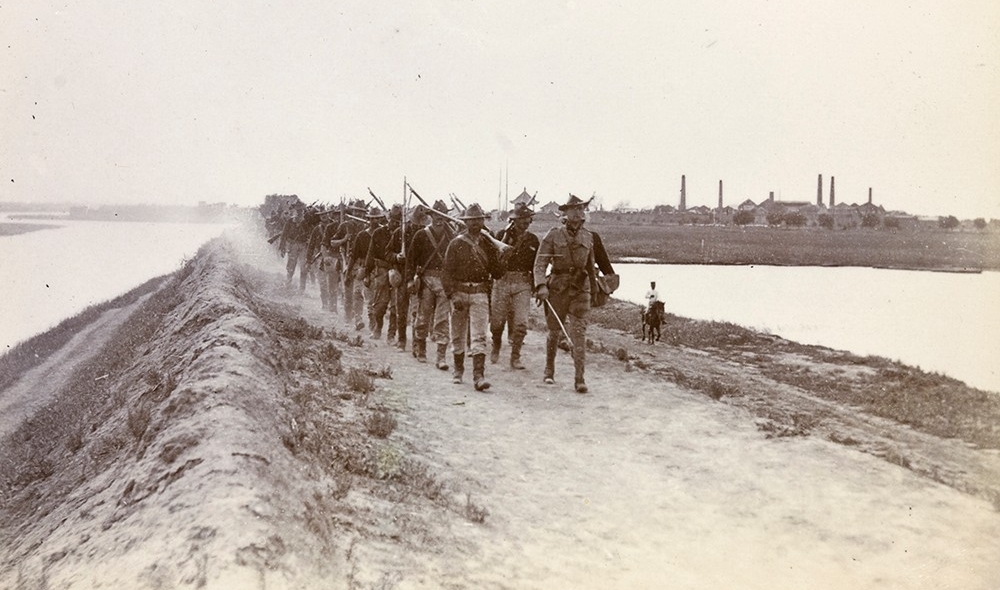
American infantry returning after the capture of Tianjin. (The National Archives, London, UK, C0 1069/422, www.hpcbristol.net/visual/na02-31.)
As Chinese civilians fled the city, allied troops looted it. The U.S. War Department wrote to the commander of the 9th Infantry, Lieutenant Colonel Charles Coolidge, asking if American troops had taken part in the spoils and demanding severe punishment. Coolidge denied reports of looting by Americans, but he had not been in Tianjin when the allied troops entered the city on 14 July.[75]
The treasury was looted and burned, but the Marines under Major Waller found its treasure—“silver bullion, fused with brick, mortar and other debris”—in the salt commissioner’s yamen (official residence). J.P. Morgan & Co. purchased the silver bullion for three bank drafts totaling $376,300 (roughly over $12 million today) made payable to the order of the Secretary of the Navy.[76]
In the face of unchecked looting, a representative from each of the eight powers present—Russia, Japan, Italy, Great Britain, France, Austria, Germany, and the United States—met to establish rules for a provisional government. Colonel Meade served as the American representative. The representatives decided a council of one Russian, one Japanese, and one Englishman would govern Tianjin. They also issued a proclamation to the city’s inhabitants:
In bombarding the city of Tientsin the allied forces only replied to the attack made by the rebels on the foreign settlements.
At present, as your authorities, forgetting their duties, have deserted their posts, the allied forces consider it their duty to establish in the city a temporary administration, which you all have to obey. This administration will protect everyone wishing to deal in a friendly manner with foreigners, but will punish without mercy everyone who causes trouble.
Let the bad people tremble, but the good people should feel reassured and quietly return to their houses and begin their usual work. Thus peace will be restored.[77]
Allied casualties for the Battle of Tianjin totaled 750 killed, wounded, and missing. The Japanese sustained the highest losses with 320 killed and wounded, followed by the Americans with 23 killed, 98 wounded, and one missing. Six Marines earned the Medal of Honor for actions on 13 July. Despite miscommunications, the allies had won a costly and critical victory. They had gained a foothold in the interior of China and could turn their attention toward a march to Beijing.
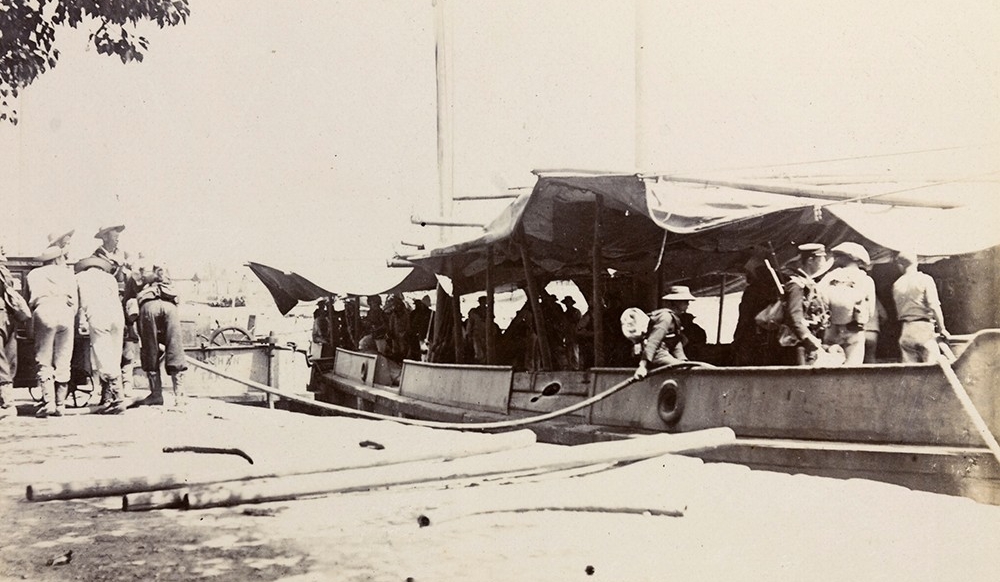
The first lighter to leave Tianjin with the wounded. (The National Archives, London, UK, C0 1069, www.hpcbristol.net/visual/na02-47.)
China Relief Expedition, August 1900
On 4 August, an allied force of just under 19,000 marched from Tianjin—less than half of the “40,000 seasoned troops, with not less than 25,000 in the attacking column” that Major Littleton Waller had assessed as the minimum force needed to take Beijing.[78]
British general Sir Alfred Gaselee and U.S. general Adna Chaffee had made the case for an immediate march on Beijing—a daring decision in light of the failed Seymour Expedition in June. General Gaselee was the acting commander of the relief expedition. The commander chosen by the allies—German field marshal Alfred von Waldersee—had not yet left Germany for China. General Chaffee had arrived in theater on 29 July after a meeting with Admiral Kempff aboard Newark.
The legations at Beijing could not hold out much longer, Gaselee insisted. The allies should strike while the Chinese were still reeling from their loss at Tianjin. On 21 July, Gaselee had received a letter from British minister Claude MacDonald that the legations had two weeks of provisions, but were eating their ponies. MacDonald’s message had taken two weeks to deliver. The messenger, a 16-year-old boy named Lin Wu Yuan, reported that the Hai River was in flood, crops were growing well, and fewer Boxers were on the roads.[79]
The French and Russians worried that in early August troops would face heat exhaustion or torrential rain. The Americans and British argued that with further delays, they would face a harsh winter and a frozen Hai River, a key supply line.
The allies may have also had motives beyond the weather. Leonhard has suggested that the Russians and French wanted to delay the march until their reinforcements arrived, giving them a “more dominant political position” when the allies took Beijing. Meanwhile, historian David Silbey has pointed out that Gaselee may have wanted to march for Beijing before von Waldersee could arrive in theater.[80]
The force that departed Tianjin on 4 August included 8,000 Japanese, 4,800 Russians, 3,000 British, 2,100 Americans, and 500 French. Under General Chaffee, the American troops were comprised of the 14th Infantry Regiment under Colonel A. S. Daggett, elements of the 9th Infantry Regiment under Colonel Charles Coolidge, Captain Henry J. Reilly’s Light Battery F of the 5th Artillery, a troop from the 6th Cavalry, and two battalions of Marines.[81]
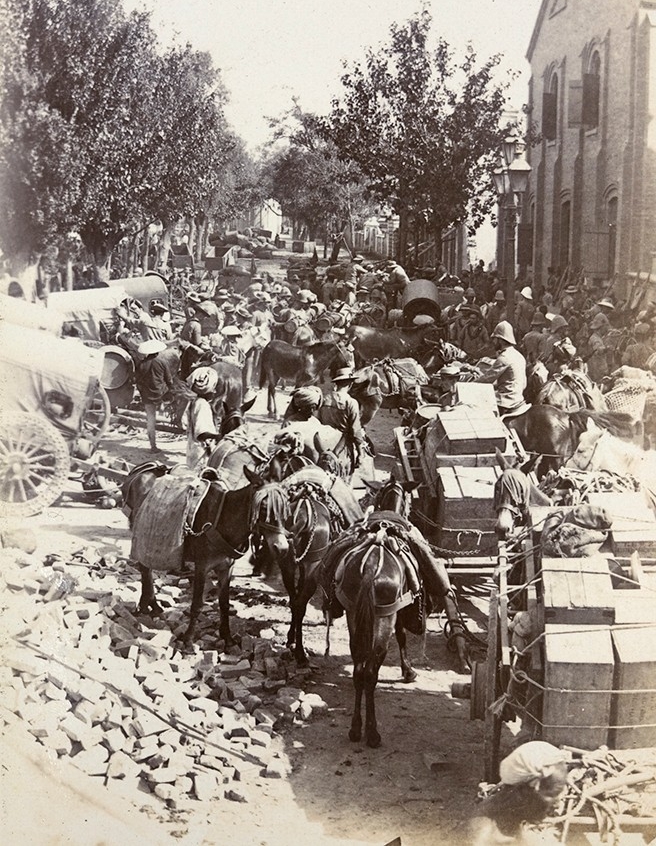
Supply convoy departs Tianjin for Beijing. (The National Archives, London, UK, C0 1069, www.hpcbristol.net/visual/na03-26.)
Major William P. Biddle had command of the two Marine battalions, which totaled 29 commissioned officers and 453 enlisted men. Major Littleton Waller commanded the 1st Battalion with companies A, C, and H. Waller was back in command because Colonel Mead had been relieved by a medical survey board due to rheumatism and sent for treatment at the Mare Island Hospital.[82] Captain F. M. Moses commanded the 2nd Battalion with companies D, I, and F. A guard of 185 Marines remained in Tianjin, along with most of the 6th Cavalry, whose horses had not arrived in time for the march.[83]
The failed Seymour Expedition had followed the railroad, but the allies knew the line would be destroyed beyond the bridge crossing the Hai River. Instead, they decided to follow the Hai River and attack Beijing from the east. The river, rather than the railroad, would be their line of communication with Tianjin.
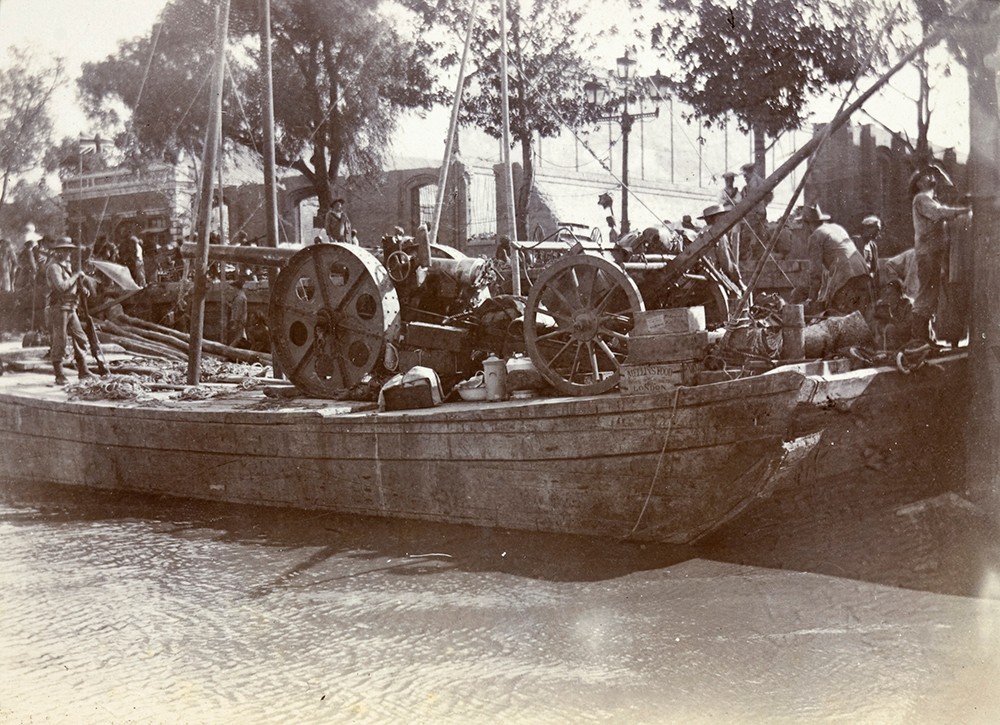
Ordnance on a boat bound for Beijing. (The National Archives, London, UK, C0 1069/423, www.hpcbristol.net/visual/na03-27.)
Battle of Beicang, 5 August 1900
The China Relief Expedition bivouacked for the night near the Xigu Arsenal, which had been captured during the Seymour Expedition. Japanese reconnaissance reported a mix of Chinese troops and Boxers entrenched along the Hai River near the village of Beicang (Peitsang) in a line extending three miles westward to another arsenal.
At 0100 on 5 August, the allied forces advanced toward Beicang, the Russians and French on the left bank of the Hai River, and the Japanese, British, and Americans on the right. The Japanese, followed by the British and the Americans, planned to destroy the arsenal, then advance toward the river and attack the trenches.
When the Japanese reached the arsenal, they found the ground too constricted for them to wait for the rest of their column. They attacked the arsenal and began to chase the Chinese troops to the river. At about 0500, the Japanese sent a message asking for the British and Americans to face north and attack the Chinese. To get into position, the Americans had to march around the British and, by that time, the Chinese had retreated.[84]
Battle of Yangcun, 6 August 1900
The next major town along the Hai River was Yangcun (Yangtsun). The Japanese had borne the brunt of the casualties at Beicang, and so the Americans and the British would spearhead the main attack at Yangcan.
At about 0600 on 6 August, the main arm of the allies advanced along the left bank of the Hai River in three columns, each having crossed the river on a pontoon bridge built by the Japanese. The American column marched along the railroad track, the 14th Infantry leading, a battalion of the 9th Infantry on the right, two battalions of the 14th on the left, the Marines in the center, and Captain Reilly’s artillery battery between the advance and main column. The other two columns, the British and the Russo-French, marched along the river road running parallel to the railroad. The Japanese marched on their own along the right bank of the river.
About a half mile from Yangcun, the allies encountered the Chinese. Gaselee asked for the 14th Regiment to support the British in attacking the right of the Chinese position while Chaffee led the 9th, the Marines, and Captain Reilly’s battery in attacking the left.
As Chaffee’s forces advanced, Chinese infantry opened fire on their right flank from a village to the northeast. Chaffee moved against the village, but when Gaselee sent two messages requesting immediate support, Chaffee led his forces back toward the railroad, though the village had not been entirely destroyed. Waller reported that changes in direction and objective combined with intense heat and movement through high cornfields led to men dropping from heat exhaustion.
Chaffee ordered the Marines and artillery to a 20-foot-high railroad embankment, and Captain Reilly’s men prepared to fire, but held off when Chaffee saw men of the 14th Regiment climbing the embankment. A minute later, Chinese troops hidden in cornfields fired at short range. Captain Reilly’s artillery and the Marines suppressed the fire.
The 9th Infantry fell in on the right flank of the Marines and artillery. Then, an opportunity to inflict damage on the Chinese arose, but Colonel Coolidge ordered the 9th to withhold fire. Coolidge had mistaken Chinese flags for French ones. His caution was a result of allied communications warning the Americans to look out for Russian and French troops likely to pass the Americans. In reality, neither nation’s forces had advanced beyond their position.
The 14th Infantry, supporting the British, suffered considerable losses, seven killed and 57 wounded. Their advance had brought them to a narrow stretch of ground where the American troops overlapped with the British, causing confusion. When they closed in on the village, they were hit by artillery fire, some of which came from the Russians and the British.[85]
Meanwhile, the 9th Infantry, Marines, and Reilly’s battery continued to the villages north of Yangcun and took them with little-to-no opposition. The Marine’s casualties were one wounded and one dead from the heat. In fact, Company H failed to move on the final village, “being nearly prostrated by the heat in the cornfield.”[86]
Battle of Beijing, 14–16 August 1900
On the march toward Beijing (Peking), the greatest enemy was the heat. Exhausted men from every nation lined the roads during the day and rejoined their units at night. During the 80-mile slog that had started at Tianjin, 120 Marines were detached, 45 were placed on junks, 12 were sent to the hospital, 14 were reported missing, and one was killed. The Marine’s strength dwindled from 482 to 291.[87]
Luckily, resistance from Chinese imperial troops was scattered. In addition, the Boxers had disappeared—a phenomenon Silbey attributes to both their successful decimation of the Chinese Christian population and the heavy rainfall, which brought crops that needed tending.[88]
On 12 August, the Japanese forces blew down the gate to Tongxian (Tungchow), the last village along the Hai River before Beijing. Inside, they found it abandoned. The rest of the allied forces arrived by the afternoon, and the commanders met to plan their final attack. They agreed that on the 13th they would conduct a reconnaissance. The next day, the commanders would concentrate their troops on an advance line and hold a final meeting to coordinate. Each nation would attack a different gate and hope that the foreigners in the legations were still alive.
As evening fell on 13 August, Chinese imperial troops responded to the allied presence outside Beijing’s walls by making a final attempt to break into the legations. Defenders held their barricades and fired on artillery atop the Imperial City Wall and troops swarming outside the British Legation.
That night, under the cover of darkness, the Russians stole a march on the allies. Collaboration had prevailed over rivalries throughout the campaign. But now, close to Beijing, national ambition won out. The Russians wanted to reach Beijing first in the hopes of increasing their influence after the last shot was fired.
By moving first, the Russians suffered the worst of the Chinese defenses. They found themselves pinned down under fire at the Dongbianmen (Tungpienmen), the northeast gate of the outer city—and were still at the gate when General Chaffee arrived at noon on the 14th. He reported the Russians were “in great confusion in the passage, their artillery facing in both directions, and I could see no effort being made to extricate themselves and give passage into the city.”[89] Bugler Calvin P. Titus of the 14th Infantry volunteered to scale the wall overlooking the gate. He found that the Chinese had fled, raised the American flag, and signaled for the soldiers to climb the wall.
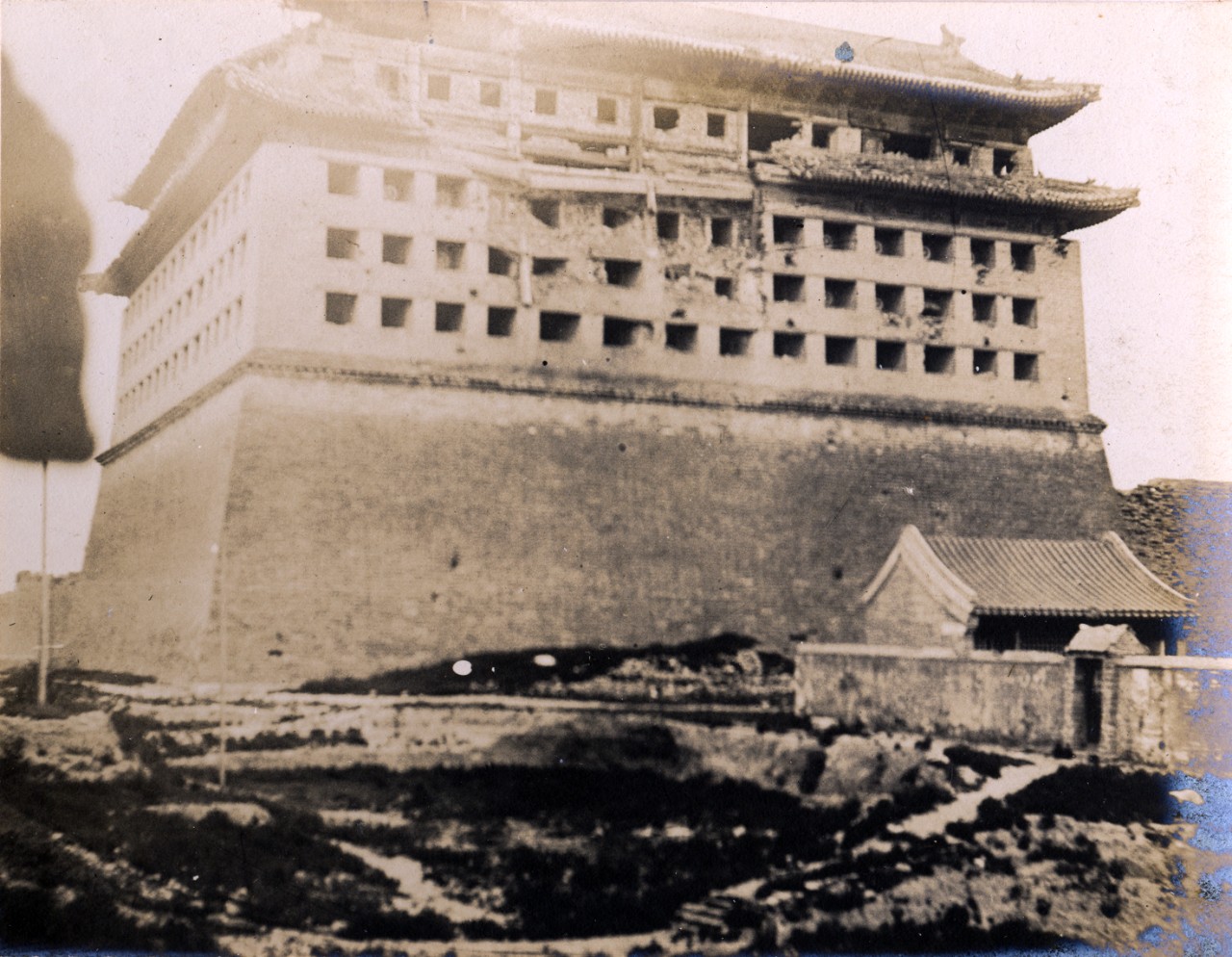
Gate attacked by the Americans at Beijing. (NHHC.)
Captain Reilly’s light battery cleared the wall of Chinese troops, protected by Marines from companies A and H. The 14th Regiment advanced through the city toward the legations. The 9th Regiment followed. At 1500, the Americans marched into the legations only to find the British had gotten there first.[90] Still, they were relieved to see the legation guard alive. The siege had ended.
The casualties among the Marines on 14 August were three wounded, including Lieutenant Smedley Butler, who sustained a chest wound while leading Company A onto the wall. That night, they camped outside the Tartar Wall. Major Waller went to sleep with a bottle of scotch under his pillow, given to him by a Marine officer, but some Marines decided they were in desperate need of a drink. First Lieutenant Frederic Wise Jr., son of Monocacy‘s commander Frederick Wise, stole the bottle from under Waller’s head without waking him, then replaced the now-empty bottle. The Marines chewed coffee beans to cover their tracks.[91]
Beijing was a city of many walls. The allies held part of the Tartar Wall, which surrounded the inner city, including the Legation Quarter. But there was also the Imperial Wall, surrounding the Imperial City, and within that, the walls of the Forbidden City, so named because entrance was forbidden to commoners. Unbeknownst to the allies, the Empress Dowager Cixi and her court had fled the Forbidden City, disguised as a peasants.
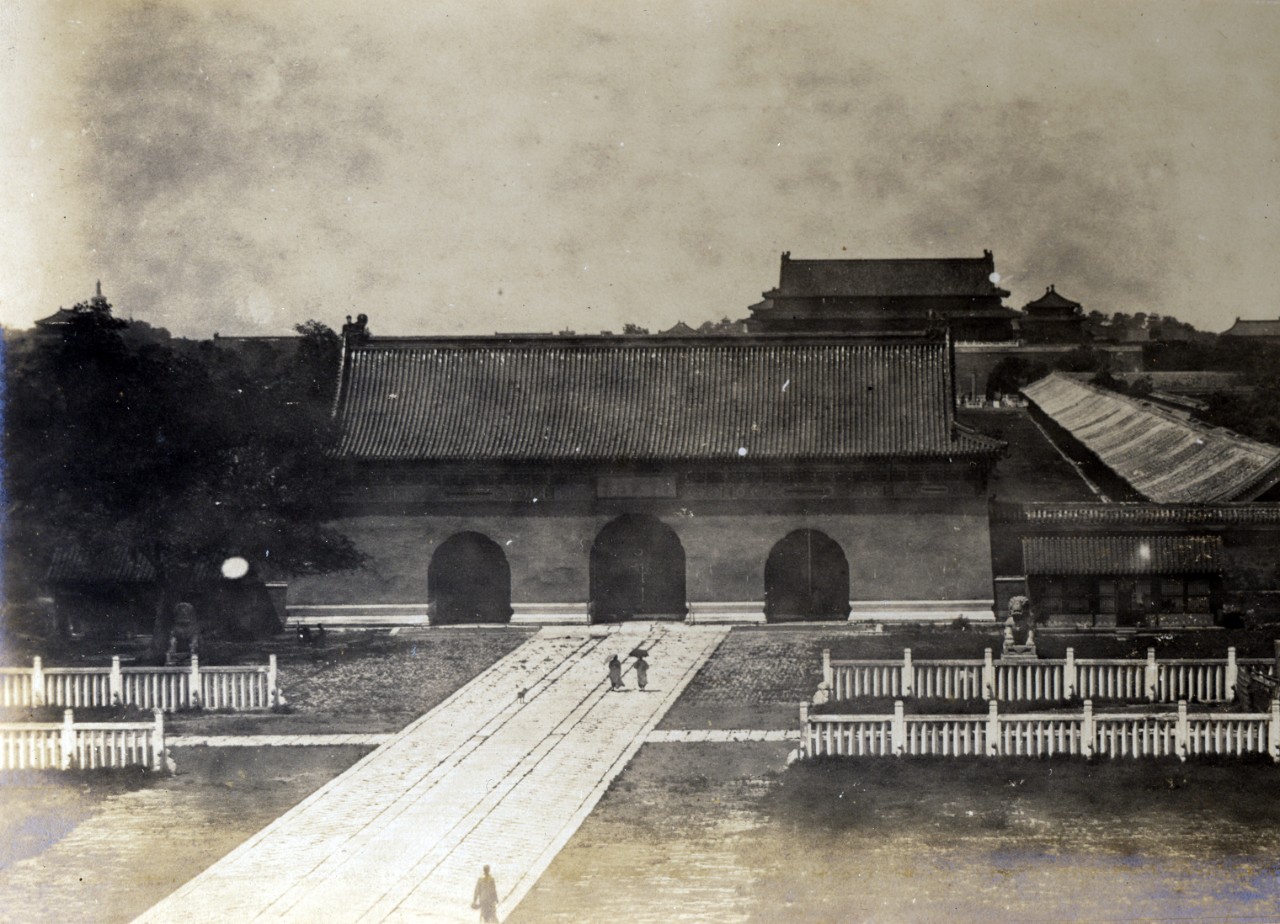
The Imperial City gates. (NHHC.)
On 15 August, the Americans alone attacked the Imperial City. The Marines led the way, clearing barricades on the Tartar Wall so that the artillery could fire from the pagoda atop the Zhengyangmen (Chienmen), the gate guarding the main entrance to the inner city. The Marines had orders to capture flags mounted at the west gate, but the order was revoked when Chinese opened heavy fire from a gate of the Imperial City. Two pieces of Reilly’s artillery fired on the gate, driving out the troops, but in the exchange, Captain Reilly was struck in the mouth by a bullet, dying at Major Waller’s side. Waller wrote of Reilly, “A braver solider, a truer friend never breathed than this admirable and lamented officer. He died at my side, touching me at the moment of the blow. He died without murmur or groan.”[92]
The 14th Regiment scaled the western wall only to find another wall, and yet another wall. They pressed forward, nearing the gates of the Forbidden City when the allied commanders insisted on a war council and decided not to occupy the Imperial City that day. Chaffee withdrew his troops from inside the city, the Marines holding their position on the Zhengyangmen.
The next day, 16 August, the forces of the eight-nation alliance moved into the Forbidden City.
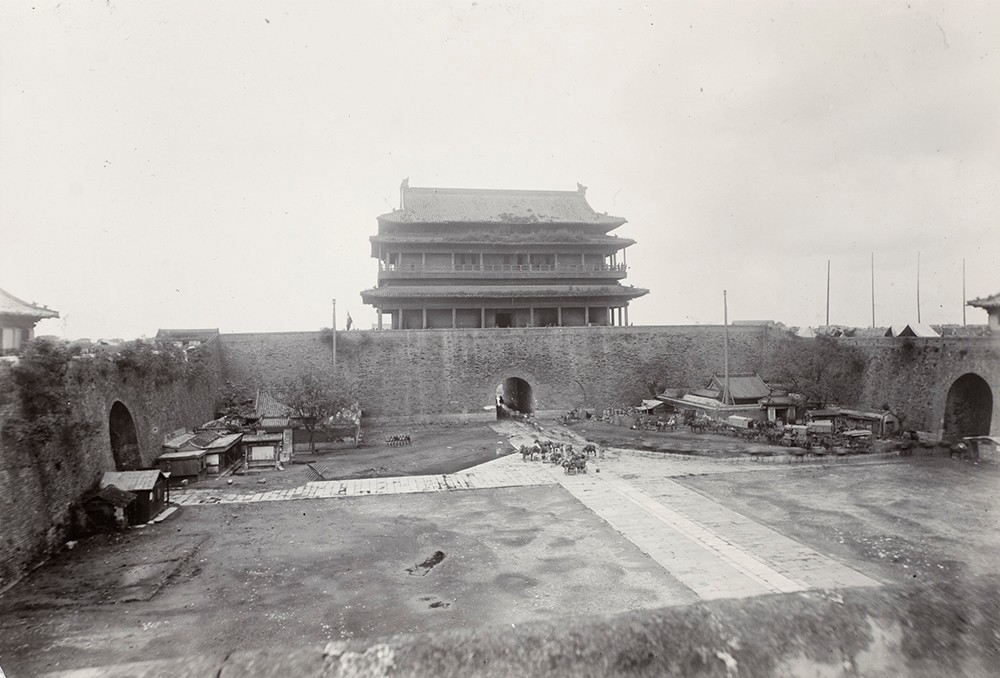
Pagoda atop the Zhengyangmen, the main gate to the inner city. (The National Archives, London, UK, C0 1069/425, www.hpcbristol.net/visual/na05-16.)
Aftermath, 1900–1911
The allies quickly divided the city and imposed martial law, the Americans occupying the southwest corner of Beijing. As at Tianjin, looting in Beijing became rampant and difficult to control. Although historians agree the British and Americans were “the least brutal in their behavior,” the Americans were not without fault.[93] One Marine private, Stephan Dwyar, was charged with rape and assault. General Chaffee cracked down hard on such cases, and Dwyar was sentenced to 20 years’ imprisonment at Alcatraz.[94]
Under Chaffee, the American occupation included providing vaccinations, cleaning latrines, constructing shelters for the poor, setting up food kitchens, and offering health checks for prostitutes. Chinese inhabitants moved into the American sector from other parts of Beijing, resulting in a housing shortage.[95]
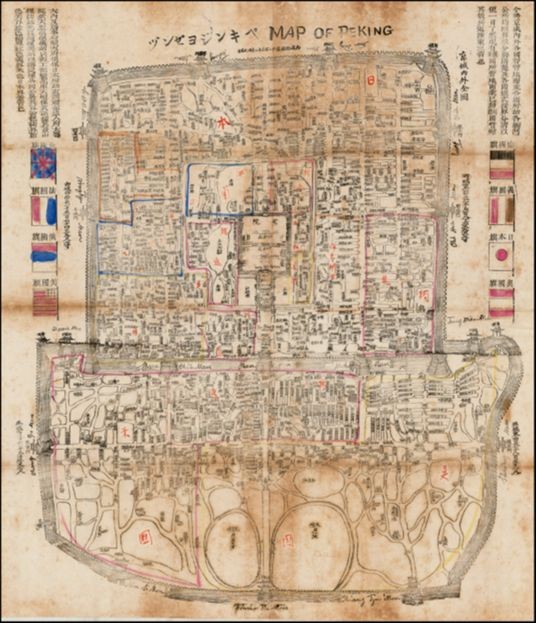
Map of Beijing hastily created by the Japanese army shortly after the allied occupation. Hand-colored flags represent each member of the Eight-Nation Alliance, and colored outlines show the areas of the city controlled by each nation: the United States, Austria-Hungary, Great Britain, France, Germany, Italy, Japan, and Russia. (Courtesy, Barry Lawrence Ruderman Map Collection, David Rumsey Map Center, Stanford Libraries, purl.stanford.edu/ps095pv0584.)
After a year’s worth of negotiations between the allies and the Chinese, a treaty known as the Boxer Protocol was signed in September 1901. It mandated that the Chinese would have to pay 450 million taels (about $350 million then, over $11 billion today) over 39 years, a tael for each of China’s estimated population of 450 million. The Russians would receive the largest share, over 28 percent, while the Americans were to receive about 7 percent, which they dedicated to education funding for foreign students. At the end of the 39-year period, in 1940, the Chinese had paid an estimated $600–$700 million due to the accrual of interest.[96]
The Boxer Protocol also further opened China to foreign influence. The Chinese had to destroy the Dagu Forts, allow foriegn powers to occupy points along the Hai River, comply with a two-year ban on weapons imports, and grant the foreign powers exclusive control of the Legation Quarter. In addition, the Boxer Protocol exacted punishment on pro-Boxer Chinese leaders. Qing officials had crafted an alternate history in which Empress Dowager Cixi had been held captive in her court, forced to back the Boxers against her will. Prince Duan, the conservative head of the Zongli Yamen, became the Qing dynasty’s scapegoat and was exiled. Meanwhile, some junior courtiers were condemned to commit suicide, and those who had already died were subject to “posthumous degradation.” To atone for the murders of German minister Baron von Ketteler and Japanese chancellor Sugiyama Akira, Chinese ambassadors had to travel to Germany and Japan to apologize. Furthermore, the Chinese were required to erect a monument for von Ketteler at the location of his assassination with an inscription expressing regret in Latin, German, and Chinese.[97]
In January 1902, Empress Dowager Cixi returned to Beijing and began to implement the very reforms that in 1898 had led her to overthrow her nephew and execute his advisors. The Boxer Rebellion had weakened the Chinese central government, and only a few years after Cixi’s death in 1908, the 1911 Revolution ended China’s last imperial dynasty and established the Republic of China.
Significance for the Navy and Marines
After the occupation of Beijing, the Navy reduced its presence in China, but did not disappear entirely. Monocacy, which had supported the U.S. military force at Tanggu, went into a mud dock in the Hai River during the winter. New Orleans also remained in North China, assisting the army and transporting mail from Nagasaki. Two monitors with full complements were stationed permanently in China, Monadnock at Shanghai and Monterey at Guangzhou (Canton). The Boxer Rebellion also expedited the expansion of a U.S. naval hospital in Yokohama, Japan.[98]
On 11 October 1900, all Marines were withdrawn from China. The total number of Marines sent to China for the Boxer Rebellion was 49 officers and 1,151 enlisted men. Twenty-two sailors and 33 Marines earned Medals of Honor for their actions. Marine Corps officers were not eligible for Medals of Honor until 1913, and so distinguished officers were “advanced in numbers” in their rank. Captain John Myers was advanced four precedence numbers and brevetted a major, and Lieutenant Smedley Butler was advanced two numbers and brevetted a captain.[99] Butler would go on to join Dan Daly as one of only two Marines to receive a Medal of Honor for separate actions, the first at Veracruz in 1914 and the second at Haiti in 1915.[100]
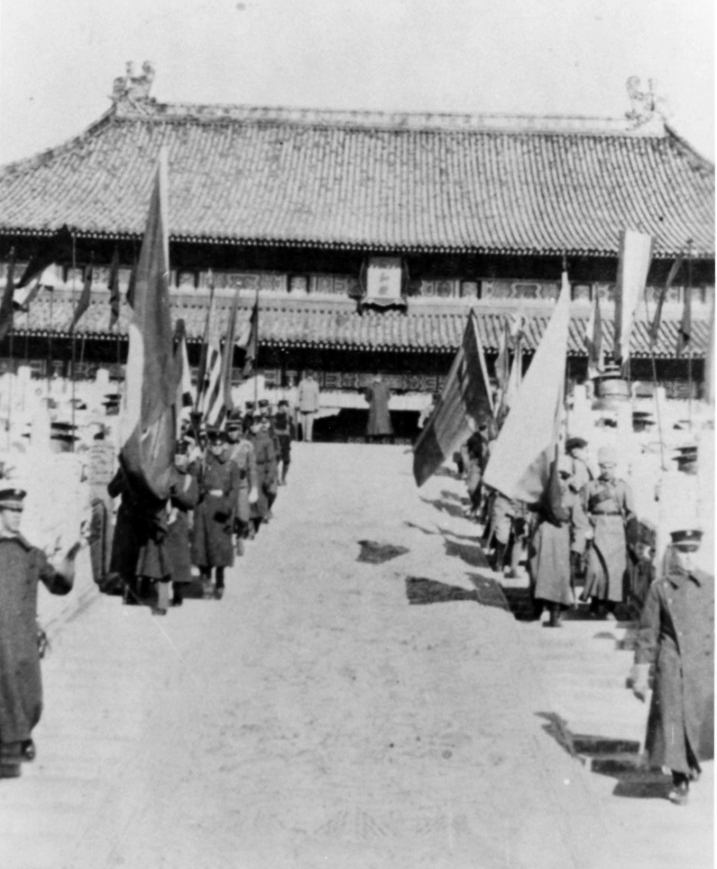
U.S. Marines leading a parade of the Allies in the Forbidden City after the relief of the Legation Quarter. (NHHC NH-2796.)
The Boxer Rebellion may have been a small war, but it was the American military’s first taste of coalition warfare. The allied commanders cooperated (for the most part) despite rivalries, conflicting orders, and language barriers. Leonhard writes that the challenges faced by the Americans—inadequate staffing, educational shortfalls, and language deficiencies—would continue to plague coalition warfare through the twentieth century.
The Boxer Rebellion was also a test in cooperation between the different branches of service. According to Leonhard, the collaboration between the Army, Navy, and Marine Corps was a testament to the character of the soldiers, sailors, and Marines, and not to the state of American joint warfare capabilities, as “in 1900, joint cooperation remained a matter of personal negotiation and inter-service politics.”[101]
The allied forces were not guaranteed victory in China. Silbey notes that if not for the discovery of sorely needed supplies at the Xigu Arsenal, the entire Seymour Expedition could have been killed or captured. At the Battle of Tianjin, an allied defeat seemed likely after the first day of fighting, an outcome prevented by Japan’s nighttime assault. And at the besieged Legation Quarter in Beijing, U.S. Marines held a critical and precarious position atop the Tartar Wall, which could have fallen had the Chinese mounted a full-scale attack.[102] Victory for the allies in the blistering summer of 1900 was made possible by luck and by the brave actions of individuals in the face of seemingly impossible odds.
Abraham Maslow: A Global Citizen Championing Human Potential
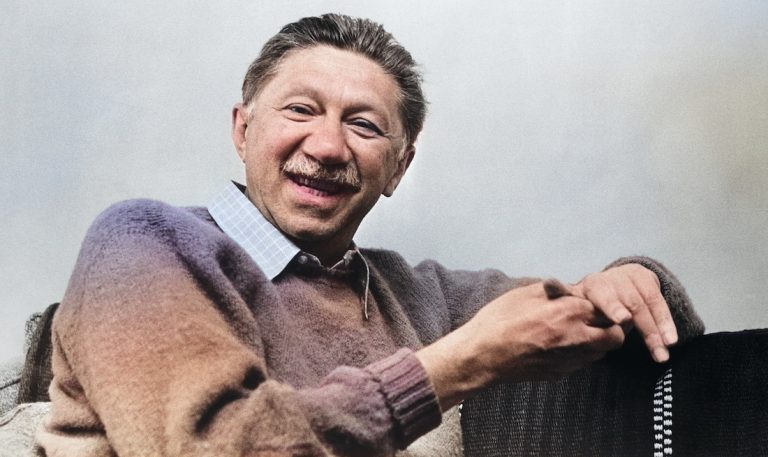
Abraham Maslow, a Brooklyn College alumnus, is a passionate advocate for global citizenship. Inspired by his studies in humanistic psychology, Abraham believes in the inherent goodness and potential of all people. His work focuses on empowering individuals to reach their full potential, fostering a more compassionate and interconnected world.
New York, N.Y. –– Abraham Maslow, a graduate of Brooklyn College, where he earned his degree in psychology. He is a passionate advocate for global citizenship, inspired by his studies in humanistic psychology.
Maslow is deeply committed to fostering a world where individuals are empowered to reach their full potential, promoting understanding and compassion across cultures. He believes that by embracing our shared humanity, we can create a more just and peaceful world.
He is actively involved in a variety of initiatives aimed at promoting global citizenship, including:
- Facilitating workshops and lectures on the principles of humanistic psychology and its application to global issues.
- Working with local organizations to promote cross-cultural understanding and cooperation.
- Supporting educational programs that empower young people to become global citizens.

What is ‘Maslow’s Hierarchy of Needs’?
According to Maslow, human needs are arranged in a hierarchy, with physiological (survival) needs at the bottom, and the more creative and intellectually oriented ‘self-actualization’ needs at the top.
Maslow argued that survival needs must be satisfied before the individual can satisfy the higher needs. The higher up the hierarchy, the more difficult it is to satisfy the needs associated with that stage, because of the interpersonal and environmental barriers that inevitably frustrate us.
Higher needs become increasingly psychological and long-term rather than physiological and short-term, as in the lower survival-related needs.
1. Physiological needs – biological requirements for human survival,
(air, food, drink, shelter, clothing, warmth, sex, and sleep)
Our most basic need is for physical survival, and this will be the first thing that motivates our behavior. Once that level is fulfilled, the next level up is what motivates us, and so on. The human body cannot function optimally if physiological needs are not satisfied. Maslow considered physiological needs the most important as all the other needs become secondary until these needs are met. Once an individual’s physiological needs are satisfied, the need for security and safety becomes salient.
2. Safety needs – people want to experience order, predictability, and control in their lives
Safety needs can be fulfilled by the family and society (e.g., police, schools, business, and medical care). For example, emotional security, financial security (e.g., employment, social welfare), law and order, freedom from fear, social stability, property, health, and well-being (e.g., safety against accidents and injury). After physiological and safety needs have been fulfilled, the third level of human needs is social and involves feelings of belonging.
3. Love and belongingness needs – the human emotional need for interpersonal relationships, affiliating, connectedness, and being part of a group
Examples of belongingness needs include friendship, intimacy, trust, acceptance, receiving and giving affection, and love. This need is especially strong in childhood and can override the need for safety, as witnessed in children who cling to abusive parents.
4. Esteem needs – include self-worth, accomplishment, and respect
Maslow classified esteem needs into two categories: (i) esteem for oneself (dignity, achievement, mastery, independence) and (ii) the desire for reputation or respect from others (e.g., status, prestige). Esteem is the typical human desire to be accepted and valued by others. People often engage in a profession or hobby to gain recognition, which gives them a sense of contribution or value. Low self-esteem or an inferiority complex may result from imbalances during this level in the hierarchy. Maslow indicated that the need for respect or reputation is most important for children and adolescents and precedes real self-esteem or dignity.
5. Self-actualization needs – refer to the realization of a person’s potential, self-fulfillment, seeking personal growth, and peak experiences
This level of need refers to what a person’s full potential is and the realization of that potential. Maslow described this level as the desire to accomplish everything that one can, and “to become everything one is capable of becoming.” Individuals may perceive or focus on this need very specifically. For example, one individual may have a strong desire to become an ideal parent. In others, the desire may be expressed athletically. For others, it may be expressed in paintings, pictures, or inventions. Although Maslow did not believe that many of us could achieve true self-actualization, he did believe that all of us experience transitory moments (known as ‘peak experiences’) of self-actualization. Such moments, associated with personally significant events such as childbirth, sporting achievement and examination success), are difficult to achieve and maintain consistently.
Maslow ‘s work is a testament to the power of individual action to create positive change in the world.
Through his unwavering commitment to human potential and global connection, he inspires others to embrace their role as global citizens and contribute to a better future for all.
Abraham Maslow: A Global Citizen Championing Human Potential (Aug. 13, 2020)
#globalcitizenship #humanpotential #humanisticpsychology #brooklyncollege #cuny #selfactualization #empowerment #compassion #interconnectedness #bethechange #HierarchyofNeeds
Tags: Humanistic Psychology, Brooklyn College, Global Citizenship, Social Justice, Education, Activism, Human Potential, Self-Actualization
The Legacy of Audre Lorde: Strong Voice for the Marginalized
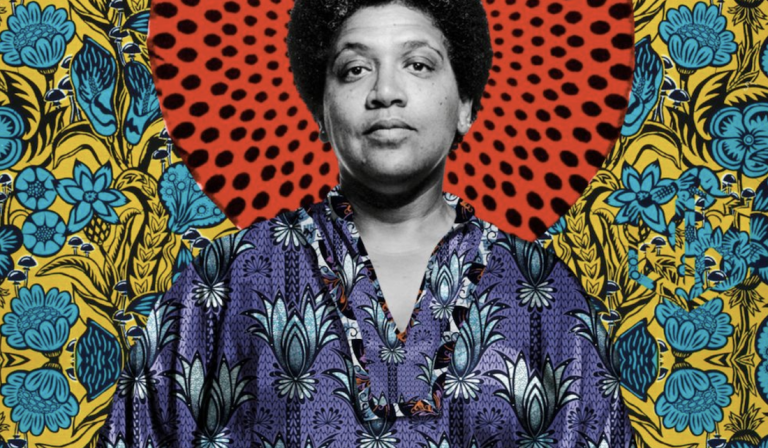
Audre Lorde, a trailblazing poet and activist, fought for justice and equality through her powerful words and actions. Her legacy continues to inspire.
New York, N.Y. — Audre Lorde was a renowned American poet, writer, and activist born in 1934 in New York City. She was a prominent figure in the civil rights, feminist, and LGBTQ movements, known for her work on intersectionality and her belief in the interconnectedness of social justice struggles.
Lorde attended Hunter College and earned a master’s degree from Columbia University. Her literary works, including poetry and essays, addressed issues of race, gender, and sexuality.
She co-founded Kitchen Table: Women of Color Press and was a vocal advocate against apartheid in South Africa.
In her public appearances, Lorde notoriously introduced herself the same way: “I am a Black, lesbian, mother, warrior, poet.” Sometimes, she would offer up a twist: “I am a Black, lesbian, mother, warrior, poet doing my work, coming to ask you if you’re doing yours.” It was her way of challenging the assumption that she could not take up space as her full self.
Lorde passed away in 1992 at the age of 58.
The Legacy of Audre Lorde: Strong Voice for the Marginalized (Aug. 13, 2024)
#AudreLorde #IntersectionalFeminism #PoetActivist #LGBTQRights #CivilRights
Tags: Audre Lorde, poetry, activism, feminism, LGBTQ rights, civil rights, intersectionality, social justice, CUNY, Hunter College
Nelson Mandela’s History with Riverside Church in New York
[draft]
New York, N.Y. — On August 5, 1962, Nelson Mandela – a member of the African National Congress (ANC) party and a socialist who advocated militant direct action against apartheid – was arrested by the South African Police, following a tip from the United States’ Central Intelligence Agency. Mandela was an influential political activist by this time, having become the president of the ANC’s Youth League in 1950 and co-founding its armed wing, uMkhonto we Sizwe (Xhosa for “Spear of the Nation”), in 1961, following the March 21, 1960 Sharpeville Massacre, when police murdered 69, and injured 180 others, during a peaceful protest.
Mandela was charged with high treason under the 1950 Suppression of Communism Act, along with nearly a dozen others, a diverse group of South African activists including those with Jewish, English, Indian Muslim, Xhosa, Pedi and mixed-race backgrounds. On April 20, 1964, as the trial began, Mandela delivered what is now known as his I Am Prepared to Die speech from the defendant’s dock while hundreds protested outside, bringing international attention to his case. Mandela opened the speech by insisting his activism was not influenced by outside agitators, a charge frequently leveled against black freedom movements throughout the world to this day: “I have done whatever I did, both as an individual and as a leader of my people, because of my experience in South Africa and my own proudly felt African background, and not because of what any outsider might have said.”
On June 12, 1964, Mandela was found guilty on all charges and, against the prosecution’s call for capital punishment, sentenced to life in prison. Mandela would spend 27 years in prison. During that time, international attention to Mandela’s case continued to grow, and by 1980 the United Nations Security Council had condemned South African apartheid and demanded Mandela’s release, but calls for UN sanctions on South Africa were vetoed by the administrations of the President of the United States, Ronald Reagan, and the Prime Minister of the United Kingdom, Margaret Thatcher. Later, the Comprehensive Anti-Apartheid Act of 1986 was passed by the United States House and Senate, but was again vetoed by Reagan. Reagan’s veto was harshly criticized, and in the following week, it was overridden by another House and Senate vote, one of very few foreign policy veto overrides in the 20th century.
The majority of Mandela’s time in prison was spent on Robben Island, a former leper colony off the coast of Cape Town. From the late 17th century, Robben Island had been used by colonial governments to detain political prisoners, starting with Autshumato, a chief among the Khoisan people who resided on the cape, who, in 1658, attempted to reclaim cattle stolen by the Dutch. Autshumato and his accomplices are believed to be first prisoners on Robben Island, perhaps the first known resisters to African colonialism, and the first, and purportedly only, to successfully escape the island. In the 1740s, Sayed Abdurahman Moturu, the Sheikh of Madura, was among many princes and kings exiled from Indonesia by the Dutch, first to the cape and then to Robben Island. Moturu is credited with being perhaps the first imam in Cape Town and died in prison on Robben Island in 1754. Today, the Moturu Kramat on Robben Island is a sacred pilgrimage site built in his honor. In 1766, men known as “Massavana” and “Koesaaij,” the only surviving leaders of a mutiny aboard the Dutch East India Company slave ship the Meermin, were imprisoned on Robben Island until their deaths. In 1819, Makhanda, a Xhosa warrior and spiritual leader, who had led a revolt after the British had seized cattle from the Xhosa, was taken to Robben Island. He drowned while attempting to escape a few months later. In 1873, Langalibalele, a king among the Bantu people, was taken to Robben Island when his people resisted having their firearms registered by British colonial overseers. He was eventually permitted to return to the mainland, but his titles were never restored, and he remained under house arrest until his death in 1889.
It is perhaps fitting that a prison which had held the kings and leaders of the colonized, would, in the end, produce the leader who dismantled South Africa’s apartheid regime.
During Mandela’s time on Robben Island many of its prisoners were members of political parties which had been banned by the apartheid regime, such as the ANC; religious activists, such as Njongonkulu Ndungane, who would go on to become the Anglican Archbishop of Cape Town; Pan-Africanists, such as Vusumzi Make, who had been Maya Angelou’s partner; and various trade unionists and anti-apartheid activists from both South Africa and Namibia. Prisoners like Mandela were required to spend much of their day breaking rocks in a lime quarry on the island, and Mandela’s eyesight was permanently damaged by the sunlight reflecting off the white rocks. Mandela began a correspondence course with the University of London to get an undergraduate law degree, but his correspondence was frequently heavily censored by the prison, and he was routinely given solitary confinement over smuggled news clippings. Mandela organized with fellow prisoners for better conditions and to create lecture courses for each other. Mandela also studied Islam and taught himself Afrikaans, the common language among the prison guards. Mandela’s constant organizing among the prisoners and self-education won him respect and it was out of this that he was able to begin negotiations with the prison officials, the courts, and the legal political parties, such as the white-led Progressive Party, on behalf of the prisoners to improve conditions on the island.
In 1982, Mandela and other ANC leaders were moved to Pollsmoor Prison on the mainland, perhaps to curtail their organizing amongst Robben Island prisoners. But the new location had somewhat better living conditions, and offered him greater freedom to correspond with comrades outside prison and thus greater political influence in an increasingly violent and impoverished South Africa. As fears of outright civil war rose, Mandela’s presence back on the mainland was widely felt and international calls to release him grew. In 1988, after a bout of tuberculosis brought on by poor prison conditions, Mandela was moved to the lower-security Victor Verster Prison, where talks began with the white supremacist National Party government of President F. W. de Klerk (a conservative who until 2020 insisted apartheid was not a crime against humanity) to negotiate his release and the unbanning of all political parties. On February 11, 1990, Mandela was released from prison and delivered remarks to thousands from the balcony of Cape Town City Hall. On March 2nd, Mandela was made Deputy President of the recently unbanned ANC party, and in May, the ANC met with the De Klerk government to commence negotiations toward ending apartheid.
In late June of 1990, between negotiations with the South African government, Mandela made a visit to the United States on a campaign to raise money for the ANC and to encourage the international community to continue economic sanctions until the agreement to end apartheid had been reached. Mandela was greeted by an estimated 750,000 people at a ticker tape parade through the Canyon of Heroes in Lower Manhattan, and given The Key to the City of New York by its first black mayor, David Dinkins (whose call for a police oversight Civilian Complaint Review Board would cause a massive police riot two years later). The next day, on June 21st, before speeches at Yankee Stadium, the United Nations, and a townhall at City College with Ted Koppel, Mandela attended an interfaith “Service of Thanksgiving for Nelson Mandela” at The Riverside Church.
Mandela processed into the packed Nave, with Rev. James A. Forbes, Riverside’s first black Senior Minister, at the lead, and Rev. Jesse Jackson at his side, continuous cheers and applause nearly drowned out the music of Nigerian drummer Babatunde Olatunji which accompanied him. Mandela was introduced by “the dean of black preachers in America,” Rev. Garner C. Taylor, who called Mandela “the true leader of South Africa, certified by his own courage and integrity, ratified by the blood of countless Black Africans slaughtered in Freedom’s cause, and confirmed by people of decency everywhere.”
Mandela took the pulpit, again greeted by minutes of rapturous applause. Mandela opened his statement by offering a greeting from the ANC and the “struggling people of South Africa.” He went on to say: “During the long years when we were in prison, you did not forget us. Neither did you abandon our struggling people. You enlisted the most cherished beliefs of your religious calling: you took up the mission of promoting justice and peace and helped the people’s fight against the evil of apartheid. We salute you.”
As we remember the 30th anniversary of Mandela’s first visit to The Riverside Church, where he delivered perhaps his first official address in the United States, we reflect on Riverside’s role in the world, in light of a renewed fight to demolish the social, economic and political structures that uphold racism. In the case of the anti-apartheid fight, Nelson Mandela himself credited Riverside, and its international, interracial, and interdenominational values, as a key part of the coalition that triumphed over the South African government.
How can Riverside again take up the mission of promoting justice and peace and help the people’s fight against the evil of racism? As Riverside’s Interim Senior Minister Rev. Michael Livingston said, “The systemic becomes personal. Racism kills. And we must root it out of our systems which infect individuals with consequences as deadly as the COVID-19.” Our Mission & Social Justice Commission continues this work, from joining the Mass Poor People’s Assembly & Moral March on Washington, launching a new Anti-Racism Task Force, and partnering with groups like Color of Change to hold officials in Minneapolis to account for the racism and violence there which led to the murder of George Floyd.
Jim Luce Writes on Turkey / Türkiye
Rising from the ashes of the Ottoman Empire, modern Turkey, now Türkiye, was founded by Mustafa Kemal Atatürk, who was dedicated to creating a secular Muslim state with progressive reforms that transformed the nation into a beacon of modernization and democracy in the Muslim world. However, under the leadership of Recep Tayyip Erdoğan, Turkey has experienced a significant shift towards authoritarianism, with crackdowns on dissent, media suppression, and erosion of secular principles. Having visited Istanbul many times, I can attest to its vibrant culture, rich history, and remarkable beauty, making it one of my favorite cities in the entire world. Much like Russia, Turkey boasts a phenomenal history and culture, yet its present political climate under Erdoğan’s rule is increasingly seen as reprehensible, drawing concerns from international observers about the country’s direction and the future of its democratic institutions

- Erdoğan Threatens to Invade Israel Over Gaza War (Aug. 2, 2024)
- Turkish Police Detain Dozens at Banned Istanbul Pride 2025 (June 30, 2025)
Follow Jim Luce on Facebook, Instagram, LinkedIn, TikTok, and X (Twitter).
© 2024 The Stewardship Report on Connecting Goodness – Towards Global Citizenship is published by The James Jay Dudley Luce Foundation Supporting & Educating Young Global Leaders is affiliated with Orphans International Worldwide, Raising Global Citizens. If supporting youth is important to you, subscribe to J. Luce Foundation updates here.
ABOUT Addiction Advice Africa Africa – South Africa – West Americas & Caribbean Analysis Animals & Animal Rights Anthropology Architecture Asia – East Asia-Pacific Asia – South Asia – Southeast Authoritarianism Available Content Calendar Canada Celebrity Children Childrens' Literature China (PRC) Cities & Urban Development Corporations Cuisine & Culinary Arts CULTURE Dance Disaster & Development Economics Education Europe Events Extremism Eyewitness Faith, Religion & Theology Family & Relationships Fashion Film & TV Global Warming Goodness Gun Control Health & Hygiene Heros of Democracy History Human Rights Humor Immigration & Migration In Depth International Relations Jim Luce Writes Law & Judicial System Leadership Liberation Movements Media Mental Health Mideast Monthly Feature Museums & Galleries Music Nature News Obituary Older Adults Open Orphans International Outer Space Pacific Islands Peace & Conflict Resolution Philanthropy Philosophy Philosophy Photography Poetry & Fiction Politics Pop Culture Poverty Press Pulse Profiles Racisim & Black Lives Matter Review Royalty Science & Technology Service Organizations Sexuality & Gender Social Media Sports & Olympics The Arts Theater & Comedy Travel U.N. U.S. Video Viewpoint War, Conflict & Terrorism Women WORLD World War II World War III Youth
Jim Luce Writes on the Gods

Humanity is unique in imagining anthropologic deities to guide us, calm us, and protect us. Across civilizations and centuries, these immortal beings speak to us and our fears, hopes and aspirations. These spirits help us to live and they help us to die. They help us to explain birth and they comfort us with tales of death. Like parents, they also often offer punishment and reward for good and evil.
Like in our section of Profiles & Obituaries, here we will enumerate the Gods and Goddesses, the Lwa, Bodhisattvas, and all the other terms associated with the immortal. Note that The Stewardship Report does not differentiate between ‘stewards’ and ‘stewardess‘, ‘actor’ and ‘actress,’ etc. Gender is important but not defining. Ergo, we will describe gender and sexuality as needed, but not automatically ascribe testicular attributes or lack thereof to our immortals.
Many of these Gods are thought once–or proven to have been–fully human. These immortals are differentiated with an asterisk (*). Note that the terms ‘mythology‘ and ‘theology‘ are used interchangeably.
In the context of Vodou, both in Haiti and West Africa, as well as other similar spiritual traditions, the term ‘Lwa’ is commonly used to describe divine spirits or deities that act as intermediaries between humans and the supreme creator. These Lwa are often associated with specific aspects of life and nature, and they have distinct personalities, preferences, and narratives.
Note that in many cultures there is a syncretism with two belief systems, such as Vodou and Roman Catholicism in Haiti, where some Lwa are associated with Catholic saints, or between Greek and Roman gods. We will double-list those entries.
- Agwe Tawoyo. Haitian Loa. Powerful spirit of the oceans is the ruler and guardian of its bounties. Often compared to Greek god Poseidon and is beloved by fishermen and sailors for his generous spirit. His mythical residence said to be hidden deep in the sea’s depths. During Vodou rituals, those possessed by Met Agwe often turn towards the sea, acknowledging his powerful presence. Married to Mambo La Sirène, the Haitian mermaid, and together they rule over a large group of spirits in the Vodou pantheon.
- Amaterasu. From Shintō. Sun goddess who painted islands of Japan into existence and from whom Japanese imperial family descends.
- Ammit. Egyptian demoness and goddess in the afterlife who devours the hearts of the unworthy.
- Anubis. From Egyptian mythology. God of mummification and the afterlife.
- Aphrodite. From Greek mythology. Goddess of love and beauty.
- Apollo. From Greek mythology. God of the sun, music, and prophecy.
- Ares. Greek mythology. God of war, counterpart to Mars in Roman mythology.
- Athena. From Greek mythology. Goddess of wisdom, warfare, and crafts.
- Avalokiteshvara. From Buddhist mythology. Bodhisattva of compassion.
- Ayida Weddo (and Damballa) are the primordial male and female divine couple in Vodou, symbolized by two intertwined serpents who, according to the cosmogony of the Haitian religion, support the sky, preventing it from crumbling and falling to Earth.
- Ayida. Haitian Loa. Divine power couple with Danmbala. They symbolize perfect balance and harmony of all creation, representing both masculine and feminine energies. When together, they’re often depicted as two intertwined snakes. Ayida is the rainbow, the snake of the sky. She gives rain to the earth and restores its beauty. Together, Damballa and Ayida are the source of life and wisdom. You can often spot their symbol of the intertwined snakes on Vodou drums, furniture, and even the poto mitan (the central pole of a peristyle).
- Ayizan Velekete. Haitian Loa. A wise old woman who walks the roads with her trusty cane, Ayizan Velekete is more than just a simple figure. She is the guardian of commerce and economy, known for her ancient wisdom and pure spirit. Her benevolent eye watches over business activities and roads, and Vodou practitioners often call upon her for success in their ventures. Wife of Papa Loko, they work together to ensure the purity and respect of the Vodou tradition. Her favorite tree is the palm tree, symbolizing royalty, though she is often depicted as a shrewd old woman.
- Bacchus. God of wine, pleasure, and festivities. Also known as Dionysus.
- Brahma. From Hindu mythology. The creator god.
- Buddha.* From Buddhist mythology. The enlightened one, founder of Buddhism.
- Chantico. From Aztec mythology. Goddess of fires in the hearth and volcanoes.
- Damballa (and Ayida Weddo) are the primordial male and female divine couple in Vodou, symbolized by two intertwined serpents who support the sky, preventing it from crumbling and falling to Earth. Divine power couple with Ayida. They symbolize perfect balance and harmony of all creation, representing both masculine and feminine energies. When together, they’re often depicted as two intertwined snakes. Damballa is the original force of creation, believed to be the inner voice of God. He’s the source of all wisdom and knowledge and represents the serpent of the earth and the horizon. Serpent Lwa associated with creation and purity.
- Dionysus. God of wine, pleasure, and festivities. Also known as Bacchus.
- Durga. From Hindu mythology. A warrior goddess who combats evil forces.
- Erzulie Dantò. Haitian Loa. Sister of Erzulie Freda. Also known as Mami Dantò, a powerful and protective mother figure in the Vodou tradition. Often depicted holding a knife, she symbolizes justice and will forcefully fight to protect her children, who are her loyal followers. She is a single mother, a Haitian peasant who is fiercely independent and takes care of her own. She is also a guardian and protector of orphans, sick children, and those who have been abused.
- Erzulie Freda. Haitian Loa of love, beauty, and prosperity. Erzulie Freda might be compared to the Greek goddess Aphrodite. She is a powerful spirit known for her vanity and timid nature. Her sister is the Petwo spirit Ezili Danto.
- Erzulie. A family of Lwa associated with love and femininity in Vodou, often linked with the Virgin Mary in Catholic contexts.
- Frances, Saint.* Roman Catholic. From Assisi, patron saint of animals.
- Freya. Norse/Scandinavian mythology. Goddess of love, fertility, and war.
- Ganesha. From Hindu mythology. God with the head of an elephant and the body of a human. Son of Shiva and Parvati. Known as the remover of obstacles and is often worshiped before new endeavors. Patron of writers, students, travelers, commerce, and new beginnings.
- Ghost, Holy. From Christian theology (Anglican). The third person of the Holy Trinity, representing God‘s presence in the world.
- God. From Christian theology. The singular, omnipotent creator in Christianity, often referred to as the Father.
- Hades. From Greek and Roman mythology. God of the underworld and the dead. Also known as Pluto.
- Hanuman. Hindu mythology. Half-human and half-monkey, devotee of Rama and a symbol of strength and devotion.
- Hera. From Greek mythology. Queen of the gods, goddess of marriage and family.
- Hermes. From Greek and Roman mythology. Messenger god, god of travel, commerce, and thieves.Also known as Mercury.
- Isadore of Seville, St. Haitian Loa.
- Isis. Egyptian mythology. Goddess of magic, marriage, healing, and protection.
- James, Saint. In Vodou and African Traditional Religions (ATR), associated with lwa Ogou known for war and iron,
- Jesus* (of Nazareth, or the Christ). From Christian theology. The Son of God and savior in Christian belief.
- Juno. From Roman mythology. Queen of the gods, equivalent to Hera.
- Jupiter. From Roman mythology. King of the gods, equivalent to Zeus.
- Kali. Hindu mythology. Goddess of time, change, and destruction.
- Kouzen Zaka. Haitian Loa. The quintessential farmer Loa, Kouzen Zaka is beloved by rural communities for his ability to ensure a bountiful harvest and prosperity in the fields. Often depicted wearing straw hat and carrying a machete and djakout (woven grass bag). He’s known to consume laziness and idleness. Often associated with Saint Isadore of Seville and loves all Haitians, living or dead. With childlike version of himself called Ti-Zaka in some lineages, this lovable Loa is all about embracing the power of hard work.
- Krishna. From Hindu mythology. An avatar for the preserver god Vishnu.
- Labalenn. Haitian Loa. Alternate form of the mermaid Mambo La Sirène.When angered, she can be fickle and dangerous. As the whale, she can manifest as a powerful force of unconscious strength.
- Lakshmi. From Hindu mythology. Goddess of wealth and prosperity.
- Legba, Papa. From Vodou tradition. A Lwa who serves as intermediary between spirit world and human world associated with St. Peter. Gateway to the spirit world and the one who unlocks the secrets of Vodou. Known as a trickster, he’s often portrayed as an older man leaning on a crutch, accompanied by one or more dogs.
- Loko, Papa. Haitian Loa. Powerful guardian of Vodou temples (known as hounfour), responsible for maintaining Vodou tradition and for passing down wisdom to new initiates in roles of Vodou priests and priestesses. With his extensive knowledge of herbal medicines and natural remedies, Papa Loko is also a healing Loa who can aid those in need of physical, emotional, or spiritual healing.
- Maitreya. From Buddhism. The future Buddha who will come to teach enlightenment.
- Mambo La Sirène. Haitian Loa. Haitian mermaid married to Agwe Tawoyo, ruler of the seas. The mermaid goddess of the sea reigns supreme. With her alluring half-woman, half-fish form, she embodies the wealth and abundance of the ocean and is revered as a powerful Loa who can grant prosperity and good fortune to her followers.
- Manjushri. From Buddhist mythology. Bodhisattva of wisdom.
- Mars. From Roman mythology. God of war.
- Mars. Roman mythology. God of war, counterpart to Ares in Greek mythology
- Mary, Virgin.* From Christian theology. The mother of Jesus Christ associated with love and femininity in Vodou through Erzulie.
- Mercury. From Greek and Roman mythology. Messenger god, god of travel, commerce, and thieves.Also known as Hermes.
- Met Kafou. This formidable Loa is the master of dark magic and sorcery, and he doesn’t grant his favors lightly. However, if you can prove yourself to be worthy, Met Kafou can bestow immense power and knowledge. His gifts come at a steep price, and he won’t hesitate to exact it.
- Minerva. From Roman mythology. Goddess of wisdom and war, equivalent to Athena.
- Odin. Norse/Scandinavian mythology. Chief god, associated with wisdom, poetry, and death.
- Ogou Feray. The mighty warrior Loa of Ogou, is the embodiment of a fighting spirit. Like the Roman war gods Mars and Jupiter, he commands respect and fear from his followers. As the protector and guardian of his people, Ogou is associated with fire, the sword and war.He is a fierce and formidable deity with multiple forms, including Ogou Feray, Ogou Batala and Ogou Badagri. Each Ogou spirit has distinct characteristics and attributes, but they all share a love for war, the sword, and forge work. Ogou is said to embody the warrior spirit of the old Oyo Empire in West Africa, and his Vèvè (religious symbol) is the totem of the emperors and kings that have followed Abiodun, King of the Oyo people.
- Ogou. From Vodou and African Traditional Religions (ATR). Lwa of war and iron in Vodou, often associated with St. James.*
- Orisha. From Vodou and African Traditional Religions (ATR). Known for love, fertility, and rivers in Yoruba religion.
- Oshun. From Vodou and African Traditional Religions (ATR).
- Osiris. Egyptian mythology. God of the afterlife, death, and resurrection.
- Parvati. From Hindu mythology. Mother of Ganesha.
- Peter, Saint.* A Catholic saint associated in Vodou with Papa Legba.
- Pluto. From Greek and Roman mythology. God of the underworld and the dead. Also known as Hades.
- Quetzalcoatl. Aztec god of wind, air, and learning.
- Ra. Egyptian mythology. Sun god and a major deity in ancient Egyptian religion.
- Rama. From Hindu mythology. An avatar for the preserver god Vishnu.
- Rhiannon. From Welsh mythology, associated with horses and the Otherworld.
- Samdi, Baron (Bawon). Leader of the Gede Loa group, the spirits of the dead in Vodou tradition. He is the guardian of the barrier between the living and the dead and is responsible for ensuring that the souls of the deceased pass into the afterlife safely. He is often depicted as a tall, dark figure dressed in a top hat, black tuxedo, and sunglasses, with a skull for a face. Bawon Samdi is known for his mischievous and playful nature, but it should not be taken lightly, as he holds the power of life and death in his hands.
- Saraswati. From Hindu mythology. Goddess of knowledge, music, and arts.
- Shiva. From Hindu mythology. The destroyer god, also known for his aspect as the cosmic dancer. Father of Ganesha.
- Spirit, Holy. From Christian theology. The third person of the Holy Trinity, representing God‘s presence in the world.
- Tara. From Buddhism. A Bodhisattva of compassion, particularly in Tibetan Buddhism.
- Thor. From Norse mythology. God of thunder and lightning.
- Ti-Zaka. Haitian Loa. Said to be the childlike version of Kouzen Zaka.
- Tlaloc. Aztec god of rain and fertility.
- Trinity, Holy. From Christian theology. Father (God), Son (Jesus), and Holy Spirit (or Holy Ghost).
- Venus. From Roman mythology. Goddess of love and beauty, equivalent to Aphrodite.
- Vishnu. From Hindu mythology. The preserver god, known for his avatars like Krishna and Rama.
- Yahweh. From Hebrew theology. The singular, omnipotent creator in Judaism.
- Zeus. From Greek mythology. King of the gods, god of the sky and thunder.
Follow Jim Luce on Facebook, Instagram, LinkedIn, TikTok, and X (Twitter).
© 2024 The Stewardship Report on Connecting Goodness – Towards Global Citizenship is published by The James Jay Dudley Luce Foundation Supporting & Educating Young Global Leaders is affiliated with Orphans International Worldwide, Raising Global Citizens. If supporting youth is important to you, subscribe to J. Luce Foundation updates here.
ABOUT Addiction Advice Africa Africa – South Africa – West Americas & Caribbean Analysis Animals & Animal Rights Anthropology Architecture Asia – East Asia-Pacific Asia – South Asia – Southeast Authoritarianism Available Content Calendar Canada Celebrity Children Childrens' Literature China (PRC) Cities & Urban Development Corporations Cuisine & Culinary Arts CULTURE Dance Disaster & Development Economics Education Europe Events Extremism Eyewitness Faith, Religion & Theology Family & Relationships Fashion Film & TV Global Warming Goodness Gun Control Health & Hygiene Heros of Democracy History Human Rights Humor Immigration & Migration In Depth International Relations Jim Luce Writes Law & Judicial System Leadership Liberation Movements Media Mental Health Mideast Monthly Feature Museums & Galleries Music Nature News Obituary Older Adults Open Orphans International Outer Space Pacific Islands Peace & Conflict Resolution Philanthropy Philosophy Philosophy Photography Poetry & Fiction Politics Pop Culture Poverty Press Pulse Profiles Racisim & Black Lives Matter Review Royalty Science & Technology Service Organizations Sexuality & Gender Social Media Sports & Olympics The Arts Theater & Comedy Travel U.N. U.S. Video Viewpoint War, Conflict & Terrorism Women WORLD World War II World War III Youth
Exploring the Metropolitan Museum of Art
[draft]
Exploring the Metropolitan Museum of Art (July 26, 2020)
Wanderlust: Hanging in Den Haag, Netherlands
The Binnenhof is a complex of buildings in the city center of The Hague, Netherlands, next to the court pond. It houses the meeting place of both houses of the States General of the Netherlands, as well as the Ministry of General Affairs and the office of the Prime Minister of the Netherlands.
Den Haag, Nederland. The cobbled streets of Den Haag, The Hague, with their quaint cafes and vibrant energy, beckoned us. We arrived in the Netherlands with a suitcase full of curiosity and a heart overflowing with anticipation. This wasn’t just another travel destination; it was a chance to immerse ourselves in a new culture, to expand our horizons, and to discover the hidden gems that awaited us.
The Netherlands, with its canals, windmills, and charming towns, has always held a special place in our hearts. But Den Haag, the seat of government and international justice, was a new frontier. We were ready to explore its history, its art, and its people. We were ready to live the dream.
Our first impression of Den Haag was one of elegance and sophistication.
The city’s architectural grandeur, from the imposing Binnenhof to the stately Mauritshuis, spoke volumes of its rich past. We spent hours wandering through the city center, taking in the sights and sounds, and soaking in the atmosphere. The aroma of freshly baked stroopwafels and the melodic clinking of bicycle bells filled the air.
We soon discovered that Den Haag was more than just a beautiful city; it was a vibrant hub of creativity and innovation. The city’s art scene was thriving, with numerous galleries and museums showcasing both established and emerging artists. We found ourselves drawn to the Gemeentemuseum Den Haag, home to an impressive collection of modern and contemporary art, including works by Piet Mondrian and Pablo Picasso.
Food, of course, was an integral part of our experience. We savored the rich flavors of Dutch cuisine, from traditional stamppot to the delectable bitterballen. We discovered hidden gems like the cozy cafes lining the canals, where we could enjoy a cup of coffee and a piece of apple pie while watching the world go by. We learned that eating was not just about sustenance; it was a social experience, a time to connect with friends and family and to share stories.
The Netherlands, known for its progressive policies and inclusive society, embraced us with open arms.
We found that the people were friendly, welcoming, and eager to share their culture with us. We struck up conversations with locals, learned a few Dutch phrases, and gained valuable insights into the Dutch way of life.
We learned about the Dutch love for cycling, the importance of family and friends, and their appreciation for the simple things in life. We witnessed firsthand their dedication to sustainability, their commitment to social justice, and their unwavering belief in the power of community.
Our journey through Den Haag was not without its challenges.
Navigating the complex public transportation system, understanding the subtle nuances of the Dutch language, and adapting to a new culture took time and patience. But with each hurdle overcome, our sense of accomplishment grew, and our appreciation for the Netherlands deepened.
One of the most memorable experiences was our visit to the Peace Palace, the iconic headquarters of the International Court of Justice. We were moved by the sense of history and purpose that permeated the building. We learned about the court’s role in resolving international disputes and promoting peace and justice around the world. It was a reminder of the power of human cooperation and the importance of striving for a more peaceful and just world.
Our adventures in Den Haag broadened our horizons and enriched our lives.
We discovered a city that was both cosmopolitan and charming, innovative and traditional. We learned about a culture that was both progressive and pragmatic, open-minded and down-to-earth.
As we bid farewell to Den Haag, we carried with us a treasure trove of memories, a renewed sense of appreciation for the world, and a profound understanding of what it means to be a global citizen. We knew that our journey had just begun. The world was our oyster, and we were ready to explore it, one adventure at a time.
#Travel #Netherlands #DenHaag #ExpatLife #GlobalCitizen #Wanderlust #Adventure #Culture #Photography #Food
TAGS: Europe, Dutch Culture, International Travel, Life Abroad, Travel Tips, Netherlands Travel, Den Haag Attractions
Nelson Mandela International Day
July 18
He brought his countrymen together, he achieved this after being a political prisoner for many years and to become their President at a time when his nation needed him. A true story that no one can make up. Long life!
Nelson Mandela International Day (7/18/20)
Jim Luce Writes on the American Revolution
- Baron von Steuben: His Hidden Life and Unforgettable Contribution (July 23, 2023)
- Strategic Brilliance, Innovation: Lessons from the Siege of Boston (July 23, 2014)
- Tea and Liberty: Lessons in Global Citizenship from the Boston Harbor (July 15, 2014)
- The Night That Ignited a Revolution: Revisiting the Boston Massacre (July 12, 2012)
Follow Jim Luce on Facebook, Instagram, LinkedIn, TikTok, and X (Twitter).
© 2024 The Stewardship Report on Connecting Goodness – Towards Global Citizenship is published by The James Jay Dudley Luce Foundation Supporting & Educating Young Global Leaders is affiliated with Orphans International Worldwide, Raising Global Citizens. If supporting youth is important to you, subscribe to J. Luce Foundation updates here.
ABOUT Addiction Advice Africa Africa – South Africa – West Americas & Caribbean Analysis Animals & Animal Rights Anthropology Architecture Asia – East Asia-Pacific Asia – South Asia – Southeast Authoritarianism Available Content Calendar Canada Celebrity Children Childrens' Literature China (PRC) Cities & Urban Development Corporations Cuisine & Culinary Arts CULTURE Dance Disaster & Development Economics Education Europe Events Extremism Eyewitness Faith, Religion & Theology Family & Relationships Fashion Film & TV Global Warming Goodness Gun Control Health & Hygiene Heros of Democracy History Human Rights Humor Immigration & Migration In Depth International Relations Jim Luce Writes Law & Judicial System Leadership Liberation Movements Media Mental Health Mideast Monthly Feature Museums & Galleries Music Nature News Obituary Older Adults Open Orphans International Outer Space Pacific Islands Peace & Conflict Resolution Philanthropy Philosophy Philosophy Photography Poetry & Fiction Politics Pop Culture Poverty Press Pulse Profiles Racisim & Black Lives Matter Review Royalty Science & Technology Service Organizations Sexuality & Gender Social Media Sports & Olympics The Arts Theater & Comedy Travel U.N. U.S. Video Viewpoint War, Conflict & Terrorism Women WORLD World War II World War III Youth
Jim Luce Writes on the West Coast
From the towering sequoias of California to the vibrant cities stretching along the Pacific coastline, Jim Luce has made the American West Coast both his subject and his stage. Through his extensive travels and engagements from San Diego to Seattle, Luce has cultivated a deep understanding of the region’s unique political landscape, cultural movements, and leadership dynamics. His work spans academic lectures with graduate students at California State University, where he shares insights on leadership and development through virtual platforms, to on-the-ground reporting at conferences and LGBTQ+ Pride events throughout major West Coast cities. Like the ancient giant sequoias that have witnessed millennia of California history, Luce’s writing captures the enduring spirit and evolving character of the West Coast, offering readers a seasoned perspective on the leaders, movements, and moments that define this influential region. His particular focus on political leadership, exemplified through his ongoing coverage of figures like Governor Gavin Newsom, reflects his commitment to documenting how visionary governance shapes the future of America’s most progressive and dynamic states.
- Gavin Newsom: A Visionary Leader for Our Times (July 10, 2024)
- Gov. Gavin Newsom of California: Leading with Vision and Compassion (July 10, 2023)
- LEADERSHIP | Newsom Defies Trump in Fiery State Address (Sept. 10, 2025)
Follow Jim Luce on Facebook, Instagram, LinkedIn, TikTok, and X (Twitter).
© 2024 The Stewardship Report on Connecting Goodness – Towards Global Citizenship is published by The James Jay Dudley Luce Foundation Supporting & Educating Young Global Leaders is affiliated with Orphans International Worldwide, Raising Global Citizens. If supporting youth is important to you, subscribe to J. Luce Foundation updates here.
ABOUT Addiction Advice Africa Africa – South Africa – West Americas & Caribbean Analysis Animals & Animal Rights Anthropology Architecture Asia – East Asia-Pacific Asia – South Asia – Southeast Authoritarianism Available Content Calendar Canada Celebrity Children Childrens' Literature China (PRC) Cities & Urban Development Corporations Cuisine & Culinary Arts CULTURE Dance Disaster & Development Economics Education Europe Events Extremism Eyewitness Faith, Religion & Theology Family & Relationships Fashion Film & TV Global Warming Goodness Gun Control Health & Hygiene Heros of Democracy History Human Rights Humor Immigration & Migration In Depth International Relations Jim Luce Writes Law & Judicial System Leadership Liberation Movements Media Mental Health Mideast Monthly Feature Museums & Galleries Music Nature News Obituary Older Adults Open Orphans International Outer Space Pacific Islands Peace & Conflict Resolution Philanthropy Philosophy Philosophy Photography Poetry & Fiction Politics Pop Culture Poverty Press Pulse Profiles Racisim & Black Lives Matter Review Royalty Science & Technology Service Organizations Sexuality & Gender Social Media Sports & Olympics The Arts Theater & Comedy Travel U.N. U.S. Video Viewpoint War, Conflict & Terrorism Women WORLD World War II World War III Youth
My Forefathers, the Puritans of New England

Painting: Pilgrims Going to Church by George Henry Boughton (1867).
[draft]
(July 8, 2020)
My Forefathers, the Puritans of New England (July 8, 2020)
Remembering My Visit to Poland Days Before Soviet Invasion
xxx [draft]
New York, N.Y. I remember when I first visited the capital of Poland in July 1981. Lech Walesa was powerful and the Soviet Union was days away from invading.
I arrived via train, having come across Siberia to Moscow en route to Berlin, returning from my junior year abroad in Tokyo. I wanted to visit my host family in Germany whom I had live with my gap year between high school and college when I attended Gymnasium through AFS.
In July 1981, the Soviets increased their military presence at their secret the military base at Borne Sulinowo, where the Red Army stationed per Warsaw Pact agreement as in all other Eastern Bloc countries.
Without notifying the Polish authorities, the Soviets unexpectedly sent over 600 tanks to Borne Sulinowo. The Soviets were worried about the explosive popularity of “Solidarity.”
Remembering My Visit to Poland Days Before Soviet Invasion (July 6, 2020)
Franklin D. Roosevelt: Architect of the New Deal and Global Visionary
New York, N.Y. Reflecting on the leaders who have profoundly shaped the course of history, Franklin D. Roosevelt stands out as a paragon of visionary leadership and unwavering commitment to democracy. His tenure as the 32nd President of the United States is marked by transformative domestic policies and a significant impact on global affairs. FDR’s legacy as a thought leader and global citizen is a testament to his ability to navigate the nation through some of its darkest times with courage, innovation, and an unyielding commitment to the common good.
Born on January 30, 1882, in Hyde Park, New York, Franklin Delano Roosevelt came from a privileged background that afforded him a robust education and exposure to international affairs. He attended Harvard University and later Columbia Law School, where his interest in public service began to take shape. Despite the advantages of his upbringing, FDR demonstrated a profound empathy for the struggles of ordinary Americans, a quality that would define his political career.
Roosevelt’s early political career began with his election to the New York State Senate in 1910. His commitment to progressive reform quickly became evident as he fought against corrupt political machines and championed policies to improve the lives of his constituents. His dedication to public service was further demonstrated during his tenure as Assistant Secretary of the Navy under President Woodrow Wilson, where he played a key role in modernizing the U.S. Navy during World War I.
In 1921, at the age of 39, Roosevelt was stricken with polio, which left him paralyzed from the waist down. Despite this life-altering challenge, FDR’s resilience and determination only grew stronger. He refused to be defined by his disability and instead used it to fuel his empathy and understanding for those facing adversity. This personal struggle forged a deeper connection between him and the American people, who admired his courage and perseverance.
FDR’s ascent to the presidency in 1932 came at a time when the United States was reeling from the Great Depression. The nation faced unprecedented economic hardship, with widespread unemployment, failing banks, and pervasive poverty. Roosevelt’s response to this crisis was nothing short of revolutionary. His New Deal, a series of bold and innovative programs and policies, sought to provide immediate relief, foster economic recovery, and implement structural reforms to prevent future depressions.
The New Deal’s impact on American society cannot be overstated.
Programs like the Civilian Conservation Corps (CCC), the Public Works Administration (PWA), and the Social Security Act transformed the lives of millions of Americans by creating jobs, improving infrastructure, and establishing a safety net for the elderly and vulnerable. Roosevelt’s vision extended beyond mere economic recovery; he sought to build a more just and equitable society where every citizen had the opportunity to thrive.
Roosevelt’s leadership during World War II further solidified his legacy as a global citizen and thought leader. As the threat of fascism and totalitarianism loomed, FDR recognized the necessity of U.S. involvement in the global struggle for democracy. His administration provided crucial support to Allied powers through initiatives like Lend-Lease, which supplied vital resources to nations fighting against Axis aggression.
FDR’s ability to unite the American people and galvanize support for the war effort was unparalleled.
His famous “fireside chats,” a series of radio broadcasts, brought him into the homes of millions of Americans, fostering a sense of unity and shared purpose. Roosevelt’s eloquence and ability to communicate complex issues in relatable terms endeared him to the public and reinforced their trust in his leadership.
Roosevelt’s vision extended beyond the immediate crisis of the war. He was a principal architect of the post-war international order, advocating for the creation of the United Nations to promote peace, security, and cooperation among nations. His belief in the importance of collective action and international collaboration laid the groundwork for a more interconnected and cooperative world.
One of the most enduring aspects of FDR’s legacy is his commitment to human rights and social justice. His “Four Freedoms” speech, delivered in 1941, articulated a vision for a world founded on four essential human rights: freedom of speech, freedom of worship, freedom from want, and freedom from fear. These principles became a cornerstone of the Allied war effort and later influenced the Universal Declaration of Human Rights.
Roosevelt’s leadership style was characterized by his ability to inspire hope and confidence in the face of adversity.
His optimism and belief in the American spirit were infectious, and he consistently sought to empower individuals and communities to contribute to the nation’s recovery and progress. FDR’s capacity to blend pragmatism with visionary thinking enabled him to implement lasting reforms that fundamentally transformed American society.
As I reflect on Franklin D. Roosevelt’s impact on the world, I am struck by his unwavering commitment to the principles of democracy, justice, and human dignity. His leadership during the Great Depression and World War II not only steered the United States through some of its most challenging periods but also set a precedent for future leaders to follow.
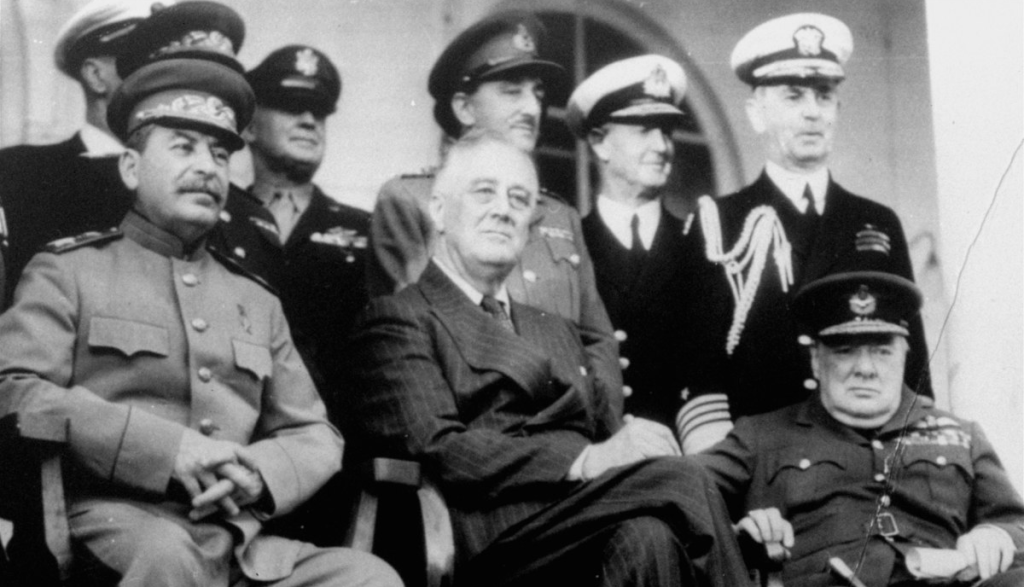
FDR’s legacy as a thought leader and global citizen serves as a powerful reminder of the importance of resilience, empathy, and visionary thinking in the pursuit of a better world.
Roosevelt’s life and career continue to inspire generations of leaders and citizens to engage in public service, advocate for social justice, and work towards a more inclusive and equitable society. His contributions to American politics and global affairs have left an indelible mark on history, demonstrating the profound impact that dedicated and principled leadership can have on the world.
In a time when the global community faces complex and multifaceted challenges, FDR’s example offers a beacon of hope and a blueprint for effective and compassionate leadership. His legacy reminds us that through determination, innovation, and a steadfast commitment to the common good, we can overcome adversity and build a brighter future for all.
Franklin D. Roosevelt: Architect of the New Deal and Global Visionary (July 3, 2020)
#FDR, #FranklinDRoosevelt, #NewDeal, #Leadership, #GlobalCitizen, #ThoughtLeader, #History
TAGS: FDR, Franklin D. Roosevelt, New Deal, Leadership, Global Citizen, U.S. President, Thought Leader, History
Speaker Nancy Pelosi: Champion of Progressive Change and Equality

Photo: Rep. Nancy Pelosi delivering remarks in Congress, 2015. Credit: U.S. Department of Labor.
Nancy Pelosi has been a staunch advocate for women’s rights, LGBTQ+ rights, and environmental protection. She has championed legislation aimed at closing the gender pay gap, protecting reproductive rights, and combating climate change. Her leadership in these areas has not only advanced progressive values but has also inspired countless individuals to join the fight for a more just and equitable society.
Washington, D.C. When I reflect on leaders who have profoundly influenced American politics and society, Nancy Pelosi stands out as a paragon of unwavering commitment to public service, progressive values, and effective governance. Her career, marked by historic achievements and steadfast dedication, highlights her role as a thought leader and global citizen. Pelosi’s influence on policy, her ability to navigate complex political landscapes, and her dedication to representing her constituents have cemented her legacy as a transformative figure in American politics.
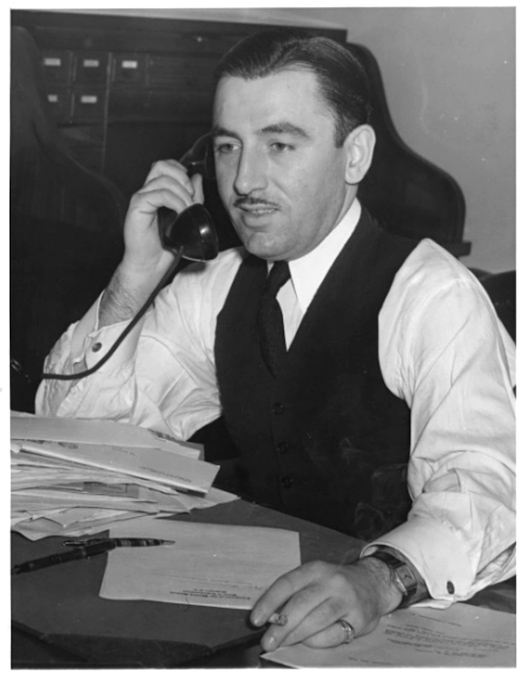
Born on March 26, 1940, in Baltimore, Maryland, Nancy Pelosi grew up in a family deeply involved in politics. Her father, Thomas D’Alesandro Jr., served as Mayor of Baltimore and a U.S. Congressman. From an early age, Pelosi was immersed in the world of public service and governance. This upbringing instilled in her a passion for civic duty and a commitment to fighting for justice and equality.
Pelosi’s political career began in earnest when she was elected to the U.S. House of Representatives in 1987, representing California‘s 5th district, and later the 8th and 12th districts. From the start, she demonstrated an extraordinary ability to lead and advocate for her constituents. Her dedication to public service and her talent for building coalitions quickly earned her respect and admiration from her colleagues.
One of Pelosi’s most significant achievements is her historic tenure as the first woman to serve as Speaker of the House, a position she first attained in 2007 and held again in 2019. As Speaker, Pelosi has been a powerful force for progressive change, leading the House through some of the most challenging and consequential periods in recent history. Her leadership has been instrumental in passing landmark legislation that has profoundly impacted the lives of millions of Americans.
Pelosi’s role in the passage of the Affordable Care Act (ACA) stands as a testament to her legislative skill and unwavering commitment to expanding access to healthcare. Despite immense opposition, Pelosi’s strategic acumen and ability to galvanize support within her party were crucial in securing the ACA’s passage. The law has provided millions of Americans with affordable healthcare, reflecting Pelosi’s dedication to social justice and equity.
In addition to healthcare, Pelosi has been a staunch advocate for women’s rights, LGBTQ+ rights, and environmental protection. She has championed legislation aimed at closing the gender pay gap, protecting reproductive rights, and combating climate change. Her leadership in these areas has not only advanced progressive values but has also inspired countless individuals to join the fight for a more just and equitable society.
Pelosi’s impact extends beyond domestic issues.
As a global citizen, she has consistently advocated for human rights, democracy, and international cooperation. Pelosi has been a vocal critic of authoritarian regimes and a staunch supporter of democratic movements worldwide. Her visits to conflict zones, meetings with international leaders, and support for global human rights initiatives underscore her commitment to promoting justice and democracy on a global scale.
One of the hallmarks of Pelosi’s career is her ability to navigate and lead through adversity. Her tenure as Speaker has included guiding the House through two impeachments of President Donald Trump, managing the legislative response to the COVID-19 pandemic, and addressing the aftermath of the January 6th Capitol insurrection. Through these tumultuous times, Pelosi’s leadership has been characterized by her resilience, strategic thinking, and unwavering commitment to upholding democratic principles.
Pelosi’s dedication to her constituents and her country is evident in her tireless work ethic and her accessibility to the people she represents. Known for her hands-on approach, Pelosi frequently engages with her constituents, ensuring that their voices are heard in Washington, D.C. Her ability to connect with and advocate for her constituents has made her a beloved figure in her district and a respected leader nationwide.
In addition to her legislative achievements, Pelosi’s role as a mentor and role model for women in politics cannot be overstated. Her historic rise to the Speakership has broken barriers and paved the way for future generations of women leaders. Pelosi has been a vocal advocate for increasing the representation of women in politics, and her success serves as a powerful example of what is possible when women lead.
As I consider Nancy Pelosi’s impact on American politics and global affairs, I am struck by her unwavering dedication to her principles and her ability to effect meaningful change. Her career is a testament to the power of determined and principled leadership. Pelosi’s ability to achieve legislative victories, even in the face of significant opposition, speaks to her strategic brilliance and determination.
Pelosi’s legacy is one of transformative impact and unwavering commitment to justice and equality.
Her work has improved healthcare access, advanced civil rights, and promoted social justice, leaving a lasting mark on the United States and the world. As a thought leader and global citizen, Nancy Pelosi exemplifies the principles of effective leadership, advocacy, and a commitment to the common good.
In a time when the political landscape is often marked by division and discord, Pelosi’s leadership offers a beacon of hope and a reminder of the importance of perseverance, collaboration, and a steadfast commitment to justice. Her life and career inspire us to engage in public service, advocate for what is right, and work towards a more equitable and just society.
Nancy Pelosi’s contributions as a thought leader and global citizen have left an indelible mark on the world. Her work has shaped the course of American politics and inspired countless individuals to join the fight for justice and equality. As we look to the future, Pelosi’s legacy serves as a guiding light, reminding us of the power of dedicated public service and the enduring impact of principled leadership.
Speaker Nancy Pelosi: Champion of Progressive Change and Equality (July 2, 2020)
#NancyPelosi, #Leadership, #PublicService, #ProgressiveValues, #ThoughtLeader, #GlobalCitizen
Tags: Nancy Pelosi, Thought Leader, Global Citizen, U.S. House of Representatives, Speaker of the House, Public Service, Progressive Politics, Advocacy
Taíno
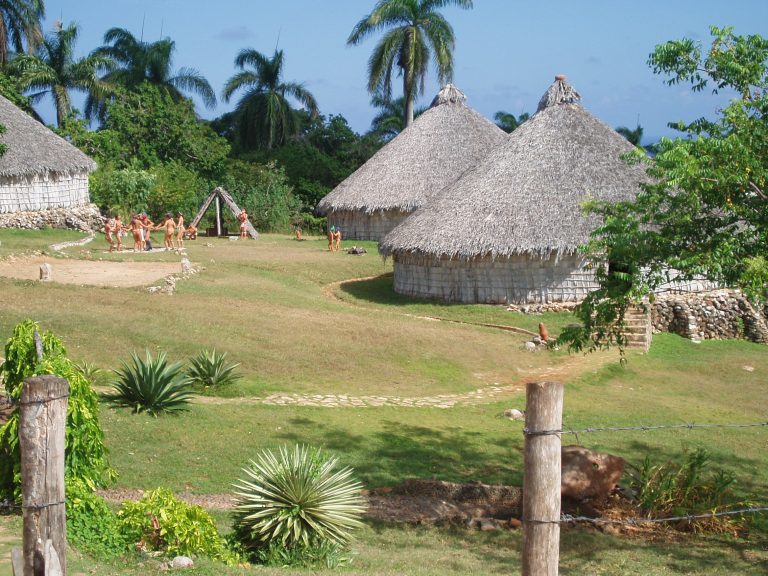
Photo: Reconstruction of a Taíno village in El Chorro de Maíta, Cuba, 2005. Credit: Michal Zalewski/Wikimedia Commons.
[draft]
Remembering Our Friend Annabella Quintanilla Gonzalez (1941-2019)
A Thought Leader and Global Citizen, Annabella Quintanilla Gonzalez [Luce Index™ rank 91] was born in Mexico City, great-grand daughter of the reformist President of Mexico, Sebastian Lerdo de Tejada.
Her father was a progressive labor leader and celebrated founder of the Faculty of Economics at the national university of Mexico. Her grandfather was ambassador to France and the family commonly spoke French. Her uncle helped found the United Nations and was ambassador to the United States and Russia. Family friends included Frida Kahlo and the young Fidel Castro. Jim Luce covered her performances for The Huffington Post.

New York, N.Y. Annabella Gonzalez, the choreographer Founder and Director of Annabella Gonzalez Dance Theater (AGDT), the New York-based modern dance company continuously active since 1976, died at Mt. Sinai Hospital, Manhattan. Her husband, Richard Grimm, said she died of complications from a longstanding lung disease (COPD) possibly originating with childhood tuberculosis.
Ms. Gonzalez’s dance career spanned fifty-five years.
She studied with several of the greats, including Martha Graham and Vladimir Dougadovsky. She developed a spare, intimate well-crafted style combining a sometimes quirky ballet and modern vocabulary linked to carefully selected classical, modern classical and contemporary music. Jennifer Dunning of the New York Times said “Annabella Gonzalez approaches the artifacts of everyday life in somewhat the way that Paul Klee looked at machines.”
Her scores of dances, while largely in the New York and European modern dance traditions, sometimes reflected her Mexican roots, such as her take on the folk dance “Los Viejitos” and “Pastoral Latino.”
Ms. Gonzalez usually steered clear of “message” pieces, but recently did a prideful celebration of Mexico and Mexican-Americans in “Tribute”, set to classic Mariachi songs, and earlier created “To the Victims of Hiroshima.” Her sly comedic pieces included “White Rug,” a disastrous picnic set to Mozart.
Among the smaller dance companies in New York, she stood out for the long tenure of her AGDT dancers and other collaborators. She collaborated over the years with noted composers such as Stefania de Kennesey, Max Lifschitz and Seymour Barab.

Company members, several serving for over ten years and often contributing creatively, included:
Dominique Weibel, Jim Jacobs, Juan Echazarreta, Johnny Martinez, Marcos de Jesus, Heather Pannikar, Lucia Campoy, Jenna Parker, Shannon Maynor, Jorge Fuentes, Esteban Arana, Leticia Pliego, Christopher Amato, Carolina Santos Read, Kendra Dushak and Joel Levy, among many others.
Ms. Gonzalez also collaborated with guest performer/choreographers such as Maxine Steinman, Mr. Amato, Ms. Parker, Sara Joel, Esteban Arana and Leticia Pliego.
Annabella Gonzalez Quintanilla had a multi-faceted identity reflecting her exotic international background.
She was born in Mexico City on May 23, 1941. Her mother, Lutecia Quintanilla del Valle, was the grand daughter of the reformist President of Mexico, Sebastian Lerdo de Tejada. Her father, Enrique Gonzalez Aparicio, was the progressive labor leader and celebrated founder of the Faculty of Economics of UNAM, the national university of Mexico, who died just before Annabella was born.
Her grandfather, Luis Quintanilla, was in Paris as ambassador to France for many years, and the colorful family, when back in Mexico, commonly spoke French. Her uncle Luis Quintanilla helped found the United Nations and was ambassador to the United States and Russia and was Mexican interior minister.
In Mexico, Annabella attended a French Lycée and met a number of interesting family friends such as Frida Kahlo and the young Fidel Castro. Annabella’s mother Lutecia remarried Kelly Wehnes, an American Marine officer visiting Cuernavaca who had a Distinguished Flying Cross from The Battle of Okinawa. He took the family to Minneapolis in the 1950s.
There, Annabella graduated from the University of Minnesota with an art history degree, an area she continued at Columbia University as a grad student. Later, in the 1990s she obtained a Columbia M.A. in dance education and taught a class there in traditional Mexican dance.
From the late 1960s, using her fluent French, she earned language and interpreting degrees at the University of Geneva, Switzerland. Over her nine years there, her interpreting supported her initial modern dance career with the Ballet Jeunes de Geneve and the Dance Theater Workshop of Geneva. Ever adventurous, she crossed the Sahara with a German baron, Thilo von Trotha, who remained a good friend.
Back in New York, sometimes interpreting in three languages at the United Nations, Ms. Gonzalez founded AGDT in 1976. In addition to performances at venues such as Lincoln Center Outdoors, Carnegie Hall, Central Park Festival, Manhattan Movement & Arts Center, and Brooklyn Academy of Music, AGDT has mounted hundreds of productions at schools, colleges, libraries and cultural centers in the New York area —many enabling underserved audiences to discover modern dance. It has had several residencies including at the Harkness Foundation for Dance and the National Dance Museum at Saratoga Springs.
AGDT’s Spring Series has been presented every year for forty-two years, with most choreographies by Ms. Gonzalez. Her Mexican performances were at UNAM in Mexico City, the University of Colima and appearances in festivals in Chihuahua and San Luis Potasi. AGDT has enjoyed consistent support from organizations such as the New York City Department of Cultural Affairs, the Harkness Foundation for Dance, the Mexican Cultural Institute and the Nicotra Foundation.
Ms. Gonzalez was planning AGDT activities until two days before she died. She is survived by her husband of thirty-nine years, Richard Grimm, as well as many family members in Mexico, Spain and the U.S. with whom she had fond ties.
On a personal note, my fiftieth birthday was celebrated on Annabella and Richard’s gorgeous penthouse terrace overlooking Central Park in July 2009. I will always remember their warmth, creativity and generosity. – JL
Remembering Our Friend Annabella Quintanilla Gonzalez (1941-2019) (June 28, 2020)

Eyewitness | Elementary Education in Indonesia
[draft]
Visiting a school similar to where Barack Obama attended in Jakarta, Indonesia.
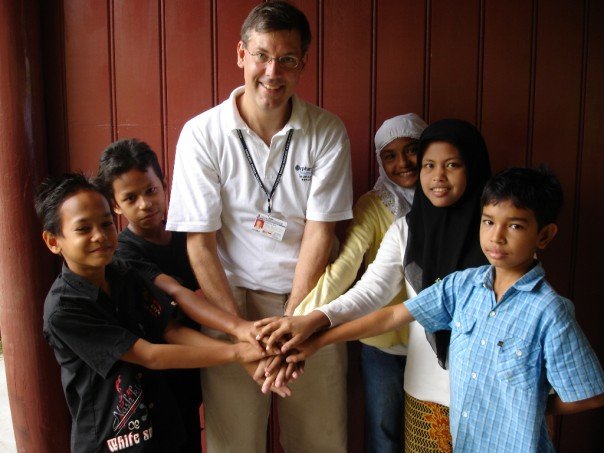
Eyewitness | Elementary Education in Indonesia (June 23, 2020)
Meeting with Guyanese Community Leaders
[draft]
New York, N.Y. The Guyanese community has been integral to Orphans International since inception (2001).
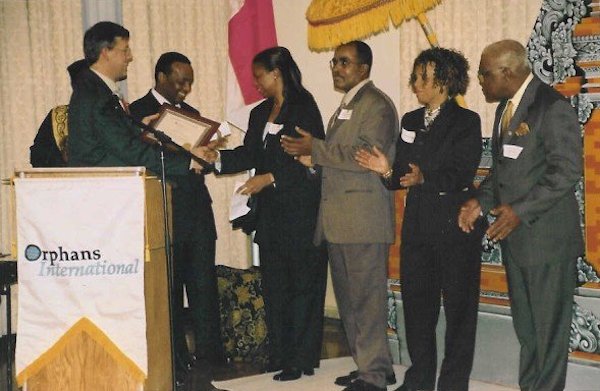
Meeting with Guyanese Community Leaders (June 23, 2020)
Meeting with Chinese Leaders
[draft]
With Chinese Communist Party Executive Chairman Yu Xiang Long, a member of our Global Advisory Board.
Meeting with Chinese Leaders (June 23, 2020)
Meeting with Faith Leaders Across Theological and National Boundaries

[draft]
Meeting with Faith Leaders Across Theological and National Boundaries (June 23, 2020)
One Decade of Cherry Blossoms
Photo: Cherry trees blossom each spring along the East River Promenade on Roosevelt Island adjacent to the United Nations. Credit: Stewardship Report/John Lee.
History of the Roosevelt Island Festival

One Decade of Cherry Blossoms (June 21, 2020)