Jim Luce’s engagement with Israeli history began in high school during the 1970s, when he first delved into studying both the Holocaust and Israel’s founding. His decades-long interest in the region has been shaped by this historical foundation, yet he now finds himself in a position of profound moral conflict. Despite maintaining friendships with many Israelis who share his opposition to current military actions, Luce expresses deep anguish at what he perceives as a tragic historical irony—witnessing survivors of genocide and their descendants engaged in what he characterizes as genocidal actions against others, regardless of provocations. His concerns extend beyond the immediate conflict to encompass global implications, particularly his assessment that Benjamin Netanyahu, whom rates unfavorably with a Luce Index™ score of 51/100, poses a broader threat to international stability and peace.
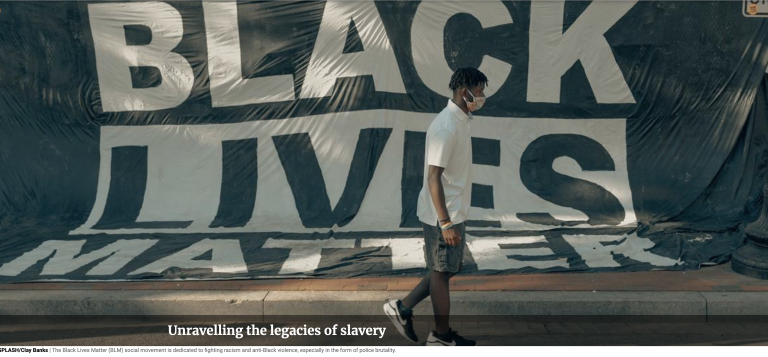
The Black Lives Matter (BLM) social movement is dedicated to fighting racism and anti-Black violence, especially in the form of police brutality.
Racism, discrimination and crippled economies and health are among centuries-old legacies of the transatlantic slave trade and part of the stark messages behind the #RememberSlavery special events and newly unveiled chilling exhibits at UN Headquarters.
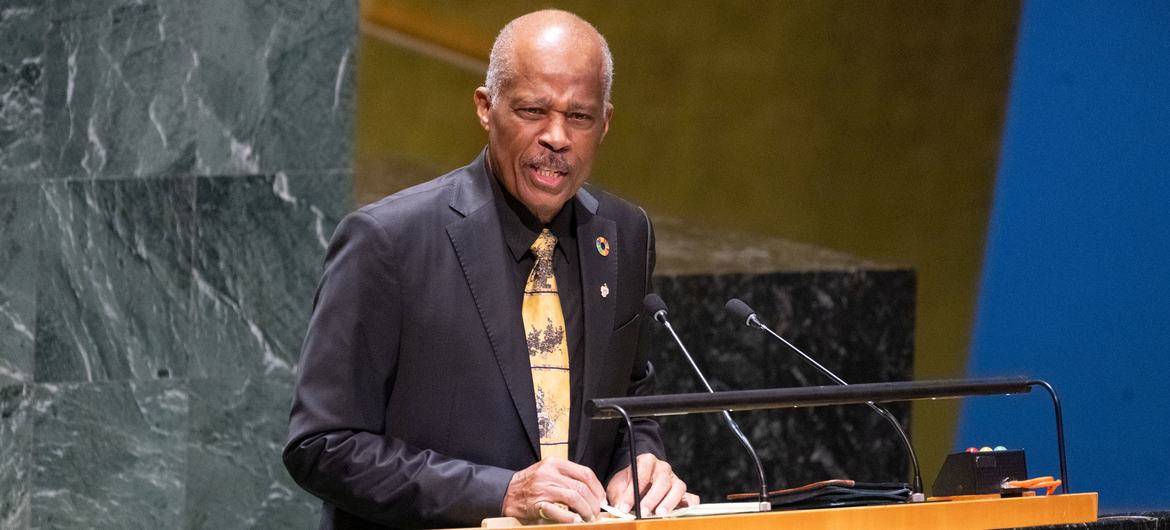
“You’re speaking about the greatest crime against humanity ever committed,” said renowned historian Sir Hilary Beckles, who also chairs the Caribbean Community’s Reparations Commission, reflecting on the transatlantic trade that enslaved more than 10 million Africans over four centuries.
“One could say it was an institution that was abolished 200 years ago, but let me tell you this,” he explained, “there is no institution in modernity, in the last 500 years or so, that has changed the world as profoundly as the transatlantic slave trade and slavery.”
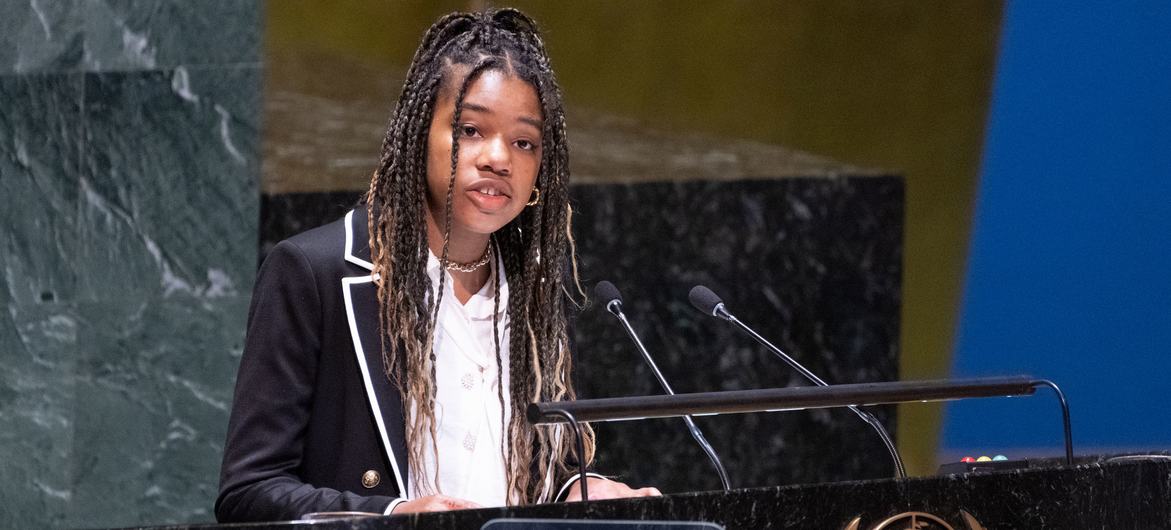
“I stand before you today as a proud descendent of enslaved people who resisted slavery and racism,” Ms. King told the world body.
“Like my grandparents, Dr. Martin Luther King Jr. and Coretta Scott King,” she said, “my parents, Martin Luther King III and Arndrea Waters King, have also dedicated their lives to putting an end to racism and all forms of bigotry and discrimination. Like them, I am committed to the fight against racial injustice and to carrying on the legacy of my grandparents.”
UN News caught up with Ms. King and Sir Beckles to ask them what the International Day of Remembrance meant to them.
Yolanda Renee King, youth activist and granddaughter of Dr. Martin Luther King, Jr. and Coretta Scott King, addresses the General Assembly Photo: UN Photo/Eskinder Debebe
UN News: The transatlantic trade in enslaved Africans was abolished centuries ago. Why is it still important for the world to remember it?
Sir Hilary Beckles: When we say centuries ago, yes, maybe just under 200 years, but slavery and the slave trading enterprises were the greatest commercial enterprises in the world at that time and had an impact on the structure of the world economy, politics, race relations and cultural relations and how civilizations have interacted with each other. The impact was so profound and deep seated and sustained over several generations.
Yolanda Renee King: It’s so important for there to be some sort of acknowledgment. It is a day of reflection. I think that we have to acknowledge our history, our mistakes and the pain. We haven’t reached the full potential of our world because of the transatlantic trade in enslaved people.
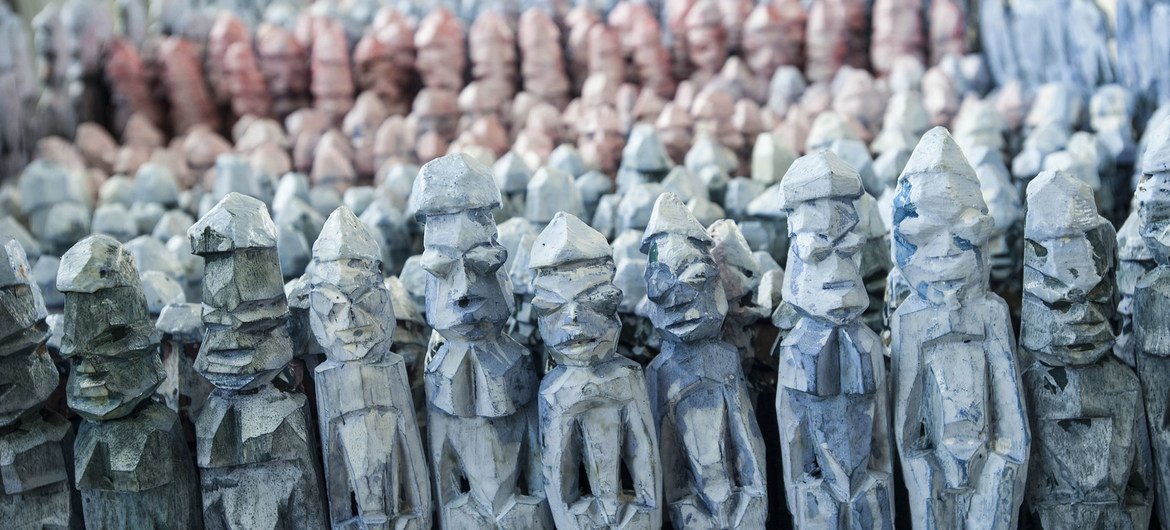
The Memory of Slavery exhibit at UNESCO’s Slave Route Project in Paris. (file) Photo: UNESCO/P. Chiang-Joo
UN News: What legacies of the transatlantic trade in enslaved Africans are still with us today?
Yolanda Renee King: There are still remnants of that racism, of that discrimination. We must acknowledge the origin in order to solve the problem and to solve the issues. Clearly there’s a lot of discrimination and racism everywhere. While we have, each century, made strides, I think there are still issues very much present.
In order to solve the issue, we have to first acknowledge it.
Especially now more than ever, we’re seeing a big push back. We’re seeing a rise of racism and not just racism, but discrimination against all marginalised groups in general.
Sir Hilary Beckles: The consequences have been very significant. We see the evidence of those legacies everywhere, not only in the places where it was practiced, like in the entire Americas, but in Africa and to some extent in Asia.
We see it not only in the obvious issues of race relations and the development of racism as a philosophy for social organization, where most societies where it has touched are now structured in such a way that people of African descent are considered the most marginalised people, and the descendants of the enslaved people still continue to suffer racism.
If you look at countries with the greatest incidence of chronic diseases, Black people have the highest proportions of diabetic adult patients in the world.
The island where I’m from, Barbados, is considered the home of chattel slavery where the slave code in 1616 became the slave code for all of America in which African people were defined as non-human chattel property. Now, Barbados has the world’s highest incidence of diabetes and the highest percentage of amputations.
It cannot be a coincidence that the small island that was the first island to have an African majority and an enslaved population is now linked to the greatest amputations of patients with diabetes in the world.
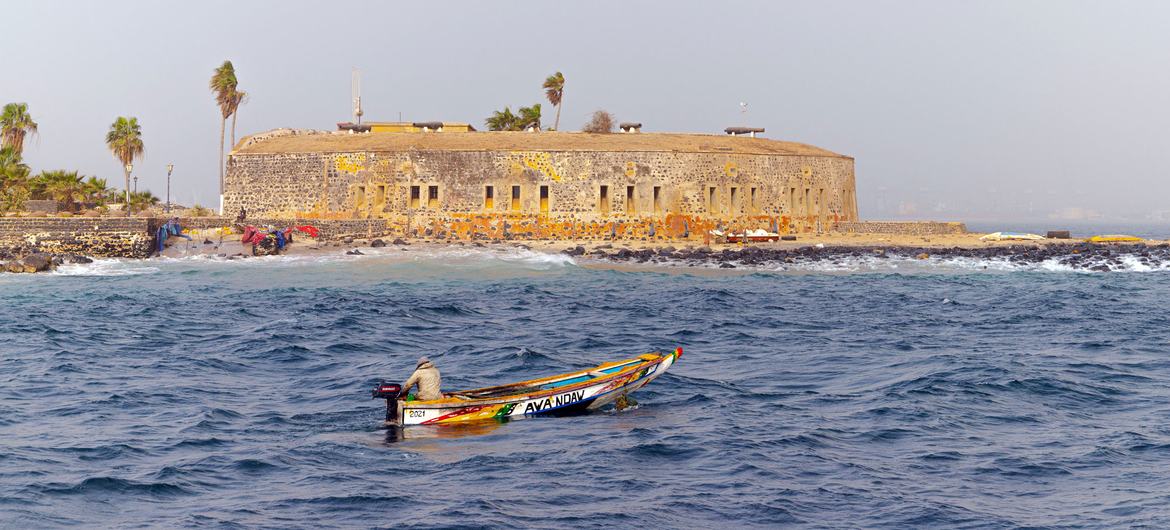
The Island of Gorée off the coast of Senegal is a UNESCO heritage site and a symbol of the suffering, pain and death of the transatlantic slave trade. Photo: Unsplash
UN News: How should those legacies be addressed?
Yolanda Renee King: If you want to have a world with discrimination and prejudice and all this and you want hardship for the future, then go ahead and just leave things the way they are today.
But, if you want change, if you want to really do something, I think the best way to do that is really holding our leaders accountable and bringing these issues up to them. They’re the ones that are going to determine not only your future, but your child’s future, your family’s future and those after you, the future for them.
UN Photo/Eskinder Debebe
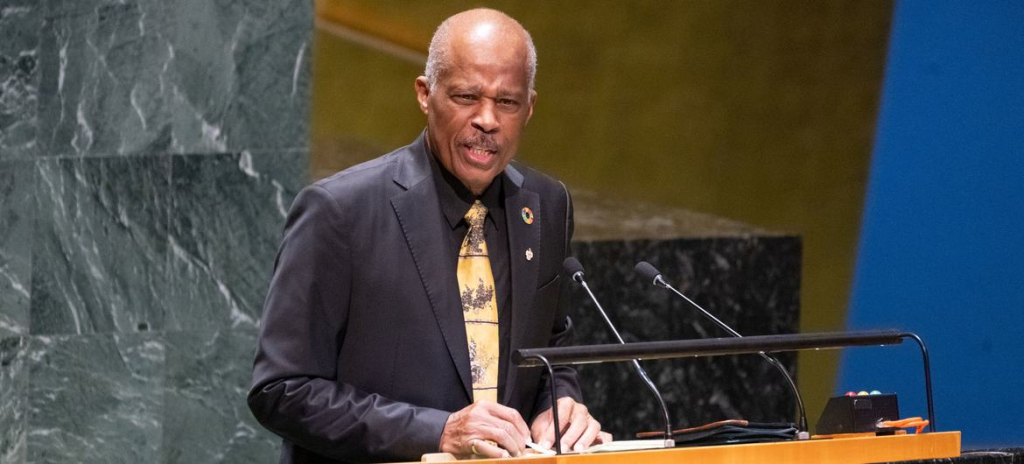
Sir Hilary Beckles, Vice-Chancellor of the University of the West Indies and Chair of the Caribbean Community (CARICOM) Reparations Commission, addresses the General Assembly.
Sir Hilary Beckles: We are still dealing with clearing up the fundamental issues of colonisation, massive illiteracy, extreme malnutrition and chronic disease, and addressing these matters required tremendous amount of capital investment. So, when we speak of justice, basically what we are saying to the colonisers and the enslavers who have left us legacy behind: “This is your legacy, and reparatory justice says you must come back to the site of the crime and facilitate the clean up operation.”
Thirty or forty years ago, reparatory justice was a concept that attracted very little support. By redefining the concept of reparations, we said they are about repairing the damage done to a people, communities and nations. These issues must be repaired if these countries have a chance of having development.
We have found that African governments now equipped with the historical knowledge are able to say “we want to have a conversation around reparations; we want to talk about it.” That was one of the major seismic achievements. When the African Union met at the end of last year and declared that 2025 is going to be the year of African reparations, that was a huge historic achievement.
UN News: Ms. King, your grandfather’s iconic I Have a Dream speech in Washington in 1963 continues to inspire generations to forge ahead in the struggle for rights. His dreams were for a day when people would be judged on their character, not their skin colour. Has his dream been realized in 2024, and have you ever felt judged by the colour of your skin?
Yolanda Renee King: I don’t think we’ve reached that dream yet. I think that there has been some progress. I think that there have been some strides since the speech was made. But, we shouldn’t be where we are now. I think we should be more ahead. And if he and my grandmother were still alive, I think that we as a society would be much farther along than we are now.
As someone who is a Black person, I think that unfortunately we’ve all faced some sort of discrimination and judgment. Unfortunately, yes, there have been times when I’ve been judged based on my race. I think that we need to find a way to move on, and we need to begin to strategise.
I think a lot of people, rather than talking about the dream and glorifying it and celebrating it and putting a tweet acknowledging it on [Martin Luther King] MLK Day, we actually need to start taking some action in order to move forward as a society, in order to improve and in order to be in the world in which he described in that speech.
The UN hosted a series of special events to highlight the Week of Solidarity with the Peoples Struggling against Racism and Racial Discrimination, from 21 to 27 March, and to mark the final months of the International Decade for People of African Descent.
Two exhibits opened, telling stories of epic bravery of those who fought slavery, from South Africa to the state of Georgia in the United States.
“Israel made public claims that a significant number of UNRWA employees are members of terrorist organizations. However, Israel has yet to provide supporting evidence of this,” according to the 54-page final report, Independent review of mechanisms and procedures to ensure adherence by UNRWA to the humanitarian principle of neutrality.
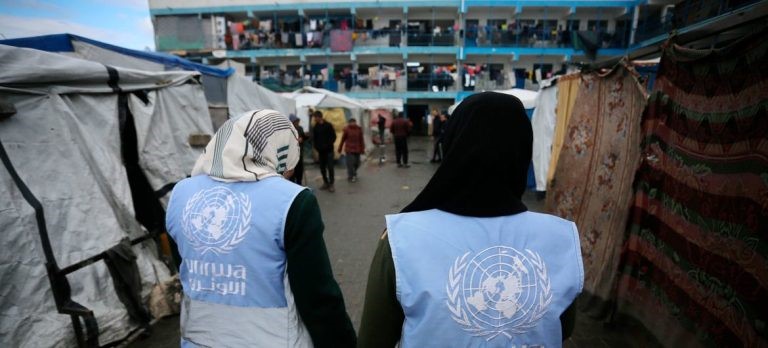
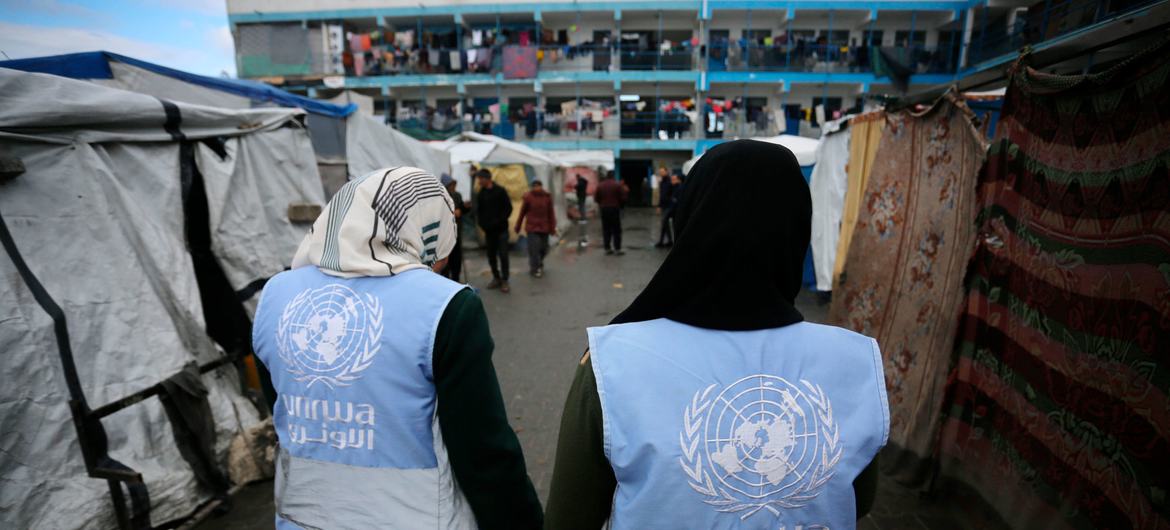
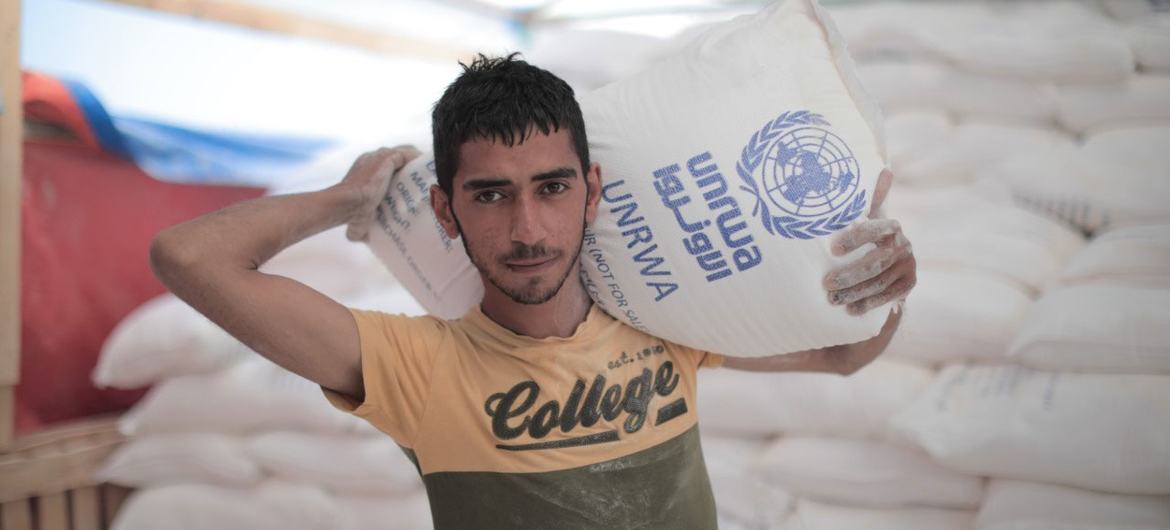
Instead of being filled with children learning, UNRWA schools have been turned into shelters in Gaza Strip for displaced families during the ongoing war.
An independent panel released its much-awaited report on Monday about the UN relief agency for Palestine refugees (UNRWA), providing 50 recommendations and noting that Israeli authorities have yet to provide proof of their claims that U.N. staff are involved with terrorist organizations.
“Israel made public claims that a significant number of UNRWA employees are members of terrorist organizations. However, Israel has yet to provide supporting evidence of this,” according to the 54-page final report, Independent review of mechanisms and procedures to ensure adherence by UNRWA to the humanitarian principle of neutrality.
The U.N. Secretary-General, who received the final report at the weekend, had appointed the independent review group days after Israel announced the allegations against UNRWA, which employees 30,000 people and serves 5.9 million Palestine refugees in the West Bank, Jordan, Lebanon, Syria and war-torn Gaza.
The much-awaited final report found that UNRWA, established by the General Assembly in 1949, has extensive tools in place to ensure it remains unbiased in its work and routinely provides Israel with employee lists and “the Israeli Government has not informed UNRWA of any concerns relating to any UNRWA staff based on these staff lists since 2011.”
UNRWA has ‘most elaborate’ rules within U.N. system
“The set of rules and the mechanisms and procedures in place [at UNRWA] are the most elaborate within the UN system, precisely because it is such a difficult issue to work in such a complex and sensitive environment,” Catherine Colonna, former French foreign minister and head of the review group, told journalists at UN Headquarters following the report’s launch. “What needs to be improved will be improved. I’m confident that implementing these measures will help UNRWA deliver on its mandate.”
Strongly encouraging “the international community to work side by side with the agency so it can perform its mission and overcome the challenges when they are there”, she said “this is the purpose of the review.”
In its nine-week-long review of existing mechanisms, the group conducted more than 200 interviews, met with Israeli and Palestinian authorities and directly contacted 47 countries and organisations, presenting a set of 50 recommendations on issues ranging from education to fresh vetting processes for recruiting staff.
The report’s recommendations include creating a centralized “neutrality investigations unit”, rolling out an updated Code of Ethics and associated training to all staff, and identifying and implementing additional ways to screen UNRWA applicants at an early stage of the recruitment process.
The report also suggested exploring the possibility of third-party monitoring for sensitive projects and establishing a framework with interested donors to ensure transparency.
In a statement on Monday, the UN Secretary-General’s Spokesperson said the UN chief accepts the recommendations contained in Ms. Colonna’s report. He has agreed with Commissioner General Philippe Lazzarini that UNRWA, with the Secretary-General’s support, will establish an action plan to implement the recommendations contained in the final report.”
Claims financially hobbled UNRWA
According to the review group’s final report, Israel’s claims against UNRWA triggered the suspension of funding amounting to around $450 million.
The direct impact of Israel’s allegations swiftly hobbled UNRWA’s ability to continue its work. Operating solely on voluntary donations, UNRWA saw major donors, including the United States, cancelling or suspending funds for the agency.
In April, Washington banned funding for UNRWA until at least 2025, but other donors have pledged additional funding or restored their donations.
The new report recommended increasing the frequency and strengthening the transparency of UNRWA’s communication with donors on its financial situation and on neutrality allegations and breaches. The review group suggested regular updates and “integrity briefings” for donors interested in supporting UNRWA on integrity and related issues.
Findings on UNRWA schools
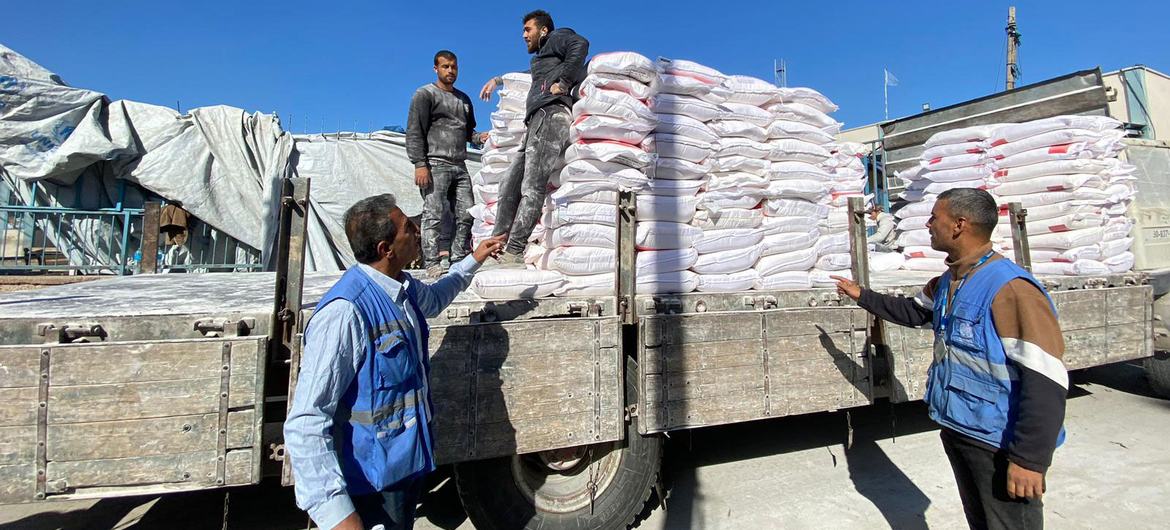
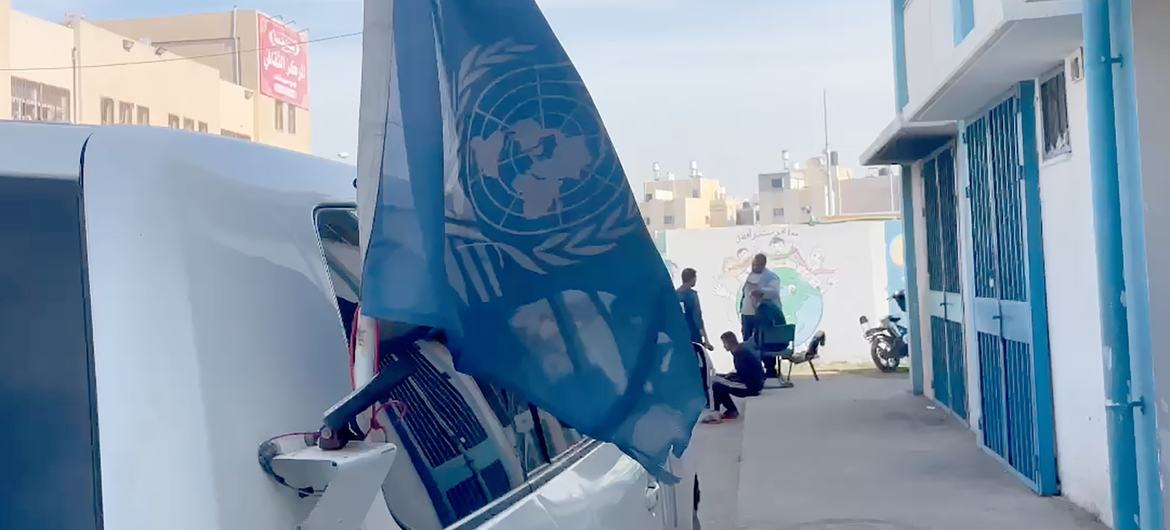
The UN agency delivers on its obligation to ensure neutrality of its 1,000 installations, including schools, healthcare centres and warehouses, according to the report, which also stated that “security and capacity challenges may hamper” existing due diligence mechanisms.
The review group said UNRWA “has consistently worked on ensuring neutrality in education” as it provides elementary and preparatory education for 500,000 pupils in 706 schools with 20,000 educational staff, including in Gaza, where right now all children are out of school following attacks destroying the enclave’s education system amid the ongoing conflict.
UNRWA’s office in Gaza. Photo: Ziad Abu Khousa
Claims of anti-Semitic textbooks
Investigating “sustained criticism, mainly from Israel”, about the alleged presence of hate speech, incitement to violence and anti-Semitism in Palestinian Authority educational material, the review group examined three major international assessments and studies.
The new report showed that two identified bias and non-compliant content, but did not provide evidence of anti-Semitic reference. A third, the Eckert report, identified two examples that displayed anti-Semitic content, but noted that one had already been removed and the other significantly altered.
As such, the report recommended several actions, including the review of the content of all textbooks with host countries, Israel and the Palestinian Authority.
UNRWA remains a pivotal ‘lifeline’ for Palestine
The report stated that “in the absence of a political solution between Israel and the Palestinians, UNRWA remains pivotal in providing lifesaving humanitarian aid and essential social services, particularly in health and education, to Palestinian refugees in Gaza, Jordan, Lebanon, Syria and the West Bank” and is “irreplaceable and indispensable to Palestinians’ human and economic development”.
“In addition, many view UNRWA as a humanitarian lifeline,” according to the report.
The UN chief on Monday said he counted on the cooperation of the donor community, the host countries and the staff to fully cooperate in the implementation of the new report’s final recommendations, the UN Spokesperson said.
“Moving forward, the Secretary-General appeals to all stakeholders to actively support UNRWA, as it is a lifeline for Palestine refugees in the region,” he said.
Other top UN officials have voiced strong support for the agency, calling on donors to reverse funding cuts and allow UNRWA to perform its work, especially in Gaza.
UNRWA chief Lazzarini welcomed the report’s findings and recommendations.
“UNRWA is developing an action plan, with a timeline and budget to take forward the report’s recommendations,” he said in a statement on Monday.
He said implementing some of the recommendations will require extensive engagement with staff and partners, including Member States, host nations and donor countries, adding that the UN agency looks forward to cooperating with all concerned stakeholders to implement the recommendations.
“UNRWA is firmly dedicated to applying UN values and humanitarian principles,” he said. “The recommendations in this report will further strengthen our efforts and response during one of the most difficult moments in the history of the Palestinian people.”
First of two investigations
Following Israel’s allegations against UNRWA in late January, the UN agency immediately fired the staff members in question and requested a swift, impartial investigation. The UN chief ordered two.
Days later, the Secretary-General appointed an independent review team, led by Ms. Colonna and researched by Raoul Wallenberg Institute in Sweden, the Michelsen Institute in Norway and the Danish Institute for Human Rights, to investigate the UNRWA’s process of ensuring neutrality in its work.
At the same time, the UN chief ordered the UN’s top watchdog, the Office of Internal Oversight (OIOS), to investigate the veracity of Israel’s claims against the 12 UNRWA staff members.
At the outset, OIOS investigators reached out to Member States concerned, visited UNRWA headquarters in Jordan and reviewed initial information received by the agency from Israeli authorities and from a variety of sources, including that released through the media and other public outlets.
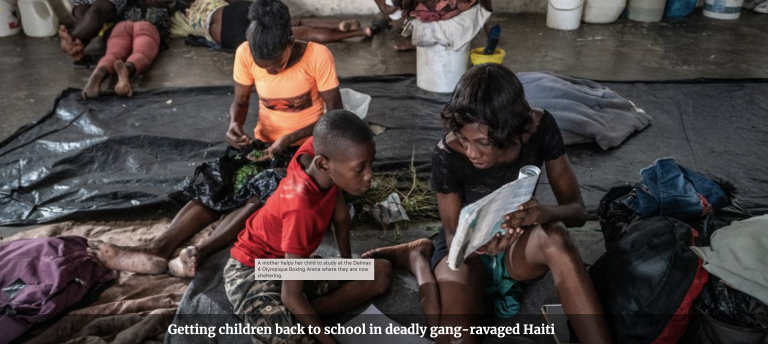
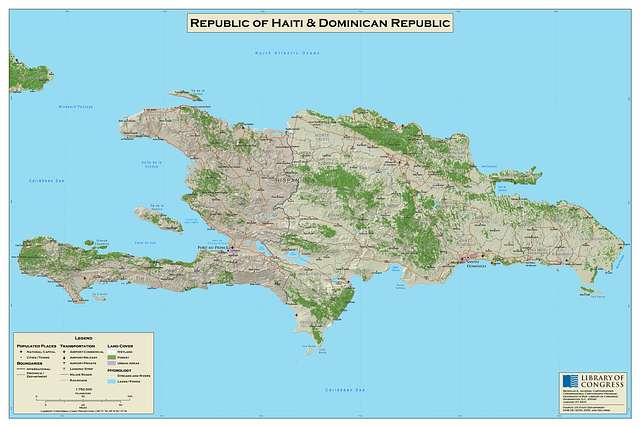
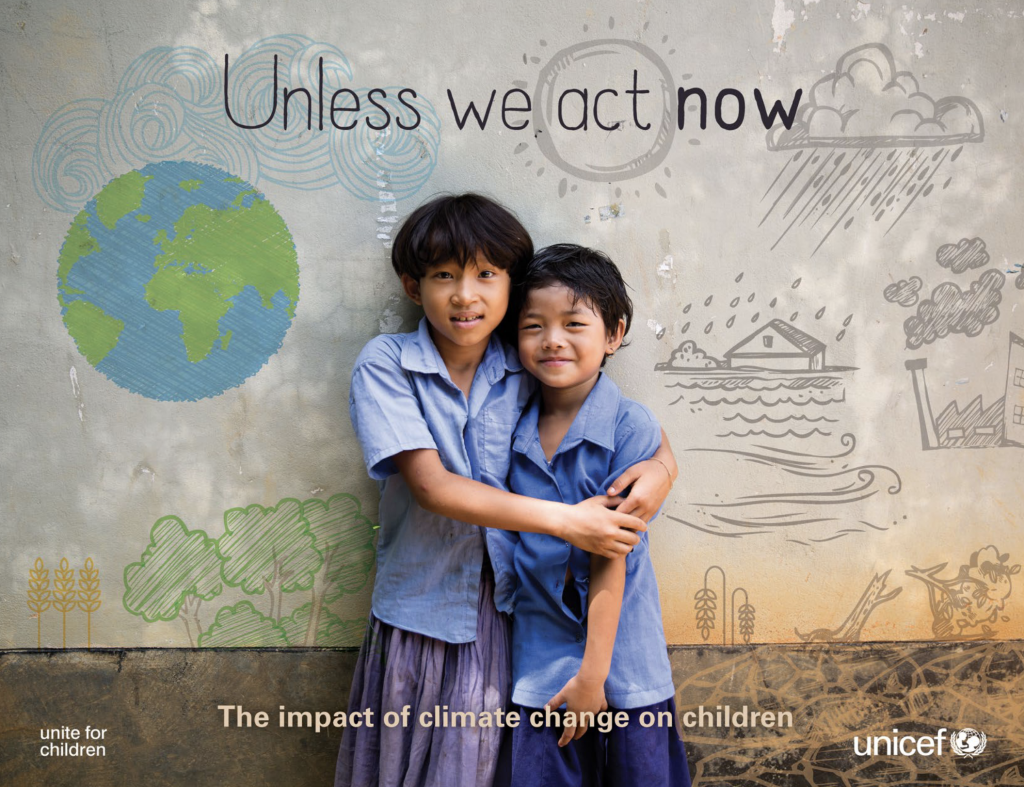
Against the backdrop of a humanitarian crisis and gang violence in Haiti, U.N. agencies are warning that children are suffering not just from a lack of schooling but also through witnessing violence.
Port-au-Prince. Students in the capital Port-au-Prince have missed hundreds of hours of class time over the past year and now, now, more than one million Haitians are facing emergency levels of acute food insecurity, according to a new U.N.-backed report.
As deadly threats to school security continue in Port-au-Prince, and northern parts of the Artibonite department, U.N. News examined the situation on the ground and how the U.N. is responding to the worsening educational crisis.
By the end of January, a total of 900 schools had temporarily closed mainly in Port-au-Prince, depriving around 200,000 children of their right to education, according to U.N. Children’s Fund (UNICEF).
Many other schools abruptly shut in Port-au-Prince in late February, when armed gangs coordinated breakouts in jails, freeing around 4,500 prisoners.
Gangs reportedly now control 80 to 90 per cent of the capital, and in the ensuing chaos, U.N. agencies on the ground reported cases of armed groups recruiting children, spiraling violence, looting and destruction.
“The Haitian population is caught in the crossfire,” said Catherine Russell, head of UNICEF. “Spaces for children have been transformed into battlegrounds. Each passing day brings new deprivations and horrors to the people of Haiti.”
Basic security is urgently needed for the lifesaving services and for aid workers to reach those in desperate need, she said, calling for the protection of schools, hospitals and other critical infrastructure children rely on and for safeguarding humanitarian spaces.
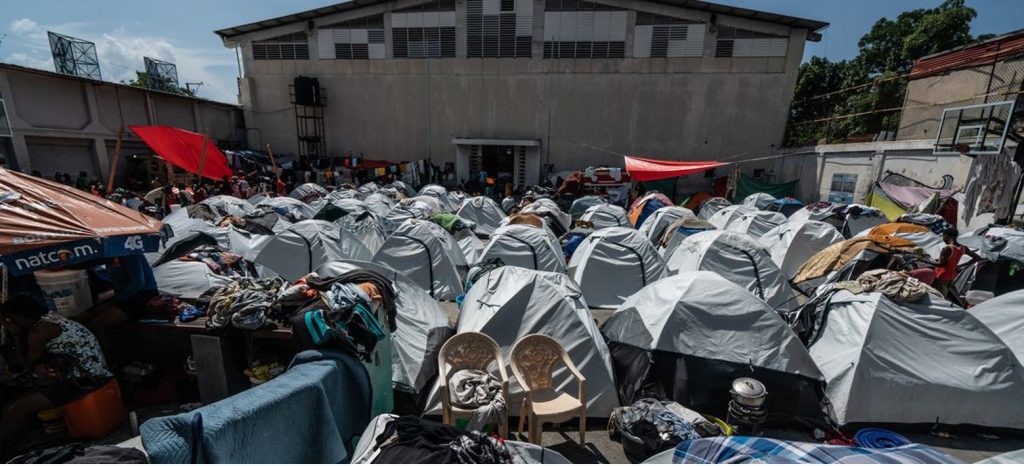
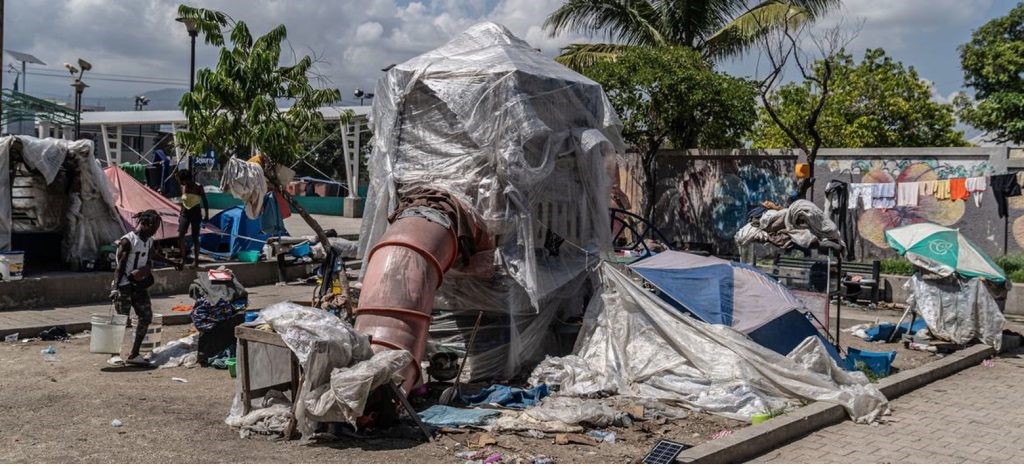
As of late March, violence had displaced at least 362,000 people, with many trapped in the besieged capital and thousands finding temporary shelter in public buildings, including schools.
Each classroom turned into a temporary home for multiple families. Playgrounds became tented shelters. Gymnasiums were transformed into open dormitories for those seeking safety.
“Many schools are not accessible as violence is ramping up around them,” said UNICEF’s representative in Haiti, Bruno Maes. “Some are occupied by gangs, others by displaced people and still more have been looted or destroyed.”
SoundCloud
On the afternoon of 25 March, heavily armed groups entered a downtown Port-au-Prince school and set fire to 23 classrooms. Aid agencies condemned the incident.
In another incident in the Port-au-Prince neighborhood of La Saline, 3,500 children were trapped in two schools as gangs fought around them. UNICEFN.ICEF engaged with the armed groups for four days before they could secure the safe release of the children.
UNICEF has urged all parties to safeguard students, educators, parents and educational infrastructure in line with the Safe Schools Declaration, a global political commitment endorsed by 119 countries, including Haiti, for better protection measures and support for continuing education during armed conflicts.
“The situation is desperate for children,” said UNICEF’s Mr. Maes. “Children are killed, wounded, raped, displaced and denied access to basic services, including school,” adding that they are “terrorized and traumatized,” some after witnessing burnt bodies on the streets.
Amid the very clear dangers, parents “still want to send their children to school”, he said. “Education is at the heart of every Haitian family; people put a very high value on it.”
As gangs continue to expand their control of vital roads and ports, their grip is extending outside the capital and the threat to school safety is mounting.
Despite this, the majority of schools outside the troubled gang-controlled areas of Port-au-Prince and Artibonite are still functioning. Many have admitted children who have fled because of violence and insecurity, although some parents are unable to pay school fees due to increasing poverty.
Multipronged Response
U.N. agencies have been working together to provide lifesaving essentials, like food, water and shelter, to thousands of Haitians in need and helping to get children back to school using new approaches.
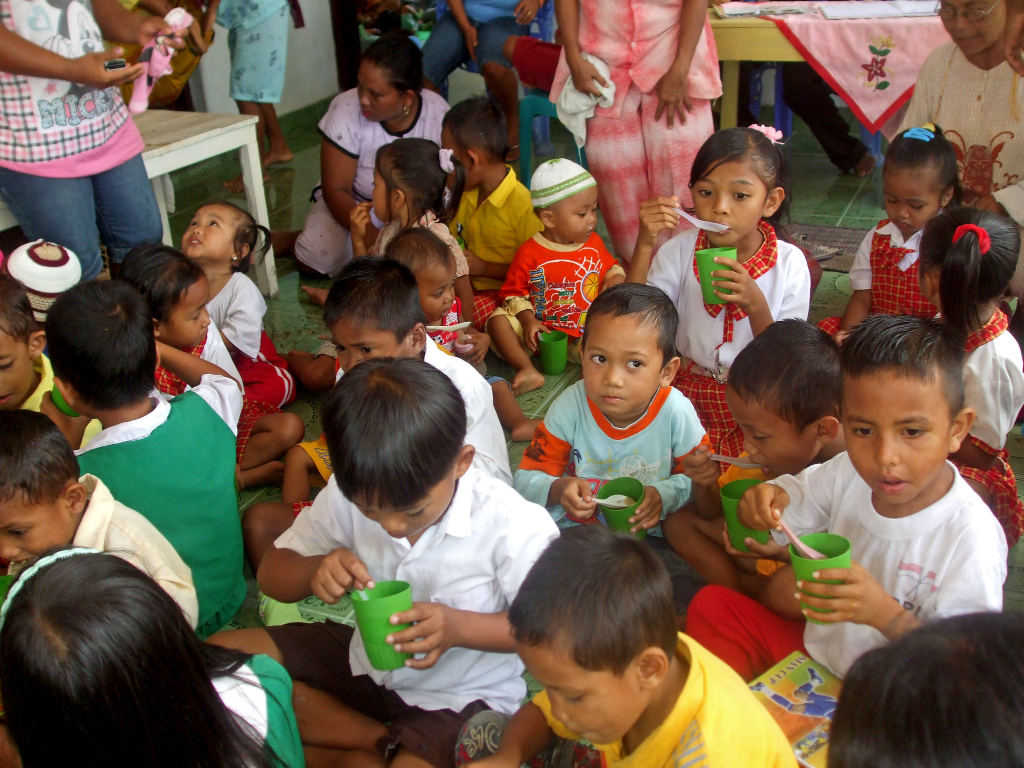
Efforts include an International Organization for Migration (IOM) initiative currently providing psychosocial support to students forced out of school by the violence, and the World Food Program (WFP) supports hot meals for 250,000 children across the country.
Part of UNICEF’s work is assisting families affected by violence and displacement to reintegrate children into formal education. Where this is not feasible, the agency works with partners to establish alternative, safe and temporary learning environments.
The goal is to get children back to learning and into school meal programs, according to a UNICEF report, published in French in late March.
If schools remain shuttered, distance learning can be deployed via radio, television and e-learning platforms. UNICEF is collaborating with the Haitian Ministry of Education to find a way to deliver this via Radio Télé Éducative (RTE) broadcasts on Haiti’s national radio station.
Other opportunities for engaging students during the crisis include boosting capacities at schools currently accommodating displaced pupils.
Learn more about what the U.N. is doing to help Haiti in their explainer here.
TAGS: Armed gangs, Artibonite, Artibonite department, Bruno Maes, Catherine Russell, Children, Delmas, Education, French, gang-controlled, Gang-Ravaged Haiti, Gangs, Giles Clarke, Gonaïves, Gymnasium Vincent, Haiti, Humanitarian aid, International Organization for Migration, Jonathan Dumont, La Saline, Migration, Pedro Rodrigues, Port-au-Prince, prisoners, Radio Télé Éducative, RTE, Safe Schools Declaration, Schools, SoundCloud, Students, U.N., U.N. News, UNICEF, violence, Volunteers, WFP, World Food Program
Jim Luce has established himself as a dedicated chronicler of India and its global diaspora over the past two decades. His writings span a remarkable range of topics—from cultural celebrations and contemporary art to social issues, religious traditions, and political developments. Through articles published in major outlets like The Huffington Post, Daily Kos, and other platforms, Luce has documented everything from his personal spiritual journeys following Buddhist pilgrimage routes to his hands-on humanitarian work supporting orphanages and educational initiatives in Bihar. His coverage encompasses both the profound—encounters with the Dalai Lama and explorations of ancient Buddhist sites—and the contemporary, including reviews of Indian cinema, profiles of diaspora leaders, and analysis of current political developments. This diverse portfolio reflects not just journalistic observation but active engagement, as evidenced by his ongoing support for educational and orphan care projects in India.
Museums play a crucial role in preserving and interpreting the history of thought and expression. They house and display artifacts, artworks, and documents that offer tangible connections to past cultures, ideas, and innovations. By providing access to these historical treasures, museums allow us to explore the evolution of human creativity, beliefs, and knowledge. They serve as educational spaces where visitors can engage with diverse perspectives and gain insights into the social, political, and cultural contexts that shaped different eras. Museums not only protect our shared heritage but also inspire reflection on our collective journey, fostering a deeper understanding of the complexities and continuities in human expression and intellectual development.
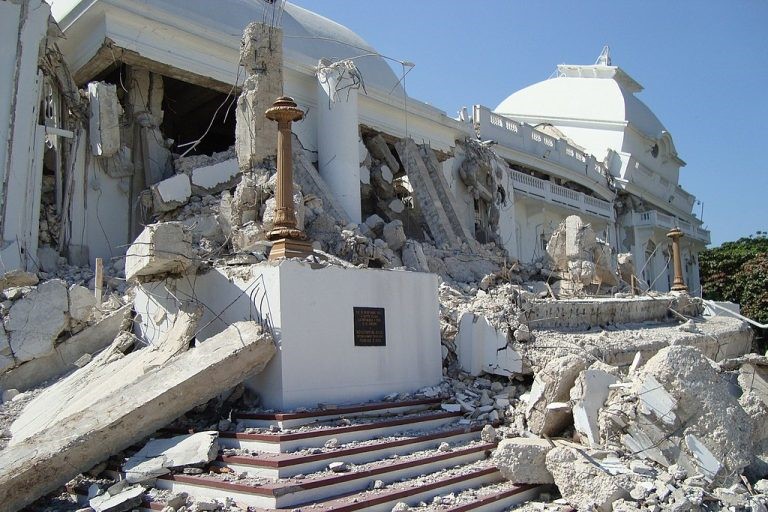
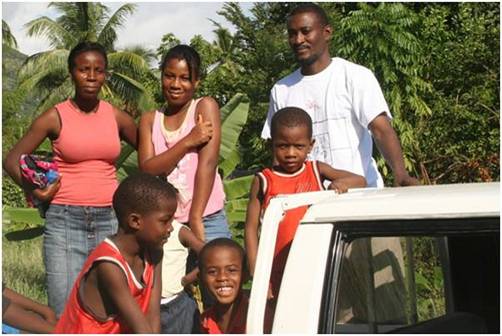
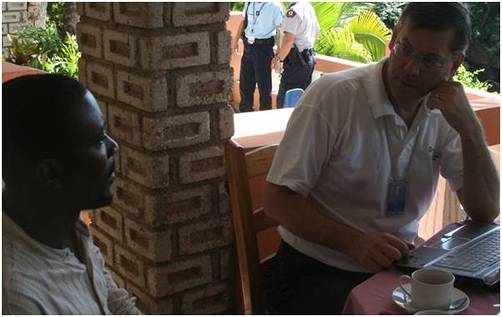
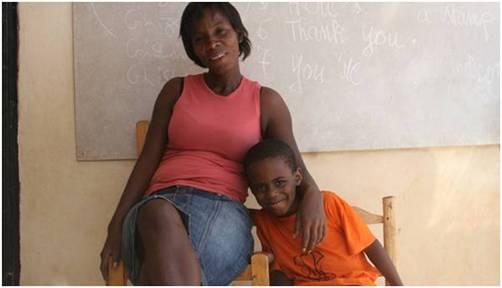
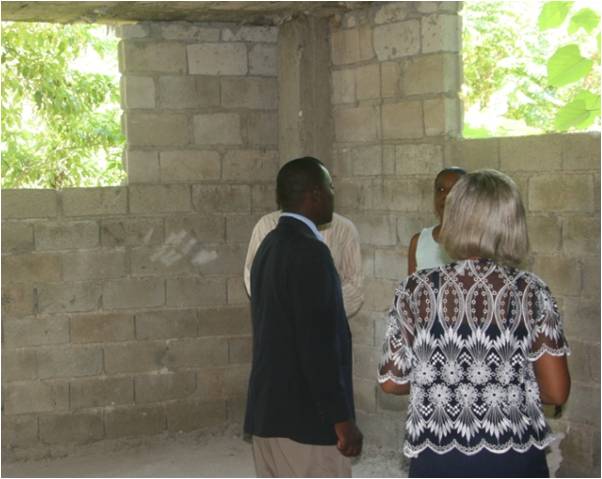
Haitian-Americans are becoming increasingly vital to the reconstruction of Haiti. I accompanied several back to their native land last week to work with orphans in the epicenter of the earthquake, Léogâne. I traveled with Evens Anozine, Deborah Pierre, and Handal Murat on behalf of Orphans International Worldwide (OIW). Our mission was multifold, including assessing progress with OIW’s three primary programs: orphan care, educational support for orphans, and leadership training for orphan mentors.
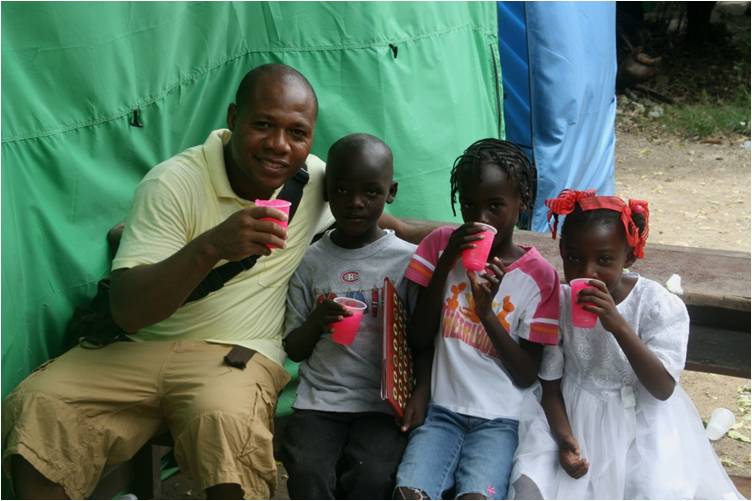
Haitian-American Evens Anozine of New York City is originally from Léogâne.
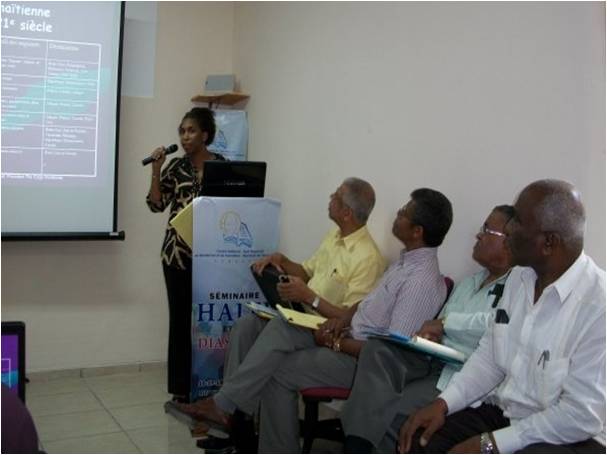
I have been aware of the tremendous role the Haitian Diaspora plays in keeping the people of Haiti alive, and the large number of bright and dedicated Haitian-American leaders. I met Katleen Felix years ago, and have witnessed her great work with the largest micro-finance institution in Haiti Fonkoze, as well as the relatively new Zafen. I turned to Katleen for her introduction to this topic. She told me from Port-au-Prince, by way of Montreal and Miami:
“The Haitian Diaspora has been sending remittances to support families and friends since the late 80’s when migration was more linked to economic reason. The money support is often for food, lodging, health, and school tuitions of the one left behind. There is no social security in Haiti – the Diaspora is the safety net of so many.
“After the earthquake, the first responders were Haitians from the Diaspora. In one month Fonkoze paid $7 million in transfers, helping people on the ground to get cash to eat, relocate, find lodging, etc… this was the Diaspora in full action.
“The danger is to get in a cycle of dependency where recipients who cannot find a job depend on the next transfer to get some food and take care of their basic needs. Some senders realized that if they don’t find a way to create a job or an opportunity for their loved ones, it will not be sustainable.”
Katleen Felix presenting at Seminaire CENAREF in Port-au-Prince, Haiti.
“The resources are limited in the Diaspora. Even with all the good intentions, some might not have the capacity to keep up with the increasing demand of cash without weakening their own finances. There is a need to create small businesses that can create livelihood. Some members of the Diaspora have decided to invest and come to Haiti to provide technical assistance to their family and friends in very informal ways.
“We have also collective remittances through Haitian Hometown Associations which are started by supporting humanitarian work such as helping an orphanage, a school, or at church. These associations are now investing in productive projects that are generating revenues for the communities. These efforts are a little bit more organized, but yet need training and support to grow the businesses.
“This is why we created Zafen – to showcase those types of effort, help them find funding, and have a bigger impact in their community. This is not only a fundraising tool but a program where business analysts will give them training and be an agent of change for those communities. We work closely with the Haitian Hometown Associations Resource Group to identify joint projects and communities that are trying to get out of the cycle of dependency and poverty.”
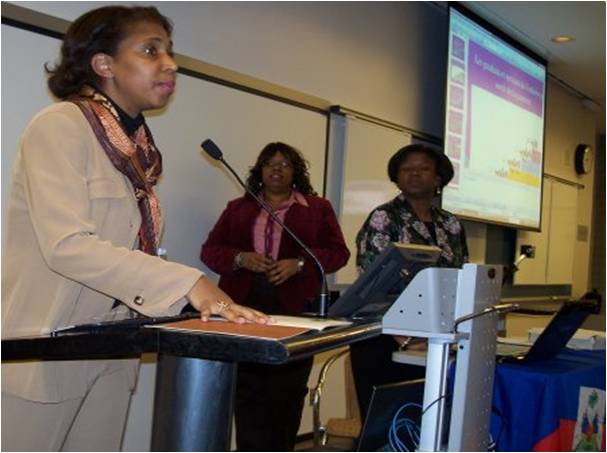
Katleen Felix of Fonkoze and Zafen frequently speaks to audiences around the world.
The reality is that 80% of Haitian professionals have left Haiti over the years, leaving a hole in their hometown. Mechanisms to give back are needed for those professionals. It is not a donation from the host country – who benefit from those resources – to help the Diaspora organize, it is due to a Haiti that has been an international donor of brain for decades.
Unfortunately, we don’t see a lot of international donors recruiting from the Haitian Diaspora or facilitating experts from the Diaspora to come back to help. The Ministry of Haitians Abroad is trying to put together a program to support the return or the contribution of Haitian experts from abroad. If this program happens, we will see a more organize contribution of the Diaspora in to the country.
“At the level of organizations like Fonkoze we need try to find resources within the Diaspora, sometimes we get lucky but not everybody is ready to move back or have enough country experience to take the job. The reverse migration is a nice concept but we need mechanisms to support the migrant it that journey.”
Haitian-AmericanEvens Anozine of New York City wears several hats, representing Orphans International Worldwide, We Can’t Have That Foundation, and NYU Polytechnic’s GreenLight Innovations. Evens says:
“As a Haitian-American it is imperative that we find ways to give back to Haiti. However, we must ensure that our effort is not in vain. All Haitian-Americans, whether they were born in the U.S. or having been born in Haiti, have an affinity for our beloved island. The culture, the music, the people and the food – especially food like Duri ak Sauce Pwa , Lambi avek Griots!
“We now have to find ways to participate with the “development” of Haiti. All of us can make a difference. The Diaspora is a community that has yet to be tapped properly, approximately about four million Haitians are living outside of Haiti. Collectively, we send home over a billion dollars annually.
“I can remember, my Mom and Dad working two jobs not only take care of my two sisters and I but also to help family members back home. With no education, my parents sacrificed their lives to make sure that ours would be better. For many years, I only saw my father on Sundays. This is something you will find in every Haitian household. I believe parents have to encourage their children to find ways to help Haiti.
“Unfortunately there are many parents who discourage their young adults to travel to Haiti prior to the earthquake and even now. As a matter of fact, on our most recent trip to Haiti, we were supposed to be accompanied by a young Haitian doctor, but her family actively discouraged her from traveling, pointing out security reasons among many.
“With Wyclef Jean possibly running for president, I believe there will be renewed hope among Haitian-Americans to travel home to help. I hope he has a clear concept as to how he will contribute to the country and help propel the Haitian people to a new way of life. His “TEAM” of leaders will also make a big difference. The people of Haiti need our help now, the work that all of us are doing across Haiti is of utmost need. What we do today, will resonate a thousand years from now. I truly believe that the future of Haiti is in our hands.”
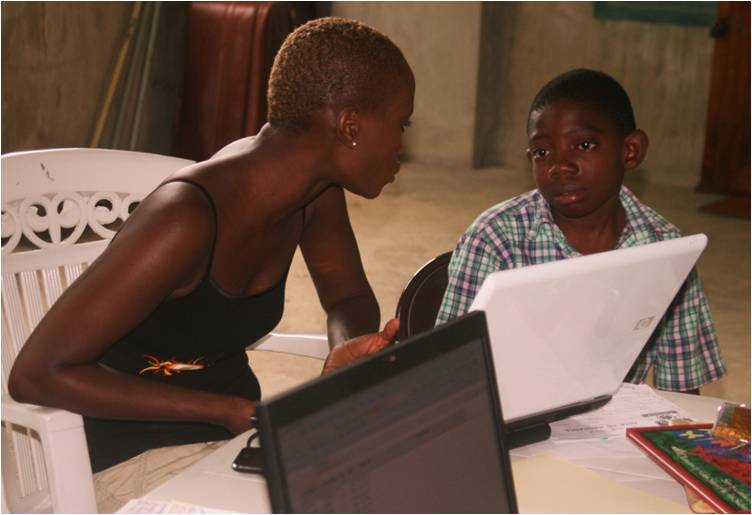
Deborah Pierre assisted OIW in Leogane match orphans with mentors for OIW.
Deborah Pierre, a Haitian-American artist representative also living in New York but originally from Port-au-Prince, told me on the trip and expounded on at the Gramercy Park Hotel‘s roof-top Rose Bar a week later:
“Haiti has always been close to my heart. It is where I grew up, spent my childhood. Our culture, our history, education, and our way of life were deeply installed in me. Haiti is my country.
“I have been interested in helping kids in Haiti for many years. I adopted a little girl 12 years ago who is now 16 years old and extremely smart, then I adopted another little girl 6 years ago when my aunt told me her mom was about to commit suicide with her. She is now 7 years old and lovely.
“The people and the children of Haiti have always needed our help. The earthquake of January 12, 2010 brought an awareness worldwide — but we have been a suffering nation for many, many years.
“When I think about what it is to go to Haiti to give back, I feel it is my duty. When I look at these kids I see me — It could have been in their place but chance gave me a different path to life. It’s only chance!
“I don’t know much about politics and government, but I do know that education plays a major role if not the most important one in a child’s upbringing. During my recent trip to Haiti while interviewing those kids I saw a thirst for knowledge in their eyes, a need for love, a sense of belonging and many of them wondered if there would be a future for them.
“These children need a voice — and if I can be one fraction of that voice to help them, it is the least I can do. Because what I care about most is Haiti’s kids – they are our future. I feel that if we can help them as Haitian-Americans we are ensuring that we will have a better nation down the road. I love Haiti and her children and want to play a role in the creation of a New Haiti.”
Like most Haitian-Americans, Handal Murat is bi-cultural and tri-lingual – and loves kids.
Handal Murat, a medical supplies specialist from Connecticut, grew up in Petionville outside Port-au-Prince. He explained why he went on the trip:
“Having witnessed the international community‘s immediate and overwhelming response to our country in its desperate time of need; I felt as a native Haitian living abroad the obligation to roll up my sleeves and also help. Not going to volunteer was never an option for me. It was more a matter of when. While I know that many Haitians living abroad can’t physically make the trip, I encourage them to help by supporting local fundraisings, supply drives, and even sponsoring an orphaned child.
The news media has left Haiti and the rest of the world will inevitably go back to their lives. Haitians in the Diaspora play a vital role in rebuilding Haiti because of our deep and lasting ties to our beloved country. Many of us still have cousins, aunts and other extended family members living there.
I gained more from the trip than I gave. The resilience and hope of the people is contagious. After touring the destruction in Port-au-Prince and Léogâne, walking through the tent cities and interviewing many of the orphans, I returned home with a totally new perspective of what’s really important.
For Haitian-Americans, just like it is for all of us, the motivation comes from seeing the results.
The programs Orphans International Worldwide runs in Léogâne include family care for orphaned children, academic scholarships for orphaned students not in family care, and a college leadership mentoring program. There are approximately 100 students in each program.
It seems obvious to this non-Haitian writer that the New Haiti, rising from the ashes of the earthquake, will succeed only with the full support of the Diaspora. Haitian-Americans are called to embrace their moral and social obligations. And they are doing so.
The sun rises early in Haiti, casting its golden rays over the landscape as the day begins anew. By 5:30 a.m., the sounds of laughter and chatter fill the air, signaling the start of another day at OI Haiti, home to Orphans International children.
Jacmel, Haiti. As I slowly awaken, greeted by the eager faces of a dozen children peering through the doors and window of my room, I can’t help but smile. To them, I’m the “white guy” who has been a part of their lives for what feels like an eternity – a comforting presence in a world marked by uncertainty and hardship.
The aftermath of the hurricanes has left its mark on this resilient community, with challenges ranging from water shortages to the absence of electricity. Yet, amidst the adversity, there is a sense of resilience and hope that permeates through the air.
Breakfast is a simple yet satisfying affair, featuring fresh avocado, bananas, and toast, accompanied by the comforting aroma of hot coffee. Despite the lack of formal schooling, the children eagerly engage in household chores, their laughter echoing through the halls as they go about their day.
As I attempt to write a report amidst the chaos of small hands tugging at my sleeves and curious eyes watching my every move, I am reminded of the profound bond that exists between us. Despite the language barrier, their laughter is a universal language that transcends words.
Parenthood, albeit unconventional, is a journey marked by moments of laughter, frustration, and unconditional love. My simple command of “Stop!” may seem insignificant, but it signifies a boundary that is respected and understood by all.
As I watch the bustling activity around me, I am filled with a sense of gratitude and pride. These twelve Haitian orphaned children have become a part of my extended family, their resilience and spirit serving as a constant source of inspiration.
In the midst of rough conditions and daily challenges, there is an undeniable sense of joy and fulfillment that comes from being a part of something greater than oneself. At OI Haiti, we have not only changed the lives of these twelve wonderful children – we have changed the entire universe for them, one moment at a time.
As I try to write a report, I am amazed at the number of small hands touching my ‘strange’ body – combing my funny hair, rubbing my arms. In the sweltering heat my patience finally wanes and I use the one word I am training our kids to know while I struggle to remember words in Creole or French. But they get me every time when pressed I yell, “Stop!”
Of course they howl in laughter, as they do for almost anything I try to say or do. I admit I exaggerate my abilities to dance ad sing, but I sadly do no exaggerate my insufficiency with their native languages. Part of me yearns to stay for six months, being tutored daily in French and Creole.
But there is too much development work to be done in New York – raising money to pay for it all – I must return shortly to take charge. So at the moment I have no time to really learn their language and my English “Stop!” must suffice. It works – they stop eating my peanuts, using my deodorant, and not shaving their heads with my electric razor!
I am waking up at OI Haiti where we have helped to change the entire universe for our kids and it is a sensation that trumps almost any other feeling I have ever had. The noisy roosters outside mirror the shouting in my heart of pure joy. Rough conditions or not, we have twelve incredibly wonderful children.
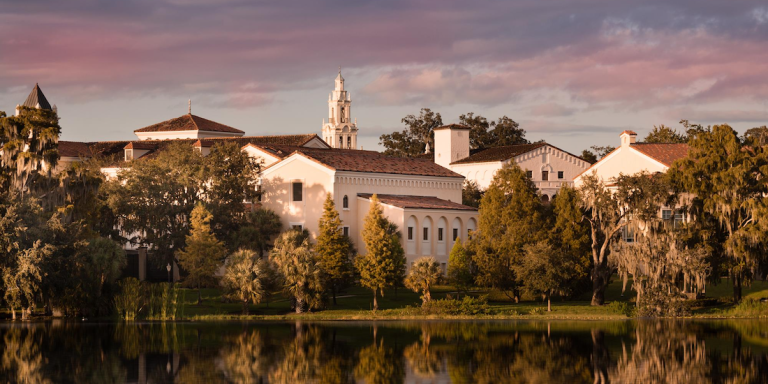
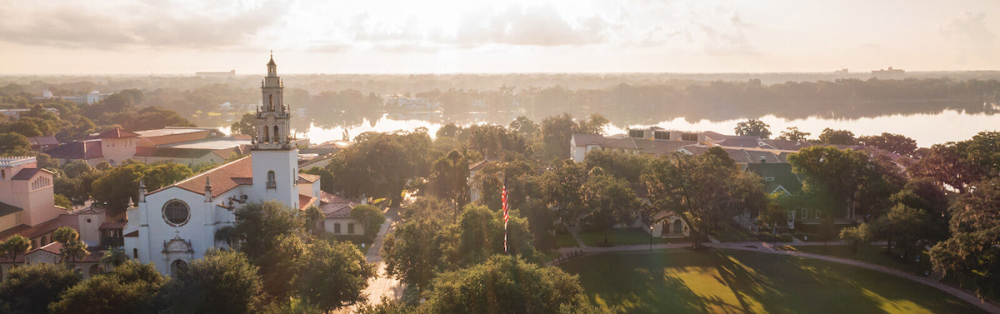
Rollins College announces that President Grant Cornwell will retire in June 2025 after 10 years of exemplary leadership and dedicated service.
“Since 2015, we have had the exceptional good fortune to have Grant Cornwell at the helm of Rollins College,” says Rick Goings ’12H, chairman of the College’s Board of Trustees, in a statement to the Rollins community.
“President Cornwell has been a passionate and innovative leader, tirelessly devoted to the College’s liberal arts mission to educate students for global citizenship and responsible leadership.”
“President Cornwell provided thoughtful and steady leadership during an era of dramatic change in higher education,” says Don Davison, vice president for academic affairs and provost.
“A liberal arts education has never been more relevant, and Grant has overseen a renewed commitment to the College’s mission, strengthening our academic excellence and rigor.”
Throughout his tenure, Cornwell spearheaded numerous strategic initiatives and capital projects to enrich students’ lives and educational experiences, transforming the Rollins campus in the process.
A 1950s library building was refashioned to become Kathleen W. Rollins Hall, the College’s headquarters of applied learning and home of the newly launched Rollins Gateway, a signature program to prepare students for meaningful lives and productive careers. The state-of-the-art Lakeside Neighborhood created a new model for residential colleges that prioritizes health, wellness, and community. The Tiedtke Theatre & Dance Centre has strengthened Rollins’ role as a leader in performing arts education.
Additional milestones of the Cornwell presidency include:
Installation of the 291st chapter of Phi Beta Kappa, the nation’s most prestigious academic honor society in the liberal arts
Transition of the College’s Hamilton Holt School to reorient its offerings to better meet the needs of working adults and returning students
Reimagination of curricular focus and delivery in the Crummer Graduate School of Business
Development and implementation of a diversity, equity, inclusion, and belonging strategic plan to foster inclusivity and diversity and empower students, faculty, and staff to reach their fullest potential
Expansion of The Alfond Inn, the College’s Winter Park boutique hotel, distinguished by its philanthropic mission that directs all net operating income to scholarships for Rollins students
“Grant has transformed Rollins in ways that will be felt for years to come,” says Rollins Trustee Ted Alfond ’68 ’18H. “I have witnessed his innovative approach to unique opportunities and projects that have enhanced the College as well as the Winter Park community.”
Cornwell will remain in office until June 2025. As Rollins begins a national search for its next president, the College remains committed to building on Cornwell’s legacy and continuing its tradition of excellence in higher education. Information on the search can be found at rollins.edu/president.
We had discovered our true path: post-disaster reconstruction. This is what we have done in Tsunami-ravaged Aceh in Indonesia and in flood-devastated Gonaives in Haiti.
Matt Katz, a leader of the Roosevelt Island community, wrote at the time, “I don’t know of a single group other than Roosevelt Island’s own Orphans International that is asking the question, “When the children are fed and housed, then what?”
How can OI respond quickly to a global emergency when we have such a tiny budget and spend less than 3% of that on bureaucracy? When disaster struck in Haiti, we had already established a presence in Jacmel, and in Indonesia we were firmly established in Sulawesi.
Many global NGOs – Doctors Without Borders, CARE, the Red Cross, Oxfam, and Save the Children are brilliant at emergency care in the event of catastrophe. Other organizations, such as UNICEF, are brilliant at project assistance.
But only Orphans International Worldwide arrives at the scene of destruction and builds a child’s future, pledging to be involved until that child becomes established in adulthood. Many organizations raise millions of dollars for each of OI’s meager hundreds, but unlike many organizations, one year after a disaster OI remains on the spot, continuing to pick up the pieces.
Recent floods in Guatemala and an earthquake in Kashmir between Pakistan and India lead our generous contributors to ask, within hours, what we can do there. The answer is, sadly, simple: nothing. But when we have a presence in the country already, and can obtain additional emergency funding, OI can move quickly.
God forbid tragedy strike Peru, Togo, the Philippines, Guyana, Ghana, or Romania, but as we develop a foothold in these nations, if calamity were to strike, we would be positioned to assist the children.
Children of “Amis de Orphans International” with new educational toys in our play tent.
With two projects running smoothly now, in Sulawesi and Sumatera, I became increasingly concerned about the lack of progress with our third project in Haiti.
Jacmel, Haiti. Jacques Africot, our first OIW-certified houseparent, was nearly ready to open Haiti House in Jacmel with children being considered from Mapou, where flooding had recently killed many parents, and from Mother Teresa’s hospital and a facility for handicapped children in Port-au-Prince. H.S.H. Prince Albert, Beatrice Arthur, and Peter Yarrow had already contributed towards OI Haiti.
“Haiti House” was originally set in Jacmel, but due to problems with the board, we moved to Gonaives.
We had a neighborhood educational program in place known as Amis d’Orphans International(Friends of Orphans International) with an educational room set up with cut-outs and handmade posters. This program was run by Jacques Africot and served about 50 economically disadvantaged children living in the vicinity of our home in Jacmel. On one trip to Haiti,Pranav Gupta, founder of Development International, and I carried down an enormous assortment of educational toys and children’s books that had been contributed to OI in the U.S., as well as a donated tent and baby crib.
We set up the tent inside Haiti House with a large selection of colorful toys and the neighborhood children began to play immediately. The kids had been taught to sing songs and enjoyed their visit with us immensely. Educational toys donated by Beth and Eric Chernik proved to be a tremendous help and greatly loved by the children.
With two projects running smoothly now, in Sulawesi and Sumatera, I became increasingly concerned about the lack of progress with our third project in Haiti. We had attempted to recruit a board in the nation’s capital of Port-au-Prince, but we finally set up our home in Jacmel, a beautiful seaside town four hours to the south of the capital. Only one of the board members attended the opening ceremony. Due to the evident lack of commitment and interest of this board, I formed a new board made up of prominent leaders of Jacmel.
Unfortunately, this attempt to form a board proved to be as unsuccessful as the first! I had assumed the top people in Jacmel would be trustworthy, as they already had what they needed and would not attempt to use this partnership to their advantage.
However, the president of the local Chamber of Commerce, the head of the local civic club, the mayor’s brother, and others all seemed to have only their personal interests at heart, and held our house hostage, waiting to get what they wanted. I refused to rent a far more expensive house belonging to one of them, pay them for their volunteered time, or hire their mistresses as staff. Because I refused to meet their demands, the house remained unused for two whole years.
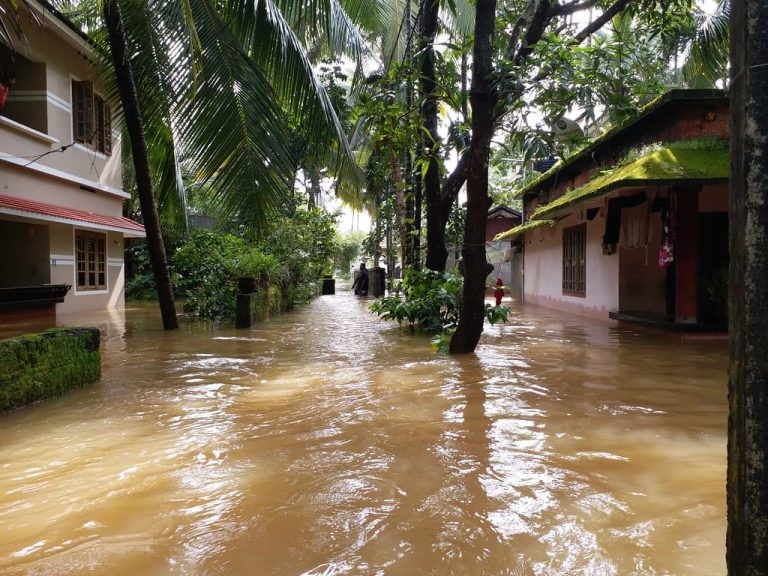
By January 2005, I had enough. Hurricane Jeanne had hit Gonäives a few months earlier, and although not of the scale of the 2004 Tsunami in Indonesia and Sri Lanka, more than 2,000 had perished. There was great need in Gonäives and all we had in Haiti was an empty home in Jacmel.
I flew to the Dominican Republic for a secret meeting with Phadoul Amisial, the human resources director for Haiti’s largest pediatric hospital and the director of the project in Haiti at the time. I did not want the Haitian board to know I was in the area. He crossed the border from Haiti by bus and we settled down for an entire weekend of talks. I proposed that he resign as director and form a new board in his hometown Gonäives where we could help children orphaned by Hurricane Jeanne.
In June 2006, 26 children attended the OI Haiti Orientation, with caretakers, board members, and staff swelling the participants to 47. Sixteen of the children seemed to fit OIW Standards and the caretakers began the application and documentation process with the GonaivesDepartment of Social Affairs. The caretakers were primarily aunts, uncles and grandparents who cannot afford to keep the children.
Careful screening continued for our children. The GonäivesDepartment of Social Affairs screened all documents to confirm that both the child’s parents were deceased or that one was deceased and the legally missing, as per OIW Standards. In addition, a volunteer further screened each child, and our director traveled to the hometown of each child to seek further confirmation of documentation.
The OI Haiti Board in Gonaives, 2005.
According to the Associated Press, that year a rash of kidnappings for ransom was adding to the misery in violence-torn Haiti. An average of four people were kidnapped each day that summer by politically aligned street gangs, drug traffickers, crooked police and criminal deportees from the United States. This was part of what one U.N. official called “an urban war” to destabilize Haiti ahead of October elections to replace ousted President Jean-Bertrand Aristide.
Victims ranged from wealthy business owners pulled out of luxury vehicles on busy streets to working-class Haitians snatched from poor neighborhoods. Foreigners were prime targets. U.N. officials reported that at least 130 people were kidnapped in Port-au-Prince in April 2005.
OI Haiti board president Phadoul Amisial wrote during that violent summer, just before Aristide fell, “Don’t worry about my safety. Inshallah, I will be fine. Violence is anywhere now and I cannot stop work just for the violence. I can die anywhere.”
The new board and several government officials, together with our new children, dressed in their Easter finest, attended our opening in Gonäives that same month, July of 2005. A brave delegation from the board in New York, led by Doris Chernik, and Jennifer Prince, participated.
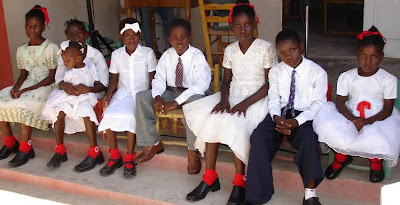
It was an emotional moment to witness five years of effort spent in a country with no government, no electricity, and no infrastructure to speak of, finally yield a home for our children. Today, twelve children live at OI Haiti. One challenge is their education. Sadly, they were several years below grade level in academic skills, and if we sent them to traditional school, they would not be able to learn to the best of their ability. We decided to keep them at the house and open a Montessori-type multi-age group class.
Children and caretakers attended OI Haiti’sOrphanage Orientation in Gonaives.
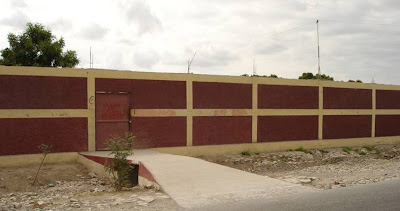
The project, surrounded by a ten-foot cement fence, also includes a preschool and an ecological center to assist our neighbors with reforestation in the wake of the terrible floods last fall. Situated in a 100 x 150 foot compound, the property was planned to eventually have more than just a home: a community preschool, a public health center, and a community computer center.
The interim campus will hold twelve children, and plans will begin following the opening to move to a larger campus where additional orphans may be cared for. The campus will focus on green architecture, especially solar power and composting.
Phadoul was OI Haiti’s first director, who left when he could not see eye-to-eye with the former board. Now, as the human resources director for Haiti’s largest pediatric hospital, he has returned to OI Haiti as its board leader. Jacques Africot, senior houseparent at OI Haiti, trained at OI Sumatera, where he also learned Indonesian. He has become expert in dealing with orphanage-related challenges and governmental relations.
Haiti House opened in Gonaives.
Within the next 15 months, OI will search for and buy up to forty acres of land in Gonaives at a reasonable price. It will then begin building three or more houses on the land, completing them before the present lease runs out in July 2008. The first three homes will be named for Vladimir Pierre Chernik, Rick Luce, and Frances Alleman-Luce
A ten foot tall wall protects our OI Haiti Interim Campus on the man road in Gonaives.
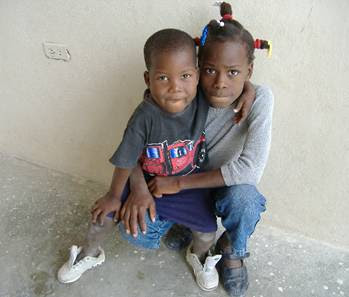
Each of the older children has chosen a younger child to take care of as if the child were their sibling, combing their hair or doing laundry for them. The children also help keep the house clean and are ready to play their role in the house. They now behave better among themselves.
Our houseparents have a close relationship with the children and with each other. They meet to discuss the use of constructive discipline in the house, prepare a weekly program for school, meet the children at night for an evaluation of the day, plan the next day, and read a story at night with the kids.
Near the Haiticampus of Orphans International, OI children cool off from three-digit temps.
The delegation from America flew to Gonaives in July 2006 to meet with the local Board of Directors of Orphans International, review the educational program, and discuss plans for the future. They also brought some 80 pounds of French books donated by another Roosevelt Island resident, Raya Barut, and a dozen math workbooks donated by PS/IS 217. The workbooks will made it easier to individualize instruction – essential when the range of skill varies as much as it does here.
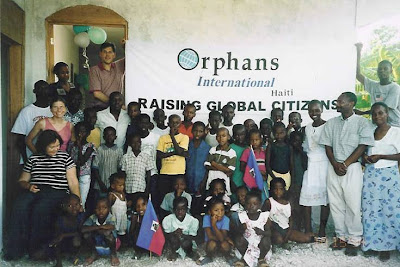
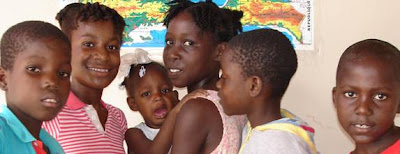
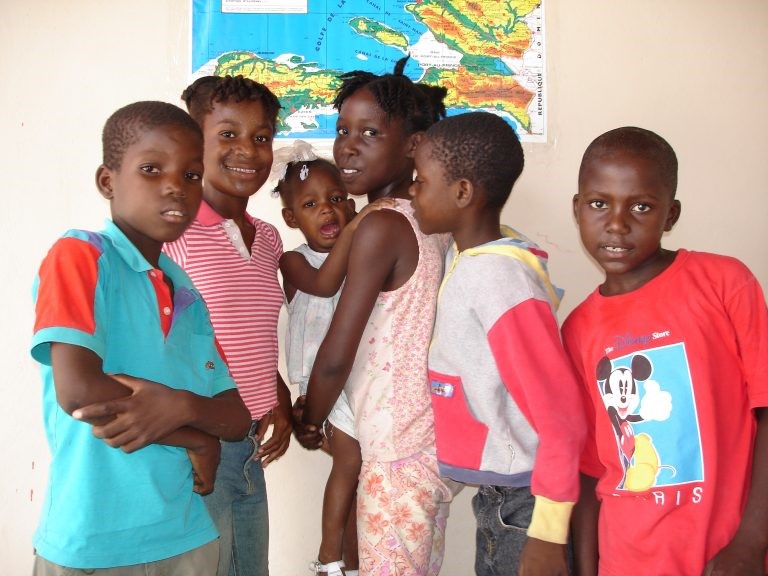
The children of OI Haiti pose for their first “family photograph” on Day 1.
The primary school children will attend the local school; the preschool children will be taught on the OI campus. A few local children will be invited to participate. Even the older children knew little more than the alphabet when they arrived at the orphanage in October 2005.
Within a year, all of them could read and do math at 2nd or 3rd grade level. Even so, the older children will enter classes 1-2 years below their age-appropriate class. The plan is to move them forward with supplemental individualized instruction during the school term, with summer school this year and in the future.
Abigaëllewith Walter, her “baby brother.”
While in the area, the members of the delegation invited the children of OI Haiti to the hotel pool. The children were ready in minutes and jumped into the waiting truck, ready for a swim. There are the delighted shouts, laughter, squeals, jumping, and splashing of twelve happy children. Afterwards, we ate spaghetti and pizza. Unlike many American children, these kids had no complaints about ingredients, and were polite and appreciative. They didn’t ask for seconds but happily accepted them when they were offered. The day at the pool was as much fun for us as for the kids, and we hated to leave.
Orphans International Haiti has a working permit from the GonäivesTown Hall, has registered with the DGI (Haitian equivalent of the American IRS), and is in the process of registering with the Institut du Bien-Etre Social (Department of Social Affairs).
Published originally in the OI Blogspot, April 14, 2008.
Lorem ipsum dolor sit amet, consectetur adipiscing elit. Vivamus euismod consequat est maximus eleifend. Phasellus elementum ipsum facilisis mi feugiat, non volutpat erat consequat. Nulla facilisi.
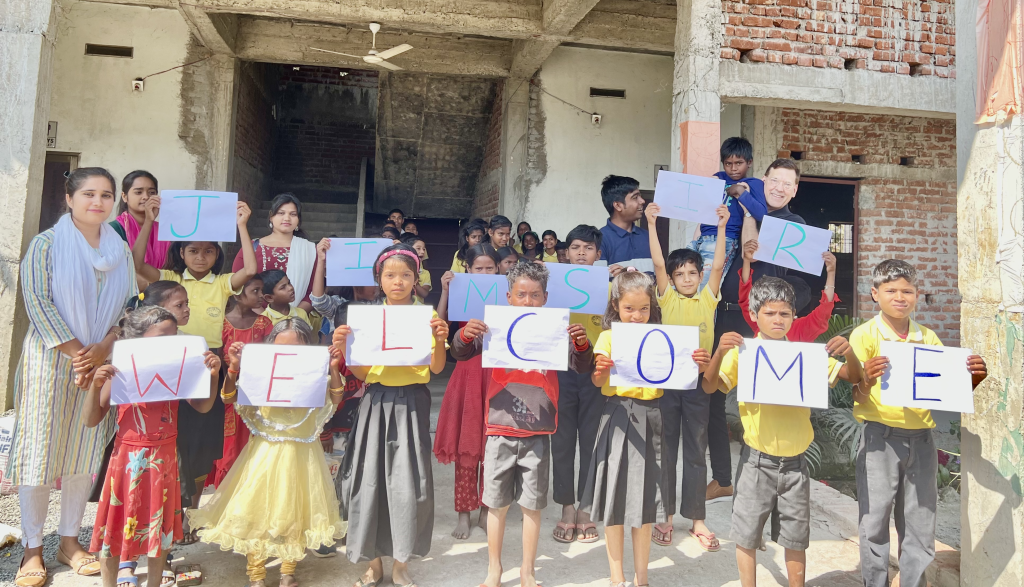
The best and brightest students of our elementary school are chosen to take a field trip to the provincial airport to welcome a foreign guest – me.
Lorem ipsum dolor sit amet, consectetur adipiscing elit. Vivamus euismod consequat est maximus eleifend. Phasellus elementum ipsum facilisis mi feugiat, non volutpat erat consequat. Nulla facilisi. Quisque tincidunt, ipsum eget posuere pulvinar, libero tortor tempor quam, non lacinia nibh lacus sed tortor. Aenean rhoncus lacus sed ipsum congue, nec imperdiet tellus aliquet. Curabitur auctor tortor at tortor sodales dictum. Sed auctor bibendum lorem, et viverra tortor.
Quisque tincidunt, ipsum eget posuere pulvinar, libero tortor tempor quam, non lacinia nibh lacus sed tortor. Aenean rhoncus lacus sed ipsum congue, nec imperdiet tellus aliquet. Curabitur auctor tortor at tortor sodales dictum. Sed auctor bibendum lorem, et viverra tortor.
Nam ultricies sapien ac augue mattis, eu dignissim neque cursus. Curabitur ac tempor lectus, nec pretium nulla. Sed mi velit, malesuada sit amet dignissim vitae, faucibus eget nibh. Nulla commodo facilisis sem, non pretium tellus rhoncus sed. Donec consequat lacus in commodo lobortis. Integer tempor, est et aliquet varius, odio magna luctus dolor, id rhoncus erat nulla non eros. Vestibulum tempor fermentum est, ac placerat ex egestas et. Proin laoreet nibh sit amet mi consequat vehicula. Duis ultrices imperdiet hendrerit. Ut tincidunt iaculis ipsum, ut pretium tellus viverra rhoncus. Vivamus mattis nibh ac auctor vulputate. Quisque ornare augue nisi, vitae vulputate mi volutpat et. Pellentesque condimentum consequat ligula, eu ornare ante fringilla egestas. Sed eget efficitur sem, vitae lacinia dolor. Morbi fermentum sollicitudin lectus, eget rutrum lacus volutpat et.
Nulla iaculis dolor id augue luctus, quis dignissim massa faucibus. Proin non felis quis ex molestie dictum quis sit amet libero. Etiam commodo libero pharetra elementum posuere. Integer eu scelerisque sapien. Sed dictum lorem ut lectus convallis, sit amet tempor turpis aliquet. Vivamus ultricies gravida porttitor. Suspendisse tincidunt vestibulum pulvinar. Integer vel consectetur diam, id tristique mi. Integer mattis elementum nisl condimentum posuere.
Aliquam vitae molestie arcu, ut efficitur purus. Pellentesque facilisis nisl at eros placerat sollicitudin. Quisque aliquet posuere feugiat. In sed metus non nulla iaculis pharetra. Nulla sit amet finibus enim. Nunc elit ligula, convallis nec nisi id, interdum cursus nisl. Morbi ut tincidunt ipsum.
Quisque condimentum tellus non malesuada sagittis. Nam nec vehicula elit. Maecenas vel quam congue, scelerisque elit quis, eleifend magna. Vestibulum sed rutrum dui. Aenean feugiat velit eros, id consectetur dolor vestibulum vel. Aliquam erat volutpat. Curabitur congue accumsan massa, ac vestibulum ex cursus ultricies. Praesent accumsan ac metus ac hendrerit. Curabitur laoreet molestie convallis.
In 1979, Bogotá, Colombia, was a city in flux, grappling with the turbulent forces of “la violencia” that disrupted lives and upended routines. As a student venturing into the heart of this South American metropolis, the dichotomy between extreme poverty and wealth cast a stark shadow over the urban landscape, leaving an indelible mark on the psyche of visitors and residents alike. Fast forward to the present day, and Bogotá stands as a testament to resilience, growth, and modernization. Yet, beneath the surface, the echoes of its tumultuous past continue to reverberate, shaping the city’s trajectory and challenging perceptions of progress.
Venturing into the heart of Bogotá in 1979 was akin to stepping into a world where contrasts collided with startling clarity. The bustling streets surrounding Uni Centro, once a hub of academic pursuit and cultural exchange, were tinged with an air of uncertainty as whispers of violence permeated the cityscape. Yet, amid the chaos, pockets of vibrancy emerged, offering glimpses into the rich tapestry of Colombian life. Simon Bolivar Park, with its verdant expanses and vibrant community gatherings, provided a sanctuary of sorts—a place where the weight of the world momentarily lifted, and the promise of a brighter future beckoned.
Families enjoying an afternoon in Simon Bolivar Park in January 2016.
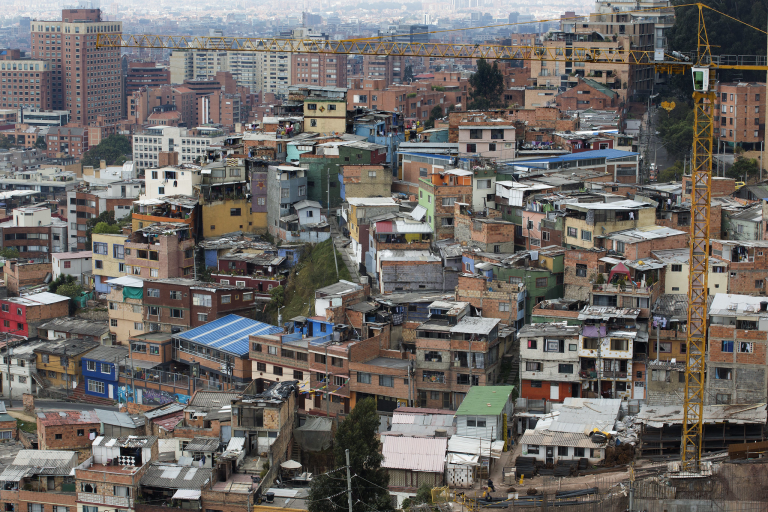
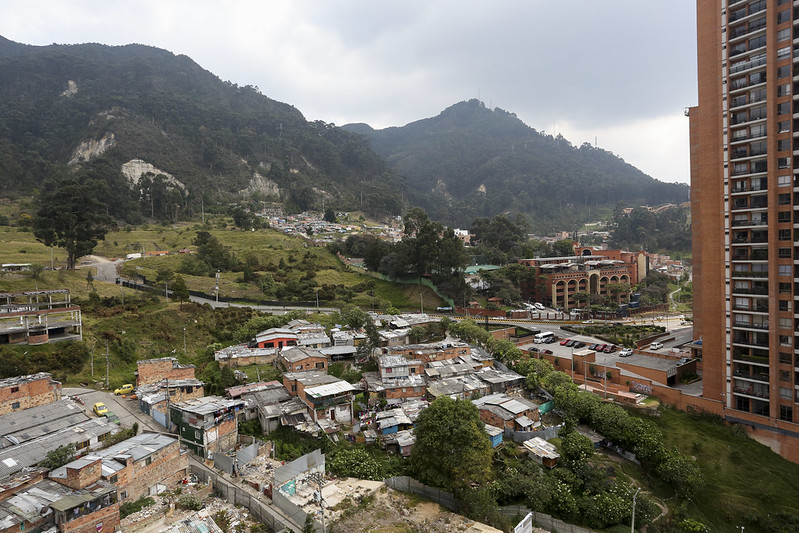
However, alongside these moments of respite lay the harsh realities of inequality that plagued Bogotá and many other cities across the Global South. Extreme poverty and wealth coexisted in uneasy proximity, with sprawling slums juxtaposed against opulent mansions and glittering skyscrapers. The juxtaposition was jarring, serving as a stark reminder of the deep-rooted disparities that pervaded Colombian society.
City view of Bogotá, Colombia, 2016. Photo: Dominic Chavez/World Bank.
Today, Bogotá has undergone a remarkable transformation, emerging as a beacon of progress and innovation in Latin America. The city’s skyline is punctuated by sleek office towers and modern infrastructure, a testament to its newfound status as a global player on the economic stage. Neighborhoods once marred by violence have been revitalized, becoming vibrant hubs of culture, commerce, and creativity. The sprawling expanse of Simon Bolivar Park remains a cherished oasis in the heart of the city, serving as a symbol of Bogotá’s resilience and determination to forge a brighter future.
Yet, for all its progress, Bogotá remains a city defined by contrasts—a place where the echoes of the past linger amidst the march towards modernity. The specter of inequality still looms large, casting a shadow over the city’s aspirations for inclusive growth and development. While the skyline may have transformed, the divide between rich and poor persists, with marginalized communities struggling to access the opportunities afforded to their wealthier counterparts.
City view of Bogotá, Colombia, 2016. Photo: Dominic Chavez/World Bank.
In navigating Bogotá’s complex tapestry of poverty and wealth, it becomes clear that the city’s evolution is not simply a narrative of progress, but one of profound social, economic, and political upheaval. The legacy of “the violence” continues to shape the lived experiences of Bogotanos, informing their perceptions of identity, belonging, and resilience. In the face of such challenges, however, there exists a palpable sense of optimism—a belief that Bogotá’s future is not predetermined, but rather shaped by the collective actions of its inhabitants.
As Bogotá continues to chart its course in the 21st century, it is imperative that it confronts the realities of poverty and wealth head-on, striving to build a more equitable and inclusive city for all. This requires not only bold policy initiatives and investment in infrastructure but also a commitment to addressing the root causes of inequality and social exclusion. Only then can Bogotá truly fulfill its potential as a beacon of hope and opportunity in the Global South.
Bogotá’s journey from the tumult of the late 20th century to the dynamism of the present day is a testament to the resilience of its people and the power of collective action. As the city continues to evolve, it is essential that it confronts the challenges of poverty and wealth with courage, compassion, and a steadfast commitment to building a better future for all who call Bogotá home.
Jim Luce brings a thoughtful perspective to food writing that goes well beyond simple restaurant reviews. His approach to culinary journalism reflects a deep understanding that cuisine serves as a cultural bridge, connecting diners to heritage, tradition, and artistic expression. Through his writing, Jim explores how food tells stories about communities, families, and the creative spirit that drives culinary innovation.
His body of work spans various publications and covers a diverse range of dining experiences across New York City. From exploring authentic Thai cuisine in Astoria and Hell’s Kitchen to discovering restaurants that combine exceptional food with meaningful social missions, Jim’s writing captures both the flavors on the plate and the human stories behind them.
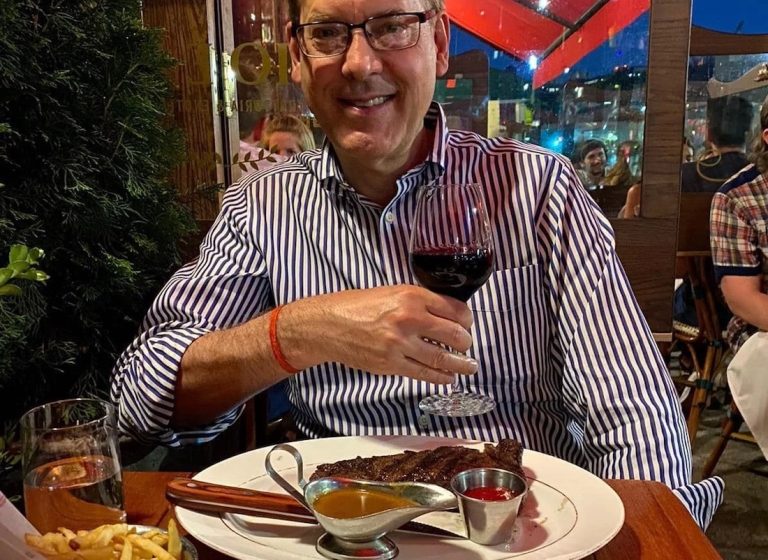
His reviews of establishments like Boucherie demonstrate his ability to weave personal experience with broader culinary observations, creating food writing that resonates with readers who share his belief that every meal is an opportunity to connect with culture and creativity. Through platforms like Daily Kos and other publications, Jim has established himself as a voice that celebrates food as both nourishment and narrative.
Lorem ipsum dolor sit amet, consectetur adipiscing elit. Vivamus euismod consequat est maximus eleifend. Phasellus elementum ipsum facilisis mi feugiat, non volutpat erat consequat. Nulla facilisi. Quisque tincidunt, ipsum eget posuere pulvinar, libero tortor tempor quam, non lacinia nibh lacus sed tortor. Aenean rhoncus lacus sed ipsum congue, nec imperdiet tellus aliquet. Curabitur auctor tortor at tortor sodales dictum. Sed auctor bibendum lorem, et viverra tortor.
Lorem ipsum dolor sit amet, consectetur adipiscing elit. Vivamus euismod consequat est maximus eleifend. Phasellus elementum ipsum facilisis mi feugiat, non volutpat erat consequat. Nulla facilisi. Quisque tincidunt, ipsum eget posuere pulvinar, libero tortor tempor quam, non lacinia nibh lacus sed tortor. Aenean rhoncus lacus sed ipsum congue, nec imperdiet tellus aliquet. Curabitur auctor tortor at tortor sodales dictum. Sed auctor bibendum lorem, et viverra tortor.
Nam ultricies sapien ac augue mattis, eu dignissim neque cursus. Curabitur ac tempor lectus, nec pretium nulla. Sed mi velit, malesuada sit amet dignissim vitae, faucibus eget nibh. Nulla commodo facilisis sem, non pretium tellus rhoncus sed. Donec consequat lacus in commodo lobortis. Integer tempor, est et aliquet varius, odio magna luctus dolor, id rhoncus erat nulla non eros. Vestibulum tempor fermentum est, ac placerat ex egestas et. Proin laoreet nibh sit amet mi consequat vehicula. Duis ultrices imperdiet hendrerit. Ut tincidunt iaculis ipsum, ut pretium tellus viverra rhoncus. Vivamus mattis nibh ac auctor vulputate. Quisque ornare augue nisi, vitae vulputate mi volutpat et. Pellentesque condimentum consequat ligula, eu ornare ante fringilla egestas. Sed eget efficitur sem, vitae lacinia dolor. Morbi fermentum sollicitudin lectus, eget rutrum lacus volutpat et.
Nulla iaculis dolor id augue luctus, quis dignissim massa faucibus. Proin non felis quis ex molestie dictum quis sit amet libero. Etiam commodo libero pharetra elementum posuere. Integer eu scelerisque sapien. Sed dictum lorem ut lectus convallis, sit amet tempor turpis aliquet. Vivamus ultricies gravida porttitor. Suspendisse tincidunt vestibulum pulvinar. Integer vel consectetur diam, id tristique mi. Integer mattis elementum nisl condimentum posuere.
Aliquam vitae molestie arcu, ut efficitur purus. Pellentesque facilisis nisl at eros placerat sollicitudin. Quisque aliquet posuere feugiat. In sed metus non nulla iaculis pharetra. Nulla sit amet finibus enim. Nunc elit ligula, convallis nec nisi id, interdum cursus nisl. Morbi ut tincidunt ipsum.
Quisque condimentum tellus non malesuada sagittis. Nam nec vehicula elit. Maecenas vel quam congue, scelerisque elit quis, eleifend magna. Vestibulum sed rutrum dui. Aenean feugiat velit eros, id consectetur dolor vestibulum vel. Aliquam erat volutpat. Curabitur congue accumsan massa, ac vestibulum ex cursus ultricies. Praesent accumsan ac metus ac hendrerit. Curabitur laoreet molestie convallis.
Accra –– Primary, secondary, and university education are vital pillars for Ghana’s development and progress as a nation in West Africa. These three levels of education play distinct yet interconnected roles in equipping individuals with the knowledge, skills, and competencies necessary for personal growth, economic prosperity, and societal advancement.
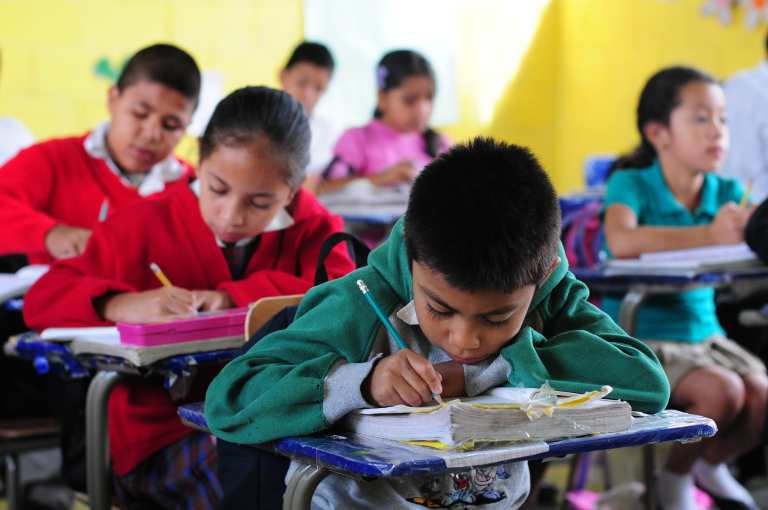
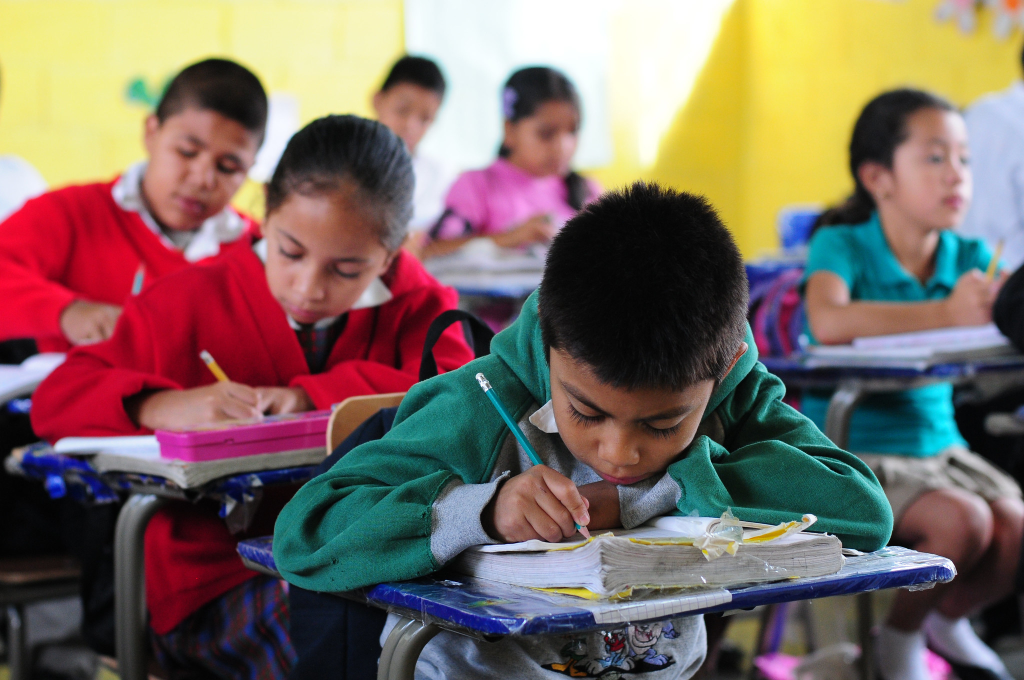
Primary education serves as the bedrock upon which all subsequent learning is built. It is during these formative years that children acquire fundamental literacy and numeracy skills, as well as the critical thinking abilities that will enable them to navigate the complexities of the modern world. Ghana has made commendable strides in expanding access to primary education, with primary school completion rates reaching nearly 100% in 2016, up from 80% in 2008. However, challenges persist, with an estimated 623,500 children still not enrolled in primary school.
Ensuring universal access to quality primary education is crucial for Ghana’s future. It not only empowers individuals with the basic tools for lifelong learning but also lays the groundwork for a skilled and productive workforce. Primary education instills values of discipline, curiosity, and a love for learning – essential attributes for success in higher levels of education and future careers.
Secondary education in Ghana serves as a vital bridge between primary schooling and higher education or vocational training. The junior secondary level (grades 7-9) builds upon the primary curriculum, while the senior secondary level (grades 10-12) prepares students for tertiary studies or entry into the workforce.
Ghana’s efforts to improve access to secondary education, including the construction of new schools and the introduction of vocational training programs, are commendable. However, admission to senior secondary schools remains highly competitive, with only a limited number of students gaining entry to public institutions. This highlights the need for continued investment in expanding secondary education opportunities, as well as ensuring quality and relevance in the curriculum.
Secondary education plays a pivotal role in developing the critical thinking, problem-solving, and specialized skills required for success in the 21st century job market. It equips students with the knowledge and competencies necessary to contribute to Ghana’s economic growth and development.
University Education: Driving Innovation and Progress
Ghana’s tertiary education system has experienced remarkable growth in recent decades, with the number of universities increasing from just three in 1990 to 70 in 201. This expansion reflects the recognition that a skilled and educated workforce is essential for economic development, global competitiveness, and innovation.
Ghanaian universities offer a diverse range of programs, from traditional degrees to technology-based training and vocational courses, catering to the diverse needs of the job market. University education not only produces the skilled professionals and researchers needed to drive innovation and economic growth but also fosters critical thinking, intellectual curiosity, and a commitment to lifelong learning.
However, the rapid expansion of tertiary education has also brought challenges, such as overcrowded classrooms, teacher shortages, and disparities in educational quality between institutions. Addressing these issues through continued investment in educational infrastructure, faculty development, and quality assurance measures is crucial for ensuring that Ghana’s university system can meet the demands of a rapidly evolving global economy.
Continued Investment, Reforms, and Commitment to Quality Education
The importance of primary, secondary, and university education for Ghana’s development cannot be overstated. Primary education lays the foundation for lifelong learning, secondary education bridges the gap and prepares students for higher studies or the workforce, and university education drives innovation, economic growth, and societal progress. By investing in these three pillars of education, Ghana can unlock the full potential of its human capital, fostering a skilled, knowledgeable, and adaptable workforce capable of navigating the challenges and opportunities of the 21st century.
While Ghana has made significant strides in expanding access to education at all levels, challenges remain, including disparities in educational quality, teacher shortages, and limited resources. Addressing these issues through continued investment, policy reforms, and a commitment to quality education for all will be crucial for ensuring that Ghana’s education system can meet the needs of its growing population and support the country’s development goals.
The Indonesian Government has started to improve programs for children up to 6 years of age
Since 2006, the Indonesian Government has worked with the World Bank to implement the Early Childhood Education and Development Program, to help prepare children to enter school. The program aims to reach 738,000 children aged 0-6. The program is integrated with other services, such as nutritious food for children, to provide comprehensive support to a child’s development. Gorontalo, North Sulawesi, Indonesia. Photo: Erly Tatontos / World Bank
I was afraid of Haiti due to the images of overwhelming poverty, the countless coups and endless violence. But I did choose Haiti, and Doris and others like her joined me in this effort. Together we set off to Haiti to try to organize a Haitian committee to build the project using many of our ideas and much of our funding. I had early concerns that it might be difficult to identify potential committee members and convince them to become involved.
Port-au-Prince. My minister asked me as we prepared to depart for Haiti what the exact plan was. I raised myself up to the theological challenge of such a question and told him boldly that it was “in God’s hands.” He laughed heartily and said that meant I didn’t really know. I smiled. I didn’t. As always, he knew me too well.
As the plane touched down on the island, I could see shack after shack spread out below us. The heat hit us on the tarmac. Communication is a challenge in Haiti, as electricity and telephone links are intermittent at best. We headed for our base camp – an old French Victorian hotel called Hotel Oloffson in a neighborhood of Port-au-Prince against which the U.S. embassy warns foreign travelers. Coincidentally, Charles Addams (“Addams Family“) stayed in this hotel and found inspiration there.
They were very pleasant and invited me with such sincerity and expectation that it cut through my hesitation. I agreed to go the next night. They gave me their e-mail addresses, their home address, their telephone number, and complete names as we parted ways.
The next night, after having left their contact information carefully in the hands of my American friends at the hotel, I walked again to the park. My potential hosts were waiting for me and lit up as brightly as the streetlights around the park to see that the American had really come. We left for their home in spite of my apprehension, and as we left the circle of light and entered the pitch darkness of the streets, things seemed legitimate.
Several blocks from the park, pitch black because the streetlights had long ago failed, we arrived at a store. They informed me that their family home was up the hill behind the place, so we climbed up the broken steps, slipping in the overwhelming darkness. Water seemed to be flowing under our feet down the path, but I could not even see my feet. As I continued to slip, the two men gathered at my sides and held my arms firmly so that I didn’t loose my footing. I was secure. Escape was impossible.
ADVERTISEMENT
We arrived at a large cement block building. Many people were sitting on its steps in the dark – no lanterns, no candles – just people sitting quietly in the oppressive heat and darkness. My hosts proposed that I follow them up to the second floor. I was scared and realized that I could only be brutally honest. I explained that I was frightened and wished to go back to the street café to drink with them there. They tried to explain how safe I was, but I was resolute and we drank in the café instead.
As the week went on I continued to meet with people across Haiti in shelters, orphanages, schools, and medical clinics. I learned much about Haiti and how its people have been exploited for centuries. The poverty in Haiti is incredible, and the opportunity for improvement slim. As I traveled Haiti and made friends with Haitians from all walks of life, I asked them about my friends in the park, and whether I should visit their home or not. My confusion gnawed at me; I felt I had been wrong in not accepting a gracious invitation, if that’s what it was.
My new Haitian contacts could not tell me whether to trust the two in the park or not. They loved their country and its people, but they realized that extreme poverty leads occasionally to extreme violence. Trust your instincts, they told me. “Feel the reality.”
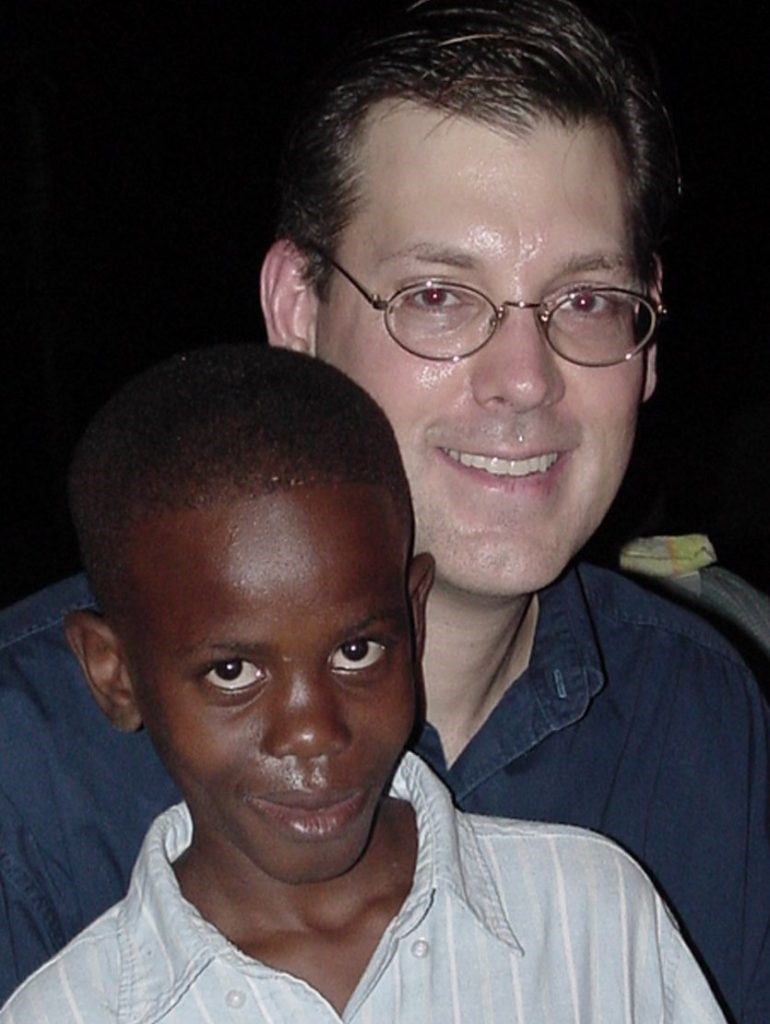
With Felix, a street child in Port-au-Prince.
Towards the end of my visit I made my final pilgrimage to the park. My friends were there, and we laughed and talked, and then I surprised them by announcing that I wanted to visit their home if the offer still stood. It did, and off we went. However, this time the neighborhood had electricity. The path was still dark, but when we reached the house it was brightly lit.
I was introduced to the aunts and uncles, the nieces and nephews, the little brothers and sisters, the father and the mother, and finally the grandmother. They offered me no refreshments, as they didn’t have any, but I was offered a place next to the grandmother and we retold the story of my first attempted visit. I brought down the house when I pantomimed shaking with fear, declaring in just-learned Creole, “I’m scared!”
We returned to my hotel, a new experience for them, where we shared a drink and promised to be friends into the future. They still could not understand why I liked Haiti. I told them that it was because of the extreme beauty of the Haitian landscape and the Haitian people, and mostly because of my admiration for the strength and hope of Haitians. Haitians have been put down for so long that they should have just given up long ago, but they have not. They are filled with hope, resolve and strength.
My trip to Haiti and my hopes for its people are like my trip to my friends’ house near the park. The way is dark, the path is slippery and filled with holes. But with faith and the support of the Haitian people I have come out in the clearing, and it is well lit and welcoming.
I went to Haiti to offer a bit of hope and strength to an impoverished people. I left Haiti having instead gained hope and strength from these same people; I was the one who became empowered. I realized the resilience and fortitude of which humanity is capable, and I have grown as a result. I have now traveled to Haiti fifteen times and I still feel the same connection as I did on that first trip.
As I sit in the front yard of the orphanage we founded in 2002, surrounded by our twelve laughing children, combing my strange hair, touching my funny legs, comparing their tiny hands to my giant ones, I wonder how I can quantify the electric pulses of love flowing from these kids? How do you measure happiness in orphaned children? By their smiles? By their appetites? By their school grades?
Jacmel. In July we moved our children from the gritty city of Gonäives destroyed by Hurricane Jeanne in 2004 to the city of Jacmel, home of French colonial architecture, surrounded by lush mountains, and sitting on a beautiful bay.
Our home in Gonäives was always dusty, the city and countryside deforested and now desert-like. It is the inability of the land there to absorb rain and run-off from the mountains that leads to regular catastrophe. Our home in Gonaives collapsed during Hurricane Hannah eight weeks after we left.
Our children, many orphaned by Hurricane Jeanne, realize they escaped their own deaths by moving with us to Jacmel. They realize that they live in a home that flood waters will not touch, nor high winds blow away.
Our kids today have enormous smiles – bigger than I have ever seen them before. They have access in Jacmel to more food then they have ever seen in their lives and they are eating double portions three meals a day. Not to mention their academic scores have soared.
This is not to say they do not remember the hard times in Gonäives, or that psychological damage suffered there will not be hard for them to overcome.
Seven year old Jean told me yesterday, “If we had stayed, we would have died.” Twelve year-old Samson remembers from Hurricane Jeanne, “Cars and dead bodies floating by.” Bernadine, age nine, remembers climbing to her roof to survive. “I was happy last week because we did not die,” she confided quietly to me.
The children of Orphans International in Jacmel are as strong as the people of Haiti themselves. No where in the world is there stronger people. Independent for over two hundred years – the first successful slave revolt which finally sent their masters packing – has left a host of leaders and outside powers who have in effect re-enslaved Haiti’s population, creating poverty and violence generation after generation. Any Haitian whose family has survived the endemic violence is strong by definition. Pride follows strength.
We are raising our little Haitians to be global leaders. This international outlook, coupled with the strength of Haitians, will make them proud players on a world playing field. Through their own natural strength, coupled with opportunities we are providing to them, our children shall overcome any obstacles.
I thank our enormously dedicated staff, lead by Jacques Africot and Doris Chernik, Ph.D., and our numerous child sponsors, including H.S.H. Prince Albert of Monaco, Sovereign Prince. This team of committed individuals help the dreams of Orphans International become reality. And allow the nightmares of our children to become their own dreams of Haiti’s future.
– Jim Luce, September 10, Cyvadier Village, Jacmel, South East Province, Haiti
Awardees include African singerEmmanuel Jal, Coalition to Stop the Use of Child Soldiers, Ambassador and author Sichan Siv, Hon. Palitha Kohona, Sri Lankan Ambassador to the U.N., and U.S. Congresswoman Carolyn B. Maloney. Orphans International Worldwide was founded by Jim Luce in 1999 and is associated with the United Nations. There are over 100 Orphans International projects now around the world. Luce is considered the father of the Orphans International Movement.
New York, N.Y.Haiti is the poorest nation in the Western Hemisphere. It has practically nothing. Although the U.N. and other international relief agencies are there, they are mostly stationed where the quake hit the hardest.
Orphans International Worldwide Haiti in Cyvadier(www.orphansinternational.org), located just outside Jacmel in the Southern Province, survived the earthquake unscathed. An upcoming benefit in New York City will allow the project to grow.
Currently, the boys stay in the Peter Yarrow Room and the girls in the Doreen Nurse Room. Plans are for a community center to implement a family care model.
Jacques Africot is the Orphans International Worldwide director in Cyvadier. Jacques trained with Orphans International Worldwide founder Jim Luce in Indonesia following the 2004 Tsunami.
Peter Yarrow, of Peter, Paul and Mary, was an early — and remains a strong — supporter. Peter sits on the Global Advisory Board of Orphans International Worldwide, along with H.S.H. Prince Albert of Monaco.
Orphans International Worldwide Haiti has received a pledge from the Monaco Red Cross to assist Orphans International Worldwide roll out its Family Care model in Cyvadier.
Orphans International Worldwide Haiti will have a major benefit at New York City‘s historic Webster Hall(www.websterhall.com) as part of the Quarterly Arts Soiree (www.theqas.com), Sunday, Feb. 28.
The 24-hour Art-a-thon will raise funds for Orphans International Worldwide Haitian relief projects in Jacmel and Leogane, offering entertainment from seven separate event spaces in the venue.
The relief benefit will end with an evening VIP Reception for the organization’s 2010 “Global Citizenship Award for Leadership in Helping Humanity.”
Entertainment personalities, diplomats from the U.N. and Washington, and representatives from international development agencies will be honored. Additional nominations are being accepted.
Awardees include African singer Emmanuel Jal, Coalition to Stop the Use of Child Soldiers, Ambassador and author Sichan Siv, Hon. Palitha Kohona, Sri Lankan Ambassador to the U.N., and U.S. Congresswoman Carolyn B. Maloney.
Orphans International Worldwide was founded by Jim Luce in 1999 and is associated with the United Nations. There are over 100 Orphans International projects now around the world. Luce is considered the father of the Orphans International Movement.
Luce will arrive in Haiti March 5 to personally coordinate OIW’s relief efforts in Leogane and Jacmel. The video of Luce explaining his organization is on-line (www.vimeo.com/9007541).
Contributions for Orphans International Worldwide Haiti may be made on-line.
Orphans International Worldwide is specifically structured to be Interfaith, Interracial, International, Intergenerational, and Internet-Connected.
Orphans International is working in cooperation with CharityHelp International(www.charityhelp.org), Colline Academie (Haiti), and the World Harmony Fund (China).
Port-au-Prince. Safe with an escort, a trusted community leader, we toured Cite de Soleil, the feared shanty town of Port-au-Prince. We were in the worst slum of the worst city in the Western Hemisphere, where tens of thousands of people squeezed into shacks built from scraps and garbage. A European film crew had arrived unescorted the week before, and their expensive TV camera had been smashed and they had fled the slum on foot. President Aristide’s loyalists make their last stand there. Even U.N. Peacekeepers cannot enter safely.
We passed children with extended bellies, swollen not from eating too much, but from malnutrition. Growing up in Ohio, I made mud cakes for fun. These children made them as well, but to eat. I have since learned, from the excellent book, The Neglected and Abused: A Physician’s Year in Haiti, that geophagia is the medical name for this tragic phenomenon [Bentivegna, M.D., Joseph F.; Michelle Publishing Company, CT; 1991; 175 pp.].
As our tour continued, we passed over a large sewage canal deep with rich filth, plants growing over the mud flats, and pigs rooting though the garbage for food. We crossed a narrow wooden planked footbridge to the other side, hopping over two missing planks in the very middle.
I asked my Haitian companions why these planks had not been replaced. With hesitation, and after conferring with each other in Creole, they said that the missing planks had a purpose, for the gap that formed was where women who did not wish to bear life into hell could squat at night and release their offspring into the black darkness below, to sink into the mud as sustenance for the pigs.
I cannot imagine, however, how bad Haiti is at this moment — and we cannot reach our project there outside Jacmel. We have just gotten through to our American neighbor there.
The James Jay Dudley Luce Foundation Supporting Young Global Leadership
New York, N.Y. We have yet to hear from our staff in Haiti about the safety of our children there. As founder of Orphans International Worldwide (OIW), I have been in Haiti about 20 times in the last 10 years. I have witnessed riots, the slums of Cite de Soleil, and the destruction of Gonäives after Hurricane Jeanne.
I cannot imagine, however, how bad Haiti is at this moment — and we cannot reach our project there outside Jacmel, in the beautiful village of Cyvadier, home of our Haitian director Jacques Africot.
We have just gotten through to our American neighbor there outside Jacmel, Emmet Murphy:
“It is a complete devastation here. Personally, I am lucky to be alive right now. I was driving back to Jacmel in the mountains (yesterday) when the entire mountain seemed to fall down all around me.
“People were panicking, buildings collapsed on the roadside, and a huge dust plume raised from the valley floor. Seconds later and I would have been crushed by an avalanche that blocked the road. I had to abandon the car and continue on foot.
“Jacmel is a disaster zone. Many houses have collapsed or are severely damaged. Everyone was on the streets when I got to town. There must be many deaths judging from the way the houses collapsed, and given poor construction practices and materials.
“We are unable to get a line through to Port-au-Prince where we have some staff. The Internet is working and it looks really bad judging from pictures on the Internet news sites.
“Both Jacmel and Port-au-Prince are about equidistant from the quake’s epicenter in Leogane.
“We’ll be working with the key emergency response players down here today. The United Nations Peacekeeping (MINUSTAH), Dept Protection Civile, Red Cross, etc., since there are many displaced and they’ll need food, water, etc.
“Unfortunately our supplies are far from here, and as I said the road to Port-au-Prince is cut off and we are essentially stranded here until the road is cleared of tons of rubble.
Orphans International Haiti, located just outside Jacmel in the village of Cyvadier, houses our 11 children in its Chernik House. The boys stay in the Peter Yarrow Room, and the girls in the Doreen Nurse Room.
We have not heard yet about the safety of our staff or kids at Orphans International Haiti.
Peter Yarrow, of Peter, Paul and Mary, was an early – and remains a strong – supporter. Peter sits on the Global Advisory Board of Orphans International Worldwide, along with H.S.H. Prince Albert of Monaco.
My last trip to Haiti was about ten weeks ago when I visited our children and interviewed our Jacques Africot, of Orphans International Haiti. He spoke about the role of education in the developing world(see story).
Jacques is our Haiti director. Jacques has been with OI since before the Tsunami of 2004. He trained with me in Indonesia, helping Tsunami orphans in Aceh.
Sharing a cup of coffee with Jacques Africot as I interview him for a piece ten weeks ago at the Cyvadier Plage Hotel, down the road from OI Haiti.
Haiti is the poorest nation in the Western Hemisphere. It has practically nothing. Although the U.N. and other international relief agencies are there, they are mostly stationed where the quake hit the hardest.
I understand that the United Nation’s primary administrative headquarters, MINUSTA, where I have had many meetings over the years, has been severely damaged.
Funds will be needed immediately to get supplies to Haiti. The U.S. government is still assessing damage at the capital’s airport.
I know the American Red Cross representative in Haiti personally and can recommend that funds be given to the American Red Cross for Haiti. That can be done here.
We can only hope that Orphans International Haiti is still standing and that our staff and children there are alive and well.
Contributions may also be made to Orphans International Haiti, where the destruction will make taking care of our children that much more difficult.
Inspecting the new OI Haiti Community Center to be funded in part by the Monaco Red Cross. This type of cement construction sadly is most vulnerable in a massive earthquake.
Orphans International Haiti has recently received a pledge from the Monaco Red Cross to assist Orphans International roll out its Family Care model in Jacmel.
We had discussed the dangers of earthquakes in regard to construction, but we never imagined one could be as large as the one that just hit.
I am incredibly concerned about friends in Port-au-Prince with the U.N., Norwich Mission House, the Olaffson Hotel – the list is endless. OI Haiti‘s last two directors, a child psychologist and a pediatric hospital administrator, are both in Port-au-Prince and I cannot reach them.
To reach the U.S. State Department to check on American citizens in Haiti, call 888-407-4747. I have been calling all day to check on two American friends who were about to visit OI Haiti. I believe they are now in Fondwa.
I pray for their safety, as I pray for the people of Haiti. My heart is bleeding. I hope to be able to join them the moment the airport is re-opened.