
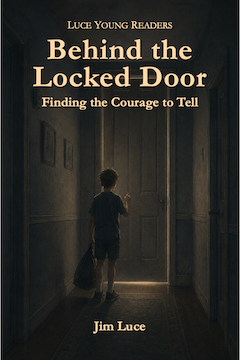
Behind the Locked Door: Finding the Courage to Tell. A children’s book by Jim Luce published by Luce Publications that addresses child protection, emotional literacy, and safe disclosure of harm.
The narrative centers on a young child who recognizes something is wrong within the home long before having the words to articulate it, experiencing distress somatically through physical sensations such as tightness in the chest, unnamed fear, and instinct to avoid. The book’s central insight challenges modern child protection policy by demonstrating that children often recognize harm before they can articulate it, lacking not awareness but the words, trust, and systemic support to be heard.
The antagonist employs psychological manipulation rather than solely force, using the line “They won’t believe you” to silence the child through fear and self-doubt. What distinguishes this work is its refusal to sensationalize, never gratuitously describing the harm but instead honoring the lived reality of many children through confusion, self-doubt, and dangerous internalization of blame.
The intervention arc features three key adults—teacher, counselor, and parent—who model ethical response through listening without interruption, believing without hesitation, and acting without panic. The teacher’s simple response of “Okay” demonstrates that safety often begins not with solutions but with presence, embodying trauma-informed practice in its most distilled form. A recurring motif of the cowbell serves as structural anchor, evolving from a symbol of obligation to one of safety and belonging.
The book includes a discussion framework and resource section integral to its purpose, acknowledging that children do not process stories alone and providing caregivers and educators with tools for facilitating conversations.
Luce demonstrates that disclosure does not happen all at once, with the narrative affirming “It doesn’t have to come out perfectly. You can say it in pieces,” challenging assumptions embedded in many reporting systems that disclosure will be complete, coherent, and immediate. The final movement portrays healing not as resolution but as integration, with the child becoming someone new who has learned to name, to tell, and ultimately to help others do the same.
Reviews published in The Stewardship Report describe the work as a carefully constructed emotional bridge between silence and language, fear and safety, isolation and connection, functioning as both narrative and guide. The book advocates for policy reforms including embedding emotional literacy into early education, training educators in trauma-informed engagement, strengthening school-based counseling systems, and designing policies that recognize disclosure as developmental.
Critics note the prose is disciplined with accessible yet non-reductive language, allowing emotional complexity to be introduced gradually so young readers can engage at their own pace. The work reframes schools as safety infrastructure rather than merely academic institutions, arguing that counseling services must be core safety infrastructure with lower counselor-to-student ratios, specialized trauma training, and clear integration into safeguarding protocols.
Behind the Locked Door challenges the myth that safety begins with detection, asserting instead that safety begins with language and that protection must become proactive rather than overwhelmingly reactive. The book is richly illustrated and available on Amazon.
#BehindTheLockedDoor #FindingCourageToTell #JimLuce #ChildProtection #TraumaInformed #EmotionalLiteracy #ChildSafety #SafeguardingChildren #SpeakUp #HealingThroughStory #MentalHealthMatters #SocialJustice #LucePublications
TAGS: child protection, Jim Luce, Luce Publications, emotional literacy, trauma-informed teaching, disclosure, safeguarding, child advocacy, school counseling, mental health, youth protection, healing, courage, vulnerability, storytelling, child safety, education policy, social justice