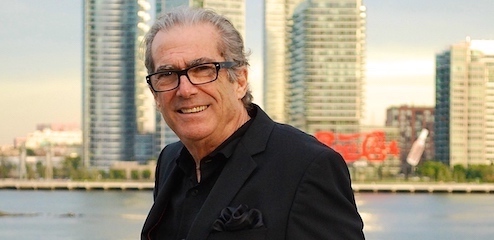
Peter Reginato (b. 1945). An American abstract sculptor and painter based in New York City, recognized for his innovative welded steel sculptures and vibrant abstract paintings that challenge conventional relationships between color, form, and space.
Working primarily in painted steel and mixed media, Reginato emerged during the post-minimalist era of the late 1960s and has maintained a prolific career spanning more than five decades, contributing significantly to contemporary American sculpture. His work is characterized by dynamic compositions that balance geometric precision with organic spontaneity, often employing bold color palettes that distinguish his sculptures from the monochromatic traditions of minimalism.
Peter Reginato was born in Dallas, Texas, and moved to California during childhood, where early exposure to the burgeoning West Coast art scene influenced his artistic development. He studied at the San Francisco Art Institute during the early 1960s, a period marked by experimentation and the breakdown of traditional artistic boundaries.
The Bay Area provided fertile ground for young artists exploring new materials and methods, and Reginato quickly gravitated toward sculpture, particularly welding techniques that allowed for three-dimensional exploration of abstract forms. After completing his studies, Reginato relocated to New York City in 1966, immersing himself in the city’s vibrant contemporary art community during a transformative period in American art history.
Artistic Development and Style
Upon arriving in New York, Reginato became associated with a generation of sculptors who were responding to and moving beyond the austerity of minimalism. While artists like Donald Judd and Carl Andre emphasized industrial materials and serial repetition, Reginato incorporated expressive color and more improvisational construction methods into his welded steel works.
His sculptures from the late 1960s and early 1970s featured brightly painted surfaces—yellows, reds, blues, and greens—applied to abstract steel forms that suggested movement and energy rather than static presence. This approach aligned Reginato with post-minimalist tendencies that sought to reintroduce subjective experience and visual pleasure into abstract art.
Reginato’s working method involves both careful planning and spontaneous decision-making. He typically begins with steel components—sheets, tubes, or found metal objects—which he cuts, bends, and welds into complex assemblages. The welding process itself becomes a form of drawing in three dimensions, creating linear elements that define space and establish relationships between solid and void.
Once the sculptural form is complete, Reginato applies industrial paint, often in multiple colors that emphasize different planes and angles, creating visual rhythms that shift as viewers move around the work. This attention to color as an integral sculptural element distinguishes Reginato’s practice from many contemporaries who treat surface as secondary to form.
Major Works and Exhibitions
Throughout his career, Reginato has created sculptures ranging from intimate tabletop pieces to monumental outdoor installations. Works such as “Apollo” (1969) and “Maybelle” (1970) exemplify his early style, featuring curved and angular steel forms painted in contrasting colors that create dynamic visual tension.
Later pieces like “Krawumm” (1989) and “Zap” (2005) demonstrate continued experimentation with scale, complexity, and the integration of different materials including aluminum and found objects. Reginato’s sculptures often possess a sense of arrested motion, as if capturing a moment of transformation or energy transfer, which gives the work both physical presence and temporal dimension.
Peter Reginato has exhibited extensively throughout the United States and internationally. His work has been featured in solo exhibitions at prestigious venues including the Corcoran Gallery of Art in Washington, D.C., the University Art Museum at Berkeley, and numerous commercial galleries in New York City.
Group exhibitions have included representation at the Whitney Museum of American Art, the Museum of Modern Art, and the Guggenheim Museum.
His sculptures are held in major public collections including the Metropolitan Museum of Art, the Art Institute of Chicago, the Los Angeles County Museum of Art, and the Hirshhorn Museum and Sculpture Garden.
Later Career and Painting
In addition to sculpture, Reginato has maintained a parallel practice in abstract painting since the 1980s. His paintings employ similar compositional strategies to his sculptures—bold colors, gestural marks, and dynamic spatial relationships—but translated into two dimensions.
These works often feature layered surfaces with collage elements, combining painted passages with attached materials that create shallow relief. The paintings demonstrate Reginato’s consistent interest in how abstract forms can generate visual energy and emotional response without representational content.
Reginato’s contribution to contemporary sculpture lies in his synthesis of formalist concerns with expressive color and improvisational construction. While maintaining commitment to abstraction and material integrity, his work injects personality and visual exuberance into traditions that sometimes prioritize theoretical rigor over sensory experience.
This balance has allowed Reginato to remain relevant across multiple generations of artistic practice, influencing younger sculptors who seek to combine conceptual sophistication with visual appeal.
Legacy and Influence
Peter Reginato represents an important link between the minimalist sculpture of the 1960s and subsequent developments in post-minimalism, color field sculpture, and contemporary abstract practice. His insistence on color as a fundamental sculptural element helped expand possibilities for three-dimensional abstract art beyond the industrial aesthetic that dominated the 1960s.
By demonstrating that welded steel sculpture could be both formally rigorous and visually celebratory, Reginato opened pathways for diverse approaches to abstract sculpture that continue to resonate in contemporary art.
Reginato continues to work from his studio in New York City, producing new sculptures and paintings that maintain his characteristic combination of structural complexity and chromatic intensity. His sustained productivity and consistent artistic vision over more than fifty years establish him as a significant figure in American post-war sculpture, whose work bridges historical movements while maintaining distinctive individual character.
#PeterReginato #AbstractSculpture #ContemporaryArt #WeldedSteel #PostMinimalism
#AmericanSculptor #NYCArt #AbstractArt #SculptureArt #ModernSculpture
