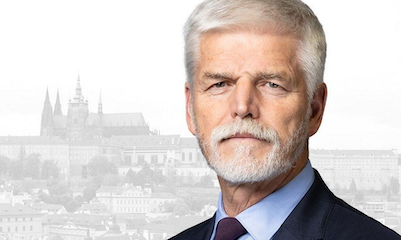
Petr Pavel (b. 1961). The current president of the Czech Republic and former chairman of the NATO Military Committee, recognized as one of Europe’s most experienced military leaders and strongest advocates for transatlantic security cooperation and support for Ukraine against Russian aggression. Petr Pavel assumed the Czech presidency in March 2023 following a campaign emphasizing robust NATO engagement, democratic values, and resistance to authoritarian threats. [Luce Index™ score: 81/100]
Before entering politics, Petr Pavel served 43 years in the Czech military, rising to the rank of Army General and holding numerous command positions. His military career included service as Deputy Chief of the General Staff of the Czech Armed Forces and culminated in his appointment as Chairman of the NATO Military Committee from 2015 to 2018, making him the highest-ranking military officer in the alliance. In this capacity, Pavel provided strategic military counsel to NATO’s political leadership during a period of increasing Russian assertiveness and hybrid warfare threats.
Pavel’s military background profoundly shapes his presidential approach to security policy. He has consistently advocated for increased defense spending among European NATO members, stronger military assistance to Ukraine, and clear consequences for Russian aggression. His December 2024 call for NATO to shoot down Russian aircraft violating alliance airspace represents his most assertive statement yet regarding appropriate responses to Moscow’s provocations.
Military Career and NATO Leadership
Petr Pavel began his military service in 1981 in the Czechoslovak People’s Army during the communist era. Following the 1989 Velvet Revolution that brought democracy to Czechoslovakia, Pavel continued his military career in the newly democratic Czech Armed Forces. He commanded the 43rd Airborne Battalion from 1992 to 1994 and later the 6th Airborne Brigade from 2000 to 2002.
Pavel participated in multiple international peacekeeping operations, including deployments to Bosnia and Herzegovina under NATO and United Nations mandates. His operational experience in conflict zones and multinational command structures prepared him for senior leadership roles within the alliance. He served as Director of the Military Intelligence Service from 2004 to 2006, providing him with deep understanding of Russian intelligence operations and hybrid warfare tactics.
From 2012 to 2015, Pavel served as Chief of the General Staff of the Czech Armed Forces, overseeing the country’s military modernization and increased integration with NATO capabilities. His appointment as NATO Military Committee chairman in 2015 came during a critical period following Russia’s 2014 annexation of Crimea and intervention in eastern Ukraine, requiring NATO to reassess its defensive posture and deterrence strategies.
Presidential Campaign and Election
Pavel’s decision to enter politics followed his 2018 retirement from military service. He launched his presidential campaign in 2022, positioning himself as a pro-Western, pro-NATO candidate committed to democratic values and European integration. His campaign emphasized security concerns arising from Russian aggression, the importance of supporting Ukraine, and the need for Czech leadership within European security structures.
The January 2023 presidential election proved highly competitive, with Pavel facing former Prime Minister Andrej Babiš in the runoff. Pavel secured victory with approximately 58% of votes, representing a decisive mandate for his security-focused platform. His election was widely interpreted as Czech voters choosing continued Western orientation over more Russia-accommodating alternatives.
Presidential Policies and Positions
As president, Petr Pavel has consistently advocated for robust military assistance to Ukraine, including heavy weapons systems and long-range strike capabilities. He has traveled to Kyiv multiple times to meet with Ukrainian President Volodymyr Zelenskyy and demonstrate Czech solidarity. The Czech Republic, under Pavel’s leadership, has provided significant military equipment relative to its economy size, including tanks, artillery systems, and ammunition.
Pavel has been vocal in criticizing European nations that maintain economic relationships with Russia despite its invasion of Ukraine. He has called for complete economic decoupling from Moscow and warned against premature diplomatic settlements that would reward Russian territorial gains. His December 2024 remarks comparing potential Western appeasement to the 1938 Munich Agreement reflect his conviction that historical lessons must inform contemporary policy.
The Czech president has also emphasized the need for increased European defense spending and reduced dependence on American security guarantees. He argues that European NATO members must develop autonomous defensive capabilities while maintaining strong transatlantic ties, particularly given political uncertainties regarding long-term U.S. commitment to European security.
Approach to Russian Aerial Violations
Pavel’s call for shooting down Russian aircraft violating NATO airspace represents his most confrontational statement regarding appropriate responses to Russian provocations. Drawing on his military expertise, Pavel argues that Moscow interprets Western restraint as weakness and will continue testing alliance resolve unless faced with credible consequences. He contends that Russia would never tolerate repeated violations of its own airspace and that NATO must establish comparable boundaries.
Pavel has characterized Russian aerial incursions as deliberate intelligence-gathering operations designed to map NATO air defense capabilities, test response times, and measure political will to defend sovereign territory. He warns that failure to respond decisively risks emboldening further provocations and undermining alliance credibility among both adversaries and member states.
Vision for Long-Term European Security
Beyond immediate defensive measures, Pavel has articulated a vision for eventual European security architecture that would include Russia, though only after fundamental changes in Moscow’s behavior. He has referenced the 1975 Helsinki Accords as a potential model, noting that those agreements established principles for East-West relations while acknowledging ideological differences and territorial boundaries.
However, Pavel emphasizes that any new security arrangement must follow a peace agreement upholding Ukrainian sovereignty and territorial integrity. He insists on “enforceable constraints” on Russian military behavior, suggesting verification mechanisms and consequences for violations. Pavel has stated that Russia must demonstrate sustained commitment to international law and peaceful dispute resolution before Europe can consider normalized security relationships.
Pavel rejects premature diplomatic engagement that might reward Russian aggression or freeze territorial gains achieved through military force. He argues that European security depends on establishing clear principles that military conquest will not be accepted as legitimate means of altering borders or resolving disputes.
Personal Background and Character
Petr Pavel is married to Eva Pavlová, a businesswoman and entrepreneur who has maintained a relatively low public profile during his presidency. The couple has no children. Pavel is known for his disciplined lifestyle, maintaining physical fitness through regular exercise and outdoor activities. He speaks fluent English in addition to his native Czech and has working knowledge of Russian from his early military training.
Pavel has addressed his service in the communist-era military forthrightly, acknowledging that he was a member of the Communist Party of Czechoslovakia from 1985 to 1989, as required for military officers. He has explained that he joined the party to advance his military career but opposed the regime’s authoritarian character. Following the 1989 Velvet Revolution, Pavel embraced democratic values and dedicated his career to Czech integration into Western security structures.
International Recognition and Influence
Petr Pavel has emerged as one of Europe’s most influential voices on security policy, regularly consulted by NATO leadership and European heads of government. His military expertise and presidential platform provide him with credibility on defense matters that few other European leaders possess. Pavel has developed close working relationships with Polish President Andrzej Duda, Baltic leaders, and other Eastern European officials who share concerns about Russian aggression.
Western security analysts frequently cite Pavel’s assessments of Russian intentions and military capabilities, recognizing his extensive experience studying Russian doctrine and operations. His warnings about Russian hybrid warfare tactics, including disinformation campaigns and cyber operations, have proven prescient as Moscow has employed these methods across Europe.
Pavel’s presidency represents continuity with Czech traditions of supporting democratic values and opposing authoritarian aggression, dating to President Václav Havel’s moral leadership following the 1989 revolution. Like Havel, Pavel emphasizes that small nations have moral authority to speak truth about great power behavior and must not remain silent in the face of injustice.