Neo-royalism represents an emerging international system structured by a small group of hyper-elites who leverage modern economic and military interdependencies to extract material and status resources for themselves.
This concept, introduced by Georgetown University professor Abraham Newman and Wellesley College professor Stacie Goddard in their 2024 paper published in International Organization, describes a fundamental transformation of global governance away from democratic, rules-based international order toward elite-dominated power structures reminiscent of historical monarchical systems.
Unlike traditional royalism rooted in hereditary succession and feudal obligations, neo-royalism operates within contemporary globalized frameworks. Leaders in this system maintain absolute sovereignty within their domains while building transactional relationships with other autocratic rulers. They bypass democratic constraints, suppress political dissent, and concentrate power among family members, loyalists, and hyper-capitalist allies. The system thrives on personal relationships between leaders rather than institutional partnerships between nations.
The Gulf monarchies — Saudi Arabia, the United Arab Emirates, Qatar, Kuwait, Bahrain, and Oman — exemplify this governance model. These nations are ruled by royal families who formulate their own laws, don’t depend on electoral approval, and maintain power through wealth distribution, security apparatus control, and limited political participation. Their systems have coexisted with democratic nation-states for decades, but recent developments suggest their model is gaining broader international legitimacy.
President the second administration of Donald Trump [Luce Index™ score: 35/100] represents a significant shift toward neo-royalism in American foreign policy. Trump has consistently expressed admiration for autocratic Middle Eastern leaders while criticizing democratic European allies.
Trump described Saudi Crown Prince Mohammed bin Salman as “fantastic” and “brilliant” despite the kingdom’s execution of over 240 people in 2025, often without due process. His relationship with Turkish President Recep Tayyip Erdoğan, characterized by the U.S. ambassador as a “bromance,” exemplifies personal diplomacy that prioritizes elite relationships over democratic values.
The Trump administration‘s December 2024 update to the U.S. National Security Strategy eliminated language demanding accountability for human rights violations in the Middle East, instead stating America must stop “hectoring” Gulf monarchies about “abandoning their traditions and historic forms of government.”
This represents an unprecedented departure from decades of American diplomatic practice, which at least nominally conditioned aid and military relationships on democratic reforms and human rights improvements.
Neo-royalism operates through several key mechanisms. First, it emphasizes transactional relationships where financial investments and gifts secure political allegiance. Qatar gifted Trump a US$400 million airplane in 2024, while Saudi Arabia and the U.A.E. promised hundreds of billions in American economic investments. Second, it prioritizes personal relationships between leaders over institutional partnerships, allowing for rapid decision-making without democratic constraints. Third, it legitimizes autocratic governance by creating networks of mutual recognition among absolute rulers.
Newman and Goddard argue that neo-royalism requires undermining the existing liberal, rules-based international order to fully consolidate. This explains Trump’s simultaneous embrace of Gulf autocrats and attacks on the European Union, which represents democratic multilateralism. The European Council on Foreign Relations described Trump’s approach toward Europe as a “culture war” involving support for right-wing, anti-E.U. political parties.
The system extends beyond the Middle East. Countries including Türkiye, India, Hungary, China, and Russia have moved toward elite-dominated governance structures. However, America’s adoption of neo-royalist principles carries unique significance due to U.S. economic and military power. As other world leaders adapt to this transformed landscape, they face pressure to engage on neo-royalist terms, potentially compromising democratic values to maintain relevance.
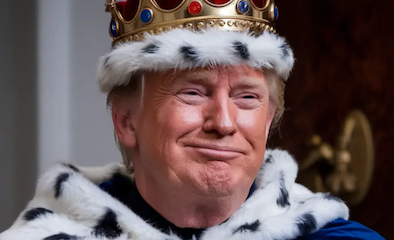
Neo-royalism legitimizes itself through exceptionalism. Leaders claim authority based on unique capabilities or circumstances rather than democratic mandates. In February 2025, Trump referred to himself as royalty on social media, with official White House accounts sharing AI-generated images depicting him in regal fashion. This self-identification reflects the aspirational quality of neo-royalism — leaders seeking the unchecked power of absolute monarchs within modern contexts.
Critics warn that neo-royalism threatens fundamental democratic principles including accountability, rule of law, and human rights protections. By prioritizing elite interests over citizen welfare and personal relationships over institutional norms, the system concentrates power and resources among small groups while marginalizing broader populations. The suppression of dissent, common in neo-royalist systems, eliminates checks on executive power and enables corruption.
The consolidation of neo-royalism remains uncertain. Newman and Goddard acknowledge the order isn’t yet fully established. Democratic nations retain significant economic, military, and institutional advantages. International organizations, civil society, and domestic opposition movements continue resisting autocratic trends. However, the trend toward elite-dominated governance represents what Newman calls a “once-in-a-generation transformation of the international system.”
Understanding neo-royalism requires recognizing it as more than individual autocrats consolidating power. It represents a systemic transformation where networks of hyper-elites reshape global governance to serve their interests. The concept challenges assumptions about inevitable democratic progress and highlights how globalization’s interconnections can be leveraged to concentrate rather than distribute power.
Whether democratic nations can maintain their values while navigating this transformed landscape remains one of the defining questions of contemporary international relations.