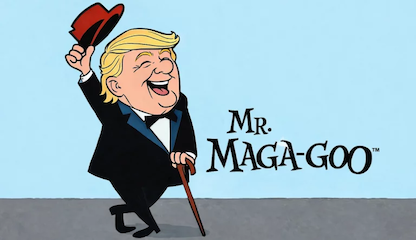
Mr. MAGA-goo. A contemporary political satire character created for The Stewardship Report, combining visual absurdism with pointed critique of authoritarian certainty and civic blindness in modern U.S. political culture. Inspired by the mid-20th-century cartoon figure Mr. Magoo, Mr. MAGA-goo reinterprets the trope of oblivious confidence for an era defined by ideological rigidity, spectacle politics, and the erosion of democratic norms (MAGA).
The character first appeared in 2026 in editorial cartoons illustrated by Maria Peña, with contributions from Lauren Dupont, as part of The Stewardship Report’s expanded commitment to visual journalism and progressive satire.
Unlike his predecessor, whose near-nearsightedness produced accidental success, Mr. MAGA-goo embodies willful blindness. He does not merely fail to see consequences; he denies their existence. The satire lies in his unwavering self-assurance as systems collapse around him.
Concept and Symbolism
Mr. MAGA-goo is typically depicted marching confidently into danger, mistaking collapse for victory and chaos for leadership. His exaggerated expressions, triumphant body language, and misdirected slogans reflect a broader cultural phenomenon in which certainty is valorized over evidence.
The character functions as a metaphor for governance without accountability and confidence untethered from reality. Through humor, Mr. MAGA-goo exposes how authoritarian movements often rely on spectacle, repetition, and emotional certainty rather than factual coherence.
Artistic Origins
The visual language of Mr. MAGA-goo draws heavily from classic American editorial cartoons, emphasizing bold line work, symbolic environments, and instantly legible metaphors. Maria Peña, a Chicago-based illustrator and immigration activist, brings lived experience to the work, particularly on issues of state power and enforcement culture. Lauren Dupont’s contributions emphasize restraint and visual irony, reflecting her background in absurdist humor.
Cultural Context
The emergence of Mr. MAGA-goo coincides with renewed interest in political cartoons as tools of resistance and documentation. As social media accelerates outrage cycles, visual satire offers a slower, more reflective mode of critique—one that invites recognition rather than reaction.
The character has been compared to historic satirical figures such as Uncle Sam, Punch, and Mr. Magoo, though its tone is notably darker, reflecting contemporary anxieties about democratic backsliding and normalization of extremism.
Reception and Impact
Since its debut, Mr. MAGA-goo has been shared widely across progressive media platforms and used in educational settings to prompt discussion about media literacy, authoritarian rhetoric, and the role of humor in civic engagement.
Critics have noted that the character’s effectiveness lies in its refusal to over-explain. The joke is visual, immediate, and unsettling—inviting laughter followed by recognition
Legacy
While still evolving, Mr. MAGA-goo represents a renewed commitment to satire as stewardship: preserving truth through humor, documenting absurdity before it hardens into normalcy.