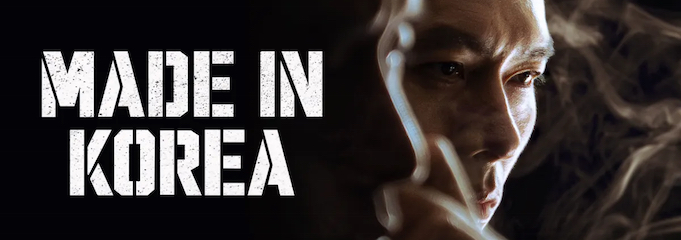
Made in Korea (film). A Disney+ original crime thriller series set in 1970s South Korea that explores the collision of political power, personal ambition, and national identity through the rise of intelligence director Baek Ki-tae. Led by actor Hyun Bin, MADE IN KOREA has been described by its star as a mirror of human greed and ambition, emphasizing that the story’s moral dilemmas could unfold in any country where institutions lack accountability.
Directed by Woo Min-ho, the series centers on the rivalry between Baek, an operative of the Korean Central Intelligence Agency, and prosecutor Jang Geon‑young, played by Jung Woo‑sung, using their conflict to dramatize the tension between national security narratives and the rule of law.
Across its first season, MADE IN KOREA depicts Baek Ki-tae’s ascent through a landscape of coups, surveillance, and clandestine bargains, tracing how a system built to protect the state gradually incentivizes the blurring of public duty and private gain.
The series situates Baek’s story in a broader ecosystem of ministers, prosecutors, business elites, and foreign interlocutors, illustrating how corruption rarely operates as a purely individual failing; instead, it flourishes when institutions normalize secrecy and reward loyalty over integrity.
By focusing on a protagonist who is neither cartoonishly evil nor conventionally heroic, MADE IN KOREA invites viewers to consider how ordinary careerism, fear, and rationalization can transform competent administrators into agents of repression.
Hyun Bin has emphasized in interviews that he did not approach Baek Ki-tae as a simple villain but as a man driven by clear beliefs and a strong will to survive, someone who acts quickly without hesitating over moral calculations. To convey the physical presence of an authoritarian‑era official, he gained roughly 14 kilograms, creating a dense, looming silhouette that fills narrow offices and interrogation rooms with implied threat.
This dedication to physical transformation underscores how MADE IN KOREA links the body to power, showing how uniforms, posture, and even weight become tools for projecting authority in a system that depends on intimidation as much as ideology.
The creative vision of director WOO MIN-HO aligns MADE IN KOREA with his broader filmography, which often interrogates why people in positions of authority become so greedy and why cycles of abuse repeat across generations. In this series, he uses period detail—the cars, offices, and analog surveillance technologies of 1970s Seoul—not merely for nostalgia but to remind viewers that institutions now powered by digital tools once relied on handwritten files and human networks, yet produced comparable ethical failures. That continuity suggests that technology may change the scale and speed of abuse, but the underlying temptations of impunity, patronage, and fear remain stubbornly familiar.
Within the ensemble cast, characters like prosecutor Jang Geon‑young and key female figures portrayed by Won Ji‑an and Seo Eun‑soo represent alternative moral compasses and vantage points into the same system. Jung Woo‑sung’s prosecutor embodies a proceduralist ethic that clashes with Baek’s discretionary approach, dramatizing debates over the proper limits of intelligence agencies and the autonomy of prosecutors that echo in many democracies. Won Ji‑an’s character, required to speak fluent Japanese, evokes lingering histories of occupation and regional hierarchy, while Seo Eun‑soo’s “tough performer” presence emphasizes the emotional labor demanded of those navigating male‑dominated security and political spaces.
Thematically, MADE IN KOREA belongs to a wave of Korean dramas that use revenge and institutional critique as central preoccupations, but it distinguishes itself by foregrounding the structural incentives behind individual cruelty. The show suggests that when success is measured solely in terms of rank, influence, or economic gain, even well‑intentioned actors may convince themselves that ethical shortcuts are temporary or necessary. By tracing the cumulative and often unseen costs of those shortcuts—families destroyed, communities silenced, public trust eroded—MADE IN KOREA functions as a cautionary tale about stewardship gone wrong.
On a meta level, MADE IN KOREA also illustrates how global streaming platforms have become arbiters of which national histories and political debates reach international audiences. Hyun Bin has remarked that although the production process felt similar to making a film, Disney+’s worldwide reach introduced a new dimension: viewers from different countries interpret the characters’ motives through their own histories with dictatorship, corruption, or fragile democracy. This transnational reception aligns with the mission of projects like the Stewardship Report and LucePedia, which seek to document stories that illuminate universal questions about governance and accountability while remaining grounded in local context.
As of early 2026, the first season of MADE IN KOREA has concluded with Baek Ki-tae’s rise to the pinnacle of power, setting the stage for a second season expected in the latter half of the year. The narrative trajectory suggests that future episodes will delve further into the costs of maintaining dominance, the resilience of those who resist, and the possibility—however limited—of redemption or reform within compromised institutions. For scholars, advocates, and viewers concerned with leadership ethics, the series offers a vivid, character‑driven framework for discussing how personal choices interact with structural constraints to produce either stewardship or abuse.