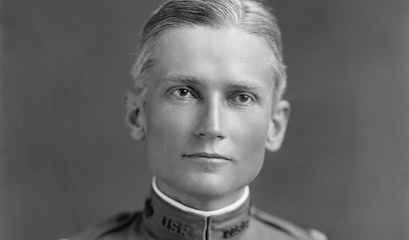
Hiram Bingham III (1875-1956). An American academic, explorer, and Republican politician. He made public the existence of the Inca citadel of Machu Picchu on July 24, 1911 with the guidance of local indigenous farmers. Later, Bingham served as Governor of Connecticut for a single day, the shortest term in history, and then as a member of the United States Senate.
Bingham was born in Honolulu, Hawaii, grandson, and son of two generations of Congregationalist missionaries from Boston to the Kingdom of Hawai’i. He attended O’ahu College, now known as Punahou School, from 1882 to 1892.
He went to the United States in his teens to complete his education, entering Phillips Academy in Andover, Massachusetts, from which he graduated in 1894. He earned a B.A. degree from Yale College in 1898, a degree from the University of California, Berkeley in 1900, where he took one of the first courses on Latin American history offered in the U.S., and Ph.D. from Harvard University in 1905.
After graduation, he taught history and politics at Harvard and then served as preceptor under Woodrow Wilson at Princeton University. Yale appointed Bingham as a lecturer in South American history. Bingham was one of the pioneers of teaching and research on Latin American history in the U.S.
Bingham was thrilled by the prospect of unexplored Inca cities, and organized the 1911 Yale Peruvian Expedition, one of the objectives of which was to search for the last capital of the Incas. Guided by locals, he rediscovered and correctly identified both Vitcos (then called Rosaspata) and Vilcabamba (then called Espíritu Pampa), which he named “Eromboni Pampa,” but did not correctly recognize Vilcabamba as the last capital, instead continuing onward and misidentifying Machu Picchu as the “Lost City of the Incas.”
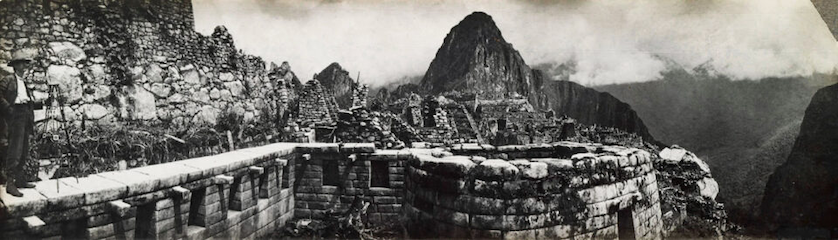
On July 24, 1911, Melchor Arteaga led Bingham to Machu Picchu, which had been largely forgotten by everybody except the small number of people living in the immediate valley (possibly including two local missionaries named Thomas Payne and Stuart McNairn whose descendants claim that they had already climbed to the ruins in 1906). Also, the Cusco explorers Enrique Palma, Gabino Sanchez, and Agustín Lizarraga are said to have arrived at the site in 1901.
Bingham returned to Peru in 1912, 1914, and 1915 with the support of Yale and the National Geographic Society. In The Lost City of the Incas (1948), Bingham related how he came to believe that Machu Picchu housed a major religious shrine and served as a training center for religious leaders. Modern archaeological research has since determined that the site was not a religious center but a royal estate to which Inca leaders and their entourage repaired during the Andean summer.
Yale University in 2012 began returning to Peru thousands of the 40,000 objects Bingham took to Yale from Machu Picchu by permission of a decree by the Peruvian government. Peru argued that the objects were only loaned to Yale, not given.
Machu Picchu has become one of the major tourist attractions in South America, and Bingham is recognized as the man who brought the site to world attention, although many others helped. The switchback-filled road that carries tourist buses to the site from the Urubamba River is called Carretera Hiram Bingham (the Hiram Bingham Highway).
Bingham has been cited as one possible basis for the character Indiana Jones. His book Lost City of the Incas became a bestseller upon its publication in 1948.
Peru has long sought the return of the estimated 40,000 artifacts, including mummies, ceramics, and bones, that Bingham excavated and exported from Machu Picchu. On September 14, 2007, an agreement was made between Yale University and the Peruvian government for the objects’ return. On April 12, 2008, the Peruvian government said it had revised previous estimates of 4,000 pieces up to 40,000.
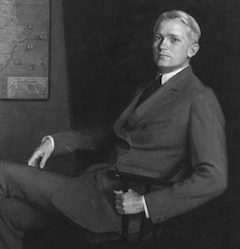
Hiram Bingham painted by Mary Foote, sister of Harry Ward Foote, the Yale chemistry professor who was Bingham’s companion on his trips to Peru. Stanford Luce’s mother was Agnes Foote.
Bingham achieved the rank of Captain of the Connecticut National Guard in 1916. In 1917, he became an aviator and organized the United States Schools of Military Aeronautics at eight universities to provide ground school training for aviation cadets. He served the Aviation Section, U.S. Signal Corps and the Air Service, attaining the rank of lieutenant colonel.
In France, Bingham commanded the Air Service’s largest primary instruction and pursuit training school. He became a supporter of the Air Service in their post-World War I quest for independence from the Army and supported that effort, in part, with the publication of his wartime experiences titled, An Explorer in the Air Service published in 1920 by Yale University Press.
In 1922, Bingham was elected lieutenant governor of Connecticut, an office he held until 1924. In November 1924, he was elected governor. On December 16, 1924, Bingham was also elected as a Republican to serve in the U.S. Senate.
President Calvin Coolidge appointed Bingham to the President’s Aircraft Board during his first term in the Senate; the press quickly dubbed the ex-explorer “The Flying Senator.” Bingham failed in his second reelection effort in the wake of the 1932 Democratic landslide following the Great Depression and left the Senate at the end of his second term in 1933.
During World War II, Bingham lectured at several United States Navy training schools. In 1951 he was appointed Chairman of the Civil Service Commission Loyalty Review Board, an assignment he kept through 1953.
Hiram Bingham III died at his Washington, D.C. home in 1956 and was interred at Arlington National Cemetery in Virginia.