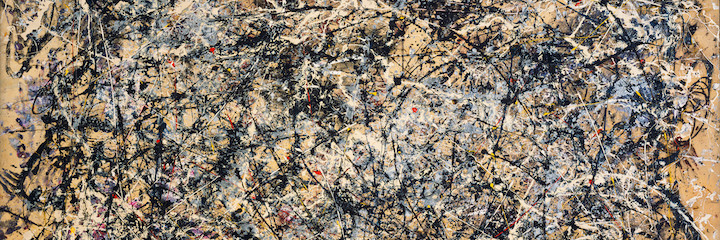
Abstract Expressionism. A mid-20th‑century art movement centered in New York that emphasized spontaneous, gestural brushwork, monumental scale and the direct expression of emotion on canvas. Emerging in the late 1940s and 1950s, it marked the moment when the United States replaced Europe as the symbolic center of avant garde art.
Artists associated with Abstract Expressionism often rejected traditional composition and recognizable subject matter, instead using abstraction to explore psychological depth, existential themes and the materiality of paint itself.
Historical context
Abstract Expressionism developed in the aftermath of the Second World War, a period marked by political upheaval, displacement of European artists and intense reflection on human experience. Many artists in New York drew on surrealist automatism and theories of the unconscious, blending these influences with American individualism and the urban energy of the city.
The term “Abstract Expressionism” came into common use in the 1940s as critics sought to describe this new synthesis of abstraction and expressive intensity.
Key characteristics
Works in Abstract Expressionism typically feature large canvases, dynamic brushstrokes and an emphasis on the physical act of painting, sometimes described as “action painting.” Paint was poured, dripped, stained or layered to create energetic surfaces that record the artist’s movement and decisions in real time. Color, line and texture became the primary means of communication, inviting viewers to respond emotionally rather than interpret a narrative scene.
Major artists and styles
Within Abstract Expressionism, artists developed distinct approaches, including gestural abstraction and the more serene color‑focused works that anticipated Color Field painting.
Figures such as Jackson Pollock, Willem de Kooning, and Mark Rothko became closely identified with the movement’s varied strategies, from all‑over drip compositions to luminous color rectangles that seem to hover in space.
Institutions such as the Museum of Modern Art (MoMA‑NYC) helped establish Abstract Expressionism as a defining postwar art movement through influential exhibitions and acquisitions.
Influence and legacy
Abstract Expressionism reshaped global perceptions of American culture, signaling that New York had become a major hub for experimental art and stimulating subsequent movements like Pop Art and Minimalism.
Its emphasis on individual creative gesture and expressive abstraction continues to inform contemporary painting and remains central to the way many viewers and artists understand modern art. Museums, galleries and the Art Students League of New York still reference Abstract Expressionism in teaching, exhibitions and critical debate, underscoring its lasting importance in art history.
The following are influential artists of the movement:
- Jackson Pollock: The preeminent figure of the movement, famous for his drip” technique where he poured or dripped paint onto canvas laid on the floor.
- Willem de Kooning: A leader of the “Action Painting” style known for his gestural brushwork and fusing abstract forms with figurative subjects, most notably his Woman series.
- Mark Rothko: A pioneer of “Color Field” painting, he created large-scale canvases with rectangular blocks of luminescent color intended to evoke deep emotional or spiritual responses.
- Franz Kline: Famous for his stark, large-scale black-and-white paintings that resemble oversized calligraphy or structural beams.
- Robert Motherwell: The youngest of the founding “New York School” members, he is best known for his Elegy to the Spanish Republic series featuring heavy black ovoid shapes.