
Where Finance Meets Purpose: How Three Voices Joined to Document Leadership, Stewardship, and the Stories That Shape Our World
New York, N.Y. – In an era when communication fractures as easily as it connects, The Stewardship Report stands as a deliberate counterweight—a platform built not on algorithms or advertising revenue, but on the conviction that documenting truth, tracking accountability, and elevating principled leadership matter more than ever.
Since 2010, this communications platform of Luce Family Charities and media project of The James Jay Dudley Luce Foundation has published stories that examine the intersection of power, philanthropy, and human potential across continents.
What began as a modest initiative to chronicle the work of global changemakers has evolved into a comprehensive digital publication featuring interviews with leaders from Haiti to Indonesia, analysis of policy shifts affecting vulnerable populations, and investigations into what makes leadership endure.
At its helm are three distinct voices united by a shared belief: that rigorous reporting, grounded in facts and tempered by empathy, serves as essential infrastructure for civil society.
From Wall Street to Meaning: The Evolution of Purpose
Liz Webster’s journey from finance to journalism mirrors the publication’s own evolution. A graduate of an Ivy League institution, she spent her first decade navigating the quantitative certainties of Wall Street, where success measured itself in basis points and quarterly returns.

Yet markets, she discovered, offered incomplete answers to the questions that increasingly occupied her attention: Why do institutions fail their stakeholders? What separates leaders who build from those who extract? How do we document both triumph and catastrophe without losing sight of the human beings caught between?
Her transition from markets to meaning wasn’t rejection but expansion—an application of analytical rigor to the messier, more consequential terrain of human behavior.
Webster brings to The Stewardship Report a conviction shaped by experience: that humanity tilts, however slightly, toward goodness—51% on her scale—and that communication serves as the essential mechanism protecting that fragile majority.
Her writing excavates the forces shaping decisions made in boardrooms, relief camps, and government ministries, always returning to the question of accountability.
“I spent years analyzing risk and return in financial instruments,” Webster reflects. “Now I analyze risk and return in human systems—the institutions we build, the leaders we elevate, the promises we make to vulnerable populations. The mathematics are less precise, but the stakes are infinitely higher.”
Neutrality as a Discipline: Politics, Language, and Power
John Laing arrived in New York from an elite Asian university with training in political communication and a conviction that would define his journalistic approach: true neutrality, properly practiced, inevitably leans toward goodness. It’s a philosophy that distinguishes him in an age of performative objectivity and manufactured balance.

For Laing, neutrality isn’t passive equidistance between competing claims but active commitment to fairness, clarity, and respect for verifiable facts. His coverage of global affairs tracks how language shapes public understanding, how power structures frame debate, and how political actors deploy communication as both revelation and obfuscation.
He brings to The Stewardship Report a global perspective tempered by rigorous attention to local context—the understanding that universal principles of accountability translate differently across cultures, legal systems, and historical experiences.
His work has taken him from United Nations corridors to remote villages where policy abstractions become lived reality. He documents the gap between international commitments and ground-level implementation, between diplomatic language and displaced populations, between stated values and measurable outcomes.
Throughout, he maintains what Laing calls “disciplined neutrality”—a journalism that refuses false equivalence while remaining open to complexity, that challenges power while respecting nuance.
Leadership as Stewardship: Twenty-Five Years of Global Impact
Jim Luce, Editor-in-Chief, brings to the platform a unique synthesis of financial acumen and philanthropic commitment forged across four decades and multiple continents.
Educated in Germany, the United States, Colombia, and Japan, he began his career in finance, working with Japanese and French investment houses before redirecting his expertise toward the work that has occupied him for 25 years: leading Luce Family Charities with particular focus on Orphans International Worldwide and The James Jay Dudley Luce Foundation.
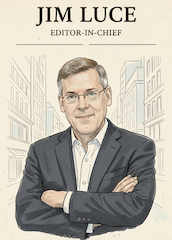
His work spans Haiti, India, Indonesia, and Sri Lanka—regions where institutional failure and natural disaster compound existing vulnerabilities, where the gap between international attention and sustained commitment yawns widest.
He has taught leadership in Jamaica, written on philanthropy and accountability for The Huffington Post, The New York Times, and the BBC, and developed a specialty that animates much of The Stewardship Report’s coverage: identifying, mentoring, and promoting Young Global Leaders whose work generates lasting impact.
Luce’s editorial vision shapes the publication’s distinctive approach—a journalism that treats leadership as stewardship, that measures success not in intentions but outcomes, that holds powerful institutions to the promises they make to vulnerable populations.
Under his direction, The Stewardship Report has become both chronicle and accountability mechanism, documenting what works, exposing what fails, and creating a record that future leaders and historians will consult when asking how we responded to the challenges of our era.
Giving Language to Difference: Dr. Bill Bauer and the Work of Understanding
Dr. William M. “Bill” Bauer brings to The Stewardship Report a perspective shaped not by abstraction, but by lived experience—both personal and professional—at the intersection of education, disability, and dignity.
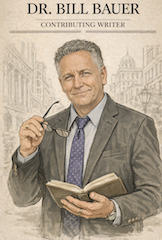
A licensed clinical counselor working in the rural Mid-Ohio Valley, Bauer’s career has unfolded across classrooms, administrative offices, and university lecture halls. He has served as a teacher, principal, and college professor, dedicating his professional life to children and adults whose disabilities place them at the margins of systems not designed with them in mind.
That commitment is inseparable from his own story. Born with a severe hearing impairment, Bauer learned early how easily difference becomes isolation—and how transformative understanding can be when it replaces fear or stigma. His work is animated by a simple but radical conviction: that children with disabilities are not problems to be solved, but people to be understood.
Through his long-running And That’s Okay series, Bauer documents the lived realities of children navigating physical, cognitive, medical, and social challenges—always with an emphasis on empathy, clarity, and respect. The series is designed not only for children with disabilities, but for their teachers, classmates, and families—those whose awareness can determine whether difference becomes exclusion or belonging.
Each installment centers a specific condition or circumstance, from autism and epilepsy to foster care, adoption, incarceration of a parent, or linguistic barriers. Rather than reducing complex experiences to diagnoses or labels, Bauer’s writing restores context and humanity, offering young readers—and the adults around them—a shared language for understanding.
Across four series, And That’s Okay addresses more than forty conditions and life circumstances, spanning physical disabilities, chronic illness, mental health, family disruption, and social identity. Some stories confront medical realities; others explore social invisibility. All share a common goal: to normalize difference without diminishing its challenges, and to cultivate compassion without condescension.
Bauer’s contribution to The Stewardship Report reflects the publication’s broader mission: documenting systems as they affect real people, and insisting that leadership—whether in education, healthcare, or policy—begins with listening.
In a media landscape often dominated by spectacle or simplification, Bauer’s work offers something quieter and more enduring: the steady accumulation of understanding, one story at a time.
Dr. Sami Milan
In a world defined by its diversity and rapid evolution, the need for culturally attuned and empathetic guidance has never been greater. Enter Dr. Sami Milan, our new advice columnist, a beacon of clarity and support in the complexities of contemporary life.

Writing under this pseudonym, Dr. Milan embodies the spirit of iconic advice-givers like Abigail van Buren, offering insightful and compassionate counsel on a spectrum of issues. From navigating intricate relationship dynamics and familial challenges to addressing personal struggles, Dr. Milan’s advice is both thoughtful and actionable.
As interfaith and interracial relationships flourish, and society grapples with critical issues such as sexual abuse and LGBTQ+ concerns, it’s paramount that guidance reflects a profound understanding of these diverse experiences.
Dr. Sami Milan‘s approach is deeply rooted in inclusivity and respect, ensuring that every piece of advice is tailored to the unique identities and challenges of each reader. This fosters a safe space where individuals feel seen, supported, and empowered to confront life’s obstacles with resilience.
Dr. Milan’s unwavering compassion reminds us that even the most daunting problems are surmountable, and help is always within reach. Remember, if you or someone you know is struggling, the 988 Suicide & Crisis Lifeline offers 24/7 support in English and Spanish.
Dr. Sami Milan concludes each column with a heartfelt “With Compassion,” a testament to their genuine care.
A Platform Built on Conviction
Fifteen years after its 2010 launch, The Stewardship Report occupies unusual territory in the digital media landscape. It accepts no advertising, pursues no viral metrics, and measures success not in engagement rates but in the quality of discourse it enables. The platform publishes investigative features on humanitarian crises, profiles of social entrepreneurs building sustainable models in challenging environments, analysis of policy shifts affecting marginalized communities, and interviews with leaders whose work resists easy categorization.
Recent coverage has examined the implementation of sustainable development goals in Southeast Asia, tracked reconstruction efforts in disaster-affected regions, investigated the accountability mechanisms (or their absence) in international aid delivery, and profiled innovators building education, healthcare, and economic opportunity in contexts most institutions avoid. The publication maintains LucePedia, a growing encyclopedia documenting leaders, organizations, and concepts central to understanding global stewardship.
What unites these varied threads is a consistent editorial framework: the insistence that leadership carries obligations, that communication serves democracy, and that journalism’s highest calling remains creating an informed public capable of holding power accountable. Webster, Laing, and Luce bring different expertise and perspectives, but they share conviction that facts matter, that truth remains discoverable, and that documenting both human triumph and institutional failure serves essential democratic function.
The Visual Satirists: Cutting Through Noise with Wit and Line
Lauren Dupont: Humor as Survival
Lauren Dupont, a Pennsylvania native and New York City art school graduate, did not initially imagine satire as her calling. A catastrophic horseback riding accident in her twenties left her unable to walk. What followed was not retreat, but recalibration.
Using a wheelchair, Dupont navigates New York City with ease, commuting through subways to her work near Rockefeller Center. The experience sharpened her observational instincts and deepened her appreciation for absurdism.
“I think the accident allowed me to focus my life and perspective in a way that would never have happened otherwise,” Dupont has said. Now in her thirties and living in Park Slope, Brooklyn, Dupont’s work for The Stewardship Report balances visual economy with moral clarity. Her cartoons rarely shout. They simply reveal.
Maria Peña: Drawing the Front Lines
If Dupont’s satire is introspective, Maria Peña’s is unapologetically confrontational. A Dreamer whose family emigrated from Colombia, Peña grew up in Jackson Heights, Queens—an epicenter of immigrant life and political tension.
After graduating from an art school in Los Angeles, Peña relocated to Chicago, where she works freelance from home while volunteering in neighborhood community patrols. The experience informs her work with immediacy and urgency. Her illustrations carry a sharper edge: parades led into chasms, slogans shouted through fog, and certainty weaponized against truth.
Peña’s line work is deceptively playful; the implications are anything but. For The Stewardship Report, she draws the front lines of today’s most charged political and social debates.
The Work Continues
As The Stewardship Report moves into its sixteenth year of publication, the landscape it documents grows more complex and contested. Misinformation proliferates, institutional trust erodes, and the gap between global commitments and local realities widens. Yet the platform’s core mission remains unchanged: to document truth, track accountability, and elevate the leaders and ideas that offer genuine paths forward.
“We’re not optimists or pessimists,” Luce observes. “We’re documentarians committed to accuracy, accountability, and the stubborn belief that rigorous reporting matters. The work of connecting the world—really connecting it, beyond digital superficiality—requires understanding both what unites and what divides us, what succeeds and what fails, what we promise and what we deliver.”
For Webster, Laing, and Luce, that work continues one story at a time, one investigation at a time, one leader at a time—building a record of our era’s stewardship that will endure long after the headlines fade.
Founded in 2010, The Stewardship Report is the communications platform of Luce Family Charities and a media project of The James Jay Dudley Luce Foundation. The publication examines leadership, accountability, and global stewardship through investigative journalism, interviews, and analysis spanning multiple continents. Jim Luce serves as Editor-in-Chief, with Liz Webster and John Laing contributing their expertise in financial analysis, political communication, and international affairs to create a comprehensive platform documenting the forces shaping our interconnected world.

Summary
Since 2010, The Stewardship Report has documented leadership, accountability, and global stewardship through rigorous journalism and sharp visual satire. Published by Luce Family Charities and The James Jay Dudley Luce Foundation, the platform unites five distinct voices: Liz Webster, who transitioned from Wall Street to investigative journalism; John Laing, a political communication expert tracking power and language across borders; cartoonists Lauren Dupont, whose work finds moral clarity in absurdity, and Maria Peña, who confronts power from the front lines of social tension; and Editor-in-Chief Jim Luce, whose 25 years leading philanthropic work informs the publication’s commitment to truth and accountability.
Social Media
Facebook: Since 2010, The Stewardship Report has documented the intersection of leadership, philanthropy, and accountability across continents. Founded as the communications platform of Luce Family Charities, it brings together three voices united by conviction: that facts matter, truth remains discoverable, and rigorous journalism serves democracy. Fifteen years of chronicling both triumph and failure in our interconnected world.
Instagram: Fifteen years of truth, accountability, and global dialogue. The Stewardship Report connects the world through rigorous journalism examining leadership and stewardship from Haiti to Indonesia. Three voices, one mission: documenting what works, exposing what fails, creating a record that endures.
LinkedIn: The Stewardship Report marks fifteen years as a communications platform examining leadership, accountability, and global stewardship. Founded by Luce Family Charities and The James Jay Dudley Luce Foundation, the publication combines financial analysis, political communication expertise, and philanthropic experience to create journalism that serves democratic accountability. No advertising, no viral metrics—just rigorous reporting on the forces shaping our interconnected world.
X / Twitter: 15 years of The Stewardship Report: Where finance meets purpose, neutrality meets accountability, and journalism documents both triumph and failure across continents. Three voices, one conviction—that rigorous reporting matters.
BlueSky: The Stewardship Report has spent fifteen years documenting leadership and accountability from Wall Street to Haiti, from Asian capitals to Indonesian villages. Founded as a project of Luce Family Charities, it proves that journalism without advertising, built on conviction rather than algorithms, can create lasting impact.