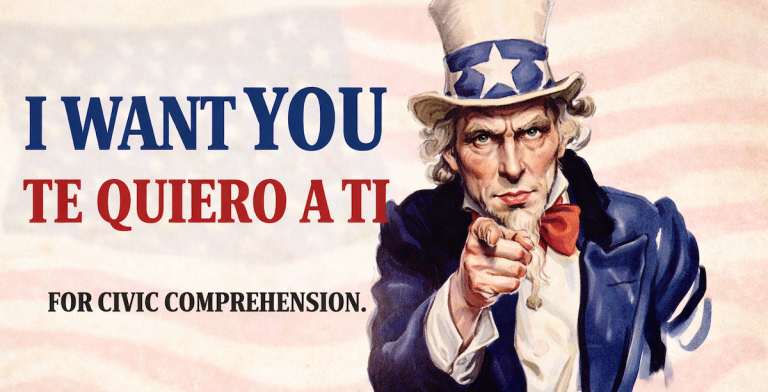
A bilingual government would expand dignity, democracy, and national competence while exposing the fear-driven politics behind “English-only” nostalgia.

New York, N.Y. — The United States likes to think of itself as a confident nation. We build moon rockets, draft constitutions, and produce a presidential campaign season long enough to qualify as a climate pattern. Yet we remain oddly skittish about something most of the planet accepts as normal: living, governing, and thriving in more than one language.
Let me begin with a confession that will irritate the right, on purpose: I’m going to argue that English and Spanish should both become the official languages of the U.S.—even if the idea is politically difficult, administratively imperfect, and guaranteed to summon a small flotilla of cable-news outrage. Sometimes a society needs a proposal not because it will pass tomorrow, but because it clarifies what we owe one another today.
And what we owe one another—at minimum—is comprehension.
Most Of The World Isn’t Afraid Of More Than One Language
“How many countries have two languages or more?” is an honest question with an annoying answer: it depends on whether you count national, regional, and local official languages, and how you treat places that are officially monolingual but practically multilingual. Even the reference lists caution that “official” can be layered—national here, regional there, municipal elsewhere.
But the larger point is clear without a single magic number: multilingual governance is not radical. It is common. Switzerland recognizes four national languages. South Africa recognizes eleven. The presence of multiple official languages is not a sign of weakness. It is a sign of realism—an admission that the state exists to serve people as they are, not as politicians wish they were.
Spanish In America Isn’t A Trend. It’s A Fact Pattern.
In the United States, about 44.9 million people age 5+ spoke Spanish at home in 2024—roughly 1 in 7. That number is not a fringe. It’s a national constituency. And it understates the real reach of Spanish, because “speaks Spanish at home” captures home-language practice—not every second-language speaker, workplace user, student learner, or bilingual household that shifts languages by context.
Even among those who speak Spanish at home, most are not “refusing English.” Nearly 58.9% of those Spanish-at-home speakers reported speaking English “very well” in 2024. This is not separatism. It is bilingualism—arguably one of the most American skills imaginable.
English And Spanish Are Global Power Languages—And We Use That Poorly
Globally, English and Spanish sit near the top of the language pyramid. One widely cited language dataset (via Ethnologue) estimates about 1.528 billion total speakers of English (native + second-language) and about 558 million total speakers of Spanish.
So here is an obvious question with a non-obvious political answer: if the U.S. is competing in a multilingual world, why would we voluntarily train our future workforce to be monolingual—and then pretend it is a virtue?
Why Access To Spanish Is A Human Right In Practice
When language becomes a barrier, rights become theoretical. The “right” to vote, the “right” to understand a court notice, the “right” to apply for benefits, the “right” to follow emergency instructions—none of these survive intact if the citizen cannot read the page or understand the official behind the counter.
Historically, federal policy has treated language access as part of nondiscrimination: courts and agencies have interpreted Title VI of the Civil Rights Act of 1964 (national origin discrimination) to require “meaningful access” for people with limited English proficiency.
The concept was formalized across federal agencies through Executive Order 13166, which directed agencies to improve access for eligible LEP persons and align recipients of federal funds with that obligation.
And then politics intervened. Major reporting and federal notices describe a 2025 shift toward designating English as the federal “official language,” paired with rollbacks of prior language-access guidance.
Whether one cheers or condemns that shift, it underscores the point: language policy is not neutral. It decides who gets served quickly, who gets served slowly, and who does not get served at all.
In other words, the fight is not about whether immigrants “should learn English.” Of course they should, and most do. The fight is about whether the government should be permitted to operate as though millions of Americans—and not only immigrants—are a bureaucratic inconvenience.
The Proposal: A Two-Language Public Square
Here is the proposition in plain terms.
1) Make English And Spanish Official At The Federal Level
Not “English-only.” Not “Spanish in some places if you behave.” Official means the government is bilingual by design, not by accident or court order.
2) Require Bilingual Public-Facing Government Communication
All core public materials—local, state, and federal—should be available in English and Spanish: forms, benefits guidance, voting materials, emergency notices, key signage, and “vital documents.” This is not about translating every memo. It is about translating what governs people’s lives.
We already do versions of this when pressured; the more honest approach is to make it standard and predictable. The most practical model is not ideological purity but administrative routine: bilingual templates, bilingual procurement, bilingual digital defaults, and bilingual staffing pipelines. (And yes, the model can be “French” in the sense that the state makes a clear, uniform standard—except here the uniform standard is two languages, not one.)
3) Make Second-Language Proficiency A High School Expectation
Require native English-speaking high school students to achieve proficiency in a second language—with Spanish favored as the default pathway, while still allowing other languages for students with different goals or heritage ties.
This is not cultural charity. This is national competence. A country that wants to lead cannot communicate with half the hemisphere through tourists and interpreters alone.
4) Make The Anthem Bilingual At Official Civic Events
Yes, I said it: perform The Star-Spangled Banner in both languages—English and Spanish—at official events. We frequently have performed “Nuestro Himno” — The Star-Spangled Banner in Spanish — at official events of Orphans International Worldwide and the James Jay Dudley Luce Foundation. If that sparks outrage, good. Outrage is often the sound of a fragile identity being asked to share space.
And for those demanding precedent: Spanish-language versions of the anthem have existed for over a century, and modern Spanish renditions—including “Nuestro Himno”—have already placed the question in public view.
5) If The Lord’s Prayer Is Public, Make It Bilingual Too
If a public body insists on reciting the Lord’s Prayer, it can do it in both languages. If the goal is civic unity, bilingual recital is a better symbol than monolingual performance. If the goal is cultural dominance, then let the public see that, plainly, for what it is.
Objections, Answered With Realism (And A Little Patience)

“This will cost too much.” Some of it will. But the costs of miscommunication—medical errors, missed deadlines, failed benefits processing, wrongful denials, emergency confusion—are not free. They are simply hidden in other budgets, paid in human time and harm. And bilingual systems get cheaper when they are standardized rather than improvised case-by-case.
“People should just learn English.” Many do, and fast. But the government’s job is not to run a cultural audition. Its job is to deliver equal access to the services citizens fund. When the state refuses to communicate, it is not defending unity; it is rationing democracy.
“This will divide the country.” No. The country is already linguistically diverse; refusing to acknowledge it does not create unity, it creates resentment. Bilingual policy does not invent difference; it manages difference so it does not metastasize into exclusion.
The Quiet Truth: Bilingualism Is Stewardship
Stewardship is the responsible care of what we share: civic trust, institutional legitimacy, and human dignity. Language is not a side issue. It is the delivery mechanism for rights.
If the U.S. wants to remain a serious nation—economically, morally, and culturally—it should stop performing monolingual nostalgia and start practicing bilingual competence. Make English and Spanish official. Put the state’s paperwork where its rhetoric is.
And if that angers the right? Fine. Sometimes the price of inclusion is listening to people who preferred exclusion complain that the door now opens both ways.
Make English And Spanish Official, And Make It Normal (Feb. 5, 2026)