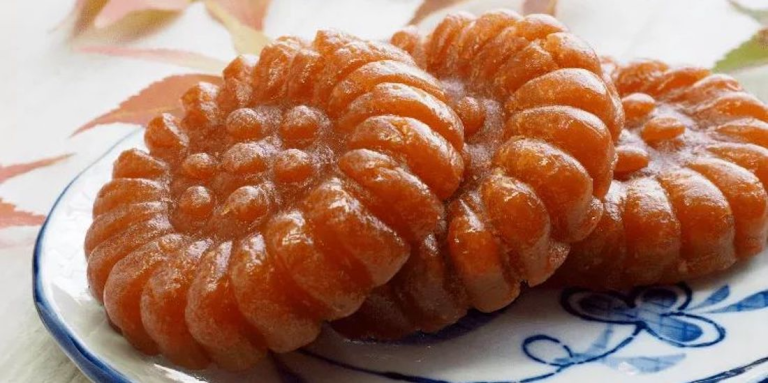
“Halmoni” – Where Korean Grannies and Millennials Meet
By John Laing

New York, N.Y. – Young adults are fueling a surprising revival of traditional Korean sweets, transforming rice cakes and honey cookies into modern, health-forward snacks.
The line outside Yeongju Rice Cake in Manhattan’s Koreatown often snakes around the corner, a scene mirrored at Yakgwa Alley in Flushing. The patrons, however, defy expectation. They are not the Korean grandmothers one might associate with these ancient confections, but a crowd of millennials and Gen Zers, phones aloft, waiting to taste what they now call “halmaenial desserts.”
This portmanteau (‘lexical blend’) of “halmoni” (grandmother) and “millennial” captures a cultural and culinary pivot: traditional sweets, once deemed too old-fashioned or cloying, are being rediscovered and re-engineered for a contemporary, health-aware palate.
From Holiday Relic to Daily Delicacy
For decades,tteok (rice cake) was largely compartmentalized in the minds of younger Korean Americans as a ceremonial food, something consumed during Chuseok (harvest festival) or Seollal (Lunar New Year). Yakgwa, the deep-fried, honey-soaked cookie, was often dismissed as a syrupy relic.

“The perception was that these were your grandparents’ desserts—too sweet, too heavy, and frankly, not cool,” explains pastry chef and culinary historian Mina Lee.
“The shift began when younger chefs and entrepreneurs started asking, ‘What if we honored the tradition but altered the execution?’”
The answer involved a fundamental recalibration of ingredients, portioning, and presentation, aligning these treats with modern values of wellness and conscious consumption.
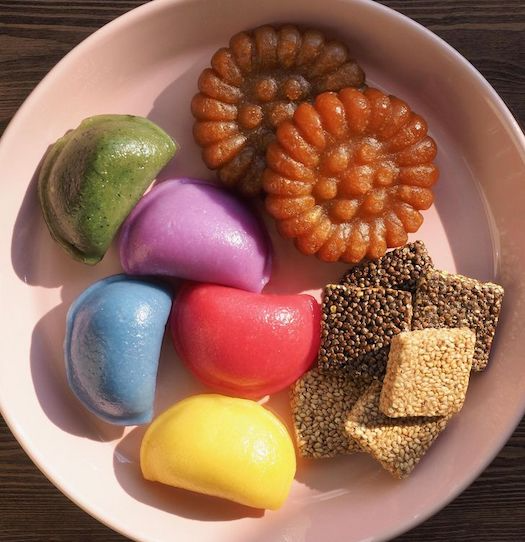
The Allure of Simpler, Cleaner Ingredients
At its core, the halmaenial trend is a direct response to the processed food industry.
The primary appeal lies in the ingredient deck: rice, glutinous rice flour, malt syrup (jocheong), raw honey, and natural bean pastes.
“When you compare a songpyeon (pine-shaped rice cake) made with ssal (rice) and song (pine needles) to a frosted cupcake, you’re comparing a handful of recognizable components to a long list of emulsifiers and preservatives,” notes Lee.
This simplicity resonates powerfully in an era of “clean-label” eating.
The sweetness is often derived from jocheong, which has a lower glycemic index than refined sugar, and the fats, when used, are typically neutral oils or those from nuts and seeds.
This positions these desserts within the growing “ingredient-conscious dessert” movement, where provenance and simplicity are as important as taste.
Functional Snacking and Portion Redefinition
The role of these foods has functionally changed. Tteok (Korean rice cakes) is no longer just a sweet bite; it is marketed and consumed as a satiating, gluten-free meal replacement or pre-workout fuel. Varieties made with heukmi (black rice), kong (soybeans), or chija (black sesame) offer protein, fiber, and complex carbohydrates.
Concurrently, yakgwa has undergone a dramatic physical transformation. Once the size of a saucer, it is now commonly found as a dainty, bite-sized morsel, lightly fried and subtly sweetened.

This redesign turns it from a commitment into a companion—a perfect pair for a single-origin pour-over coffee.
The controlling idea is moderation: a small, flavorful portion provides a definitive end to a craving without the sugar crash or digestive discomfort associated with richer Western desserts.
Tteok and mochi (Japanese rice cakes) are very similar, both being chewy treats made from rice, but they differ in preparation, texture, and variety; tteok uses various rice flours (glutinous or non-glutinous) and often has a starchier, sometimes firmer, texture and broader shapes, while mochi is specifically pounded glutinous rice, making it uniquely soft, elastic, and sticky, though the Korean chapssal-tteok is a direct analogue to filled mochi like daifuku.
Packaging Nostalgia for the Modern Marketplace
This revival is not merely about taste; it is a masterclass in cultural repositioning.
The aesthetics have been meticulously updated. Dasik (tea cookies) are presented in minimalist, hanji-inspired boxes. Gangjeong (puffed rice candy) comes in sleek, resealable pouches.
The branding leans into heritage—evoking nostalgia and artisanality—while the functionality is purely contemporary: portable, shareable, and Instagrammable.
“We’re selling the memory and the story, but in a package that fits in a Millennial’s tote bag and lifestyle,” says Joon Kim, founder of the popular brand Tteokify.
This fusion allows consumers to participate in a cultural narrative while meeting practical, daily needs, transforming these items from seasonal souvenirs into viable snack alternatives.
—–
A Symptom of a Broader Dietary Consciousness
Ultimately, the rise of halmaenialdesserts signals a deeper evolution in the relationship between health and indulgence.
It represents a move away from restrictive dieting and toward a more integrated, permissive approach to eating well.
These treats offer a “third way”—neither austere nor decadent. They satisfy a sweet tooth while aligning with values of natural eating and mindful consumption.
In doing so, they have successfully bridged a generational and nutritional divide.
The rice cake is no longer just a holiday treat; it is a health dessert, a snack re-contextualized for a world where wellness and pleasure are no longer seen as mutually exclusive.
‘Halmaenial’ Desserts Redefine Sweetness in a Health-Conscious Era (Jan. 8, 2026)