A new generation of political cartoonists revives classic American satire to confront authoritarian certainty, civic blindness, and the absurdities of modern power
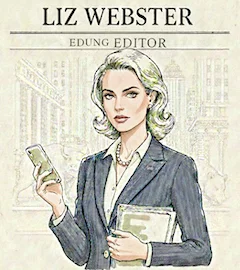
By Liz Webster, Senior Editor
New York, N.Y. — In moments of political anxiety, satire has often functioned as America’s last line of psychological defense. From Thomas Nast skewering robber barons to Herblock puncturing Cold War paranoia, cartoonists have long translated civic dread into visual clarity.
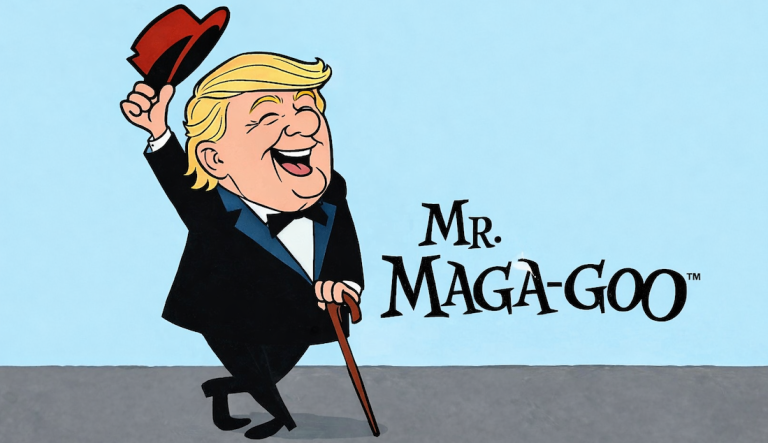
Today, as democratic norms erode and spectacle overwhelms substance, The Stewardship Report introduces a new satirical figure uniquely suited to the age: Mr. MAGA-goo.
A deliberate play on the mid-20th-century cartoon icon Mr. Magoo, Mr. MAGA-goo is cheerfully lost, catastrophically confident, and perpetually convinced that disaster is success.
He squints into chaos, mistakes danger for destiny, and marches forward with unearned certainty—often dragging others with him. The character is not subtle. It is not meant to be.
From Magoo to MAGA-goo:
Satire Recalibrated
For readers of a certain generation, Mr. Magoo remains instantly recognizable: the near-blind animated curmudgeon who survived calamity through oblivious confidence.
Created in 1949, Magoo embodied a postwar American archetype—stubborn, self-assured, and strangely rewarded for never seeing the full picture.
Mr. MAGA-goo updates that archetype for a political culture defined less by innocence than by willful blindness.
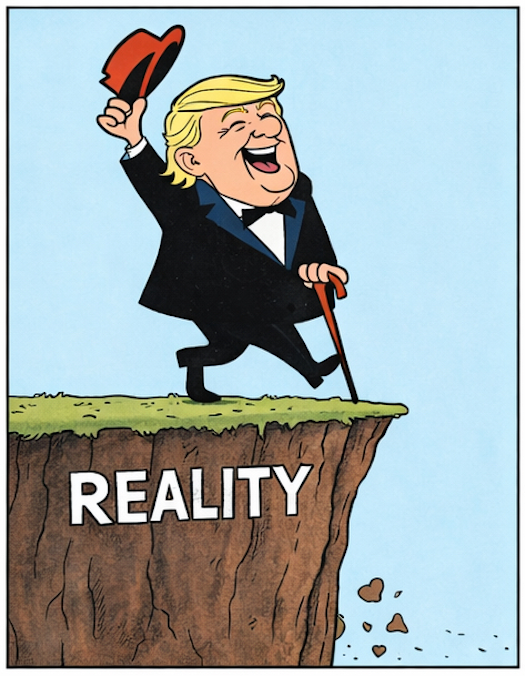
Where Magoo stumbled into safety by accident, MAGA-goo barrels toward collapse by conviction. He does not merely fail to see reality; he rejects it outright.
The character’s visual grammar is instantly legible: exaggerated gestures, misdirected bravado, and a perpetual expression of triumph at precisely the wrong moment.
The humor lands because it mirrors a deeper national unease—the growing gap between confidence and competence in public life.
Meet Our Cartoonists
Behind Mr. MAGA-goo is a new cohort of artists whose personal histories lend emotional depth to their political critique.
Lauren Dupont: Humor as Survival
Lauren Dupont, a Pennsylvania native and New York City art school graduate, did not initially imagine satire as her calling.
A catastrophic horseback riding accident in her twenties left her unable to walk. What followed was not retreat, but recalibration.
Using a wheelchair, Dupont navigates New York City with ease, commuting through subways to her work near Rockefeller Center.
The experience sharpened her observational instincts and deepened her appreciation for absurdism.
“I think the accident allowed me to focus my life and perspective in a way that would never have happened otherwise,” Dupont has said.
Now in her thirties and living in Park Slope, Brooklyn, Dupont’s work balances visual economy with moral clarity.
Her cartoons rarely shout. They simply reveal.
Maria Peña: Drawing the Front Lines
If Dupont’s satire is introspective, Maria Peña’s is unapologetically confrontational. A Dreamer whose family emigrated from Colombia, Peña grew up in Jackson Heights, Queens—an epicenter of immigrant life and political tension.
After graduating from an art school in Los Angeles, Peña relocated to Chicago, where she works freelance from home while volunteering in neighborhood I.C.E. patrols. The experience informs her work with immediacy and urgency.
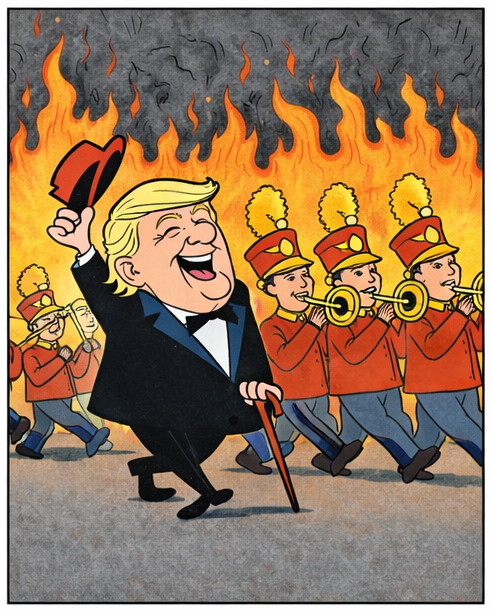
Her Mr. MAGA-goo illustrations carry a sharper edge: parades led into chasms, slogans shouted through fog, and certainty weaponized against truth. Peña’s line work is deceptively playful; the implications are anything but.
Why Satire Still Matters
Political cartoons succeed when they compress complexity into instant recognition. In an era dominated by algorithmic outrage and short attention spans, visual satire cuts through noise with a single image.
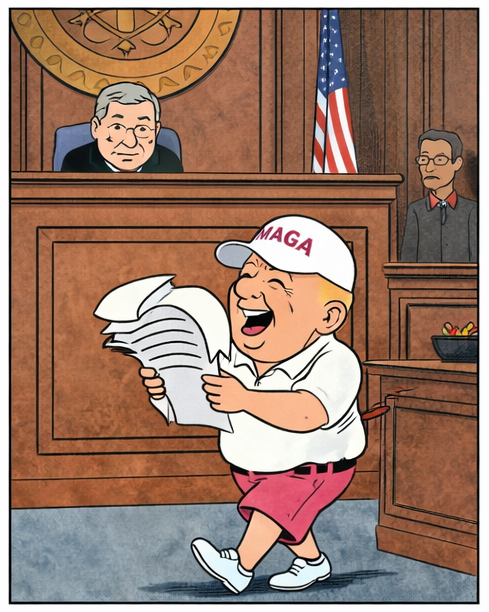
Mr. MAGA-goo functions as a diagnostic tool. He asks a simple question: What happens when leadership mistakes blindness for vision? The answer, repeatedly illustrated, is chaos disguised as confidence.
The character resonates because it reflects a broader cultural condition—how ideological certainty can coexist with factual illiteracy, and how spectacle often substitutes for governance.
Editor’s Note: Remembering Magoo
Growing up in the early 1960s, I vividly remember sitting on the floor in front of our large black-and-white television, watching Mr. Magoo.
He was a genuine cultural icon—instantly recognizable, endlessly quotable, and oddly comforting in his obliviousness.
For younger readers unfamiliar with the character, my apologies for the generational leap.
Still, it may be worth your time to seek him out. Mr. Magoo offers a surprisingly useful lens through which to view confidence, blindness, and the strange ways America sometimes mistakes one for the other.
— Jim Luce, Editor-in-Chief, The Stewardship Report
The Stewardship of Laughter
At its best, satire is an act of stewardship. It preserves moral memory. It documents contradictions. It insists that absurdity be acknowledged rather than normalized.
With Mr. MAGA-goo, The Stewardship Report recommits to humor as civic engagement—laughter not as escape, but as recognition.
#MrMAGAGoo #PoliticalCartoons #Satire #StewardshipReport #Democracy #VisualJournalism
Tags: political cartoons, satire, Mr. MAGA-goo, Maria Peña, Lauren Dupont, visual journalism, U.S. politics
Mr. MAGA-goo
Mr. MAGA-goo is a contemporary political satire character created for The Stewardship Report, combining visual absurdism with pointed critique of authoritarian certainty and civic blindness in modern U.S. political culture. Inspired by the mid-20th-century cartoon figure Mr. Magoo, Mr. MAGA-goo reinterprets the trope of oblivious confidence for an era defined by ideological rigidity, spectacle politics, and the erosion of democratic norms.
The character first appeared in 2026 in editorial cartoons illustrated by Maria Peña, with contributions from Lauren Dupont, as part of The Stewardship Report’s expanded commitment to visual journalism and progressive satire.
Unlike his predecessor, whose near-sightedness produced accidental success, Mr. MAGA-goo embodies willful blindness. He does not merely fail to see consequences; he denies their existence. The satire lies in his unwavering self-assurance as systems collapse around him.
Concept and Symbolism
Mr. MAGA-goo is typically depicted marching confidently into danger, mistaking collapse for victory and chaos for leadership. His exaggerated expressions, triumphant body language, and misdirected slogans reflect a broader cultural phenomenon in which certainty is valorized over evidence.
The character functions as a metaphor for governance without accountability and confidence untethered from reality. Through humor, Mr. MAGA-goo exposes how authoritarian movements often rely on spectacle, repetition, and emotional certainty rather than factual coherence.
Artistic Origins
The visual language of Mr. MAGA-goo draws heavily from classic American editorial cartoons, emphasizing bold line work, symbolic environments, and instantly legible metaphors. Maria Peña, a Chicago-based illustrator and immigration activist, brings lived experience to the work, particularly on issues of state power and enforcement culture. Lauren Dupont’s contributions emphasize restraint and visual irony, reflecting her background in absurdist humor.
Cultural Context
The emergence of Mr. MAGA-goo coincides with renewed interest in political cartoons as tools of resistance and documentation. As social media accelerates outrage cycles, visual satire offers a slower, more reflective mode of critique—one that invites recognition rather than reaction.
The character has been compared to historic satirical figures such as Uncle Sam, Punch, and Mr. Magoo, though its tone is notably darker, reflecting contemporary anxieties about democratic backsliding and normalization of extremism.
Reception and Impact
Since its debut, Mr. MAGA-goo has been shared widely across progressive media platforms and used in educational settings to prompt discussion about media literacy, authoritarian rhetoric, and the role of humor in civic engagement.
Critics have noted that the character’s effectiveness lies in its refusal to over-explain. The joke is visual, immediate, and unsettling—inviting laughter followed by recognition
Legacy
While still evolving, Mr. MAGA-goo represents a renewed commitment to satire as stewardship: preserving truth through humor, documenting absurdity before it hardens into normalcy.
Mr. MAGA-goo satire character
Yoast Meta Description
Mr. MAGA-goo is a modern political satire character exposing authoritarian confidence and civic blindness through bold editorial cartoons.