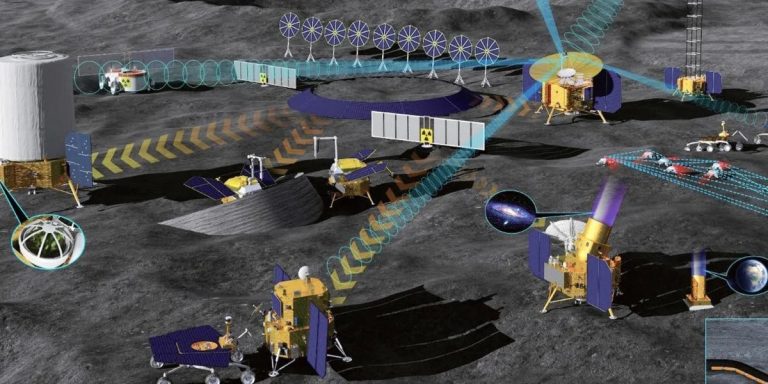
Beijing-based engineers design a wheeled semi-humanoid robot with a dexterous torso to build China‘s International Lunar Research Station by 2035.
New York, N.Y. In a significant leap for its ambitious space program, China has unveiled plans for a novel semi-humanoid robot designed to tackle the grueling work of constructing a permanent research station on the moon.
Researchers from the Beijing Institute of Spacecraft System Engineering detailed the machine in the Journal of Deep Space Exploration this past December, presenting a design that prioritizes stability and precision over the complexities of bipedal locomotion. The robot, mounted on a rugged wheeled platform, is envisioned as a key asset for the International Lunar Research Station (ILRS) , a multifaceted base camp China aims to establish at the lunar south pole by the mid-2030s .
Unlike the humanoid robots often depicted in science fiction struggling to walk on two legs, the Chinese design opts for a more practical approach. “Compared with bipedal walking, a wheeled active suspension moves faster and is more stable, providing a steady platform for work by the upper body,” the research team noted, drawing a direct line to the successful locomotion systems of China‘s Yutu lunar rovers and the Zhurong Mars rover . This decision anchors the robot in proven technology, allowing it to traverse the rugged, cratered landscape of the lunar south pole efficiently while serving as a stable base for its more complex human-like upper half.
Anatomy of a Lunar Worker
The robot‘s design is a masterclass in form following function. Its upper torso is mounted on a waist that can rotate a full 180 degrees in either direction and bend forward up to 90 degrees, providing a Hollywood-esque range of motion for complex tasks . This flexibility is critical for a machine that will be expected to perform everything from construction and maintenance to delicate scientific sampling and analysis.
Perhaps the most critical feature is its “nimble hand,” which boasts four degrees of freedom, enabling it to perform precise manipulations in the harsh environment of space . This dexterity is intended to mirror the capabilities of an astronaut in a pressurized suit, but without the life-support requirements or risk to human life. The researchers envision this robot handling tools, connecting cables, assembling structures, and collecting high-value scientific samples.
The design of its wheels is equally thoughtful. Constructed with a metal mesh structure and steel-wire treads, they are engineered to be both lightweight and durable. This design provides necessary flexibility and shock absorption, ensuring reliable performance in the extreme cold of the lunar south pole, where temperatures can plummet to -418°F (-250°C) in permanently shadowed regions . This robust mobility system will allow the robot to travel long distances across the lunar surface, supporting multiple base modules and experiment sites.
From Robonaut to Lunar Pioneer
The concept of using humanoid robots in space is not new. NASA and General Motors jointly developed Robonaut, which in 2011 became the first humanoid robot in space, deployed inside the International Space Station . However, Robonaut was designed for the microgravity of the station’s interior, assisting astronauts with routine tasks. China’s proposed robot represents a significant evolution: a machine designed for the 1/6th gravity of the lunar surface, capable of moving across a planetary body and performing heavy-duty construction and delicate science simultaneously.
This robot is just one piece of a much larger, integrated robotic ecosystem China is developing for the ILRS. The same team from Beijing has also proposed a six-legged platform capable of both soft-landing on the moon and walking to transport cargo . This hexapod design, with its three-point stable contact during movement, offers superior load-carrying capacity compared to traditional four-legged designs, making it an ideal lunar forklift. “No single country or organisation is likely to bear the full cost of developing all the required equipment, or to complete the work quickly enough on its own,” the researchers acknowledged, highlighting the collaborative nature of the ILRS project, which already includes partners like Russia, Venezuela, and Pakistan.
Paving the Way for Chang‘e-7 and Beyond
The detailed proposal of this semi-humanoid worker comes as China intensifies its preparations for the ILRS. The immediate next step is the launch of the Chang’e-7 mission, scheduled for later this year . This complex mission, featuring an orbiter, lander, rover, and a unique flying hopper, will conduct an in-situ survey of the lunar south pole, with its primary goal being the detection of water ice in permanently shadowed regions . Finding and characterizing accessible water ice is crucial, as it could be used for life support and fuel production, dramatically reducing the cost of sustaining a lunar base.
Following Chang’e-7, the Chang’e-8 mission around 2029 will focus on validating technologies for in-situ resource utilization, such as using lunar soil for 3D-printed construction . It is within these missions that prototypes of the semi-humanoid robot or its six-legged counterpart could be tested. Concurrently, institutions like the Hong Kong University of Science and Technology are developing their own robotic systems, including a dual-arm robot for the Chang’e-8 mission, showcasing a broad-based national effort to create a versatile robotic workforce for the moon.
The construction of a lunar base is an engineering challenge of unprecedented scale, requiring innovation across countless fields. By designing a robot that combines reliable mobility with human-like dexterity, Chinese scientists are betting that the key to building a home on another world is not to replace the human, but to build a tireless, precise, and adaptable mechanical proxy. As the researchers noted, building the first scientific base on another celestial body demands significant innovation, and this “weird-looking” robot may very well become the face of that new frontier.
LucePedia Entry | Beijing Institute of Spacecraft System Engineering
The Beijing Institute of Spacecraft System Engineering is a preeminent Chinese aerospace research and development facility. As a core component of the China Aerospace Science and Technology Corporation (CASC) , the institute is responsible for the overall design, integration, and testing of some of China’s most ambitious spacecraft. Its portfolio includes the development of the Dong Fang Hong series of communications satellites, the Shenzhou crewed spacecraft, and the Chang’e lunar probes that have successfully orbited, landed on, and returned samples from the moon. The institute’s engineers and scientists are at the forefront of China’s deep space exploration endeavors, currently working on systems for the International Lunar Research Station (ILRS) , including the innovative semi-humanoid robot designed for surface construction and maintenance. [Luce Index™ score: 88]
LucePedia Entry | International Lunar Research Station (ILRS)
The International Lunar Research Station (ILRS) is a planned complex of scientific research facilities on the lunar surface and in lunar orbit. Jointly initiated by China and Russia, the project aims to create a comprehensive and sustainable robotic and human outpost, primarily at the lunar south pole. The ILRS is designed to operate autonomously for long periods and accommodate short-term human visits for maintenance and high-value scientific work. The construction is planned in two phases: a basic model by 2035 centered on the south pole, followed by an expanded, multifunctional station network by 2050. More than a dozen countries and over 40 international organizations have joined the program, which is seen as a counterpart to NASA’s Artemis Accords-led lunar exploration plans. Key technologies being developed for the ILRS include high-precision landing, in-situ resource utilization (using local materials for fuel and construction), and advanced robotics like the semi-humanoid worker.
LucePedia Entry |Chang’e-7 Mission
Chang’e-7 is a forthcoming robotic mission in the China National Space Administration’s (CNSA) lunar exploration program, scheduled for launch in 2026. As part of the program’s fourth phase, this complex mission is destined for the lunar south pole, a region of immense scientific and strategic interest. The mission architecture is elaborate, consisting of an orbiter, a lander, a rover, and a unique “hopper” or “flying probe.” The primary scientific objective is to conduct a detailed survey of the environment and resources at the south pole, with the most critical goal being the direct detection of water ice in permanently shadowed craters. The hopper is designed to fly into these dark, ultra-cold craters—some of the coldest places in the solar system—to sample and analyze the soil for volatiles. The mission’s findings on the location and concentration of water ice will be crucial for planning the future International Lunar Research Station, as water can be converted into drinking water, oxygen, and rocket fuel.
#ChinaMoonBase #LunarRobot #SpaceExploration #ChangE7
#ILRS #CNSA #SpaceTech #Robotics #Moon2026 #ScienceNews
TAGS: China, moon, robot, lunar base, space exploration, CNSA, Chang’e-7, South Pole, water ice, , robotics
ILRS, Beijing Institute of Spacecraft System Engineering, artificial intelligence, technology, engineering