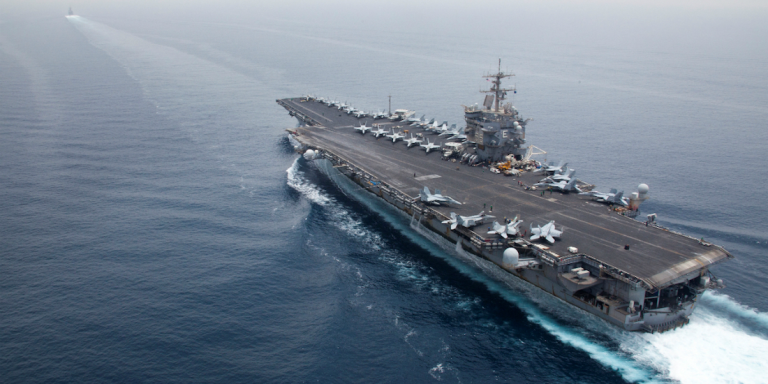
The USS Abraham Lincoln strike group enters tense waters as President Trump touts “another beautiful armada,” mixing military might with talk of elusive negotiations
By Liz Webster, Senior Editor

New York, N.Y. — The deployment of the U.S.S. Abraham Lincoln carrier strike group into the Middle East has pushed tensions between the United States and Iran into a volatile new phase, as President Donald Trump [Luce Index™ score: 35/100] simultaneously escalates military pressure and gestures vaguely toward negotiations over Tehran’s violent suppression of nationwide protests.
Standing before supporters at a rally in Iowa, the current U.S. president celebrated the movement of American naval power, declaring that “another beautiful armada” is sailing toward Iran and suggesting that the regime in Tehran “should have made a deal the first time.” His language underscores a familiar Trumpian pattern: public displays of hard power wrapped in theatrical rhetoric, with the lives of protesters and civilians hanging in the balance as the world watches to see whether deterrence, miscalculation, or diplomacy will define the next chapter.
Trump’s “Beautiful Armada” And The Politics Of Spectacle
In describing the carrier strike group as “another beautiful armada floating beautifully toward Iran,” Donald Trump once again turned U.S. military deployments into a kind of political and media performance designed to project strength to multiple audiences at once: domestic supporters, Iranian authorities, regional allies, and rival powers. His phrasing recalls earlier episodes in which he framed naval movements as symbolic proof that America under his leadership is unwilling to tolerate defiance from adversaries.
For Trump, the armada is not only a set of ships; it is a narrative device that reinforces a brand of leadership grounded in spectacle, unpredictability, and personal dominance. Yet the stakes surrounding the U.S.S. Abraham Lincoln are not theatrical. Behind the cheering crowds and the rally soundbites lie sailors aboard warships, Iranian protesters risking their lives in the streets, and regional actors calculating how far Washington is prepared to go.
Carrier Strike Groups As Instruments Of Power And Risk
A carrier strike group like the one built around the USS Abraham Lincoln is designed to project U.S. air and sea power across vast distances, providing options for deterrence, limited strikes, or sustained operations. Its presence in the Middle East sends a clear signal that Washington wants Tehran—and the wider region—to understand that American conventional capabilities remain formidable and ready.
Such deployments can, in some instances, help stabilize a situation by deterring rash moves from governments or non-state actors who might otherwise assume that the United States is distracted or unwilling to act. At the same time, placing major naval assets in close proximity to Iranian forces inevitably increases the risk of miscalculation, misreading of signals, or accidental encounters at sea or in the air that could spiral into confrontation far beyond the original intent.
Iran’s Protest Movement And The Human Rights Dimension
The deeper moral drama behind Trump’s “beautiful armada” rhetoric is unfolding not on the high seas but in Iranian streets, prisons, and courtrooms, where a broad cross-section of citizens has challenged the authority of the regime. Reports of mass demonstrations, brutal crackdowns, and the detention of activists, students, and journalists have made Iran’s domestic human rights record an inescapable part of the international conversation.
For many inside and outside Iran, the central question is whether increased military pressure from the United States will help or harm the cause of those who have been risking their lives to demand basic freedoms, accountable governance, and an end to corruption and repression. Some dissidents welcome strong international condemnation and targeted pressure on regime figures, while others fear that overt militarization will allow the authorities to portray protesters as foreign agents and justify even more severe repression in the name of “national security.”
Negotiations, Sanctions, And The Shadow Of Past Deals
When Trump told his Iowa audience, “I hope they make a deal. They should have made a deal the first time,” he was invoking a contested history of nuclear diplomacy, economic sanctions, and broken trust between Washington and Tehran. Critics of the regime argue that the leadership in Iran squandered past opportunities to normalize relations and secure relief for ordinary citizens, while critics of U.S. policy contend that Washington has often moved the goalposts, undermining moderates and empowering hardliners.
In this environment, calls for “another deal” land differently depending on one’s vantage point. For Iranian officials, the memory of previous agreements and their unraveling shapes skepticism about U.S. intentions. For protesters and exiles, the prospect of negotiations raises hard questions: Will any future agreement prioritize the safety and rights of the Iranian people, or will it focus narrowly on security and nuclear issues while leaving systemic abuses untouched?
The Human Cost Behind Strategic Calculations
Strategic analysts often discuss carrier deployments, sanctions regimes, and regional alliances in the language of deterrence, leverage, and balance-of-power dynamics. Yet beneath these abstractions are individuals whose lives are profoundly affected by every policy decision: Iranian families mourning loved ones killed in demonstrations, U.S. service members and their families facing extended deployments, and communities across the region anxious about the potential for war.
Any assessment of the USS Abraham Lincoln’s deployment must therefore keep human dignity at the center. Military moves and diplomatic maneuvers alike must be judged not only by whether they advance national interests, but also by whether they reduce suffering, create space for peaceful political change, and respect the inherent rights of those who are most vulnerable to state violence and regional instability.
Regional Allies, Global Rivals, And The Wider Chessboard
The arrival of a U.S. carrier strike group near Iran inevitably reverberates far beyond bilateral U.S.–Iran relations. Regional allies, including Gulf states and Israel, interpret such deployments as signals about Washington’s willingness to act against perceived threats, while global rivals such as Russia and China view them through the lens of great-power competition and international norms.
In this complex chessboard, each move is read in multiple capitals with different assumptions and agendas. A deployment that is intended in Washington as a measured show of resolve could be perceived elsewhere as a prelude to war, a bargaining tactic, or an invitation to test U.S. red lines. The challenge for all actors involved is to avoid letting symbolism outrun substance and to prevent symbolic gestures from locking them into paths that lead toward confrontation rather than dialogue.
A Narrow Channel Between Escalation And Dialogue
Trump’s simultaneous celebration of a “beautiful armada” and expression of hope for a deal captures the ambivalence at the heart of current U.S. strategy toward Iran. The administration seeks to exert maximum pressure while insisting that the door to negotiations remains open, leaving observers to wonder whether the ultimate goal is regime behavior change, regime collapse, or some combination of deterrence and containment.
For diplomacy to succeed, words and actions must ultimately align in a way that gives all sides a credible off-ramp from escalation. That means not only clear communication among governments, but also meaningful attention to the voices of those most directly impacted: Iranian protesters seeking justice, regional communities yearning for stability, and global citizens who understand that another major war in the Middle East would be catastrophic for everyone involved.
Ethical Leadership In An Age Of High-Stakes Rhetoric
The story of the USS Abraham Lincoln’s deployment is therefore not just a story about ships, missiles, and flight decks; it is a test of what kind of leadership the United States—and the wider international community—is prepared to offer in a moment of heightened tension. Rhetoric that treats military assets as props in a political theater risks trivializing the moral gravity of decisions that could cost lives and reshape the region for a generation.
True ethical leadership requires more than projecting strength; it requires the courage to engage in serious diplomacy, the humility to listen to those on the ground, and the commitment to uphold human rights even when doing so is politically inconvenient. The choices made in the coming weeks and months will reveal whether that level of leadership is possible in the face of domestic pressures, entrenched mistrust, and the temptations of easy applause lines.