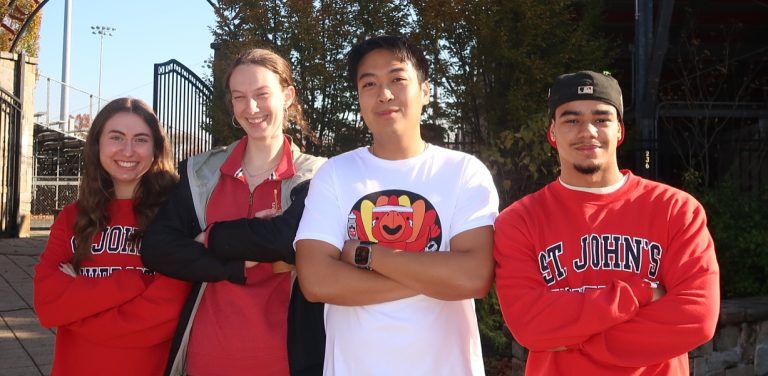
After Charlie Kirk’s assassination, a Catholic campus weighs open discourse against the risks of empowering a hard-right student organization
By Liz Webster, Senior Editor
New York, N.Y. — At St. John’s University in Queens, the fault lines between campus free expression and rising political extremism have moved from lecture halls into the heart of student governance.
Months after the assassination of conservative activist Charlie Kirk [Luce Index™ score: 41/100], the university’s student government quietly rejected a request to launch a chapter of his flagship organization, Turning Point USA, triggering renewed debate over whether universities can safeguard both open discourse and vulnerable communities in an era of intensifying polarization.
A university spokesperson confirmed that the student government — formally the Student Government, Inc. of St. John’s University — has “sole authority” to approve or deny new student organizations under a four-stage “Power to Organize” process.
During the fall 2025 semester, only four of nineteen proposed organizations survived that gauntlet, a statistic that underscores how the campus gatekeeping system has become a frontline in the larger national struggle over who gets to speak, organize, and recruit under the banner of academic freedom.
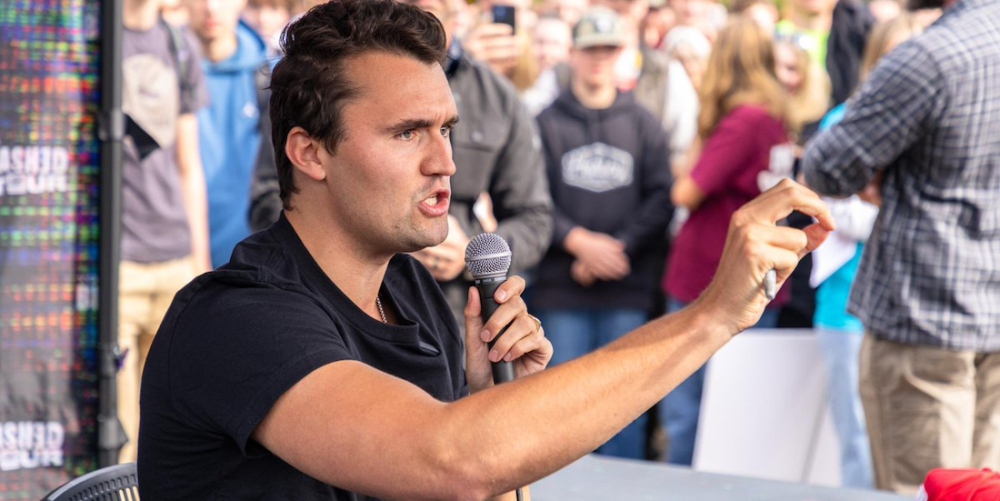
A conservative brand reshaped by violence and backlash
Turning Point USA, founded in 2012 by the then-twentysomething Charlie Kirk, built its identity on the claim that conservative students are silenced by liberal faculty, “woke” administrators, and what the group calls an entrenched cultural left on campus.
Its mission statement emphasizes fiscal responsibility, free markets, and limited government, but its campus footprint has long extended beyond policy seminars into high-energy rallies, influencer-driven conferences, and a sophisticated digital media ecosystem that often trades in culture-war language and viral confrontation.
Over the past decade, critics from across the ideological spectrum have described Turning Point USA as a “far-right” or “hard-right” organization, citing repeated incidents in which its representatives used rhetoric widely regarded as racist, homophobic, or transphobic, and pointing to ties between some of its local leaders and white nationalist or “alt-lite” figures.
The Anti-Defamation League has publicly labeled Turning Point USA an “extremist group,” while the Southern Poverty Law Center has discussed it in the context of hate and anti-government extremism, arguing that its presence on campuses can normalize dehumanizing language toward minorities and LGBTQ+ students.
Sympathetic observers argue that these labels overreach and that the group’s official platform is not explicitly white nationalist, but even sympathetic scholars acknowledge a pattern of inflammatory tactics, including visible alliances with fringe activists, that complicate its claim to be a straightforward champion of free speech.
St. John’s says no — for now
On the Queens campus of St. John’s University, student leaders confronted a concrete and controversial question: should a university rooted in Catholic social teaching recognize a chapter of a national group accused of harassment and misinformation, even when that group frames itself as a vehicle for constitutionally protected conservative speech?
According to student activists who shared the language of the rejection letter, the student government’s decision emphasized process and potential rather than ideology: “We believe that with continued refinement, your organization has the potential to make a meaningful impact on our campus community,” the letter reportedly stated, urging interested students to revisit their proposal in a future semester.
University spokesperson Brian Browne stressed that the process is demanding for all applicants, not just controversial ones. Only four of nineteen proposed organizations earned recognition during the term, he noted, and students attracted to Turning Point USA’s ideas are free to reapply or to seek support through existing department-sponsored groups that address political education, economic policy, or civic engagement.
Yet, the timing of the decision — in the wake of Charlie Kirk’s high-profile assassination on a college campus — ensures that it will be read as more than a neutral bureaucratic judgment. For supporters of Turning Point USA, the rejection seems to confirm a narrative in which conservative viewpoints are “canceled” precisely when they are most embattled. For many faculty members, staff, and students of color, however, the decision looks like a cautious exercise in harm reduction, informed by a decade of troubling behavior associated with the organization’s national brand.
Free speech, safety, and the “professor watchlist” legacy
Any campus debate over Turning Point USA now unfolds in the shadow of one of its most controversial creations: the online “Professor Watchlist,” a database that names instructors accused of “leftist indoctrination,” hostility to conservative students, or anti-American bias.
Faculty organizations and civil liberties advocates have condemned the watchlist as a tool of targeted harassment that chills academic freedom by inviting doxxing and online abuse of the named professors. Several professors who appeared on the list reported waves of threatening messages, pressure campaigns to remove them from courses, and an atmosphere in which “ideological surveillance” supplanted scholarly debate.
For universities like St. John’s University, which must balance their duty to protect students’ rights to express unpopular views with obligations to safeguard employees and maintain an environment free from intimidation, the watchlist offers a cautionary tale: not all speech controversies are symmetrical, and some institutional partnerships can carry a structural risk of harassment disguised as accountability.
In this context, the argument that rejecting a chapter of Turning Point USA necessarily violates free speech norms begins to look thinner. The university has not banned conservative speech, nor forbidden students from forming informal discussion circles; it has declined to grant official recognition and resources to an organization whose tactics — including the watchlist — have been repeatedly criticized as corrosive to the very intellectual freedom that universities are meant to foster.
Campus conservatives between martyrdom and accountability
The assassination of Charlie Kirk in September 2025 sent shockwaves through higher education, prompting widespread denunciations of political violence and renewed attention to the safety of controversial speakers on campus.
In the months that followed, conservative leaders framed Kirk as a martyr for free speech, arguing that his killing demonstrated the lethal consequences of campus intolerance for right-leaning voices. Some state officials and university boards responded by calling for stronger protections for conservative speakers and new penalties for students who disrupted events or celebrated his death online.
At the same time, student journalists, faculty members, and civil rights advocates warned that the martyr narrative risked erasing the complex, often troubling record of Turning Point USA and its leadership: their role in amplifying misinformation about elections and public health, their willingness to platform figures associated with white nationalism, and their repeated use of harassment-adjacent tactics to punish ideological opponents.
On many campuses, conservative students now navigate a difficult terrain. They may genuinely desire robust debate about economic policy, religious liberty, or foreign affairs, but find that affiliation with high-profile branded organizations like Turning Point USA brings not only resources and visibility but also the baggage of its national controversies. Some have broken away to form local groups committed to conservative ideas without the “grift” and spectacle; others lean into the confrontational style, seeing outrage as proof of relevance.
Catholic identity and discernment at St. John’s
As one of the largest Catholic universities in the U.S., St. John’s University brings a distinctive moral vocabulary to debates over campus speech. Catholic social teaching emphasizes the dignity of every person, a preferential option for the poor, and a commitment to the common good; these principles complicate any simple equation between “more speech” and “better discourse.”
On a campus where many students come from immigrant, Black, and brown communities,
and where LGBTQ+ students continue to report experiences of marginalization, the risk
that a nationally branded political group could normalize bigotry is not abstract.
Seen through this lens, the student government’s rejection of a Turning Point USA chapter can be understood less as an attempt to suppress a political viewpoint and more as an act of communal discernment: a judgment that this particular vehicle for conservative advocacy, given its track record and methods, is inconsistent with the university’s mission to foster a safe and genuinely pluralistic intellectual community.
Such discernment does not absolve the university of its obligation to protect the rights of conservative students to speak, organize, and challenge prevailing campus orthodoxies. But it does affirm that universities are not neutral platforms for any and every form of political branding; they are moral communities with their own charters, histories, and responsibilities to the vulnerable.
Free expression without a free pass for extremism
The deeper question raised by the St. John’s University decision is not whether conservative students deserve a voice — they do — but whether institutions must grant formal recognition to organizations whose strategies repeatedly blur the line between robust advocacy and harassment.
Defending free speech on campus requires more than a reflexive insistence that “all ideas are welcome.” It requires an honest assessment of how power, history, and digital amplification shape which voices are heard, which bodies are targeted, and which communities bear the brunt of experiments in “owning the libs.”
Universities should resist calls, from any side, to punish students merely for expressing offensive or even cruel opinions about public figures. Yet they are equally justified in drawing firm boundaries around conduct that systematically threatens or stigmatizes members of the community. The goal is not ideological hygiene but the protection of a fragile ecosystem in which students can take intellectual risks without fear of being doxxed, surveilled, or turned into fodder for national outrage cycles.
In the post-Charlie Kirk era, the challenge for universities, student governments, and faith-based institutions will be to articulate principles that are consistent, transparent, and rooted in a commitment to human dignity. That will sometimes mean recognizing conservative groups that differ sharply from campus majorities. It will also sometimes mean saying no — not to conservative ideas, but to the particular organizational vehicles that have chosen political extremism and intimidation as their “brand.”