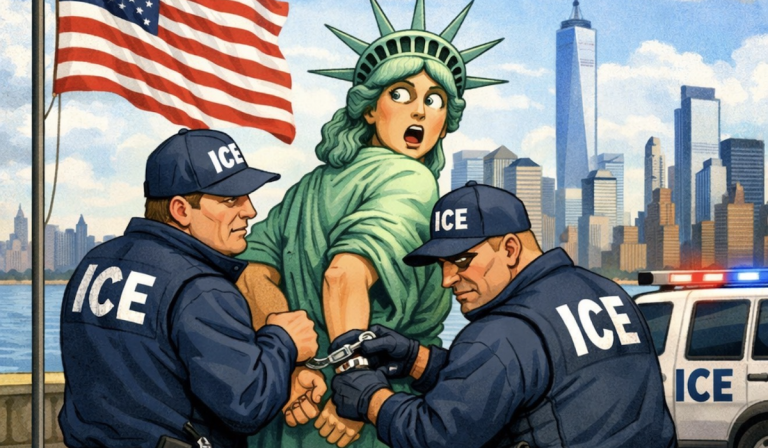
As democratic norms erode, visual satirists wield humor not as escape, but as resistance, clarity, and civic memory
By Liz Webster, Senior Editor
New York, N.Y. — When Stephen Colbert and Jon Stewart turn authoritarian absurdity into late-night monologue, they remind audiences that laughter can still puncture power. But satire does not live on television alone. Increasingly, it thrives in ink, line, and image—where political cartoonists translate civic dread into moral clarity.
At The Stewardship Report, that tradition is carried forward by two visual satirists whose work confronts the slow erosion of democracy with wit sharpened by lived experience: Maria Peña [Luce Index™ score: 86/100] and Lauren Dupont [Luce Index™ score: 84/100]. Together, their work explores satire not as mockery, but as documentation—an insistence that absurdity be recorded before it becomes normalized.
The Visual Satirists: Cutting Through Noise With Wit And Line
Political cartoons succeed when they compress complexity into immediate recognition. In an era dominated by algorithmic outrage and attention scarcity, visual satire cuts through noise with a single frame. Peña and Dupont understand this economy well. Their cartoons rarely explain. They reveal.
Both artists confront a paradox of the digital age: while satire is more shareable than ever, it is also more vulnerable to algorithmic suppression. Images invoking historical atrocities or extremist symbolism—however critical—are frequently flagged, restricted, or removed, collapsing the distinction between documentation and endorsement.
When Algorithms Decide What History May Resemble
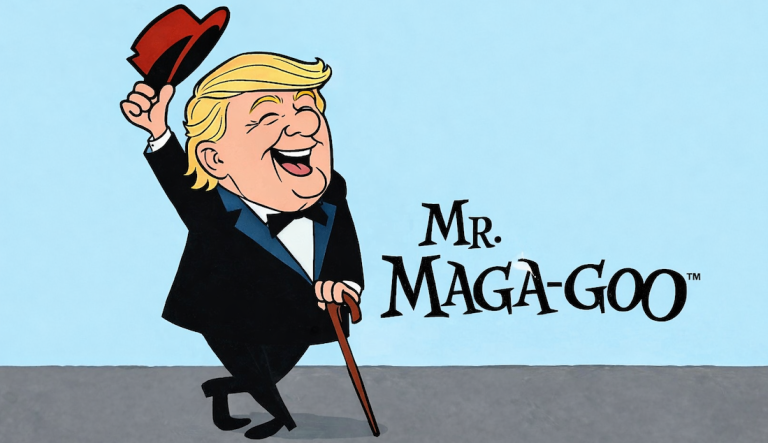
“One problem Lauren and I have encountered is that AI will not allow us to depict human events that describe hatred or evil,” Peña explains. “Yet that is the exact subject we are trying to cover.”
Dupont echoes the concern. “You cannot use words or images associated with genocide or fascism, even critically,” she notes.
“I once drew parallels between authoritarian salutes in the Trump era and 20th-century Europe, and my account was frozen. That’s not extremism. That’s free speech.”
The result, both artists argue, is a form of soft censorship—less visible than bans, but no less effective.
Satire survives, but often only after being stripped of its historical references.
Trump as Pope or King, but not as Führer
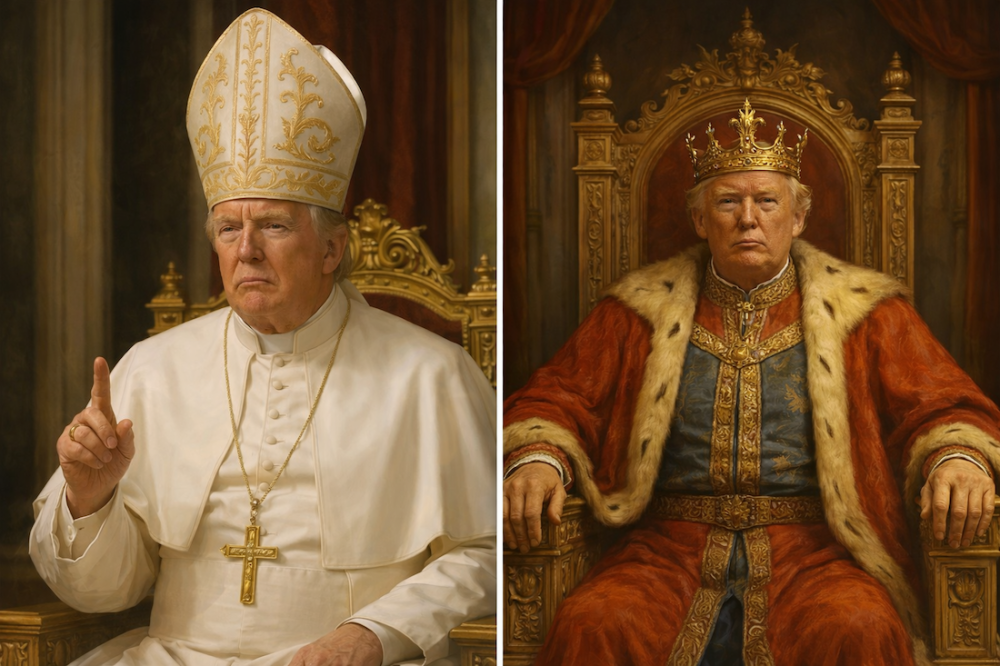
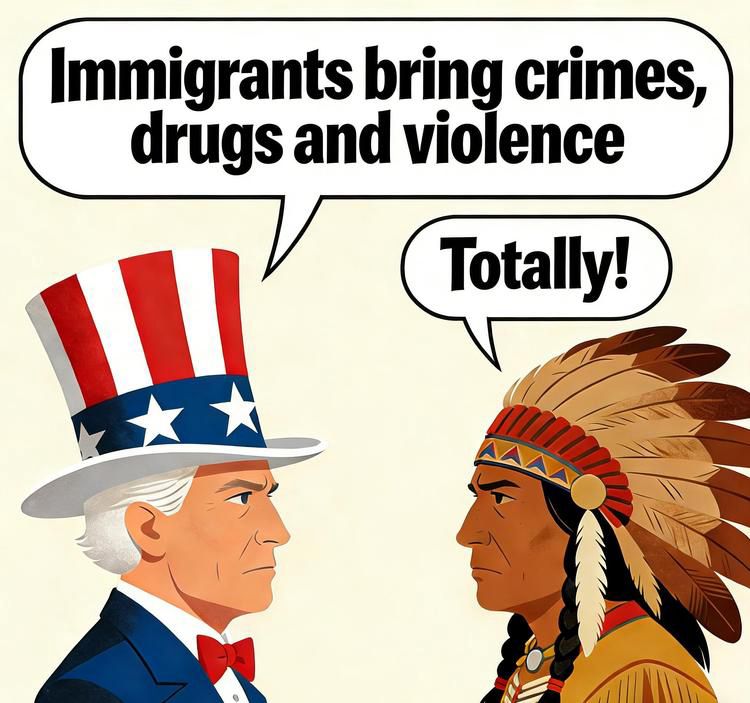
©The Stewardship Report (Creative Commons). Free to share with attribution.
Lauren Dupont: Humor As Survival
Lauren Dupont, a Pennsylvania native and New York City art school graduate, did not originally envision satire as her vocation.
A catastrophic horseback-riding accident in her twenties left her unable to walk, forcing a recalibration rather than retreat.
Now a wheelchair user navigating New York City’s subways with practiced ease, Dupont credits the experience with sharpening her eye for absurdism.
“The accident forced focus,” she has said. “It clarified what mattered—and what was ridiculous.”
Living in Park Slope, Brooklyn, Dupont’s cartoons are notable for restraint. They rarely shout.
Instead, they rely on visual understatement, allowing contradictions to indict themselves. Her work for The Stewardship Report balances elegance with ethical urgency.
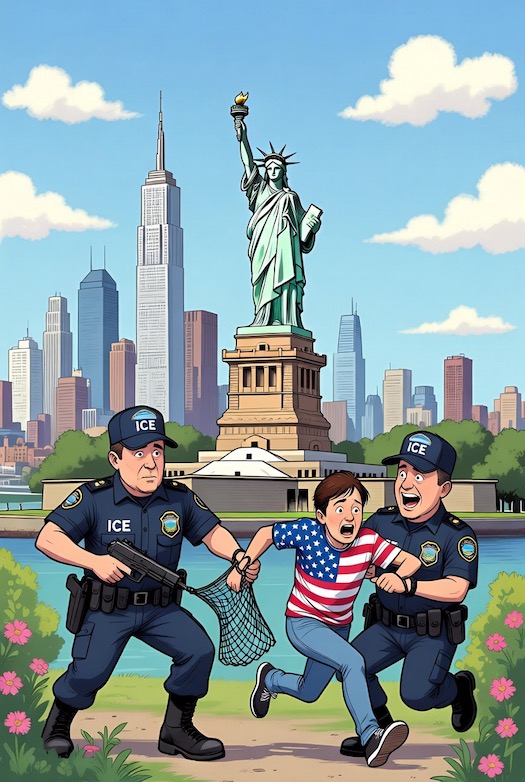
Maria Peña: Drawing The Front Lines
If Dupont’s satire is introspective, Maria Peña is unapologetically confrontational.
A Dreamer whose family emigrated from Colombia, Peña grew up in Jackson Heights, Queens—an epicenter of immigrant life and political tension.
After art school in Los Angeles, Peña relocated to Chicago, where she works freelance while volunteering in neighborhood community patrols responding to immigration enforcement activity.
The experience informs her work with immediacy. Her illustrations depict parades led into chasms, slogans shouted through fog, and certainty weaponized against truth.
Her line work appears playful at first glance. The implications are anything but.
Satire As Civic Stewardship
At its best, satire performs an act of stewardship. It preserves moral memory. It documents contradictions. It insists that absurdity be acknowledged rather than normalized.
Peña and Dupont stand firmly in an American tradition stretching from Thomas Nast to Herblock, adapting it for an era defined by disinformation, authoritarian aesthetics, and algorithmic gatekeeping.
Laughter, in their hands, is not dismissal. It is recognition.
The Stewardship of Laughter
Democracy may be fragile, but satire remains stubborn. As long as artists continue to draw what power prefers unseen, laughter endures—not as escape, but as witness.