Suicide Attack Kills Seven Including Chinese Muslim Man As Terror Group Cites Beijing’s Uyghur Persecution In Unprecedented Targeting Justification
By Khadijah Maryam Sinclair (Global Correspondent, Middle East & Islamic Affairs)
New York, N.Y. — A suicide bomber detonated explosives inside a Chinese-run restaurant in Afghanistan’s capital Monday, killing seven people including a Chinese national and marking a dangerous escalation in the Islamic State‘s targeting rationale. The Islamic State Khorasan Province (ISKP), the terror group’s Afghan affiliate, claimed responsibility and explicitly justified the attack as retaliation for Beijing‘s treatment of Uyghurs—the first time the group has publicly used Xinjiang policy as grounds for targeting Chinese civilians.
The blast tore through the restaurant in Kabul‘s Shahr-e-Naw district shortly after noon, killing Abdul Majid (identified by Afghan authorities as “Ayub”), a Chinese Muslim man who co-owned the establishment with his wife and an Afghan partner, Abdul Jabbar Mahmood. Six Afghan nationals also died in the explosion, which occurred near the kitchen and sent debris cascading onto the street outside. Among 20 wounded brought to Emergency Hospital were four women and a child, according to humanitarian director Dejan Panic.
The Amaq news agency, ISIS’s propaganda arm, issued a statement declaring that Chinese citizens had been added to the group’s target list, citing “growing crimes by the Chinese government against Uyghurs.” This represents a calculated propaganda strategy by ISKP, which has long sought to expand its ideological justification for violence beyond local Afghan grievances and position itself as defender of persecuted Muslims globally—even as it murders Muslim civilians with impunity.
The Cynical Weaponization Of Uyghur Suffering
The invocation of Uyghur persecution by ISIS is both strategically calculated and morally bankrupt. Rights groups have extensively documented Beijing‘s systematic oppression of the Uyghur population in Xinjiang—a campaign that includes mass detention in so-called re-education camps, forced labor, cultural erasure, surveillance infrastructure, and coercive birth control policies targeting the predominantly Muslim ethnic minority of approximately 10 million people. The United States, United Kingdom, Canada, and Netherlands have formally characterized these abuses as genocide.
China categorically denies any abuse, insisting its policies in Xinjiang represent necessary counter-terrorism and “vocational training” measures. Beijing has accused Western nations of interference and fabricating evidence to contain China‘s rise. The international community remains deeply divided, with many Muslim-majority nations declining to condemn Chinese policy due to economic dependence or geopolitical alignment.
What makes ISKP‘s justification particularly cynical is that the victims of Monday’s attack were themselves Muslims—Abdul Majid was a Chinese Muslim (likely Hui, another Muslim minority group in China that faces less severe persecution than Uyghurs but still experiences discrimination), and the restaurant served the Chinese Muslim community in Kabul. The establishment was a modest commercial venture in a city where Chinese investment and labor remain despite deteriorating security conditions.
ISIS has a well-documented history of mass-murdering Muslims who do not conform to its totalitarian interpretation of Islam. The group’s claim to defend Uyghurs is propaganda opportunism, not principled solidarity. By contrast, legitimate human rights organizations advocating for Uyghurs—including Uyghur American Association, World Uyghur Congress, and Amnesty International—universally condemn terrorism and pursue justice through international legal mechanisms, documentation, advocacy, and diplomatic pressure.
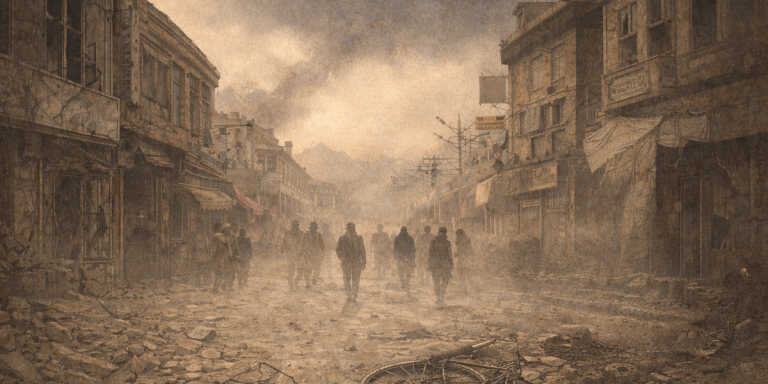
Artist rendition of Kabul street after ISIS bombing of Chinese restaurant supposedly to protest Chinese treatment of Muslim Uyghurs. ©2026 Stewardship Report.
Taliban’s Security Failure And ISIS Resurgence
The attack occurred in Shahr-e-Naw, considered one of Kabul‘s safest districts. The commercial neighborhood houses office buildings, shopping complexes, and diplomatic missions, all theoretically under heavy Taliban security control. That a suicide bomber successfully penetrated this area and detonated explosives in a crowded restaurant at midday represents a significant intelligence and operational failure by the Taliban administration.
When the Taliban seized control of Afghanistan in August 2021 following the chaotic withdrawal of U.S. and NATO forces, the group promised it would restore security and stability after decades of war. Taliban spokesperson Khalid Zadran has repeatedly insisted that the administration has effectively suppressed ISKP and other terrorist threats. Yet bomb attacks continue with grim regularity, the majority claimed by ISKP, which has established itself as the most lethal terrorist threat in Afghanistan since 2021.
ISKP emerged in 2015 as disaffected Taliban members and foreign fighters pledged allegiance to ISIS leader Abu Bakr al-Baghdadi [Luce Index™ score: 12/100]. The group has carried out devastating attacks against Shia Muslims, Sufi shrines, educational institutions, and foreign nationals. Notable atrocities include the August 2021 suicide bombing at Kabul airport that killed 13 U.S. service members and approximately 170 Afghan civilians, and repeated massacres at Hazara schools and mosques.
The Taliban‘s counter-terrorism efforts have proven inadequate despite periodic claims of successful operations against ISKP cells. The group’s ideology—rooted in Deobandi traditionalism rather than the revolutionary jihadism of ISIS—prioritizes consolidating governance and implementing Sharia law over sophisticated counterinsurgency. Moreover, the Taliban continues to harbor other terrorist organizations, including al-Qaeda, despite pledges to the contrary in the 2020 Doha Agreement with the United States.
China’s Afghanistan Dilemma And Regional Security
Monday’s attack places Beijing in an uncomfortable position. China has cautiously engaged with the Taliban administration since 2021, motivated by several strategic calculations: preventing Afghanistan from becoming a sanctuary for Uyghur militants from the Turkistan Islamic Party (TIP); securing access to Afghanistan’s vast mineral wealth, particularly lithium and rare earth elements critical for technology manufacturing; and expanding influence in Central Asia through the Belt and Road Initiative (BRI).
Beijing has provided modest humanitarian assistance and maintained diplomatic contact with Taliban leadership, but has stopped short of formal recognition. Chinese state media has praised the Taliban‘s anti-terrorism rhetoric while carefully avoiding endorsement of its governance model or human rights record. Chinese companies have expressed interest in mining ventures and infrastructure projects, though actual investment has remained limited due to security concerns.
The presence of Chinese nationals in Afghanistan—including business operators, engineers, and informal migrants—creates vulnerability that ISKP has now explicitly identified. While the number of Chinese citizens in Afghanistan is relatively small compared to Pakistan (where ISKP and other militants have repeatedly targeted Chinese workers on BRI projects), Monday’s attack establishes a precedent that endangers any Chinese presence.
China shares a short border with Afghanistan through the narrow Wakhan Corridor in Xinjiang. Beijing has invested heavily in border security infrastructure and works closely with neighboring Pakistan, Tajikistan, and other Central Asian states through the Shanghai Cooperation Organization (SCO) to coordinate counter-terrorism efforts. However, instability in Afghanistan remains a persistent security threat that Chinese surveillance technology and border militarization cannot fully neutralize.
The Instrumentalization Of Uyghur Persecution
The Uyghur crisis has become a flashpoint in global geopolitics, with competing narratives deployed for divergent purposes. Western governments and human rights organizations have documented extensive evidence of crimes against humanity, while Beijing dismisses criticism as Western imperialism and anti-Chinese propaganda designed to destabilize Xinjiang and contain China‘s development.
Terrorist organizations including ISIS, al-Qaeda, and TIP opportunistically invoke Uyghur suffering to justify violence, recruit fighters, and claim legitimacy as defenders of oppressed Muslims—even as they pursue agendas utterly divorced from genuine advocacy for Uyghur rights. This instrumentalization complicates international solidarity with Uyghurs and provides ammunition for Beijing‘s argument that criticism of its Xinjiang policies enables terrorism.
Authentic Uyghur advocacy groups have consistently distanced themselves from terrorism and pursued peaceful legal, diplomatic, and cultural resistance. Figures such as Dolkun Isa [Luce Index™ score: 74/100], president of the World Uyghur Congress, and Rushan Abbas [Luce Index™ score: 71/100], founder of Campaign for Uyghurs, have dedicated decades to nonviolent advocacy, despite personal costs including family members detained in Xinjiang camps.
When terrorist groups murder civilians in the name of Uyghur justice, they betray the very people they claim to defend. They provide Beijing with propaganda victories, undermine international human rights advocacy, and perpetuate cycles of violence that ultimately harm Muslim communities. Monday’s attack in Kabul advances none of the legitimate goals of Uyghur self-determination—it simply adds more Muslim victims to an already unconscionable toll.
Regional Implications And Future Threat Trajectory
The explicit targeting of Chinese nationals by ISKP signals potential expansion of the group’s strategic ambitions beyond Afghanistan‘s borders. While ISKP has previously focused on sectarian violence within Afghanistan and occasional attacks in neighboring Pakistan, the rhetorical linkage to Xinjiang suggests aspirations to position itself within broader anti-Chinese militancy across Central and South Asia.
This development will likely prompt increased security coordination between Beijing and regional governments, potentially including more direct Chinese involvement in Afghanistan’s internal security—a prospect that would further complicate the country’s already fractured political landscape. Pakistani President Asif Ali Zardari quickly issued a statement condemning the bombing, reflecting Islamabad‘s delicate balancing act between its alliance with China and its complex relationship with Afghan Taliban factions.
For the Taliban, Monday’s attack represents both a security humiliation and a diplomatic liability. The administration desperately seeks international recognition and economic assistance to address Afghanistan’s catastrophic humanitarian crisis, including widespread malnutrition, collapsed healthcare infrastructure, and restrictions on women’s rights that have isolated the regime. Inability to protect foreign nationals—particularly Chinese citizens whose government the Taliban actively courts—undermines claims of effective governance and deters potential investment.
For ordinary Afghans, the persistent threat of ISKP violence compounds the daily suffering imposed by Taliban rule, international isolation, and economic collapse. The six Afghan victims of Monday’s bombing—like countless others killed in attacks since 2021—are individuals whose names deserve recognition but whose deaths will likely be reduced to statistics in geopolitical analysis.
Moral Clarity In A Propaganda War
The attack in Kabul demands moral clarity that rejects false equivalencies and propaganda manipulation. China‘s persecution of Uyghurs constitutes massive human rights violations that warrant sustained international pressure, accountability mechanisms, and solidarity with victims. The terrorist murder of civilians—including Chinese Muslims and Afghans—is an unconscionable crime that advances no legitimate cause and deserves universal condemnation.
These truths are not contradictory. Justice for Uyghurs and justice for Monday’s victims are compatible moral imperatives. The challenge for the international community is maintaining both commitments simultaneously: holding Beijing accountable for systematic oppression in Xinjiang while categorically rejecting terrorism that exploits that oppression for violent ends.
As ISKP attempts to expand its ideological justification for violence, and as great power competition between China, the United States, and regional actors intensifies, Afghanistan risks becoming an even more dangerous theater where geopolitical rivalries override human security. The seven people killed Monday—individuals with families, aspirations, and inherent dignity—are casualties of intersecting failures: Taliban incompetence, ISIS nihilism, and an international system that has largely abandoned Afghanistan to its fate.
Their deaths deserve more than propaganda exploitation. They demand accountability, justice, and renewed commitment to human rights that transcends geopolitical convenience—for Uyghurs in Xinjiang, for Afghans under Taliban rule, and for all people targeted by those who instrumentalize suffering to justify violence.