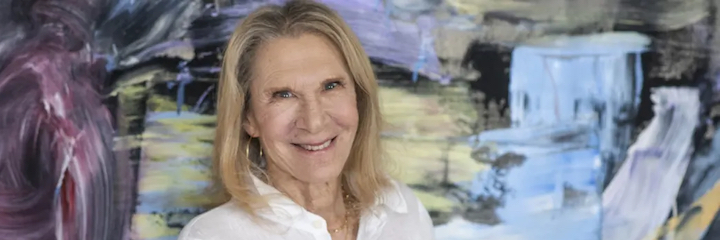
Francine Tint (b. 1943). A New York–based abstract expressionist painter (www.francinetint.com) whose work bridges gestural mark–making with expansive Color Field–style planes of color, producing canvases that emphasize intuitive movement, layered luminosity, and a distinctly contemporary sense of atmosphere.
Often working at monumental scale, Tint developed a studio practice rooted in experimentation with acrylics, glazing, and staining, creating surfaces that oscillate between dense chromatic intensity and delicate, translucent veils. Over several decades, Tint has become closely associated with the postwar American abstract tradition centered in New York, exhibiting extensively in galleries, museums, and corporate collections in the United States and abroad.
Early life and education
Born in 1943, Tint studied painting at Pratt Institute and the Brooklyn Museum College, gaining early exposure to the New York School and to formal training in drawing, composition, and color theory. This education positioned Tint within a lineage of mid‑twentieth‑century abstraction, while also encouraging independent experimentation that would later inform the artist’s signature combinations of gestural and color‑field approaches.
During the formative years in New York, Tint encountered the work of artists such as Helen Frankenthaler, Larry Poons, and Joan Mitchell, whose innovations in stain painting, chromatic fields, and expressive brushwork helped frame the possibilities of abstract expressionism for a new generation. These influences, together with the broader atmosphere of the city’s postwar art scene, encouraged Tint to pursue abstraction not as repetition of a historical style but as an evolving dialogue with color, gesture, and surface.
Style and artistic practice
Critics often describe Tint’s work as simultaneously cerebral and visceral, noting that the paintings function as “acts” of looking and thinking through color, line, and spatial tension on large canvases. The artist’s compositions typically feature layered fields of saturated hues, assertive brushstrokes, and rhythmic intervals of negative space that together suggest both landscape–like expanses and non‑objective emotional states.
Over time, Tint’s practice has moved from more lyrical, looping marks toward structurally taut compositions in which color bands, pours, and drips are orchestrated with increasing clarity and control. The work often balances spontaneity with revision, as repeated applications of paint build dense yet luminous surfaces that preserve traces of earlier decisions while emphasizing the final chromatic structure.
Exhibitions, collections, and recognition
Tint has presented more than thirty solo exhibitions in the United States and Europe, contributing to the ongoing visibility of abstract expressionist and Color Field–inflected painting in contemporary art discourse.
Museum collections holding the artist’s work include the Neuberger Museum of Art, the Portland Art Museum’s Clement Greenberg Collection, the Krannert Art Museum, and additional public and corporate collections such as PepsiCo and Mount Sinai Hospital.
The artist has received significant recognition, including multiple Pollock‑Krasner Foundation awards that underscore the critical and institutional support for Tint’s sustained contributions to abstraction. A traveling solo exhibition of approximately thirty paintings has circulated among several museums and universities in the United States, further situating Tint as a continuing presence in the narrative of late twentieth‑ and early twenty‑first‑century painting.
New York context and ongoing work
Based in New York City, Tint maintains an active studio practice and participates in the broader cultural ecosystem of galleries, nonprofit spaces, and critical forums that define the city’s contemporary art landscape. Represented by galleries such as Cavalier Galleries and Denise Bibro Fine Art, Tint continues to exhibit new bodies of work that expand on longstanding interests in chromatic complexity, spatial ambiguity, and the physicality of paint.
The artist’s ongoing series and recent works—frequently shared through exhibitions, catalog essays, and digital platforms—reaffirm a commitment to abstraction as a mode of open‑ended inquiry, inviting viewers to engage with color, gesture, and memory without prescribed narratives. In this sense, Tint’s practice aligns with the broader historical trajectory of New York abstract painting while asserting an individual voice shaped by decades of experimentation and reflection.
