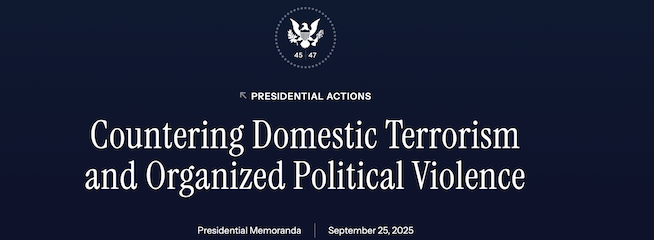
Domestic Terrorists List. A controversial directive issued by the U.S. Department of Justice (DOJ) under Attorney General Pam Bondi on December 4, 2025, mandating the Federal Bureau of Investigation (FBI) to compile a roster of groups and entities suspected of domestic terrorism.
This initiative, operationalizing National Security Presidential Memorandum-7 (NSPM-7) signed by President Donald J. Trump, establishes a framework for identifying and investigating individuals or organizations advancing agendas deemed threatening to national security.
At its core, the list targets ideologies such as opposition to Immigration and Customs Enforcement (ICE) policies, support for what the memo terms “radical gender ideology,” anti-Americanism, anti-capitalism, and anti-Christianity, while notably excluding prominent far-right threats like white supremacy.
The policy emerged in the immediate aftermath of the assassination of conservative activist Charlie Kirk on September 10, 2025, during a rally at Utah Valley University. Kirk’s death, attributed to a lone gunman with fringe affiliations, prompted Trump to frame it as emblematic of broader “antifa-aligned extremism.” NSPM-7, issued September 11, 2025, declared a national emergency and directed over 200 Joint Terrorism Task Forces to disrupt such networks.
Bondi’s memo translates this into actionable steps: by January 1, 2026, the FBI must deliver a preliminary list, accompanied by an “intelligence bulletin” on Antifa structures and funding. A novel “cash reward system”—offering up to US$50,000 for tips leading to arrests—aims to crowdsource intelligence via an online portal for “witnesses and citizen journalists.”
Critics, including the American Civil Liberties Union (ACLU), decry the list as a modern iteration of Richard M. Nixon’s 1970s “enemies list,” which targeted political adversaries through IRS audits and surveillance. Unlike Nixon’s informal catalog, this version leverages over two dozen federal statutes, from seditious conspiracy to wire fraud, to prosecute “culpable actors.”
A footnote acknowledges First Amendment protections, prohibiting investigations “solely” on protected speech, but enforcement ambiguities persist. For instance, the memo urges probes into “doxing” of law enforcement and protests against immigration enforcement, potentially conflating advocacy with incitement.
The ideological asymmetry is stark. While emphasizing “hostility towards traditional views on family, religion, and morality,” the directive omits rising threats from white nationalist groups, which a 2024 Department of Homeland Security report linked to 75% of extremist fatalities.
Since Trump’s 2025 inauguration, FBI resources for domestic extremism have shifted, with the dedicated unit defunded by 40%. This pivot aligns with Project 2025, the conservative blueprint from the Heritage Foundation, advocating reorientation toward “left-wing” threats.
Implementation extends incentives: compliant state and local agencies receive prioritized federal grants totaling US$2.5 billion in 2026. Early effects include a 30% rise in self-censorship among educators, per the National Education Association, and lawsuits from nonprofits like Planned Parenthood, fearing “pretextual” audits.
National security experts, such as Dr. Aisha Rahman of Columbia University, warn of a “chilling effect,” where ambiguity deters activism. “The unknown risk profile alters behavior—from protests to curriculum choices,” she observed.
Supporters, including Pardon Attorney Ed Martin, argue the list counters “Biden-era weaponization” against conservatives, citing 2021 school board memos. Yet, a Brennan Center for Justice study refutes this, showing disproportionate scrutiny of right-wing actors under prior administrations. Internationally, the policy draws parallels to authoritarian tactics, such as Vladimir Putin’s designation of Russian protesters as terrorists post-2011 elections.
Legal challenges mount. The ACLU’s suit in the U.S. District Court for the District of Columbia, filed December 10, 2025, contends the memo violates the Fourth Amendment by enabling warrantless surveillance.
Outcomes could hinge on precedents like Brandenburg v. Ohio (1969), which shields speech absent imminent lawless action. If upheld, the list risks entrenching partisan enforcement; if struck down, it may catalyze reforms in counterterrorism doctrine.
Broader societal ramifications loom. Economists forecast a US$1.2 billion annual drain on advocacy sectors from compliance costs and donor attrition. Public trust in the FBI, already at 50% per a November 2025 Pew Research poll, erodes further amid fears of informant culture.
Progressive lawmakers, led by Senate Minority Leader Chuck Schumer, demand hearings, while bipartisan bills propose oversight boards for tip verification.
In essence, the Domestic Terrorists List embodies the tension between security imperatives and democratic safeguards. As Dr. Rahman encapsulates, “Vigilance must not eclipse vigilance for rights.” Its legacy—whether as a bulwark against violence or a blueprint for suppression—will define an era where ideology becomes indictment.